I’ve just heard the news of Stan Bowles’ death. He was born on 24 December 1948 and was a great maverick Mancunian footballer. Here’s a profile of him, focusing on his Manchester City days.
Bowles joined City as an amateur on 27 July 1965, becoming an apprentice on 1 October 1965 and then professional on 29 December 1966.
Then in 1967 things really began to happen and Bowles’ first game was as a substitute in a League Cup tie at home to Leicester City. He scored two goals in the second half and the following Saturday he made his League debut another memorable one. He scored two again!
Lots of stories have circulated over the years about his time at City. Like Mario Balotelli many years later some are truthful; others are exaggerations and some are completely make up.
The stories go that Bowles once missed a flight to Amsterdam where City were to play against Ajax, and that Bowles’ interest in the horses led to Joe Mercer saying: ‘If Stan could pass a betting shop like he can pass a ball, he’d be a world beater.’ Suspensions and other issues led to Stan refusing to sign a new contract and he asked to leave. That in itself led to him being suspended for 14 days on the advice of the Football League.
Inevitably Bowles moved on, first to Bury (July 1970) and then to Crewe (September 1970).
A spell at Carlisle followed and then in September 1972 a bid of £110,000 took him to Loftus Road where he won five England caps as a QPR player.
Seven years later Nottingham Forest’s Brian Clough bought him for £210,000 but sold him again less than a year later after further issues. Further spells were reported at Orient, Brentford, Hounslow and Epping.
In 2015 it was announced he was suffering with Alzheimer’s Disease, like his former boss Joe Mercer.
At City Bowles made a total of 20 first team appearances, scoring 4 goals, but he remains recognised as a hugely talented player.
There are articles on this site mentioning Bowles. Here’s a selection:
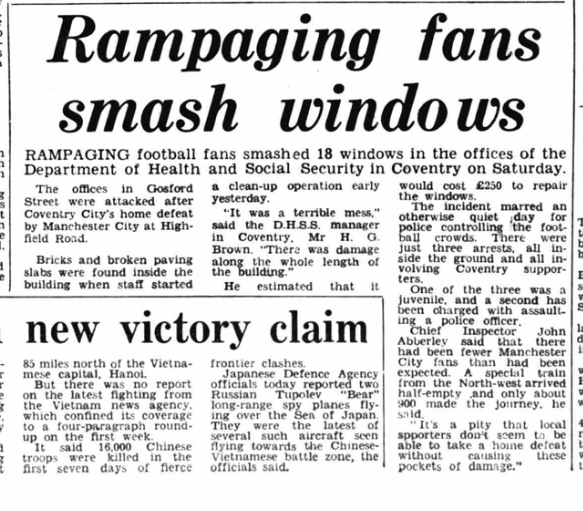
The series of features/articles covering Manchester City in the 1970s continues with this flashback to today (24 February) in 1979 when City won 3-0 at Coventry. The goalscorers were Mike Channon (2) and Brian Kidd and was City’s second successive away win by that score (the previous had been Spurs 3 weeks earlier). You can read a report of the game above but you may also be interested in this article about some ‘rampaging’ that occurred after the game. For once away fans were not blamed! Instead newspapers blamed the Coventry fans who, it was felt, couldn’t handle the defeat. All interesting stuff!
This series of articles and features on Manchester City in the 1970s has been running throughout January and into February with indepth articles some days and smaller ‘on this day’ style posts on others. Every day offered something to enjoy.
Subscribers can access everything. If you want to know more on this incredible decade for Manchester City Football Club then why not subscribe and read it all? You could even subscribe for a month and see what you think. The following 5,700 word article is on the 1978-79 season and is available to subscribers below. Enjoy!
Subscribe to get access – Monthly
Read more of this content when you subscribe today. It costs £3 per month (cancel anytime) to access everything posted since 1 October 2022 or there’s a special annual rate below which gives greater access and works out much cheaper.
Read more of this content when you subscribe today. It costs £3 per month (above) or £20 a year (here) to access everything posted since the site was created in December 2020. This special rate works out about £1.67 a week and gives access to everything posted, including PDFs of 3 of my books.
If you enjoy all the free material on my website and would like to support my research and keep this website going (but don’t want to subscribe) then why not make a one-time donation (or buy me a coffee). All support for my research is valued and welcome. It allows me to keep some free material available for all. Thanks.
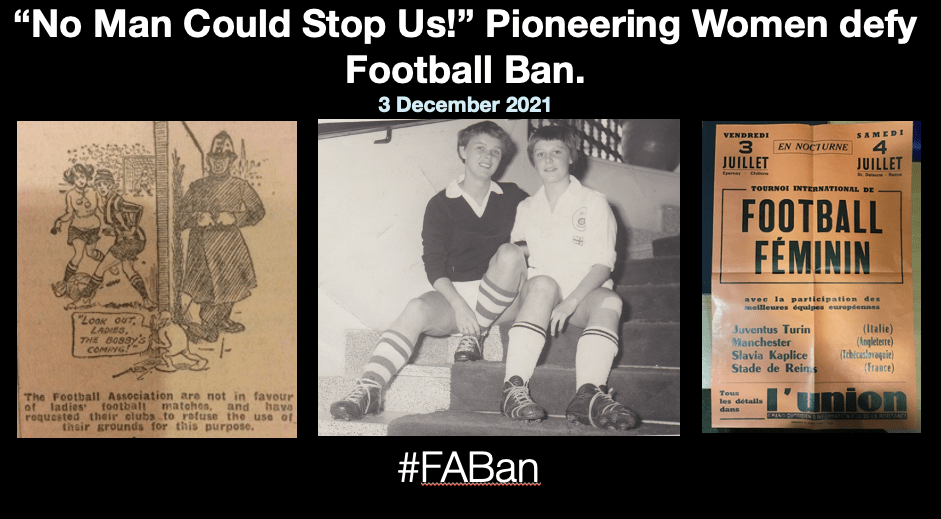
In December 2021 I staged a talk at Hebden Bridge on the FA ban of women’s football. The night was sponsored and supported by Geoff Matthews and his company Cansquared Ltd. It was a wonderful night and lots of attendees asked about the future and what they could do to help promote the stories of the women who played at a time when the FA tried to kill female participation in the sport. Well, after that night a lot has happened to recognise the Manchester Corinthians.
As part of my longstanding project into female participation and involvement in football in Manchester I have been researching and writing Manchester Corinthians: The Authorised History. The book will be of a similar scope to my Manchester City Women: An Oral History on City’s women’s team.
Margaret Shepherd and Margaret Whitworth with me prior to the Hebden Bridge event
A lot has been written on the Corinthians (see the section on women’s football on this site for a few examples) but not nearly enough, plus there are some inaccuracies out there that need to be corrected (even now there are some that keep on being repeated). Basically, this team possessed a talented group of players who toured Europe and South America promoting football, female endeavour and Manchester.
I talked quite a bit about Corinthians at Hebden Bridge and we were fortunate to have three Corinthians as guests that night. Margaret Whitworth, Margaret Shepherd and Lesley Wright between them covered every season of the club’s life from the 1950s through to its demise. Since that night I’ve also tracked down a player from the club’s very first season of 1948-49 who, together with detailed archival research, has helped me piece together for the first time several people who were instrumental in the birth of the club. Again, this is not something that has appeared in any of the articles or films connected with the club in recent years. This will be explained properly for the first time in my book.
I’m still trying to track down other Corinthians to include in the book. To date I’ve identified over 230 players. See:
After the Hebden Bridge night it was clear that we needed to recognise the Corinthian players further. On that night I mentioned my idea of having a plaque erected for the Corinthians in a significant/related location in Manchester. Several members of the audience thought this was a wonderful idea and asked if they could support the wider promotion of the Corinthians – one more or less suggested we should march on Downing Street to persuade them to do something about it!
In 2019 I’d written articles for a variety of publications suggesting the same and urging the FA and others to recognise the Corinthians. In the Manchester City men’s match programme as well I highlighted my desire to get a plaque erected about their achievements.
The talk at Hebden Bridge
Via Manchester Council I was put in contact with the Friends of Fog Lane Park and we ultimately set up a successful appeal in their name. The FA made a significant donation which funded the plaque and our fundraising efforts raised enough to allow the Friends to commission 2 murals and other tributes to the Corinthians as well.
Those present at Hebden Bridge in December 2021 helped raise the profile and that event was significant in highlighting the incredible achievements of its female footballers. Now, the authorised history of the Corinthians will tell the story of the club from its birth right through to the blue plaque appeal. It will use the voices of the women who represented Manchester and England in a positive manner and who won trophies in South America & Europe and who toured North Africa. They won a significant European competition before either Manchester men’s team yet their achievements were not recognised by the city until the blue plaque appeal started.
I am immensely proud of how this has all happened. The event at Hebden Bridge was free to attend and was made possible by the support of a locally based business, Cansquared (Geoff Matthews – who co-hosted the evening). We felt it was vital we made this free to attend to spread the word.
If anyone runs a key Manchester venue and would like a Corinthians celebration event then please get in touch. The more we can do to promote their story the better.
Thanks for reading this. If you would like to find out more about the Corinthians then follow the tabs on this site or use the search function. If you’d like to know more about the FA Ban then you can download for free an article I’ve recently co-written here:
Copies of my book on Manchester City Women are still available. This tells the history of City Women via the voices of the women (and some men) involved. The book has been heralded as a model for oral histories by the Oral History Society.
Here’s a link you can follow to order a signed copy of the City Women book:
Watch this space for more on the Corinthians and women’s football over the coming months. Thanks – now use the tabs and search to learn more on women’s football in Manchester. Ta!
Research into the pioneering women who played for Manchester Corinthians and its sister clubs is ongoing for the authorised history which will be published this summer. So far over 230 players have been identified for the club and their names will be included within the book. BUT I don’t want to leave anybody out so if you know of someone who played for the team or its sister clubs that I may have missed then please get in touch.
Ask your mam or your nan if she played – you never know what you’ll hear! I have had players talk to me during my years of research into the Corinthians who had kept it quiet from their own families, so granny may well have been one of the club’s pioneering figures but just hasn’t talked about it!
I really don’t want to leave anybody out.
As well as asking your mam or your nan, how about helping the book get published by subscribing to it? You will get a copy of the book (posted before it appears in the shops) and your name will be included in a special roll of honour published within the book if ordered by 31st March 2024 here:
Manchester Corinthians: The Authorised History
The story of a pioneering women’s club as told to Gary James by those who were there
£19.95
Opportunities to buy multiple copies, sponsor the book or donate to ensure it’s published to the size and standard the women who played deserve exist. Please email Gary@GJFootballArchive.com for more information on those opportunities.
This book is a must for anyone interested in Manchester or women’s football and will consist of over 300 pages. It will be fully illustrated throughout and subscribers can order it now for £19.95 (including UK postage and packaging). All orders received before 31st March 2024 will have the purchaser’s name included within the special roll of honour at the back of the book. You can order the book for someone else – all details will be checked and confirmed before publication.
The book will be published this summer.
If you live outside the UK then please contact for details of additional postage costs.
You do not need to have a PayPal account to order – use the ‘Pay with PayPal’ button above and it will give you the option to pay by credit/debit card without creating a PayPal account.
The book will include the story of the club as told by the women involved, alongside a significant amount of archive material. Myths will be corrected and the facts of this pioneering club will be told in an easy to read format.
Guided by founder Percy Ashley, the club went on to represent Manchester, football and female endeavour for decades, winning major international tournaments in Europe and South America. The Corinthians are, without doubt, one of the most important football clubs ever to come from Manchester and they were a prominent and pioneering club in so many ways.
As well as the interviews and dozens of archive trips there’s been a concerted effort to compile as comprehensive list as possible on women who played for the club. I’ve managed to compile a list of around 300 women who played for the club. Objects and trophies have also been rediscovered. This is the type of detailed research I enjoy. It’s time consuming, difficult and often frustrating but occasionally you find a little gem that adds significantly to our knowledge. There have been quite a few of those.
The Hebden Bridge talk when the campaign for a Blue Plaque and other tributes was publicly announced, December 2021
I’m still keen to hear from any former player who can add their voices to the history of the club, though the research and writing stage will be ending soon, so please get in touch as soon as possible. Please email Gary@GJFootballArchive.com with your name, rough dates you played and contact details.
Those subscribing to the book will receive a copy signed by author Gary James and posted out to subscribers before it appears in any shop or is distributed to any retailer. This is the ONLY way to guarantee your copy.
Manchester Corinthians: The Authorised History will include interviews with players from every era of the club from a founding player back in 1949 through to those playing for the club in its final days over 40 years later (yes, that’s right – over 40 years later!). The book will finally tell the story of the club from start to finish via the voices of the women who played. Via these voices the entire history of the club will be explained with the key figures identified and remembered. There’s a remarkable trail of women linking the first game with the last.
The book will be published to a similar style and quality to the acclaimed Manchester City Women: An Oral History and is destined to be another landmark publication on a major, pioneering women’s football club. Dozens of former players have been interviewed for this book and their remarkable stories and memories will be supported with an amazing array of photographs, newspaper articles, match programmes, trophies and other items of memorabilia from every era of the club’s existence.
Alongside chapters chronicling the history of the club there will also be features on founder Percy Ashley, who dedicated his life to promoting women’s football, and on Gladys Aikin (a key figure not only with the Corinthians but also with the early years of the Women’s Football Association) and George Aikin, who continued to take the Corinthians on tours into the 1980s. There will be special features on the major tours of the 1950s and 1960s when Percy Ashley led the Corinthians to major international success.
The cover of the book will be worked on by the designer over the coming months but following feedback from former players the maroon has been replaced with a darker blue, more reminiscent of the colour most frequently worn by the Corinthians (based on the reports, programmes and other material found so far and the majority of comments from players). This may still change of course (‘The Authorised History’ will probably change colour too). The back will contain later images and wording.
If you’d like to purchase my earlier book on women’s football then a limited number of copies, signed by me, are still available. You can order here:
Manchester City Women: An Oral History book
The first history of Manchester City’s women’s team, taking the story of the club from formation in 1988 until 2019-20 season.
£16.95 including UK postage (outside UK contact for additional postage costs)
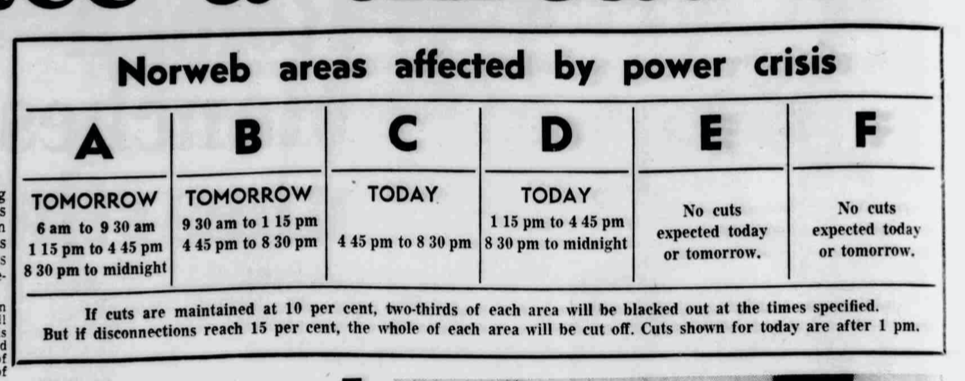
The series of features/articles covering Manchester City in the 1970s continues with a brief flashback to a time when industrial action and power cuts led to us all having to look in the local newspaper to see when our electricity would be available. It feels like an alien world today but in February 1971 (and at other times in the years that followed) electricity was provided at certain times of the day in certain areas. This led to games being re-arranged for afternoon kick offs or postponed altogether.
On this day (15 February) Liverpool newspapers carried the story that LFC’s match with Manchester City would be one game played earlier in the day.
These newspaper cuttings give a brief idea of how it all was. If there’s interest I may do a more detailed piece on this later. There’s a famous gave v Coventry a few years later that I remember being at. That day a generator ensured the match went ahead but we also had a bomb scare. We were asked to look under our seats and around us to see if there was a bomb there (seriously!) and play was halted. Mike Summerbee (in my memory but others say it was the referee) picked up the ball and shook it to see if it was a bomb! More of that another day. Here are the cuttings from today in 1971:
There have been flashbacks to great 1970s games, players and more every day in January & February. Subscribers get access to everything. If you want to know more on this incredible decade for Manchester City Football Club then why not subscribe and read it all? You could even subscribe for a month and see what you think. The following 5,200 word article is on the 1970-71 season and is available to subscribers below. Enjoy!
Subscribe to get access – Monthly
Read more of this content when you subscribe today. It costs £3 per month (cancel anytime) to access everything posted since 1 October 2022 or there’s a special annual rate below which gives greater access and works out much cheaper.
Read more of this content when you subscribe today. It costs £3 per month (above) or £20 a year (here) to access everything posted since the site was created in December 2020. This special rate works out about £1.67 a week and gives access to everything posted, including PDFs of 3 of my books.
If you enjoy all the free material on my website and would like to support my research and keep this website going (but don’t want to subscribe) then why not make a one-time donation (or buy me a coffee). All support for my research is valued and welcome. It allows me to keep some free material available for all. Thanks.
You can help the authorised history of the Manchester Corinthians get published by subscribing now. You will get your name included in a special roll of honour published within the book if ordered by 31st March 2024 here:
Manchester Corinthians: The Authorised History
The story of a pioneering women’s club as told to Gary James by those who were there
£19.95
Opportunities to buy multiple copies, sponsor the book or donate to ensure it’s published to the size and standard the women who played deserve exist. Please email Gary@GJFootballArchive.com for more information on those opportunities.
This book is a must for anyone interested in Manchester or women’s football and will consist of over 300 pages. It will be fully illustrated throughout and subscribers can order it now for £19.95 (including UK postage and packaging). All orders received before 31st March 2024 will have the purchaser’s name included within the special roll of honour at the back of the book. You can order the book for someone else – all details will be checked and confirmed before publication.
The book will be published this summer.
If you live outside the UK then please contact for details of additional postage costs.
You do not need to have a PayPal account to order – use the ‘Pay with PayPal’ button above and it will give you the option to pay by credit/debit card without creating a PayPal account.
The book will include the story of the club as told by the women involved, alongside a significant amount of archive material. Myths will be corrected and the facts of this pioneering club will be told in an easy to read format.
Guided by founder Percy Ashley, the club went on to represent Manchester, football and female endeavour for decades, winning major international tournaments in Europe and South America. The Corinthians are, without doubt, one of the most important football clubs ever to come from Manchester and they were a prominent and pioneering club in so many ways.
As well as the interviews and dozens of archive trips there’s been a concerted effort to compile as comprehensive list as possible on women who played for the club. I’ve managed to compile a list of around 300 women who played for the club. Objects and trophies have also been rediscovered. This is the type of detailed research I enjoy. It’s time consuming, difficult and often frustrating but occasionally you find a little gem that adds significantly to our knowledge. There have been quite a few of those.
I’m still keen to hear from any former player who can add their voices to the history of the club, though the research and writing stage will be ending soon, so please get in touch as soon as possible. Please email Gary@GJFootballArchive.com with your name, rough dates you played and contact details.
Those subscribing to the book will receive a copy signed by author Gary James and posted out to subscribers before it appears in any shop or is distributed to any retailer. This is the ONLY way to guarantee your copy.
Manchester Corinthians: The Authorised History will include interviews with players from every era of the club from a founding player back in 1949 through to those playing for the club in its final days over 40 years later (yes, that’s right – over 40 years later!). The book will finally tell the story of the club from start to finish via the voices of the women who played. Via these voices the entire history of the club will be explained with the key figures identified and remembered. There’s a remarkable trail of women linking the first game with the last.
The book will be published to a similar style and quality to the acclaimed Manchester City Women: An Oral History and is destined to be another landmark publication on a major, pioneering women’s football club. Dozens of former players have been interviewed for this book and their remarkable stories and memories will be supported with an amazing array of photographs, newspaper articles, match programmes, trophies and other items of memorabilia from every era of the club’s existence.
Alongside chapters chronicling the history of the club there will also be features on founder Percy Ashley, who dedicated his life to promoting women’s football, and on Gladys Aikin (a key figure not only with the Corinthians but also with the early years of the Women’s Football Association) and George Aikin, who continued to take the Corinthians on tours into the 1980s. There will be special features on the major tours of the 1950s and 1960s when Percy Ashley led the Corinthians to major international success.
The cover of the book will be worked on by the designer over the coming months but following feedback from former players the maroon has been replaced with a darker blue, more reminiscent of the colour most frequently worn by the Corinthians (based on the reports, programmes and other material found so far and the majority of comments from players). This may still change of course (‘The Authorised History’ will probably change colour too). The back will contain later images and wording.
If you’d like to purchase my earlier book on women’s football then a limited number of copies, signed by me, are still available. You can order here:
Manchester City Women: An Oral History book
The first history of Manchester City’s women’s team, taking the story of the club from formation in 1988 until 2019-20 season.
£16.95 including UK postage (outside UK contact for additional postage costs)
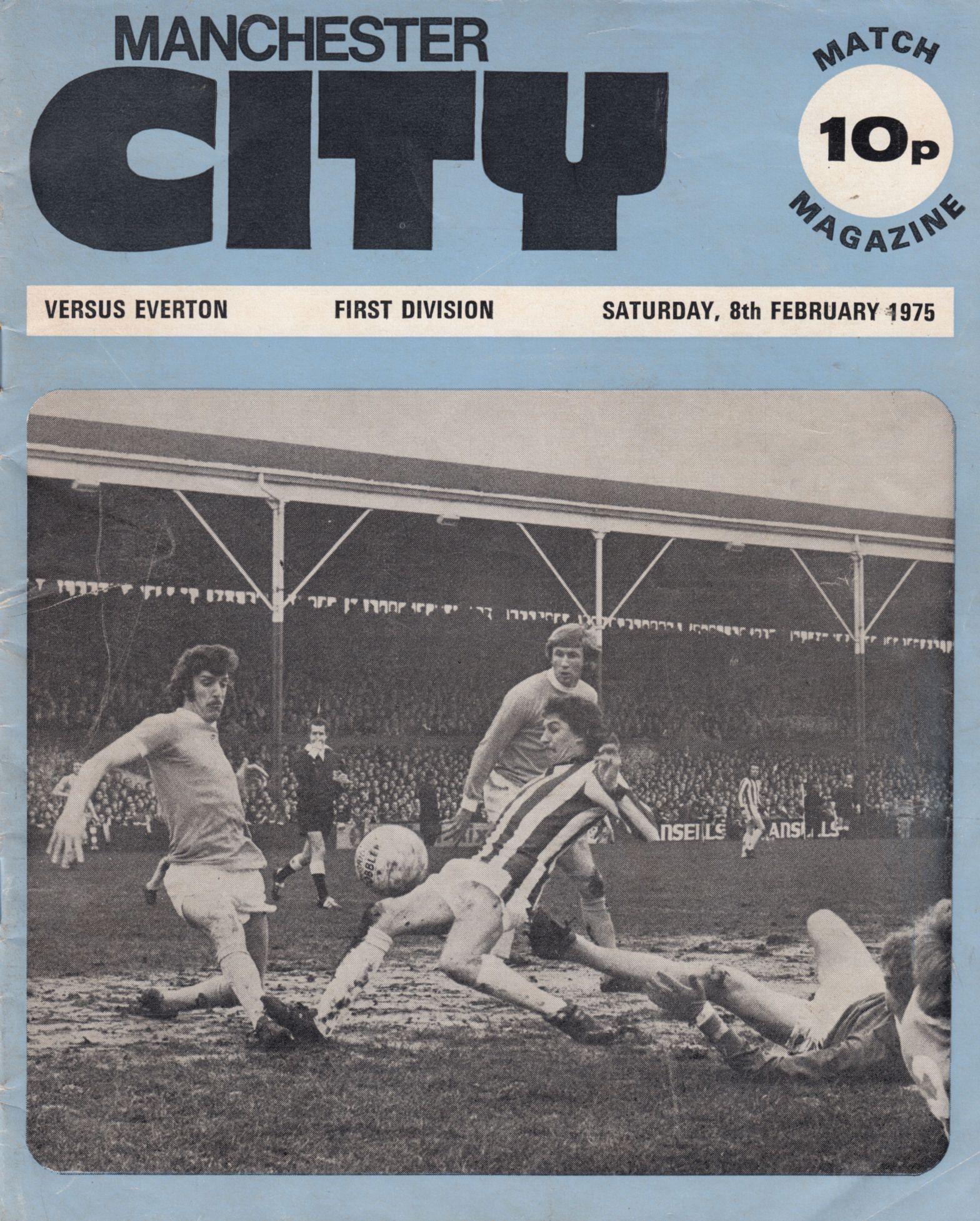
An unfortunate late own goal by Mick Horswill hardly mattered as Manchester City defeated Everton 2-1 on this day (8 February) in 1975. The Blues were leading 2-0 thanks to goals from Colin Bell and Dennis Tueart. You can watch all the goals (and a Marsh opportunity!) here:
This series of articles and features on Manchester City in the 1970s has been running throughout January and Februaru with indepth articles some days and smaller ‘on this day’ style posts on others. Every day offered something to enjoy.
Subscribers have access to everything. If you want to know more on this incredible decade for Manchester City Football Club then why not subscribe and read it all? You could even subscribe for a month and see what you think. The following 1,600 word article is on the 1974-75 season and is available to subscribers below. Enjoy!
Subscribe to get access – Monthly
Read more of this content when you subscribe today. It costs £3 per month (cancel anytime) to access everything posted since 1 October 2022 or there’s a special annual rate below which gives greater access and works out much cheaper.
Read more of this content when you subscribe today. It costs £3 per month (above) or £20 a year (here) to access everything posted since the site was created in December 2020. This special rate works out about £1.67 a week and gives access to everything posted, including PDFs of 3 of my books.
If you enjoy all the free material on my website and would like to support my research and keep this website going (but don’t want to subscribe) then why not make a one-time donation (or buy me a coffee). All support for my research is valued and welcome. It allows me to keep some free material available for all. Thanks.
I’ve been asked a few questions this last week about the origins of men’s football in Manchester. For those that don’t know I researched & wrote a detailed history on the topic for Manchester University Press a few years back. I don’t have copies available myself but the publisher does have paperback copies, retailing at £21 on their website:
Follow the link (above) and it will explain more on the book but it basically tells the stories of the pioneering men’s clubs in the 1860s/1870s; the development of Manchester’s main two men’s clubs (City & United; correcting many myths!); first trophy successes; the scandal at City and the match fixing at United; plus much more. It considers the types of people who went to watch the clubs during early 20th Century and, again, there may be some detail in there that surprises a few.
If you want to know more then feel free to ask. Thanks
Here’s another attendance flashback piece. This is from February 1984 when Second Division Manchester City were reported as only being a few thousand behind League leaders Liverpool. The article praised City fans of course but it also highlighted the support Newcastle were also getting in the second tier of English football at the time.
In recent years it has become fashionable to knock fans when stadia are not quite full but in the past we tended to praise and recognise those that continued to be loyal. With the cost of football now considerably higher than it was back in the 1980s then I think it’s only fair that we start to go back to recognising the dedication and loyalty of fans. It is so frustrating when modern day fans (often who don’t pay to attend games) or even journalists/commentators/former players on TV (again, often who do not pay to attend games) criticise the supporters of any club if they see a seat or so empty. If only they realised the efforts fans go to to attend games at times usually arranged for the media’s benefit and not ours.
Parking issues, money concerns, travel gridlock, strikes, weather, travel, work… a whole host of things get in the way and it takes dedication to attend any game.
Lots more on this website about attendances. If you want to know crowd comparisons for the decade before 1983-84 season then this is well worth reading. It may surprise fans of some clubs:
If you enjoy all the free material on my website and would like to support my research and keep this website going (but don’t want to subscribe) then why not make a one-time donation (or buy me a coffee). All support for my research is valued and welcome. It allows me to keep some free material available for all. Thanks.
Today’s game with Burnley and the return of Vincent Kompany provides a great opportunity to remember some key games and stories from years gone by featuring the two clubs. I’ve written a lot about City & Burnley games over the years so sit back and get yourself in the mood for tonight’s game by having a look at these articles:
One of my quests to find missing objects involves the 1904 FA Cup final ball. I know it was in Burnley for over 40 years and was still there in the 1950s but where is it today? Can you help find it? Have a read of this:








 Gary James' Football Archive