Politics & Sportswashing

Lots said these days about using football as a means of ‘sportswashing’. The basic idea being that politicians and state leaders use football to sell a better image of themselves. The suggestion often made in the media is that this is a recent phenomenon but of course, like so many other things in life, it’s far from new. In fact, as far as football goes there are plenty of examples of politicians or businessmen pushing a particular idea to fans of certain clubs. As Manchester City are often highlighted today by those who are critical of the club’s owners, I thought it would be worth posting this image of a postcard created to promote a Manchester City director’s Conservative campaign.

Chapman was the first chairman for City back in 1894 and years later he died in office during his second spell as City’s chair. As part of his political campaigns he often linked the club’s successes to help present a positive image of success to potential voters. City’s captain Billy Meredith even campaigned for him at times.

City chairman John Chapman used City’s success as part of his political campaign.

Chapman was a decent guy it seems and both his political career and City chairmanship seemed on the whole to be positive for the people of Ardwick, though of course there were critics.

Regardless of how he was viewed it is clear that he did use City’s successes as part of his political campaigns. Nowadays someone would call this sportswashing no doubt, but it does show how people have used their sporting connections to further other ambitions. There’s nothing new in football!

My True Blue profile of Chapman will appear on 27 March 2023. You can read other True Blue profiles of City’s earliest figures by using the True Blue tab below. Thanks.

The Great Jimmy Ross

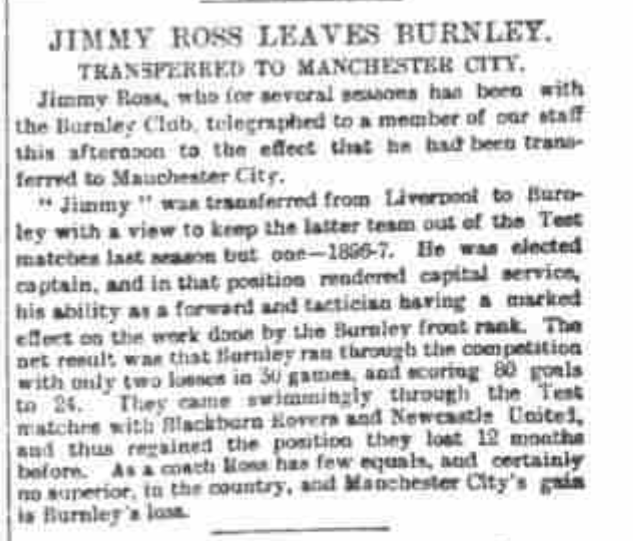
On this day (24 February) in 1899 the great Jimmy Ross signed for Manchester City.  Ross was one of football’s leading names and earliest heroes when he played for the famous Preston side that won the League and Cup double of 1889. He had scored an incredible eight goals when Preston beat Hyde 26-0 in the record breaking F.A. Cup tie of 15th October 1887 – a game in which the referee is reputed to have lost his watch and allowed play to last two hours!  (you can read about that game here: https://gjfootballarchive.com/2021/02/22/hyde-v-preston-a-record-breaking-day/ ).

In addition, he was the Football League’s top scorer in 1890 (24 goals), and was quite a character.

He signed for Manchester City from Burnley for a reported £50 after previously captaining Liverpool to promotion. He had also played for the Football League.  

At City he was influential from the start. He netted an incredible seven goals in the final nine games of the 1898-99 season (his first nine games at City too!) brought the Division Two title for the first time – this was the first national success of either of Manchester’s professional clubs.  

Years later the legendary Billy Meredith, looking back on his City days, remembered Ross with great affection: “I must confess that Ross will always be my favourite hero.  He was good at everything he put his hand to and what he didn’t know about football wasn’t worth knowing.  At billiards and card games he was an expert.  Though he must have been thirty-four at least when he joined us, he was able to win seventy yards handicaps with ease and did so.  He could talk like a lawyer and on and off the pitch his comic sayings had us in stitches.”  

Today many of the heroes of football’s earliest years as a professional sport are forgotten and in Manchester’s case people often talk about Meredith as if he was the first and only hero in the city. But Jimmy Ross was a major figure and he was absolutely essential in City’s early development. Without him they may not have achieved that first Second Division title success. He helped develop Meredith into a star and should never be forgotten.

The leading sports newspaper of the day, the Athletic News, often praised Ross. When the club was making its first steps in the top flight the newspaper talked of City’s right sided players and stressed the importance of Ross and of course Meredith:  “For real brilliance the right wing took the biscuit….In fact, there are few, if any, better men at outside right  (Meredith).  His partner, the veteran Ross, of whom it is predicted every season that he has had his day, is in reality taking a second lease of footballing life, despite the paucity of head-covering, and as a wing the two will cause some trouble”.

At one point a newspaper article claimed that Meredith was absolutely brilliant when he was being well served by Ross but when the going got tough, Meredith disappeared.  It seems that at this stage in the Welshman’s career he needed the experienced Jimmy Ross more than Ross needed him.  One article claimed that Meredith: “doesn’t like donkey-work and if his partner is off, Meredith is off too.”

By the end of the 1901-02 season it looked as if Ross and Meredith, despite Ross’ age, would go on forever. Sadly, tragedy struck in 1902. Ross died on 12th June that year after an illness described as “an acute skin disease and a raging fever.”

Ross’ last appearance was appropriately against Preston North End in the First Round of the F.A. Cup in January 1902.  Ross died of an infectious skin condition.  City helped his mother, whom he was looking after at the time of his death, financially.  They also arranged the funeral.

Ross helped Meredith develop and over time the legend of Meredith grew, while Ross’ name has slowly faded. This is a major shame as Ross’ influence on Preston, Liverpool and City’s development is immense. Ross helped City establish their name at a time when Meredith was not quite the finished article. So many players have been described as legends in the decades that have followed. Many of them become forgotten over time, but it is important that once in a while we pause and remember those players. 

Today let’s think about Jimmy Ross and remember him as one of the men who made Manchester City.

Why not now read about the game when Ross played for Preston against Hyde? It already appears on my blog here:

Hyde v Preston – A Record Breaking Day

Scandals, Investigations… We’ve Been Here Before!

‘The punishment was the largest ever inflicted, wiping out an entire team, its directors and one of the most charismatic managers of the period.’

‘The League met and representatives of each club voted in favour of the punishment meted out to us being enforced. And while their representatives were passing this pious resolution most of them had other representatives busy trying to persuade the “villains whose punishment had been so well deserved” to sign for them under conditions very much better in most cases than the ones we had been ruled by at Hyde Road.’

These quotes are connected with investigations into Manchester City over 100 years ago when the FA considered the Blues to be a ‘nouveau riche’ club despite incredible support etc. Back then certain clubs who were regarded as the aristocracy of football (that included Aston Villa and Everton back then) were somewhat dissatisfied that Manchester City had come from foundation as MCFC in 1894 to FA Cup winners and League runners up within a decade. Lots of investigations followed with some determined to kill off this challenger. This all sound familiar? Well 118 years ago the largest punishment ever inflicted, wiping out an entire team, its directors and one of the most charismatic managers of the period was imposed on the club.

Below for subscribers is a 4,500 word article written on the topic by me. This is an academic piece, focusing on the facts and was written for an academic publication, not something club specific. The article considers the investigation, the ban and its long terms impact on Manchester football, where Manchester City’s first golden era came to an end but Manchester United’s first golden era followed. A truly transformational period in Manchester’s football story and essential reading for anyone looking at precedents or wanting to understand how football in the city was shaped.

Subscribe to get access – Annual

Read this indepth article and access everything else on the site when you subscribe. It costs £20 a year (about £1.67 a month) or £3 a month (see below). Annual subscribers access everything posted to the site since December 2020 (including PDFs of Manchester A Football History & my first book, audio & written interviews, history talks etc.).

Subscribe to get access – Monthly

It costs £3 a month (cancel anytime) or £20 a year (above) to subscribe. Monthly subscribers access everything posted to the site since 1 October 2022 (including PDFs of books, audio & written interviews, history talks etc.).

Manchester’s First Major Trophy Success

It’s the return of the FA Cup tonight with Manchester United facing Everton. It’s always worth reminding ourselves of the significance of the FA Cup to Manchester and the story of Manchester’s first major trophy success. The captain and goalscorer of the first triumph by Manchester in 1904 was the great Billy Meredith. In 2021 following the purchase of the oldest surviving FA Cup by Sheikh Mansour (to loan to the National Football Museum) I helped Manchester City with the story of the cup and its significance to Manchester. They’ve produced a video telling the story and it can be viewed here:

https://www.mancity.com/citytv/mens/manchesters-first-trophy-1904-fa-cup-documentary-63745781

For more on the significance of this FA Cup trophy check out the category 1903-04 in the drop down list below.

The Great Billy Meredith

101 years ago today the great Billy Meredith returned to Manchester City from Manchester United. This was the third time the legendary Welsh player had joined the Blues – a club he continued to watch and support until his death in 1958. I discussed his life and career with his daughter Winifred (who was 98 at the time) and his grandson Ian Pringle many years ago and they both talked fondly and passionately about his Manchester City connections.

Here for subscribers is a detailed profile of Billy Meredith I wrote about 17 years ago. It appeared in my Hall Of Fame book. Enjoy….

Subscribe to get access

Read more of this content and the other 400+ articles when you subscribe today.

The Death Of Jimmy Ross

One of the earliest stars of League Football died on this day (12th June) in 1902. Jimmy Ross, who was a major figure for almost three seasons with Manchester City and had competed in every season of League football since the League was established in 1888, died with an illness described as “an acute skin disease and a raging fever.”

Ross was one of the Preston ‘Invincibles’ in 1888-89 and also scored 7 (sometimes reported as 8) against Hyde in the famous FA Cup record breaking game (read more on that game here: https://gjfootballarchive.com/2021/02/22/hyde-v-preston-a-record-breaking-day/ ).

At the time of his death Ross was a Manchester City player. His last first team appearance was appropriately against Preston North End in the First Round of the F.A. Cup in January 1902.  

City helped his mother, whom he was looking after at the time of his death, financially.  They also arranged the funeral and he was buried at Southern Cemetery (according to newspaper reports of the time he was buried in a grave that contained another City player – Bride – who had died a couple of years earlier). Several City players/personalities carried the coffin, including Billy Meredith.

More can be read on Ross’ life here:

The Great Jimmy Ross

On This Day: Manchester’s First Major Trophy Success

On this day in 1904 (23 April) Manchester found its first major trophy success. The captain and goalscorer was the great Billy Meredith. Last year, following the purchase of the oldest surviving FA Cup by Sheikh Mansour (to loan to the National Football Museum) I helped Manchester City with the story of the cup and its significance to Manchester. They’ve produced a video telling the story and it can be viewed here:

https://www.mancity.com/citytv/mens/manchesters-first-trophy-1904-fa-cup-documentary-63745781

For more on the significance of this FA Cup trophy check out the category 1903-04 in the drop down list below.

Historic Name That Ground – Week 21 Answer

On Monday I asked if you could name this ground. I said: ‘I know it’s a tough one BUT… there’s a reason I’ve chosen this week to post this image plus eagle-eyed visitors to this site may notice that I have actually used part of this image before in connection with another story. So where is it?’ The answer is…

Manchester City’s old Hyde Road ground. So did you work out why I’ve posted the image this week and what the previous story I’d used part of this image for was in connection with? Well this equivalent week in 1920 saw the stand featured being built. This is the only known surviving photo of Hyde Road’s temporary Main Stand built in the week following the Hyde Road fire.

The Main Stand was destroyed on the night of the November 6 by fire and, after attempts to move to United’s Old Trafford failed as a result of United demanding an exorbitant rent. For the full story of this see this chapter of Manchester A Football History (available with the rest of the book as a download for subscribers):

Manchester A Football History part 13

City didn’t think the rent was fair (neither did the media – again see that chapter of Manchester A Football History) and so they decided to soldier on at Hyde Road. A new stand – the one seen from the back here – was constructed using wood.

So, what about the previous story part of the image was used for? That was a piece about Billy Meredith returning to City in July 1921. Meredith is the player on the far right and this photo was taken to show him back at Manchester City.

Watch out for another Historic Name That Ground on Monday.

While you’re here why not subscribe to my site and you can then access every article, interview, audio recording etc. already posted and those that will be posted during your subscription. It costs £20 per year (about £1.67 a month) or you can sign up on a monthly basis at £3 per month (you can cancel at any time, so you could sign sign up for a month, access everything you want and then cancel). You can subscribe below:

Subscribe to get access

Read more of this website including all of Manchester A Football History and my first book, From Maine Men To Banana Citizens, when you subscribe today.

Manchester’s First Great Season

“Not a little of the success the City club has achieved is due to the indefatigable labours of the secretary, Mr T.E. Maley, who came to Manchester three years ago, when the City were in the Second Division.  He brought to his duties valuable experience gained with the famous Celtic club, and he has had the benefit of being a player, a club official, a legislator, and a selector.  His splendid services to the City are reflected in the position they at present occupy – the holders of the English Cup – the most coveted of football prizes, and one of the leading clubs in the League.”The Manchester Evening Chronicle, 12 November 1904

This season became Manchester’s first major trophy-winning season. It established the city’s trophy-winning heritage and it helped transform Manchester from a rugby playing city to a footballing one. Every Mancunian needs to know the story of this season. The following 10,000 word article tells the story of that season.

If you would like to read the full article and other pieces like this then please subscribe below. It works out about £1.67 a month if you take out an annual subscription (£20 per year) or £3 a month if you’d like to sign up for a month at a time. Each subscriber gets full access to the hundreds of articles posted so far and the hundreds scheduled to be posted in the coming months.

Subscribe to get access

Read more of this content when you subscribe today.

Manchester City V Brighton – The Story And Film Of The First Ever Meeting

Tomorrow (13th January 2021) Manchester City and Brighton meet in the Premier League. So far there have only been 24 games between the two clubs with the first coming in 1924. This game was a newsworthy FA Cup tie due to the return of a legend to the City team. In fact it was so newsworthy that a movie company sent their camera (you’ll see from the footage it never moved!) to Brighton’s Goldstone Ground to capture the return of a true Blue hero.

Subscribe to get access

If you would like to view this article then please subscribe below. It works out about £1.67 a month if you take out an annual subscription (£20 per year) or £3 a month if you’d like to sign up for a month at a time. Each subscriber gets full access to the 150+ articles posted so far and the hundreds scheduled to be posted in the coming weeks.