Record Average Crowds

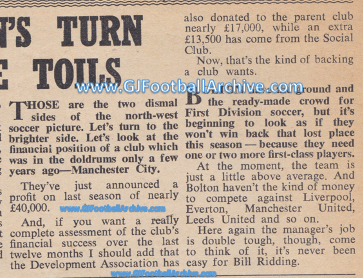
I’ve not done one of these for a while but I know they always prompt a bit of debate, so here goes… a feature on Manchester City FC attendances. It is a fact that the Blues have, generation after generation, been one of the English game’s top attractions. Like all – and I do mean all – English clubs there have been some average attendance lows over the years, but when the entire history of Manchester City is reviewed and the club’s average figures are compared with the national average it is clear that the Blues have consistently been one of football’s most attractive draws.  Take a look at the following:

  • Since the beginning of the Football League in 1888 only nine sides have topped the table for average attendances.  In chronological order of their first appearance at the top of the average table they are: Everton (1888-9), Villa (1898-99), Newcastle (1904-05), Chelsea (1907-08), Tottenham (1909-10), City (1910-11), Liverpool (1922-23), Arsenal (1929-30), & Manchester United (1956-57) 
  • As early as 1895-96 City were the third best supported side in the entire League despite being a Second Division side.  Only First Division sides Everton & Aston Villa could better the Blues.  Modern day giants Arsenal were 10th; Liverpool were 19th; United were 21st and Chelsea had yet to exist.
  • In 1900-01 City were the 2nd best supported side in the entire League with only 400 people separating Villa (1st) and City 
  • The 1910-11 season saw Manchester’s Blues top the attendance charts for the first time.  City’s average was 26,000 and was the 8th highest average of all time at that point (all clubs, all seasons). 
  • Regularly amongst the best supported sides throughout the inter war period, City’s average exceeded 37,000 for the first time in 1927-28 when the Blues established a record average crowd for the Second Division.  This was also the entire League’s highest.
  • In 1947-48 City’s average crowd exceeded 42,000 for the first time.  Prior to that season only Chelsea (1919-20 & 1946-7), Arsenal (1934-5, 1936-7, 1937-8, & 1946-7) , Newcastle (1946-7), Liverpool (1946-7), United (1946-7), and Wolves (1946-7) had exceeded that figure.
  • From 1975 to relegation in 1983 City were always one of the top 4 best supported sides, usually third behind United and Liverpool.
  • Since the 1980s whenever City have played outside of the top division, they have tended to be the best supported side in that division.  
  • Since moving to their current home in 2003, the increased capacity has allowed City to re-establish itself as one of best supported clubs again. Maine Road’s capacity from 1994 onwards was extremely low compared to the club’s entire history and prevented the Blues from staging games in front of attendances of approximateley 35,000 upwards.

In general many people believe success increases support, and while that is undoubtedly true to some extent, for City it is often periods of adversity that prove the loyalty of the Club’s fans.  It is highly significant, for example, that the first time City were the best supported side in the entire League (1910-11) Manchester United (6th best supported side) won the League title for the second time in 3 seasons.

Similarly, in 1925-26 when City were the best supported side in Division One and had established a new record average, the Blues were actually relegated.  This coupled with significant poverty and hardship in Manchester at the time should have reduced support but loyalty increased!  In my book “Manchester A Football History” I explore the relationship between attendances and Manchester’s major sides and it is fair to say that City fans can feel immensely proud of their loyalty throughout the history of the game.  Something that cannot be said by all of the League’s biggest names.  

In fact, it is worth highlighting that City have never been the worst supported side in their division but, of today’s so-called giants, Arsenal (1912-13 – average = 9,100) and Manchester United (1930-31 – average = 11,685) have.  City’s worst average of the Twentieth Century came in the desperate 1964-65 season and was 14,753 (half the average of 1960-61 and a 3rd of the 1957-8 figure).  However it is significant that for every League season City’s average has always been above the divisional average and, apart from 17 seasons, has always been in the top 11 nationally.  Again, few of today’s giants can’t say that – United’s 20th Century low stands at 4,650 and Chelsea averaged 15,731 as recently as 1988-89. In fact City’s lowest League attendance is more than double United’s lowest League attendance at Old Trafford (United have several crowds of less than 4,000 at Old Trafford, including top flight games; City’s lowest in the League was a little over 8000 in the second tier).

For fans average attendances are often used as an indicator of size of club and so a number of people over the years have tried to produce a definitive ‘all-time’ attendance table.  Several years ago analysis by a member of the Association of Football Statisticians claimed that if stadium capacity was not an issue for any club City would be the fourth biggest side in terms of attendance.  That analysis compared postwar attendance detail with performance on the pitch.  

In 2002 writer Brian Tabner calculated an all-time attendance table based on each club’s average attendance position during seasons 1925-2002.  His top ten were:  Arsenal, Liverpool, United, Everton, Tottenham, Newcastle, City, Chelsea, Villa and Sunderland.  Since 2002 several clubs have increased their capacities of course and this will have a positive impact on each club’s standing in a more up to date analysis.   

Figures can be manipulated in many different ways, but City should feel proud that they have many attendance firsts that can never be matched by today’s perceived biggest clubs.  

The Seasons City Have Topped the Divisional Charts

The following figures show the seasons when City were the best supported side in their division and the Club’s highest individual crowd that season.  Those crowds marked in italics were also the highest individual crowds for the entire division that season (crowds pre-1925 are inconsistently recorded and so have not been highlighted).  It is fair to say that when an average crowd is within 4,000 of the highest then the stadium is likely to have been full for the majority of games with the size of away support varying.     

Average         Season          Highest Crowd                                  

10,000            1895-96         30,000 (Liverpool)                

10,000            1898-99         25,000 (N. Heath)    

16,000            1902-03         30,000 (United)        

18,275            1909-10         40,000 (Oldham)

26,000            1910-11         40,000 (Liverpool)    

21,000            1914-15         40,000 (Oldham)

32,000            1925-26         62,994 (United)

30,848            1926-27         49,384 (Bradford C)

37,468            1927-28         59,500 (Preston)

31,715            1928-29         61,007 (United)

35,016            1950-51         45,842 (Hull)

27,739            1965-66         47,171 (Huddersfield)

24,220            1984-85         47,285 (Charlton)

23,500            1988-89         40,070 (Chelsea)

26,753            1996-97         30,729 (Oldham)

28,273            1998-99         32,471 (York)

32,001            1999-00         33,027 (Blackburn)

33,059            2001-02         34,657 (Portsmouth)

With the increase in capacity at the Etihad coming this year it will be interesting to see how attendances develop. No doubt I’ll post more on this as the season progresses. Undoubtedly City will establish a new record average attendance in 2026-27.

Rev Arthur Connell

Here’s a photo of the Rev Arthur Connell who was the rector at St Mark’s Church in West Gorton when the boys of the parish established the club’s first association football team. That team continued (via a number of incarnations, reformations etc.) to become Ardwick AFC, the predecessor of Manchester City. Arthur and his family established many pioneering activities in the parish with the hope of improving the lives of ordinary working class inhabitants. Savings banks, libraries, soup kitchens etc. It was a grim life for many at the time. I’ve written about this extensively over the years and much can be found elsewhere on this site. Why not subscribe and read everything? Here’s another image of Connell, a bit younger here.

Arthur Connell

On this day… Malcolm Allison joins Manchester City

On this day (July 20) in 1965 Malcolm Allison was formally interviewed by the Manchester City board to be manager Joe Mercer’s assistant. Mercer had wanted to bring Allison in since he took the job earlier in the month. Here is a feature I did on Allison back in January 2005.

I first interviewed Malcolm in 1991, and, using material from several conversations with him, and in 2005 I took the opportunity of a MCFC v Crystal Palace game to remind everyone of his significance. Today, for subscribers, I’m posting it here.

Subscribe to get access

Read this article and all other content when you subscribe today.

Kevin Keegan

I’m really saddened to hear the news of Kevin Keegan’s death. I guess we all began to worry when we heard the news of his cancer. My thoughts are with his family and close friends. I met Kevin a few times and was in various meetings with him too. He was a genuine football legend and when you were in his presence you could feel his aura. To mark his passing I’ve decided to include something here on his first season at Manchester City. Kevin was obviously so much more than City’s manager and his time as a player and time at other clubs/England as manager probably deserves more focus but, as I’m a City fan, I feel it’s right to pay tribute by focusing on his time at City. Here goes…

Kevin joined City in 2001, only three days after the departure of Joe Royle. At first supporters were uncertain how to greet the former European Player of the Year. They knew he was passionate about football and his record in club management was good. He had helped re-establish Newcastle United as a leading club, and had started to create momentum at Fulham, before he took on the England role. Fans also knew he might move on if he ever felt he was unwelcome, or his approach was failing. Fortunately, the appointment was to be the catalyst for a great season and an important era.

Early in 2002 chairman David Bernstein looked back at the decisions leading up to Keegan’s appointment during an interview with Noel Bayley: ‘When I heard Kevin Keegan was possibly available my personal view – shared by my colleagues – was we just had to go for him. We had a lot of applications for the job when Joe went. It was a very tight timescale, but we did have a lot of applications.

‘We didn’t look at the others frankly. I thought we were incredibly fortunate getting hold of Kevin. I thought that his reputation had been affected by the England experience, but that was our gain. That was completely irrelevant to his ability to manage. What he had done at Newcastle and Fulham – and particularly at Newcastle – was quite incredible, and I felt that what this club needed was someone of that stature, someone who had ability, but also glamour and that energy that Kevin has got which, among other things, would have the ability to bring in players to the Club while we were not in the Premier League, which is not the easiest thing to do. Kevin has shown that he can bring in the right players and motivate them. Energise them. Look after them, and get the best out of creative players, and that was my view when we took him on. It’s very early days still, but the impact has been made.’

Following his arrival Keegan attended a Fans’ Forum and outlined his reasons for taking on the job: ‘This truly is a massive club and it’s my job to turn it around. The new stadium is a fantastic incentive for us – not only to get back in the Premiership but to win something as well. It takes very little force to join a club like this. It’s a fantastic opportunity. I’m ready for it.

‘I’ll be judged on what happens from now on. I’ve got a lot to prove to myself. I’ve had other opportunities, but this is the only one that appealed. I’m not a fool. I have a real chance here. Hopefully, I can build a successful outfit that people will really want to be part of, and I think that’s my strength. I think I’ve already proved that twice at League level at Newcastle and Fulham, and I’m pretty confident that, given that bit of luck everybody needs, we can do it here.’

Immediately Keegan set about improving the staff. He brought in his former manager Arthur Cox as Chief Scout, and signed former England star Stuart Pearce. Keegan desperately wanted Pearce to be his captain: ‘He was actually going to quit playing and clean out his horses at home when I saw him this summer, but I told him this club needed a leader. He says more than me in the dressing room and what he says is probably more important as well.’

Pearce said at the time: ‘I had always said that I would not drop out of the Premier League, but this was too good an opportunity to miss. If I was going to drop out of the top-flight it could not have been to a bigger club than Manchester City. It is my sort of club and has my sort of supporters – passionate and knowledgeable about the game.’

He made his debut in the opening match with Watford, as did Israeli Eyal Berkovic. Keegan: ‘Berkovic was a £5.75 million player only two or three years ago, but I bought him for £1.25 million. He is a key signing because we mustn’t settle for mediocrity.’

That was an important line: ‘We mustn’t settle for mediocrity.’

Both Pearce and Berkovic shone in the opening match. Watford, managed by Gianluca Vialli, were perceived as strong promotion candidates and so it was important City started their season in the right manner. Pearce was fired up from the start. According to Matt Dickinson in The Times: ‘One feared for Watford from the moment Stuart Pearce led City on to the pitch and performed a little war dance before kick-off.’

City won the match 3-0 with both Berkovic and Pearce scoring. The other scorer was Shaun Goater, proving once again he would be an important team member. The result convinced the media City were already on the right track. Journalist Matt Dickinson: ‘Keegan has found a natural home amid the unrelenting fervour of Maine Road. Place your mortgage on Manchester City winning promotion to the FA Barclaycard Premiership. What happens after that is anybody’s guess, but even Keegan’s arch-doubters would not bet against him riding an open-top bus through Manchester in May.’

Under Kevin City were exciting to watch and, more importantly, they delivered that season. The Blues entertained game after game and, while Keegan’s City had the ability to concede goals, they also scored an incredible number. It’s no exaggeration to say that if City conceded three than fans would still feel Kevin’s City could score four. That season of 2001-02 became the last truly entertaining seasons at Maine Road. Wolves and West Brom (who had for much of the season been a serious threat) were no longer perceived as a threat to promotion by April and then when the Blues were at home to 21st-placed Barnsley on 6 April 2002 (three games remaining) the League Championship was within reach.

On the eve of the Barnsley match Ali Benarbia was asked about the challenge facing the Blues if promoted. He responded: ‘If? There is no “if”. I know we’ll go up and win the Championship against Barnsley. No problem for us.’ For supporters used to decades of Blue inconsistency the confidence expressed felt refreshing. The Blues had rarely made life easy for themselves, and the impact of Keegan and his staff had supporters walking tall in a similar manner to the early days of the Mercer-Allison partnership. 

Benarbia’s confidence proved valid later that night; promotion was assured when Wolves were defeated 1-0 at Millwall. The following day, a 1pm kick-off meant supporters arrived bright and early for a day of celebration, and what a celebration. Maine Road was awash with blue and white as ecstatic fans waved their flags and banners and anticipated the Championship. One supporter told Paul Connolly of The Times: ‘I can’t believe it. There’s nothing that can go wrong. We’ve already been promoted – we could field a veterans’ team and still go up! And the sun’s bloody shining.’

Despite this refreshing situation the atmosphere was a little muted at the start. Perhaps fans were still nervous of City’s past reputation and were fearful of a last-minute failure to secure the Championship. If they were concerned then Darren Huckerby was quickly on hand to reassure them with a twelfth minute strike and another twenty-four minutes later. 

Barnsley pulled one back shortly before half-time but a double for Macken and a third for Huckerby gave City a 5-1 lead by the 70th minute. The fourth goal had been the best. Player of the Year Ali Benarbia sent a great pass to Huckerby who proceeded to move quickly forward. Huckerby returned the ball to the Algerian while he continued to move into a goalscoring position, then Benarbia passed back to the ex-Coventry man, who sent the ball crashing into the net. And that was when the celebrations began in earnest. 

The cry of ‘Champions’ bounced around the old stadium, as it had done around St. James’ Park in 1968. Throughout the final minutes the fans cheered every player, every move, every moment of the match. Then, when the final whistle blew, the roar was incredible as the Blues finally achieved their first major success since 1976. 

The players performed a lap of honour, while Kevin Keegan seemed to delight in bowing to each of the stands in turn. He clearly enjoyed the moment although afterwards he tried to put City’s achievement into perspective: ‘I am not one for getting carried away with celebrations because all we have done so far is return the club to its rightful place.’

He did, however, acknowledge the supporters’ need to celebrate: ‘The Barnsley game gave me an insight into the depth of feeling for this club. You all wanted to say ‘Thank You’ to the players. I sensed many of you had desperately wanted a day like that for years.’

He was right, and City’s promotion felt like a major success, especially as they would receive the League Championship trophy as a result. So many of City’s promotions in the modern era had come via desperate last game of the season victories or draws, but this success was different. Keegan: ‘There have been a few false dawns here, and the fans have to trust us this isn’t going to be another.’

The supporters were as convinced as Keegan that this side was better equipped than those promoted during the previous twenty years. For many weeks the Blues had been destined to go up. It may have only become a formality in the final couple of weeks, but City were head and shoulders above the rest. This success was thoroughly deserved. Interestingly, a few of Keegan’s predecessors were quick to criticise with the most vocal being Alan Ball: ‘I couldn’t take the club forward because they were in terrible financial difficulties. I had to bear the brunt of what was going wrong by losing my job. Joe Royle had the same thing. He got them promoted but once he got to the big time, they didn’t have the money to stay there. Kevin’s going to find the same thing.’ 

The criticism may have backed the neutrals’ view of City’s position, but in truth Keegan’s side was already in better shape than any created by Ball or Royle. In addition, City had made it clear Keegan would be supported financially. With a move to the new stadium on the horizon the Blues were keen to attract the best. Before the season’s end goalkeeper Peter Schmeichel arrived at Maine Road, while rumours of future major purchases were circulating. 

The final away game of the season ended in a 3-1 victory at old foes Gillingham, allowing the Blues to set a new record of 39 points away from home. There was also confirmation the League Championship trophy would be presented at the final match of the season against Portsmouth. Another incredible day that can be read about elsewhere on this site.

This promotion, the last experienced by the club, set the mood and tone for everything that has followed. Without Keegan’s period in charge the Blues may not have achieved the modern day successes. Of course, anything was possible in the years that followed (and it wasn’t all plain sailing!) but the fact is that staying out of the Premier League could’ve changed everything negatively.

As for Kevin, he stayed at City until March 2005. City suffered a 1-0 home defeat by Bolton Wanderers on 7 March 2005, and the game ultimately led to a significant change to the then 12th placed Blues.  Years later, in an interview I did with him the former City chairman John Wardle told me that Keegan took him to one side:  ‘There were nine games left and Kevin said “John, I can’t do any more for you”.  I didn’t believe him.  I thought it was a joke at first but with Kevin you knew when he was being serious.  He said, “I know when I’m done and it’s only right that you put somebody else in”.  I sat there shell-shocked.  He said that if I wanted him to recommend someone he would.  He then recommended Stuart Pearce. 

‘Stuart had already left Carrington, and we had to call him back.  I spoke with him, then Kevin talked with him.  It was like a handover.  Kevin packed his bags and left.  We never saw him again at the training ground.  That’s Kevin.  Once he makes a decision to move on, he moves on.  Obviously, it stunned me on the day, but I have to stress that I cannot speak highly enough about Kevin Keegan.  He’s a real football person and he also cares about people.’

Keegan was hugely popular with fans and they recognised that he had been responsible for the second stage in City’s redevelopment following the disastrous mid-nineties.  

It is fair to say that Keegan’s time brought a great deal of pride back to the Club.  Director Dennis Tueart felt that bringing Keegan in during 2002 was absolutely the right move for the Club. He told me:  ‘I knew he wouldn’t stay for years and years because I knew him.  He said to me in 1975 that he would never stay anywhere longer than about five years.  People told us he wouldn’t stay but I said if he can have control for a couple of years and get us out of this division then that’s fine.  That’s what we needed.  Let’s manage first things first and get out of this division.  If we can’t do that then what hope? So it was no surprise to me when he eventually left us.’

Kevin Keegan was a remarkable footballer and a truly important Manchester City manager.

Ardwick Wins Card

Here’s a nice card from John Baines (he used to produce these cards in Bradford, West Yorkshire) featuring Ardwick AFC’s captain Davie Weir. Presumably this is from 1892-1894 when the team was in the Football League. Weir was the club’s top scorer in 1892-93.

Missing: A City Blue Plaque

There are not many blue plaques in Manchester dedicated to football – There’s the Manchester Corinthians blue plaque (see elsewhere on this site for details of the campaign); the Football League first meeting (a red plaque); Newton Heath’s first pitch (a red plaque which is the standard colour for Manchester sites); the Fallowfield FA Cup final (black if I remember right) and that’s about it. Oh, there’s also the Bank Street plaque for United’s former home (just behind the velodrome/BMX centre). There used to be one to mark Manchester City’s birth positioned on the Aces public house close to Clowes Street in West Gorton BUT this vanished shortly after the pub closed many years ago. This image shows the plaque as it looked when I took this photo in the early 2000s. It’s seeing this plaque years ago that first got me thinking about marking footballing sites in Manchester.

What happened to it? It was obviously stolen but where is it today?

It was positioned incorrectly and should have been a few streets away to mark the actual first pitch of St Mark’s or maybe even the church itself.

If anyone knows where this plaque is today then please get in touch. Incidentally, I think the plaque marking United’s Newton Heath birth is missing too but I’ve not checked on it recently.

There are other plaques around Greater Manchester connected with football, for example the one at Stalybridge for Bert Whalley (again, see elsewhere on the site for the details of that).

Maine Road’s Early Football History

Years before Manchester City created the Maine Road stadium and housing filled all sides of the street a field on the road was used for football and other sporting activity. The area was quite rural in the 1860s and 1870s but gradually housing and industry swamped the area. Maine Road itself was originally called Dog Kennel Lane and it used to continue past its current end point with a bend in the road changing its direction south towards the area of Hough End (see below for map etc.).

I’ve talked about Dog Kennel Lane a lot over the years and include its story and why the name of the street changed in Farewell To Maine Road and elsewhere on this site. Here’s an early mention of Dog Kennel Lane in relation to football. Manchester Association were the city’s prominent team in the mid 1870s and early 1880s. They promoted the game extensively and subscribers can read their story here:

And here:

I explain a lot more about them in The Emergence of Footballing Cultures: Manchester 1840-1919.

The brief newspaper cutting from 1882 mentions their Dog Kennel Lane ground. On the following I show where Maine Road was later built but the Manchester ground was probably further up the road/lane towards what became Great Western Street.

An early 20th century interpretation of an older map, showing modern streets (dotted) with the original roads.
Manchester Association at Dog Kennel Lane, 1882

If you’d like to read more on the history of Maine Road, take a look at Farewell To Maine Road, which can be downloaded from this page:

Great Photo of Manchester City fans in 1909

Here’s a great cutting from the Daily Mirror from 23 August 1909 showing City fans at Hyde Road for the public practice match that season. really atmospheric. The other images show first choice ‘keeper Walter Smith in action. THe 1909-10 season was a good one for City and you can read a review of that season below.

This is an article on the 1909-10 season when the Blues returned to the First Division as champions after a one season absence. If you’re a subscriber you can read this below.

If you’re not a subscriber then why not sign up for a month and see what you think?

Subscribe to get access

Read more of this content when you subscribe today. It costs £3 per month (cancel anytime) or sign up a year at a time for the discounted annual fee of £20. This gives access to everything on the site, including PDFs of 3 of my books and various other articles, interviews and audio material. Each subscriber has access to all content posted during their subscription period too. Why not sign up for a month and see what you think?

More on the 1910s soon. Why not subscribe and read this and all the other subscriber features?

Hyde Road – More Cover Than Old Trafford

In 1913 the Edinburgh Evening News included this on City’s Hyde Road ground within a feature on the club. There are some interesting comments in this about the Hyde Rd Ground. I”ve argued for years that City’s old stadium was actually better than is often claimed and this article tends to back that view up. Back in 1910 City spent significant amounts to ensure there was cover on all four sides of the stadium. Part of the reason was because United had moved to Old Trafford the previous year and, while that was a new stadium, there was limited cover. In 1910 City claimed there was covered accommodation for over 35,000 (in a stadium that typically could house no more than about 40,000).

Enjoy this brief article.

The Oldest Manchester Club

Here’s a brief cutting from October 1912 which mentions that Manchester City FC was the ‘oldest’ Manchester club. At the time there were plenty of people around who had been involved with the establishment of both Manchester Football League Clubs and so it seems logical to me that we listen to these views. Both clubs were newly formed organisations in 1894 (City) and 1902 (Utd) though both claims roots going back decades earlier. In their earlier incarnations City’s earliest known game is in Nov 1880, as is United’s (one week later). More on this elsewhere on the site and in my book The Emergence of Footballing Cultures: Manchester 1840-1919.