On this day in 1913: Frank Swift was born. Here for subscribers is a detailed article I wrote on Swift a few years back: Swift, Frank Victor (1913-1958), footballer and journalist was born in Blackpool, Lancashire on 26 December 1913, the second son of five children. From his earliest memories, he was always obsessed with the game of football, playing at every opportunity with his brothers, one of whom, Fred, became first team goalkeeper for a variety of clubs, most notably Blackpool, Oldham Athletic and Bolton Wanderers.
Subscribe to get access
Read more of this content when you subscribe today. It’s £20 for an annual subscription or £3 per month (cancel anytime, see below).
As League Cup holders Manchester City expected to challenge for honours again in 1976-77. It became a remarkable season with some incredible highs; important transfers; return form injury and much more. You can read all about that season in this 2000+ word article.
Subscribe to get access
This article is available to subscribers. Annual subscribers get access to everything posted on this site since December 2020 (including PDFs of 2 out of print books and audio interviews with Malcolm Allison John Bond etc.) while monthly subscribers get access to everything posted since 1 October 2022. It costs £20 for annual subscription (here) and £3 per month for monthly subscription (below)
This article is available to subscribers. Annual subscribers get access to everything posted on this site since December 2020 (including PDFs of 2 out of print books and audio interviews with Malcolm Allison John Bond etc.) while monthly subscribers get access to everything posted since 1 October 2022. It costs £20 for annual subscription (above) and £3 per month for monthly subscription (here)
Back in 1989 my first book was published and subscribers to this site (both annual and monthly) can now download a PDF of that entire book. The original book cost £6.95 when it came out; you can subscribe at £3 per month and get the PDF free here then cancel the subscription if you like). Ignoring yearbooks, this was only the 6th book (and two of those were more like pamphlets published in the 1930s & 40s) ever published specifically on Manchester City Football Club.
Subscribe to get access – Annual
To access the book and everything else on my website please take out an annual subscription here or, alternatively, scroll a little further and take out a monthly subscription. It’s £20 a year (about £1.67 per month) or £3 a month (cancel anytime).
I do not have the original layouts and so I’ve scanned my only surviving copy of the book and put the pages together on a PDF. The pages appear in the order they did in the original but, obviously, as I’ve just placed images of the pages on a word document it’s not as it all appeared. Nevertheless, for those who have never seen it you can now.
There were all sorts of issues with the original publication. My co-author had died and the book was delayed by a year. It was originally due out when I was 20 in 1988. As Keith, my co-author, had died mistakes were made. Keith was also a key figure at the publisher and, without his expertise, the quality of the images and other areas was not as great as it should have been. Even the title was incorrectly published (I’d agreed a different title). Ah well… I got enough of a bug to have started writing my second book within about a month of this coming out.
If you’d like to download the book then you do need to be a subscriber to this site. Subscribers pay £20 a year (works out about £1.67 a month) or £3 a month at a time (cancel anytime). For that annual subscribers now get the entire From Maine Men To Banana Citizens plus my 2010 edition of Manchester A Football History AND all articles/interviews posted so far. These include audio interviews I did with John Bond, Malcolm Allison and George Graham in the 1990s. Monthly subscribers get all content posted since 1st October 2022. All subscribers get access to all new material posted during their subscription too.
Merry Christmas to all. On this day (25 December) in 1896 Manchester City played their first competitive Christmas Day fixture. The game, staged within sight of the present day Etihad Stadium, was a derby match with Newton Heath (United). It was played at Bank Street, Clayton (behind the Velodrome and the current BMX site). It was a Manchester derby which ended in a Newton Heath victory.
On this day (24 December) in 1948 the great maverick Mancunian footballer Stan Bowles was born. Here’s a profile of him…
Bowles joined City as an amateur on 27 July 1965, becoming an apprentice on 1 October 1965 and then professional on 29 December 1966.
Then in 1967 things really began to happen and Bowles’ first game was as a substitute in a League Cup tie at home to Leicester City. He scored two goals in the second half and the following Saturday he made his League debut another memorable one. He scored two again!
Lots of stories have circulated over the years about his time at City. Like Mario Balotelli many years later some are truthful; others are exaggerations and some are completely make up.
The stories go that Bowles once missed a flight to Amsterdam where City were to play against Ajax, and that Bowles’ interest in the horses led to Joe Mercer saying: ‘If Stan could pass a betting shop like he can pass a ball, he’d be a world beater.’ Suspensions and other issues led to Stan refusing to sign a new contract and he asked to leave. That in itself led to him being suspended for 14 days on the advice of the Football League.
Inevitably Bowles moved on, first to Bury (July 1970) and then to Crewe (September 1970).
A spell at Carlisle followed and then in September 1972 a bid of £110,000 took him to Loftus Road where he won five England caps as a QPR player.
Seven years later Nottingham Forest’s Brian Clough bought him for £210,000 but sold him again less than a year later after further issues. Further spells were reported at Orient, Brentford, Hounslow and Epping.
In 2015 it was announced he was suffering with Alzheimer’s Disease, like his former boss Joe Mercer.
At City Bowles made a total of 20 first team appearances, scoring 4 goals, but he remains recognised as a hugely talented player.
There are articles on this site mentioning Bowles. Here’s a selection:
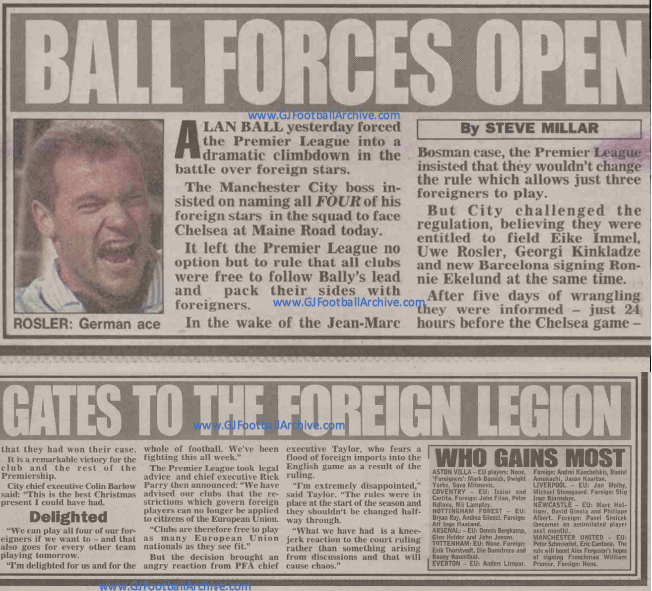
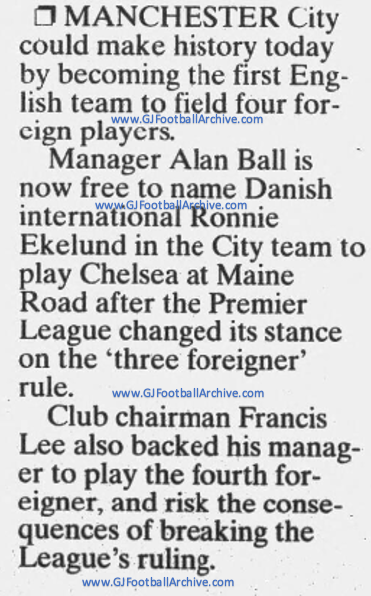
On this day (23 December) in 1995 there was a great deal of speculation that Manchester City would be the first team to field four ‘foreign players’ which wound PFA chief Gordon Taylor up considerably. There had been a rule in place limiting the number of foreign players to three but this had been challenged by English clubs, following the historic Bosman judgement in the European Court of Justice.
Basically, before Bosman challenged the restrictive trade practices UEFA insisted that a maximum of three foreign players could appear for clubs. The Bosman judgement was immediately considered by Premier League clubs who felt it meant they could play as many players from the European Union as they wanted (though the maximum of 3 from outside the EU was still a limit).
The Premier League, supported by the FA, said the ruling meant that City and other clubs could play as many EU players as they wanted. At Maine Road Alan Ball had brought Danish under-21 international Ronnie Ekelund on loan and together with Eike Immel, Uwe Rosler and Georgi Kinkladze it was suggested he would play against Chelsea on 23 December 1995.
In the end Ekelund came on as substitute for Rosler, so 4 ‘foreign players’ had appeared that day but only 3 at any one time (though there’s a whole other discussion to be had about players from other United Kingdom countries and Ireland and whether they should count as that day the Republic of Ireland’s Niall Quinn played, as did Gerry Creaney from Scotland and Welsh international Kit Symons!).
As for the game… City lost 1-0 to Chelsea!
Ekelund had a brief up and down career at City, making only 6 (plus 3 as sub) appearances and he was soon off to Barcelona, while the change to the ‘foreign player’ rule was to have a massive impact on the development of football in England, paving the way for the multitude of talented players at City today.
Subscribe to get access
If you have enjoyed this piece and would like to support my writing while also accessing further great content, then why not subscribe? Those who subscribe on an annual basis get access to everything posted on this site since December 2020 (including PDFs of 2 out of print books, and audio interviews with John Bond, Malcolm Allison etc.). Those subscribing on a monthly basis get access to everything posted since 1 October 2022. It’s £20 a year (subscribe here) or £3 per month (subscribe below). Why not try it for a month?
If you have enjoyed this piece and would like to support my writing while also accessing further great content, then why not subscribe? Those subscribing on a monthly basis get access to everything posted since 1 October 2022. It’s £20 a year (subscribe above) or £3 per month (subscribe here). Why not try it for a month?
We’ve reached the final minutes of my interview with John Bond from November 1995. I hope you’ve enjoyed it so far. As before, there’s a lot to interest and perhaps surprise in these frank views.
At the time this interview was performed I was researching my in-depth history of the club called Manchester The Greatest City (later updated as Manchester The City Years).
I met John at his home and spent a good few hours with him chatting about the Blues and his career. I loved doing this interview and was always grateful for the time he gave me. He was extremely frank, open and honest – which delighted me because he was a great talker. He was also happy for me to quote everything he said in the interview. I did end up quoting him extensively in the book (and in others I’ve produced) but, until now, none of the interview has ever been heard by the wider public.
Subscribe to get access
If you would like to listen to the final part of this frank interview (and the other parts) and read all the in-depth articles on this site (including the entire Manchester A Football History book) then please subscribe. It works out about £1.67 a month if you take out an annual subscription (£20 per year, here) or £3 a month (below) if you’d like to sign up for a month at a time. Annual subscribers get full access to everything posted since December 2020.
If you would like to listen to the final part of this frank interview (and the other parts) and read all the in-depth articles on this site (including the entire Manchester A Football History book) then please subscribe. It works out about £1.67 a month if you take out an annual subscription (£20 per year, above) or £3 a month (here) if you’d like to sign up for a month at a time. Monthly subscribers get full access to everything posted since 1 October 2022.
On this day (23 December) in 1942 future Manchester City player and manager John Benson born at Arbroath. He joined the Blues at the age of 15 in July 1958 and went on to make 52 League and Cup appearances before being transferred to Torquay in 1964. Spells at Bournemouth, Exeter and Norwich followed, before John moved into coaching. In 1980 he returned to Manchester as assistant to manager John Bond. Here’s an interview I did with him during October 2004.
Sadly, John died on October 30 2010 at the age of 67.
Here for subscribers is the interview from 2004.
Subscribe to get access
Subscribers get access to lots of additional content on this site. Annual subscribers get access to everything since December 2020 (including PDFs of 2 out of print books plus ausio interviews with John Bond, Malcolm Allison etc.) while monthly subscribers get access to everything from 1st October 2022. Annual costs £20 here and monthly is £3 per month below.
Subscribers get access to lots of additional content on this site. Annual subscribers get access to everything while monthly subscribers get access to everything from 1st October 2022. Annual costs £20 above and monthly is £3 per month here.
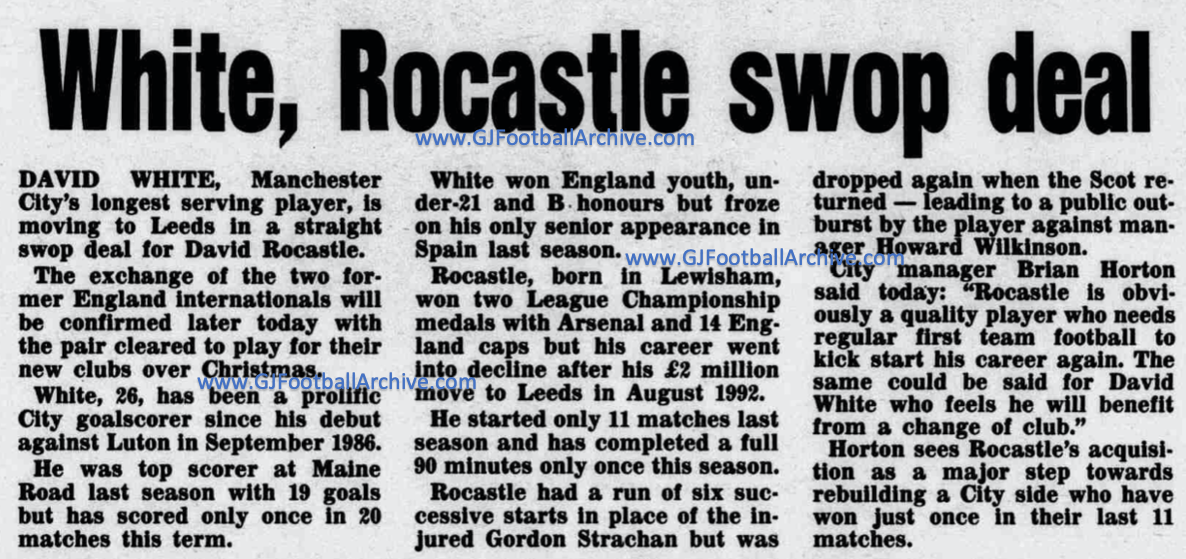
On this day (22 December) in 1993 David White left Manchester City after years of dedication to the Blue cause. He was transferred to Leeds United in a swap deal for David Rocastle. It was a sad loss for the Blues but it was also a new beginning for Rocastle.
We’ve entered the final thirty minutes of my 1995 interview with John Bond with these final minutes split into two sections. This section, part 6 of the full interview, sees Bond and I discuss City’s directors, lack of success and so on. For anyone wondering what the issues were with City in the 80s and 90s it’s well worth listening to this. He ends with his views on a game between City and Liverpool from Boxing Day 1981.
At the time of this interview in November 1995 I was researching my in-depth history of Manchester City called Manchester The Greatest City (later updated as Manchester The City Years).
I met John at his home and spent a good few hours with him chatting about the Blues and his career. I loved doing this interview and was always grateful for the time he gave me. He was extremely frank, open and honest – which delighted me because he was a great talker. He was also happy for me to quote everything he said in the interview. I did end up quoting him extensively in the book (and in others I’ve produced) but, until now, none of the interview has ever been heard by the wider public.
Subscribe to get access
If you would like to listen to the sixth part of this frank interview (and the other parts) and read all the in-depth articles on this site (including the entire Manchester A Football History book) then please subscribe. It works out about £1.67 a month if you take out an annual subscription (£20 per year, here) or £3 a month (below) if you’d like to sign up for a month at a time. Annual subscribers get full access to everything posted since December 2020.
If you would like to listen to the sixth part of this frank interview (and the other parts) and read all the in-depth articles on this site (including the entire Manchester A Football History book) then please subscribe. It works out about £1.67 a month if you take out an annual subscription (£20 per year, above) or £3 a month (here) if you’d like to sign up for a month at a time. Monthly subscribers get full access to everything posted since 1 October 2022.



 Gary James' Football Archive