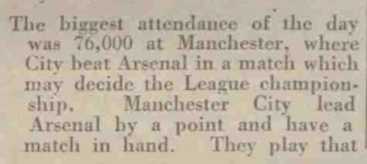
Tonight Manchester City and Arsenal face each other in what some are suggesting is a title decider. Of course, regardless of who wins it definitely isn’t a title decider as there are games to play and points to be won and lost, but it is a significant match in the season. Way back in April 1937 the two clubs met in very similar circumstances. Back then Arsenal were top and Manchester City were second and their Maine Road meeting was also promoted as a potential title decider. So what happened next?
Here for subscribers is the story of that game…
Subscribe annually to get access to the entire site
Read more of this content when you subscribe today. £20 for a year to access to ALL posts, books, interviews, talks etc. posted (site created in December 2020).
You can subscribe on a monthly basis for £3 (cancel any time). Monthly subscribers get access to all posts, interviews, talks etc. posted since 1 October 2022.
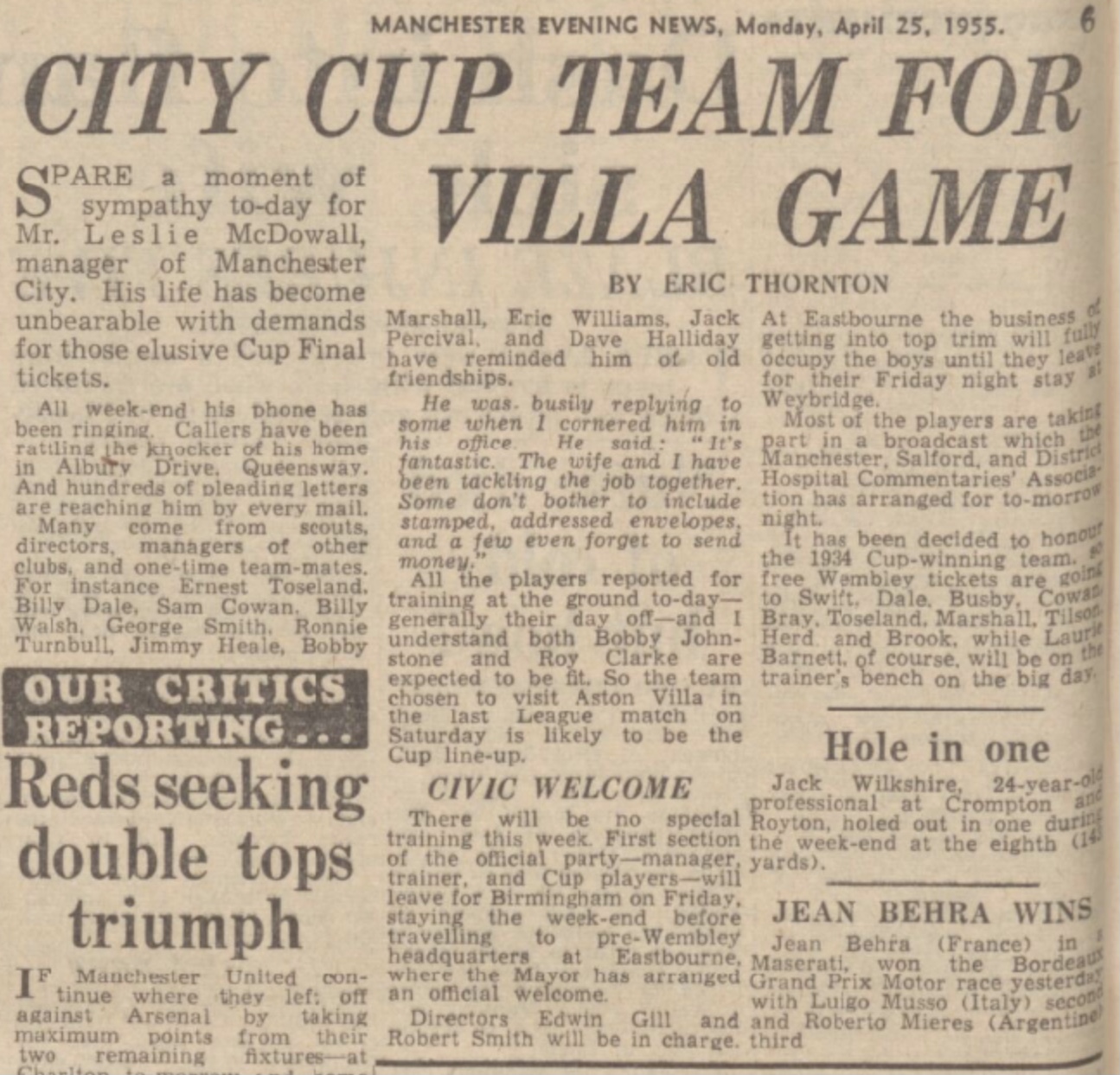
This is an odd article for a few reasons from today (25 April) in 1955. Basically the Manchester City manager Les McDowall was getting inundated with requests for FA Cup final tickets from fans, friends, former players and others. Some were turning up at his house…. So what did the Manchester Evening News do? It included the name of the street McDowall lived on! Surely that would’ve added to his woes?
A few months back I started writing a series of articles on football in the Manchester region for the Manchester Confidential website. If you’ve missed the and are interested here are links to them:
Tomorrow Manchester City face Arsenal in the League and there’s the possibility that national goalscoring records could be broken once again. A few weeks back I calculated that if Erling Haaland maintained a goal a game ratio in the remaining League fixtures for Manchester City he would better Tommy Johnson’s 38 goal tally by a goal. Since then Haaland, who is already City’s seasonal record scorer in all competitions, has indeed kept up that ratio – in fact he has surpassed it – and has now broken another barrier: 30 League goals in a season.
To celebrate this I’ve put together a feature comparing every player who has scored 30 goals or more for City, plus those Premier League goalscorers whose achievements could be bettered by Haaland this season. Here goes….
Subscribe to get access – Monthly
This article is available for subscribers. It costs £3 a month (here) or £20 a year (below) to access this and other articles on the site, including books, videos and 100s of articles. Why not try it for a month?
This article is available for subscribers. It costs £20 a year (here) to access this and everything else on the site, including books, videos and 100s of articles.
Continuing the weekly series on Manchester City’s seasons from 1999-2000 through to 2008-09. Each week I’ll be publishing here the story of a different season of that remarkable ten-year period. Today we have a 5,400 word article on the 2001-02 season (below) which saw City win the old League Championship trophy. City’s manager was Kevin Keegan.
Subscribe to get access – Annual
This article is for subscribers to my website. It costs £20 a year to access everything on the site since creation in December 2020. That includes articles, history talks, videos, interviews & more. There’s also a monthly option below.
Monthly subscription costs £3 per month to access everything on the site since 1 October 2022 (cancel anytime). All subscribers access all new material until their subscription ends. Why not give it a try for a month?
The FA Cup helped establish Manchester’s footballing identity – more on that in a minute. On this day in 1948 Manchester United appeared at Wembley for the first time to win the FA Cup. Manchester’s 1st FAC success came in 1904 (City). Before 1948 the Blues had appeared in 3 Wembley finals. Utd’s 1948 success meant 2 FA Cups each.
The closest Manchester City and Manchester United have got to playing each other in a Wembley FA Cup final were FA Cup semi finals in 1926 and 2011. I wasn’t around in 1926 but I definitely was in 2011. So a couple of years ago I made this special audio recording talking about the years building up to the semi and the day itself.
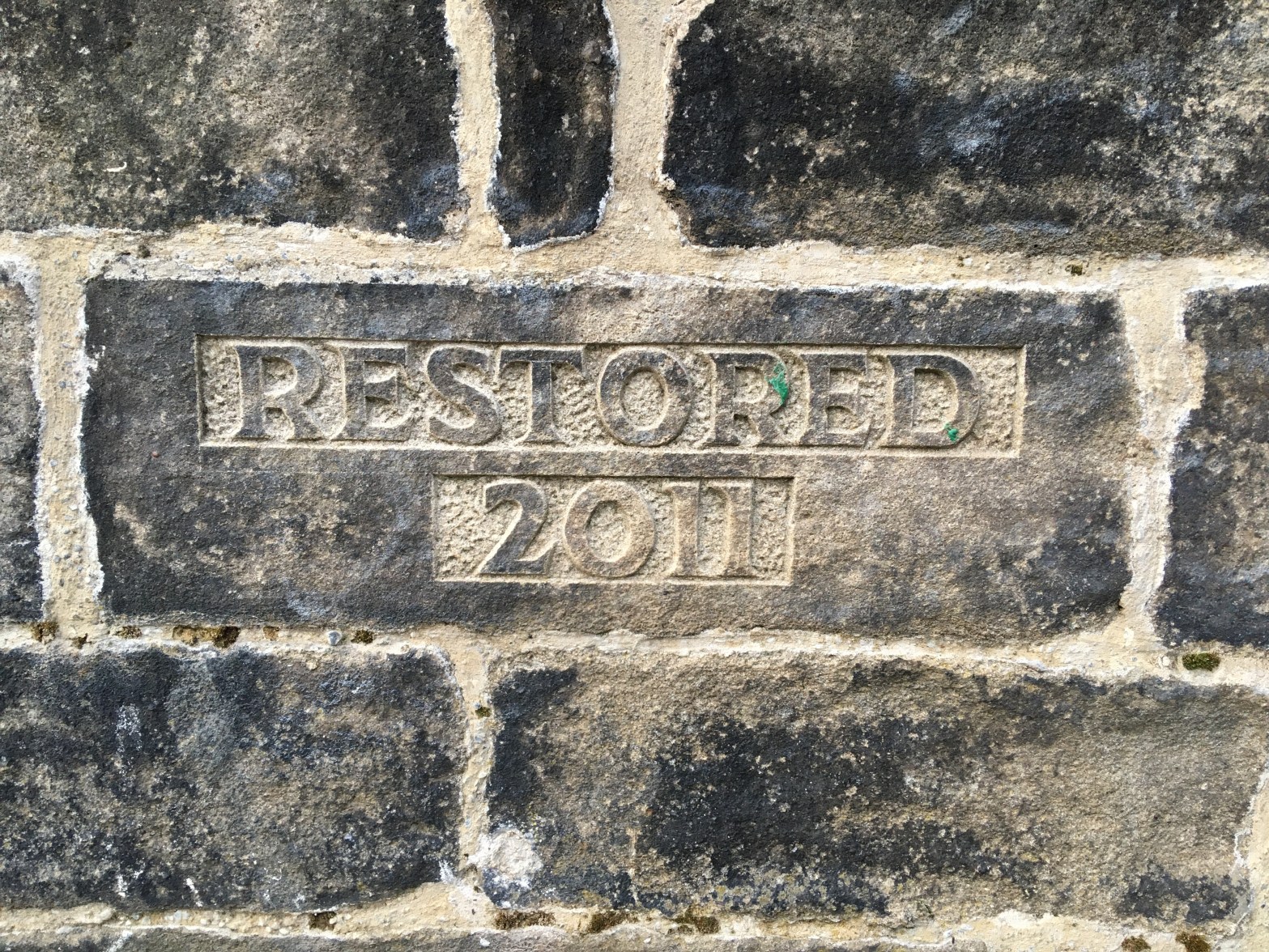
Restored 2011: The All-Manchester FA Cup Semi Final is a special 1 hour audio recording looks at the game and the years between the 1976 League Cup success and the FA Cup glory of 2011. The 2011 semi-final was a crucial step in City’s journey since the 2008 takeover and I felt it was vital to do a special marking this.
So what’s in this special recording? Well, I’ve included exclusive material from interviews and recordings I’ve done over the years with Garry Cook, Brian Marwood, Roberto Mancini, Peter Barnes and Peter Swales. Why Swales? Well, have a listen and you’ll hear why. Basically though I’m trying to set the tone for why the 2011 FA Cup semi final victory and overcoming Manchester United was so significant.
On Mancini… I include a few words from him recorded in 2011 and at one point he talks about the view that was then being expressed that City were ‘trying’ to buy success (now they say City ‘have’ bought success!). His words are a reminder that City have been having that particular criticism thrown at them for over a decade! Oh well, I wonder how long those criticisms were laid at other clubs who had seen major investment which propelled them forward?
Anyway, get yourself a brew and be prepared to be transported back in time. Here’s the recording:
If you enjoy the recording then please let me know, comment or subscribe to the site. I’ve produced videos/talks like this highlighting key points in Manchester City’s footballing history which subscribers can watch.
Subscribe to get access – Annual
Read more of this content when you subscribe today. It costs £20 a year to subscribe (it works out £1.67 a month) or £3 if you’d like to sign up a month at a time. Annual subscribers get full access for as long as you subscribe (you can always try it for a month). It’s worth bearing in mind that the 2010 Manchester A Football History cost £24.95 and all subscribers will be able to access all of that for as long as they are a subscriber (plus all the other stuff of course).
It costs £3 a month to subscribe a month at a time. Why not give it a try! Monthly subscribers get access to everything posted since 1 October 2022 for as long as you subscribe.
If you enjoy all the free material on my website and would like to support my research and keep this website going (but don’t want to subscribe) then why not make a one-time donation (or buy me a coffee). All support for my research is valued and welcome. It allows me to keep some free material available for all. Thanks.
On this day (24 April) in 2010 Gunnar Nielsen became the first Faroe Islander to play in the Premier League. The goalkeeper came on for the injured Shay Given in the 76th minute and kept a clean sheet as City drew 0-0 at Arsenal, watched by a crowd of 60,086.
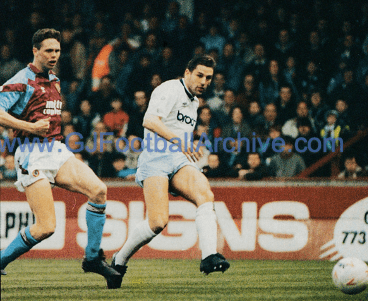
On this day (23 April) in 1991 a marvellous 5-1 win at Villa Park for Manchester City saw David White become the first City player since the war to score four in an away game. You can watch highlights here:
David White outpacing Comyn & McGrath for his second goal v Aston Villa, 23/4/1991
On Saturday April 22 1899 the football season ended with Manchester City as comfortable champtions of the Second Division. They were the first side nationally to gain automatic promotion (a series of test matches, similar to play offs, had been utilised in previous seasons) and the first of the Manchester teams ever to earn promotion and win a national League competition.
Subscribers can read about the final game and other information from that season below:
Subscribe to get access
Read more of this content when you subscribe today. It costs £20 a year (here) to access everything since December 2020 or for £3 per month (below) you can access everything from 1 October 2020.
Read more of this content when you subscribe today. It costs £20 a year (above) to access everything since December 2020 or for £3 per month (here) you can access everything from 1 October 2020. Why not join for a month and see what you think?


 Gary James' Football Archive