Hyde v Preston – A Record Breaking Day

On 15 October 1887 one of the most remarkable FA Cup games of all time occurred at Preston and featured Hyde FC, who were formed in 1885 at a meeting attended by approximately forty men in the White Lion public house.

At the start of the 1886-87 season one of the giants of the period, Blackburn Rovers, were invited to Hyde for a friendly which Hyde lost 8-0 but afterwards members of Blackburn’s side stressed they believed Hyde had potential.

These comments encouraged Hyde to enter the FA Cup the following season and they opened the 1887-88 season with a friendly against significant opposition with Bolton defeating Hyde 8-1. 

Preston had arranged a fixture with West Bromwich Albion and wanted to play the FA Cup tie midweek instead. Hyde, because of the complications a midweek game would have caused, rightly refused and, as a result, Preston made it clear that they would do all they could to win the match – in those days friendlies were often perceived as being more lucrative than FA Cup ties (actually we’re back at that point now in 2020s England for some clubs!).

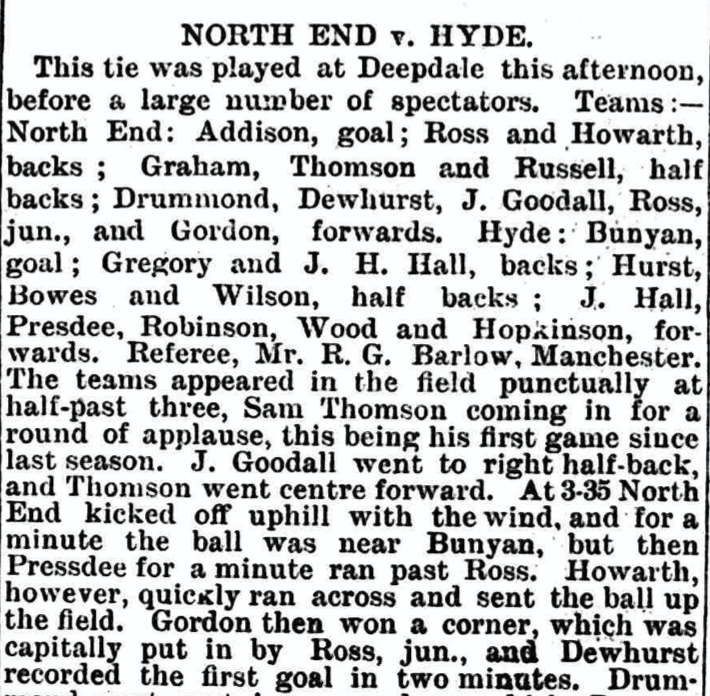
The game commenced on 15 October 1887 at 3.30pm and within five minutes Fred Dewhurst headed Preston’s first goal and the score reached 4-0 after approximately twenty minutes. 

According to reports the Preston goalkeeper didn’t touch the ball until the twenty-fifth minute when he took a goal kick, but by this point Hyde was already a struggling side and almost immediately after the goal kick Preston challenged Hyde’s goal again with Hyde conceding three goals in five minutes. By half time they had scored twelve goals.

Hyde commenced the second half determined to demonstrate an attacking spirit and they briefly put Preston under some pressure but Preston soon regained the initiative and the goals flooded in. 

Match reports simply list the scorers from this point on as, presumably, the pace was so frenetic that it was impossible for the reporters to record the general action, and the final score was 26-0. There had been significant controversy and confusion as Hyde’s centre-back Bowers had left the pitch with a sprained arm at 3-0 and Preston allowed the Hydonians to bring on another player for the second half even though substitutions were not allowed at this point in football history. Presumably they had felt a half time twelve goal lead was enough of a cushion. 

Famous Lancashire cricketer and footballer Richard Barlow played his part in the large victory as he was the referee, emphasising the continuing existence of a local sporting elite that crossed the conurbation. 

Barlow had played an additional five minutes during which time Preston’s last goal was scored and the reason this additional time was played remains unclear, although some suggested the referee was simply too involved with the action to check his watch, while others over the years that followed claimed his watch had stopped and that an additional ten or fifteen minutes had actually been played. 

Whatever the truth this was a remarkable victory for Preston. Despite the scoreline, Hyde’s goalkeeper Bunyan was regarded as one of the best players on the pitch. The referee, himself a former goalkeeper with Manchester Association, was equal in his praise when reflecting on the game in 1908: ‘I may say that had the Hyde goalkeeper not been in good form, North End would have materially increased their score. I have never seen such splendid passing and shooting in my life. The old Preston team would, in my opinion, be at least two goals better than any team in the field at the present day.’

After the game Hyde and Preston regularly played each other in friendlies, and the two sides also met to raise money for the victims of the Hyde Coal mining disaster of 1889 – that same year Newton Heath LY&R and Ardwick met under floodlights at Belle Vue to raise money for the families. Walter Chew, the Ardwick secretary, was responsible for organising the floodlit match in February 1889, which raised £240 for the families of the twenty-three killed in the disaster. This is believed to be the first floodlit association match played in the area, although there is anecdotal evidence to suggest that Preston played against Ardwick at Hyde Road around the same time under artificial light and there was also a meeting between Everton and Ardwick on 10 March 1890 under artificial light. 

In 1987 Preston and Hyde United met to remember the 1887 FA Cup tie. This time Preston defeated Hyde 4-1 on their plastic pitch at Ewen Fields.

In the FA Cup Hyde were drawn away to Preston North End, who had reached the semi-finals the previous season and were recognised as a leading side. For Hyde, the game was expected to be exceptionally tough, however there was some controversy pre-match. 

Barney Daniels

I’ve heard the sad news that the former Manchester City and Stockport County player Barney Daniels has died. He also played for Manchester United (though not in the first team), Chester City, Ashton United and Hyde United.

He joined City on 30 March 1973 and made his first team debut against Derby County on 6 Feb 1974 (report below). In total he played 3 games in 1973-74 (debut v Derby 1-0 win; 9/2/74 at Chelsea & came on as sub at Liverpool on 16/4/74).

Screenshot

The following season (1974-75) he made ten appearances and the first of those was against Leicester on 23/11/74 when he scored 2 goals and made the headlines as he helped City go to the top of the top flight (see following report):

Daniels moved to Chester City on 9 July 1975 (Chester’s record signing at the time) and went on to join Stockport County (July 1976), Ashton United (1978-82), Hyde United 1982 and back to Ashton United (1982-84).

At City he was a consistent performer for the reserves.


John Maddocks (City’s former statistician/historian in the 80s/90s) gave these notes he’d written on Barney in the late 1990s which are worth posting here: ‘Most enjoyable it was watching Barney Daniels in action in the Reserves in the 1970’s. He scored an average of almost a goal a game in 1973-74 including several hat-tricks and he deserved his first team chance when it came. He had had trials with Blackpool, scoring three goals in four reserve games, but was not taken on, and in his first season with Ashton United he scored 27 goals. City bought him for £1,000 and also played a friendly at Ashton.

‘Barney was top reserve team marksman in consecutive seasons from 1973-75, scoring 44 times.’

John’s stats showed that Barney made the following City appearances:

FL:9+4 apps. 2 gls.

TOTAL:9+4 apps. 2 gls.         

Res:61+1 apps. 44 gls.

Other:10+2 apps. 12 gls.

Rare Hyde Letter

Here’s a rare letter from the archives. It’s dated 11 June 1913 and was written by the secretary of Hyde FC (present day Hyde United) to Companies House to answer some questions about the valuation of Hyde’s ground, Ewen Fields. It’s a little difficult to read but the key points are:

Hyde wore ‘Amber Shirts and Blue Pants’ back then. The ground valuation had increased because the club had installed additional hoardings at Ewen Fields. This meant the ground’s assets were considered to be: a covered stand, open stand, hoardings, turnstiles, dressing rooms, baths and office furniture.

The club’s president was Rev. Henry Enfield Dowson, after whom Dowson Road is named.

A WW1 Death

On this day (17 November) in 1915 former Manchester City, Oldham Athletic and Hyde forward Frank Hesham was killed in action in Belgium (often reported as northern France at the time of his death). The Gorton born player was on City’s books for 5 years during the late 1890s. Here’s a profile of his life and career:

Frank Hesham began his football career at St Francis (the well-known Catholic monastery and related school in Gorton) before joining City in November 1896. He made his debut at Newcastle United in February 1897. Sadly, the game ended in a 3-0 defeat and Hesham was unable to establish himself in the team. 

In total he only made three first team appearances for the Blues and one reserve game over a period of about five years.

Brief spells at Crewe and Accrington followed before he signed for Stoke in May 1904. 17 Stoke appearances followed before he moved to Leyton Orient, returning north to join Oldham in August 1907.

He made his Oldham debut in a 3-0 victory over Hull City on 28 September 1907 and it finally looked as if he’d found the right club. He stayed at Boundary Park for a couple of years, playing 29 first team games before joining Preston North End in 1909.

The move to Preston was not a success and two months later he joined Croydon Common in the Southern League where he scored 27 in 55 appearances. Another return north came – he clearly had reasons for wanting to alternate between southern and northern clubs so frequently which have yet to be identified – and he joined Hyde.

Hesham also played for Newton Heath Albion but was working as a clerk in Manchester when war broke out. 

The following details of his military service and death are from the website: https://www.footballandthefirstworldwar.org

First World War Service

Gunner 53546 Hesham, who had pre-war service with the 4th Volunteer Battalion of the Manchester Regiment (time-served), enlisted in the Royal Garrison Artillery (RGA) on 18 November 1914 and was subsequently sent for basic training. After leaving Number 2 Depot, Gosport, Gnr Hesham was posted to 21 Siege Battery RGA and landed in the French port of Boulogne on 25 May 1915. On 29 September 1915, Hesham was granted short leave before returning to his unit on 3 October 1915 – just two weeks before the Second Battle of Ypres. On 17 November 1915, Gnr Hesham was killed in action and subsequently buried at La Clytte Military Cemetery, located 8km south-west of Ypres. He left a widow and a 14 year-old son who lived in Longsight, Manchester.

On This Day in 1887…

It was a remarkable record breaking day when Hyde travelled to Preston for a FA Cup tie on 15th October 1887. The story of that day can be read here:

Hyde v Preston – A Record Breaking Day

Hyde v Preston – A Record Breaking Day

On 15th October 1887 one of the most remarkable FA Cup games of all time occurred at Preston and featured Hyde FC, who were formed in 1885 at a meeting attended by approximately forty men in the White Lion public house. For subscribers to this site here is the story of a remarkable day that saw Hyde, the town I spent the first 18 years of my life living in, enter the history books. 

Subscribe to get access

If you would like to read this piece and all the other in-depth articles (including the entire Manchester A Football History book) then please subscribe below. It works out about £1.67 a month if you take out an annual subscription (£20 per year) or £3 a month if you’d like to sign up for a month at a time. Each subscriber gets full access to the 240+ articles posted so far and the hundreds scheduled to be posted in the coming weeks.

Manchester A Football History part 30

This is the twenty-ninth chapter of the 2010 edition of the book Manchester A Football History (Gary James, published by James Ward). As with everything else on this site copyright laws apply. The book is published here for the personal use of subscribers to this site. For any other use please email the publishers at info@manchesterfootball.org

Subscribe to get access

Read more of this content when you subscribe today.

Manchester A Football History part 28

This is the twenty-seventh chapter of the 2010 edition of the book Manchester A Football History (Gary James, published by James Ward). As with everything else on this site copyright laws apply. The book is published here for the personal use of subscribers to this site. For any other use please email the publishers at info@manchesterfootball.org

Subscribe to get access

Read more of this content when you subscribe today.

Manchester A Football History part 23

This is the twenty-second chapter of the 2010 edition of the book Manchester A Football History (Gary James, published by James Ward). As with everything else on this site copyright laws apply. The book is published here for the personal use of subscribers to this site. For any other use please email the publishers at info@manchesterfootball.org

Subscribe to get access

Read more of this content when you subscribe today.

Manchester A Football History part 22

This is the twenty-first chapter of the 2010 edition of the book Manchester A Football History (Gary James, published by James Ward). As with everything else on this site copyright laws apply. The book is published here for the personal use of subscribers to this site. For any other use please email the publishers at info@manchesterfootball.org

Subscribe to get access

Read more of this content when you subscribe today.