Another 1970s flashback today with film of the 1976 League Cup final played on this day (28 February) in 1976. I blame Tueart for my bad back as we all tried to replicate his goal at school the following week! Here’s film of the game:
You can read more on this amazing season below.
This series of articles and features on Manchester City in the 1970s has been running throughout January and February with indepth articles some days and smaller ‘on this day’ style posts on others.
Subscribers get access to everything. If you want to know more on this incredible decade for Manchester City Football Club then why not subscribe and read it all? You could even subscribe for a month and see what you think. The following 5,320 word article is on the 1975-76 season and is available to subscribers below. Enjoy!
Subscribe to get access – Monthly
Read more of this content when you subscribe today. It costs £3 per month (cancel anytime) to access everything posted since 1 October 2022 or there’s a special annual rate below which gives greater access and works out much cheaper.
Read more of this content when you subscribe today. It costs £3 per month (above) or £20 a year (here) to access everything posted since the site was created in December 2020. This special rate works out about £1.67 a week and gives access to everything posted, including PDFs of 3 of my books.
If you enjoy all the free material on my website and would like to support my research and keep this website going (but don’t want to subscribe) then why not make a one-time donation (or buy me a coffee). All support for my research is valued and welcome. It allows me to keep some free material available for all. Thanks.
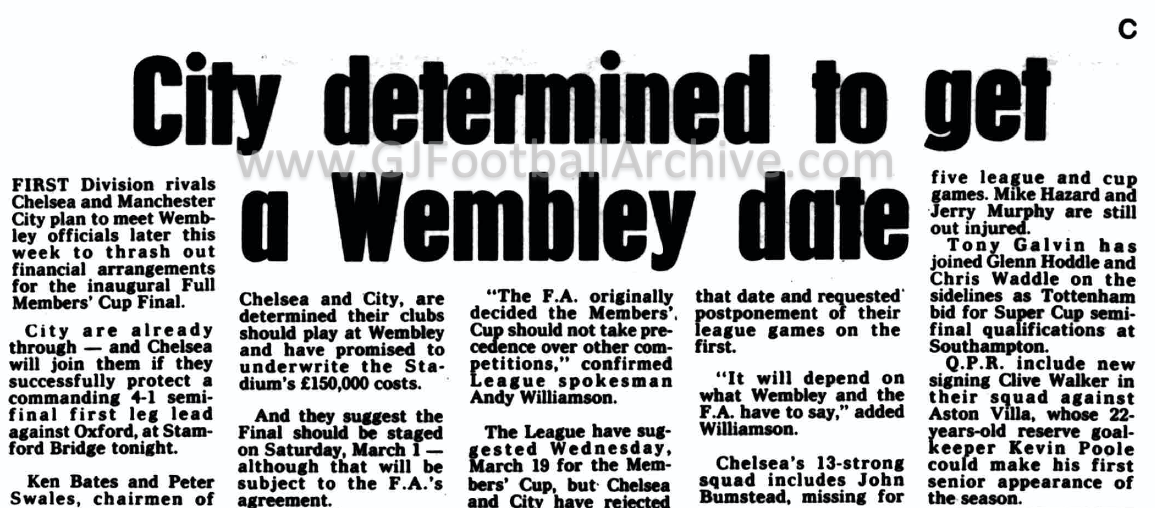
Today’s 1980s flashback is an on this day (17 December) from 1985 when newspapers carried the news that Full Members’ Cup finalists Manchester City and potential finalists Chelsea planned to meet to set a date for the competition’s final. These were strange days and I guess there are many younger fans who have no idea what the Full Members’ Cup was all about. Elsewhere on this site you can find material on it or you can read the article on this season below (see boxes on subscribing below).
The issue was that the competition needed a Wembley final to add some credibility to it and both City and Chelsea were determined this would take place at a weekend. The preferred date was 1 March 1986 but this required clubs to postpone fixtures as the article suggests. What was not realised on 17 December 1985 was that City’s opponents on 1 March would object. Why? Well, City’s opponents were Oxford and they were the team that Chelsea had to beat to reach the national final. Had Oxford won then it seems likely they would have had no objection to rearranging their League game with City, but once Chelsea beat them the chance of City getting their preferred date was never going to happen.
In the end the final was played on Sunday 23 March, the day after an Old Trafford Manchester derby!
The 1980s was a truly important decade in the history of Manchester City Football Club and you can find out more on this season by reading the following 2,500 word feature on 1985-86. Enjoy!
Subscribe to get access – Monthly
Read more of this content when you subscribe today. It costs £3 per month (cancel anytime) to access everything posted since 1 October 2022 or there’s a special annual rate below which gives greater access and works out much cheaper.
Read more of this content when you subscribe today. It costs £3 per month (above) or £20 a year (here) to access everything posted since the site was created in December 2020. This special rate works out about £1.67 a week and gives access to everything posted, including PDFs of 3 of my books.
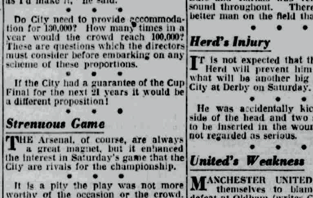
Day 57 of my posts counting down to the centenary of Maine Road’s opening game is a follow on from yesterday. It’s a cutting from the same newspaper, which was produced shortly after City and Arsenal had met at Maine Road in February 1935. It also follows on from some recent articles about stadium improvements. Here, the rumour was that City were planning to make Maine Road a 130,000 capacity venue.
February 1935 City v Arsenal Maine Road extension plans
Maine Road was only 12 years old but already it held a record individual crowd (84,569) for a game on a club ground that still stands today and it held the record League crowd (set at the game with Arsenal in February 1935). It had been expanded a little with the extension to the Platt Lane Corner (near the Main Stand and numbered 3 on the 1971 aerial photo lower down the page).
There was a development plan being developed which would see both the Platt Lane End and Scoreboard End have roofs added and be extended and then attention would turn to the Kippax where a double deck stand was suggested. By that time it was felt the stadium would hold 130,000. As it was the 1930s extensions meant it’s capacity was viewed as about 86,000.
The Platt Lane Stand (number 5 below) was built in 1935 (the old terracing was extended at the back on wooden steps and a roof was erected over the terracing) to the plan but World War Two meant the other plans were put on hold. They were eventually dropped and the next major development would be the Kippax roof and terracing extension in 1957.
Back in February 1935 the local media debated how often City would need a 100,000 capacity venue. The view was that, unless City could persuade the FA to move the FAC Final to Maine Road, then only one game a season would attract that kind of figure to the ground. With United in Division Two for much of the 1930s, and being watched by exceptionally low crowds, the game that most fans saw as the biggest meeting back then was the visit of Arsenal. How times change!
This 1971 aerial image shows the proximity of the housing on Thornton Road (bottom left, near number 6) and behind the North Stand (number 10). They were planned to be demolished in Lee’s 1994 plan.
Maine Road aerial 1971 from Farewell To Maine Road
If you’d like to read more on the history of Maine Road, take a look at Farewell To Maine Road, which can be downloaded from this page:
If you enjoy all the free material on my website and would like to support my research and keep this website going (but don’t want to subscribe) then why not make a one-time donation (or buy me a coffee). All support for my research is valued and welcome. It allows me to keep some free material available for all. Thanks.
Well, the first all-Manchester FA Cup final has been and gone but what a day? Before any major fixture you hope that it will live up to the hype and, as a historian, I always hope that something different than normal will occur, or a record will be broken.
I’m always keen on pointing out that history is made every day and that historians have to constantly re-evaluate what stories they are telling if they want to represent and record society as it changes. I am totally against those that think history is something that doesn’t move with the times and I always try to think about those who may be experiencing something for the first time. City’s 2023 FA Cup success could easily be the earliest footballing memory for some and what a memory it will be!
As I entered the stadium the entry gate and stairway I used had the usual years and landmark moments decorating its walls and I did notice the comment about the fastest goal in a FA Cup final (it claimed Di Matteo’s goal after 43 seconds was still the record, so that needed updating even before the game!). I didn’t expect any goal to occur in the first few minutes of the game, never mind the first few seconds. More on that in a moment.
The journey to Wembley was more difficult than normal, due to the rail strike and the fact so many were going down the same routes. The route I took, mostly M1, seemed busier than normal (normal – it’s ‘normal’ going to Wembley now!) but it was mostly City fans I saw. I’m sure others experienced something else but for me there were the occasional United vehicles. Most of the cars and coaches that I saw with colours showing (scarves out the window is an absolute must on days like these for many of us!) were blue not red. That reminded me a lot of the 2011 FA Cup semi final when every City car we saw was full of happy, laughing, smiling City fans pre-match but United fans seemed more serious or concerned with what the day would bring. The similarities between the two days were striking.
Traffic jams meant the journey was longer than anticipated but once we parked up in our usual spot (‘usual’, ‘normal’ – I hope that never changes) we were ready. A quick wander around was followed by buying the programme. I had two articles in this year’s FA Cup final programme – one on City & United’s first FA Cup successes in 1904 and 1909 and another was a peaks and troughs sort of timeline. Both pieces were neutral and I was delighted to be asked to contribute to the programme once more.
Inside the stadium the tickets we had bought were up at the back of level 5 block 546. Coincidentally just before kick off the people on the row behind us arrived and one was Ian Brightwell, one of the players when City defeated United in the only previous All-Manchester FA final (that was the 1986 FA Youth Cup).
As for the game. Well, what an opener! We’d not had chance to settle really when Gundogan netted that wonderful strike. I remember looking straight up to the video screen and seeing the clock change from 12 to 13 seconds. Incredible.
As Brightwell was behind me I couldn’t resist turning to him and saying ‘I see Gundogan “just wellied it!” like you did in 1990.’ For those that don’t remember or are too young Brightwell did a similar goal from several yards out in an Old Trafford derby in 1990. Afterwards while being interviewed he was asked about the goal but the interview kept being interrupted and so he had to answer the question multiple times. On the last occasion he simply answered: ‘I just wellied it!’ and the phrase entered City folklore.
There was the penalty given to United of course – I won’t go into the rights and wrongs of that but i do want to mention VAR. I find it absolutely ridiculous that those of us who have spent considerable time and effort in getting to Wembley and attending the final are the ones who knew least about what was going on. We had nothing on the screen to tell us a check was in progress; we had no opportunity to see the video clips and we only knew it was being reviewed when the ref stopped the game (after some time too! What if a player had been injured or another goal had been scored in the meantime?) and went over to the monitor.
The moment he headed towards the monitor we knew something was going to be given because I can’t think of a time when a ref has stuck to his guns in England (I’m sure it’s happened but I don’t remember).
The penalty changed the mood for a while, but City fans were in good voice when the second half started and it seemed inevitable then that the Blues would score again. I don’t think any of us expected Gundogan to be the man again but over these last few months he’s clearly led by example. He deserved the man of the final award and hopefully he’ll get further honours this season.
So the game ended 2-1 and City have achieved a coveted double again (last time was the only time an English club had won a domestic treble!). Brilliant work City and the season isn’t over yet!
It was wonderful to see the players celebrate. Those celebrations on the pitch demonstrated how much this all meant to them. People often try to suggest a domestic cup isn’t anything special but it absolutely is. How many of us have ever won a FA Cup? These players were outstanding and deserve tremendous praise, as does the manager of course.
People talk about money but City are not the biggest spenders either in actual outflow terms or in net spend terms. Like Alex Ferguson and United in the late 1980s/early 1990s, City have spent money on players to find success. Also, like United at that time trophy success brings additional income, gate receipts, prize money, sponsorship etc. which in turn can be used to invest in youth development and finding ways to sustain success. There’s no point going on about this but I do wish that people looked at the history of football and focused on fact rather than the fiction that often gets spouted.
On the way home there was a lot of talk on the radio about possible trebles and it was interesting that almost every phone-in I could find was trying to compare United’s 1999 treble with the possibility of City winning one this season. Who knows how Saturday will go and I won’t get drawn into that but I do want to say that United winning the treble was an incredible achievement. If City manage to do the same this year then that will also be an incredible achievement. So much has changed in 24 years that comparisons are ridiculous.
Actually, I did hear on the radio one presenter go on about how City have spent because ‘in 1999 when United were winning their treble they were getting promoted’ (paraphrased but basically that comment). Had I been able to call in I might have done because 24 years ago that is true but it is also true that 24 years before 1999 United were also getting promoted. It’s a similarity people have overlooked, but if somehow it is wrong for City to go from struggling team to potential treble winners in 24 years then surely it would also be wrong for United to do the same? Ah well! Facts not fiction.
When City got back to Manchester they were greeted by Elton John who, it has been said, waited to meet and congratulate them. The videos and photos are wonderful to watch. Noel Gallagher may have to watch out – usually he’s the one singing along with Pep and the players after a major trophy success.
While you are here why not have a look at the 100 day countdown I’m doing to mark the centenary of Maine Road’s first game? You can do a search on Maine Road or start by looking at this one:
On this day (30 May) in 1999 Manchester City won the Second Division Play Off final at Wembley in a tense, dramatic day. Understandably, Paul Dickov’s goal in that Play Off final has often been described as the most important Manchester City goal of all time. That goal does deserve significant recognition, however it is also important to remember the other contributing factors on that day all those years ago, including the opening City goal scored by Kevin Horlock.
The late 1990s had been a very difficult period for City and Horlock’s goal came at a moment when all hope that the Club could resurrect itself seemed to have vanished. This goal was obviously important as it gave City hope and ultimately that transferred into achievement.
The following article, covering Horlock’s goal and the story of that day, is available for subscribers to the website. It costs £20 a year (it works out £1.67 per month) and you get full access to all articles posted, including PDFs of the out of print Manchester A Football History and my first ever book about Manchester City. There are also audio interviews & more. Do a few searches on past content to see what’s available.
Subscribe to get access
Read more of this content when you subscribe today.
The FA Cup helped establish Manchester’s footballing identity – more on that in a minute. On this day in 1948 Manchester United appeared at Wembley for the first time to win the FA Cup. Manchester’s 1st FAC success came in 1904 (City). Before 1948 the Blues had appeared in 3 Wembley finals. Utd’s 1948 success meant 2 FA Cups each.
Today I’m focusing on Manchester emblems and, in particular, those used by Manchester City over the years. The club’s current badge has been worn on shirts for over six years after first being revealed at Christmas 2015 and worn from summer 2016, but its roots go back decades with City developing a round badge by the 1930s.
Here for subscribers is a 1500 word piece on the development of badges at City and United. Enjoy!
Subscribe to get access
Read more of this content when you subscribe today. It costs £20 a year (works out about £1.67 a month) and you get access to everything on the site and help future research into Manchester’s football history.
Paul Dickov’s goal in the 1999 Play Off final has often been described as the most important Manchester City goal of all time. That goal does deserve significant recognition, however it is also important to remember the other contributing factors on that day all those years ago, including the opening City goal scored by Kevin Horlock.
The late 1990s had been a very difficult period for City and Horlock’s goal came at a moment when all hope that the Club could resurrect itself seemed to have vanished. This goal was obviously important as it gave City hope and ultimately that transferred into achievement.
The idea of this ‘GOLDEN GOALS’ feature is to remember a significant or spectacular Manchester City goal from yesteryear. My hope is that supporters who were not around back then will learn more about these goals while those who were here will hopefully be reminded of them. If you would like to nominate a goal for possible use in a future feature then please comment at the end of this piece or email me with details of game, goal scorer and date.
This article, covering Horlock’s goal and the story of that day, is available for subscribers to the website. It costs £20 a year (it works out £1.67 per month) and you get full access to all articles posted, including PDFs of the out of print Manchester A Football History and my first ever book about Manchester City. There are also audio interviews & more. Do a few searches on past content to see what’s available.
Subscribe to get access
Read more of this content when you subscribe today.
In January this year the Newcastle Chronicle published a story that intrigued me. It talked of the history of fans wearing football scarves and suggested that a Newcastle fan in 1932 was the first to be photographed wearing a football scarf. The article explained that previously it had been claimed that an Arsenal supporter at a 1934 FA Cup tie had been the first filmed/photographed wearing a traditional bar scarf. This set me off looking into the history of football scarves and of fans showing their colours.
So, here for subscribers to my site is a 1400 word article on showing your colours, focusing on the stories associated with Manchester City…
Subscribe to get access
Read more of this content when you subscribe today. It only costs £20 a year and throughout your membership you get full access to everything published on the site, including the entire Manchester A Football History book and my first book From Maine Men To Banana Citizens to download. You can also sign up a month at a time for £3 per month. My commitment is to publish at least 4 new lengthy articles per month but in practice I’ve posted a lot more than that. Why not sign up for a month and give it a try?
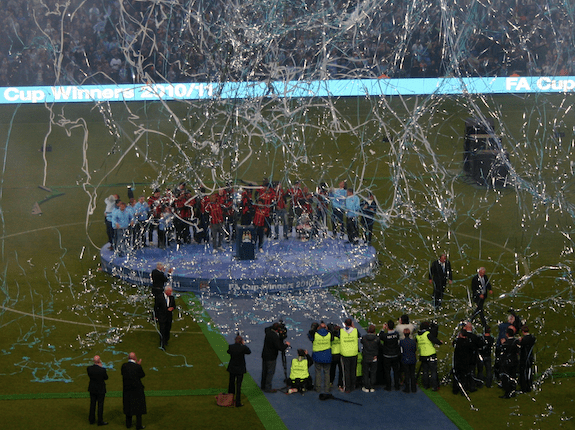
Had we all been allowed to attend matches last season I would have marked the tenth anniversary of Manchester City’s 2011 FA Cup success with a programme feature. Sadly, Covid prevented that and now, a year on, I want to commemorate the eleventh anniversary of that FA Cup success. How time flies!
There are so many angles to that first major success of the modern era for Manchester City and it is impossible to cover them all here. Elsewhere on this website I talk about the 2011 FA Cup run, especially that semi-final win over Manchester United. If you’ve not heard it have a listen to this:
This is a subscriber article. It costs £3 a month to subscribe OR take out an annual subscription at £20 (works out about £1.67 a month). All subscribers get full access to everything throughout their subscription.
Subscribe to get access
Read more of this content when you subscribe today.




 Gary James' Football Archive