Almost 46 years since their first ever meeting Manchester City and Real Madrid meet tomorrow (10 December 2025) in the Champions League. I doubt anyone in the media covering the game will mention the first meeting but if there is anyone interested it took place on 19 December in 1979. Back in 1979 the game was considered a prestigious friendly, or at least that’s what it was supposed to be, but it turned out to be a controversial game with implications for the Blues for some time. Here for subscribers is an 1800 word article with images of that game and the controversy surrounding it.
Subscribe to get access – Monthly
This article is available to subscribers to the website. It costs £3 per month (cancel anytime) or £20 a year (see below).
This article is available to subscribers to the website. Annual subscribers access everything on the site (books, articles, videos, history talks, interviews etc.) posted since it was created in December 2020. Monthly subscribers access everything since 1 October 2022. Both Monthly & Annual subscribers access all new content too throughout their subscription.
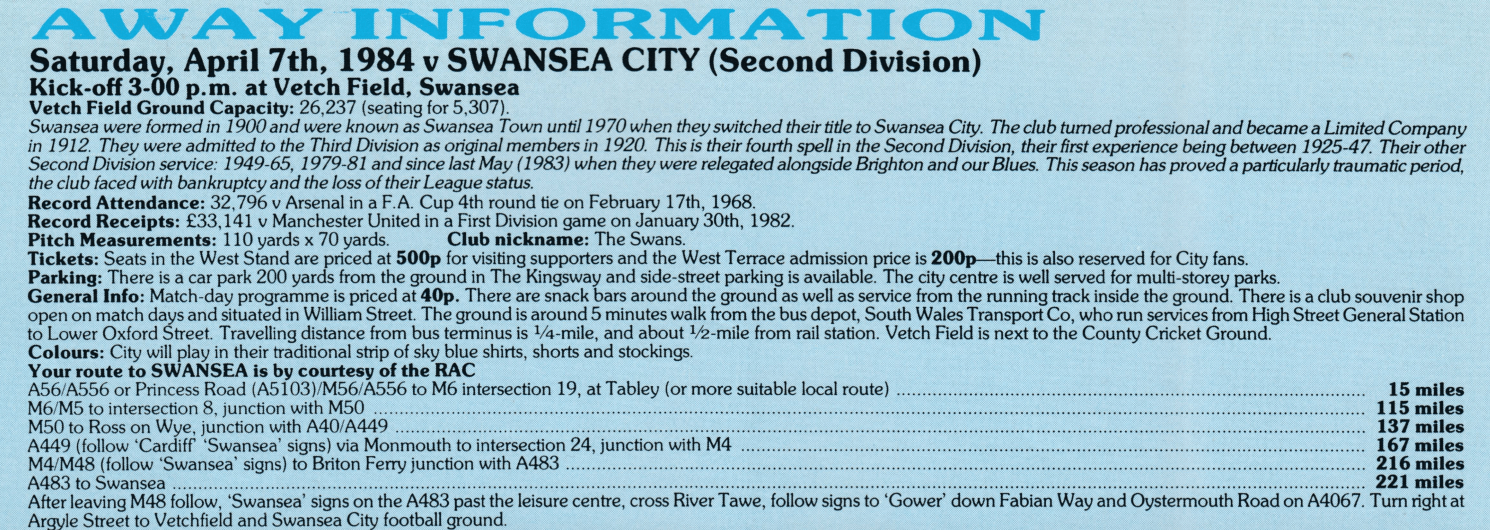
Here’s film from this day (7 April) in 1984 when Manchester City won away at Swansea. The score was 2-0 with goals from Steve Kinsey and Derek Parlane. Enjoy: https://www.youtube.com/watch?v=0R8xnhDgbIk
You can read more from this season in the following 2,500 article on the 1983-84. It’s called ‘Fish Supper’ because manager Billy McNeill said City were so skint at the time that they could hardly buy a fish supper! Sadly, the purchases were often funded out of the money City had received for their talented young defender Tommy Caton who joined Arsenal.
Subscribers can read a 2,500 word feature on the 1983-84 season below. Enjoy!
Subscribe to get access
Read more of this content when you subscribe today. It costs £3 per month (cancel anytime) or there’s a special annual rate of £20 below which gives access to everything posted since December 2020 and works out much cheaper.
New Manchester City manager John Bond’s first cup game was the fourth round tie against Second Division promotion hopefuls Notts County at Maine Road, played on 29 October in 1980 The game had the potential to end in defeat, especially as Bond would be unable to play any of his new signings (remember the struggles pre-Bond’s arrival earlier in the month and the impact he and his new arrivals Now, Hutchison and McDonald had?), nor would the expensive Steve Daley be able to play due to injury.
The match actually ended 5-1 to the Blues with Dave Bennett opening the scoring after 16 minutes. Dennis Tueart was in inspiring form that night scoring the other four City goals, but the result was prof that Bond’s whole approach had lifted the Club. Basically, Bond had taken Allison’s team and given them belief and confidence. Some of the younger players, like Bennett and Caton, may have been given their chance under Allison, but it was under Bond that they started to achieve their potential.
If you’d like to support my research then why not subscribe? Every subscription directly helps support my research and provides annual subscribers with access to everything posted on this site, including the entire Manchester A Football History and From Maine Men To Banana Citizens books, plus interviews, articles and more. I am not employed by anyone and all my research is self funded or comes from subscriptions to this site.
You can subscribe at either £20 per year (above) or at £3 per month here (cancel any time). For those subscribing £3 per month you will be able to access all content from October 2022 onwards for as long as you are a subscriber. Those subscribing £20 a year have access to everything posted since December 2020.
On this day (19 December) in 1979 Manchester City’s first meeting with Real Madrid occurred. Back then it was viewed as a prestigious friendly, or at least that’s what it was supposed to be, but it turned out to be a controversial game with implications for the Blues for some time. Here’s an 1800 word article with images of that game and the controversy surrounding it.
Subscribe to get access – Monthly
This article is available to subscribers to the website. It costs £3 per month (cancel anytime) or £20 a year (see below).
This article is available to subscribers to the website. Annual subscribers access everything on the site (books, articles, videos, history talks, interviews etc.) posted since it was created in December 2020. Monthly subscribers access everything since 1 October 2022. Both Monthly & Annual subscribers access all new content too throughout their subscription.
Continuing the series focusing on Manchester City in the 1980s here’s a brief reminder of Tommy Caton and a day (4 December) in 1982 when he scored twice to give City a 2-1 victory over his future club.
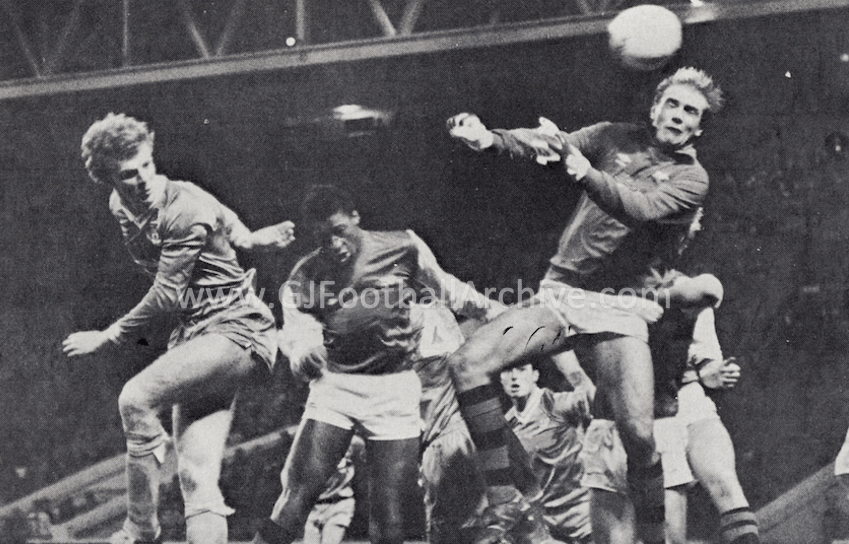
The photo shows central defender Caton sending a 52nd minute header past Arsenal ‘keeper George Wood, following an Asa Hartford corner. This gave City the lead at Maine Road but then five minutes from time the away team equalised. In the last minute another corner (this time from Paul Power) led to Caton leaping to send the ball home and give the Blues a 2-1 victory.
Two days later Caton was called up to the full England squad for a European Championship qualifier. Caton was a gifted defender who should have played regularly for England. Sadly, it was not to be.
If you want to know more about this period then why not subscribe? As well as all the other benefits you could read the following 3,500 word feature on the 1982-83 season. Enjoy (well, if you know the outcome of this season you can enjoy this memory refresh while reflecting on the modern day successes of the Blues!).
Subscribe to get access – Monthly
Read more of this content when you subscribe today. It costs £3 per month (cancel anytime) to access everything posted since 1 October 2022 or there’s a special annual rate below which gives greater access and works out much cheaper.
Read more of this content when you subscribe today. It costs £3 per month (above) or £20 a year (here) to access everything posted since the site was created in December 2020. This special rate works out about £1.67 a week and gives access to everything posted, including PDFs of 3 of my books.
A new daily series of articles for subscribers started last week covering the 1980s. This is a seasonal journey through a truly important decade in the history of Manchester City Football Club. Today’s article is a 2,500 word feature on the 1983-84 season. Enjoy!
Subscribe to get access – Monthly
Read more of this content when you subscribe today. It costs £3 per month (cancel anytime) to access everything posted since 1 October 2022 or there’s a special annual rate below which gives greater access and works out much cheaper.
Read more of this content when you subscribe today. It costs £3 per month (above) or £20 a year (here) to access everything posted since the site was created in December 2020. This special rate works out about £1.67 a week and gives access to everything posted, including PDFs of 3 of my books.
Here’s the fifth part of the 1995 interview I performed with former Norwich City, Manchester City and Burnley boss John Bond. In this section, exclusive to subscribers, Bond talks about the great players he had at City. Most notably he talks about Dennis Tueart, Kevin Reeves, Joe Corrigan, Paul Power and Tommy Caton.
He was extremely frank, open and honest – which delighted me because he was a great talker. It’s well worth listening to. At the time we did this I was researching my in-depth history of the club called Manchester The Greatest City (later updated as Manchester The City Years).
I met John at his home and spent a good few hours with him chatting about the Blues and his career. I loved doing this interview and was always grateful for the time he gave me. He was also happy for me to quote everything he said in the interview. I did end up quoting him extensively in the book (and in others I’ve produced) but, until now, none of the interview has ever been heard by the wider public.
Subscribe to get access
If you would like to listen to the fifth part of this frank interview (and the other parts) and read all the in-depth articles on this site (including the entire Manchester A Football History book) then please subscribe. It works out about £1.67 a month if you take out an annual subscription (£20 per year, here) or £3 a month (below) if you’d like to sign up for a month at a time. Annual subscribers gets full access to everything posted since December 2020.
If you would like to listen to the fifth part of this frank interview (and the other parts) and read all the in-depth articles on this site (including the entire Manchester A Football History book) then please subscribe. It works out about £1.67 a month if you take out an annual subscription (£20 per year, above) or £3 a month (here) if you’d like to sign up for a month at a time. Monthly subscribers gets full access to everything posted since 1 October 2022.
New Manchester City manager John Bond’s first cup game was the fourth round tie against Second Division promotion hopefuls Notts County at Maine Road, played on this day (29 October) in 1980 The game had the potential to end in defeat, especially as Bond would be unable to play any of his new signings (remember the struggles pre-Bond’s arrival earlier in the month and the impact he and his new arrivals Now, Hutchison and McDonald had?), nor would the expensive Steve Daley be able to play due to injury.
The match actually ended 5-1 to the Blues with Dave Bennett opening the scoring after 16 minutes. Dennis Tueart was in inspiring form that night scoring the other four City goals, but the result was prof that Bond’s whole approach had lifted the Club. Basically, Bond had taken Allison’s team and given them belief and confidence. Some of the younger players, like Bennett and Caton, may have been given their chance under Allison, but it was under Bond that they started to achieve their potential.
Subscribe to get access
If you’d like to support my research then why not subscribe? Every subscription directly helps support my research and provides annual subscribers with access to everything posted on this site, including the entire Manchester A Football History and From Maine Men To Banana Citizens books, plus interviews, articles and more. I am not employed by anyone and all my research is self funded or comes from subscriptions to this site.
You can subscribe at either £20 per year (above) or at £3 per month here (cancel any time). For those subscribing £3 per month you will be able to access all content from October 2022 onwards for as long as you are a subscriber. Those subscribing £20 a year have access to everything posted since December 2020.
It’s the 40th anniversary of the 1981 FA Cup final on May 9 and ten years ago, as we looked forward to Manchester City appearing in the 2011 FA Cup final, I was asked by the Manchester Evening News to write profiles of the eleven players who started the 1981 final.
For the next few days I will post those profiles, one a day, free to read here. These will only be free to view until May 16, so please read them while you can. Thanks.
Here’s the latest (appearing here as it was written in 2011)…
As we look forward to the 2011 FA Cup final, Gary James takes a look at the eleven players who made the starting line-up for City’s last FA Cup final in 1981. Today, centre-back Tommy Caton.
Together with Nicky Reid (aged 20), 18 year old Tommy Caton made history by forming the youngest pair of centre-backs ever seen in the FA Cup final when they played at Wembley in 1981. Despite their age both had been playing first team football for a couple of seasons with Caton managing 12 first team appearances before his 17th birthday.
Caton was actually the fourth ever youngest City player when he made his debut on the opening day of the 1979-80 season. The media and most supporters thought pre-match that this was one of Malcolm Allison’s more off-the-wall selections. In fact Allison had wanted to play the defender in the first team the previous season, but claimed he had been prevented from doing so by the school authorities because of Caton’s age.
All suggestions that the 16 year old’s debut was an Allison-gimmick were soon proved false. Caton helped City keep a clean sheet and his assured performance proved he thoroughly deserved the chance. The defender retained his place for the rest of the season and, together with Joe Corrigan, Caton was an ever-present in all competitions that season.
Shortly after his 17th birthday, Caton gave his view of his career to date: “I came to City in March 1978, signing on associate schoolboy forms and then started a full time apprenticeship in July, this year. It was a bit strange to say the least when I played in my first few games. I think the biggest tests have been against Arsenal, at Highbury, facing Stapleton and Sunderland. Plus the match against Forest when it was Woodcock and Birtles.”
He struggled with injury a little during 1980-81 – a chipped ankle bone caused him to miss a period of what became a crucial season – yet he recovered in time to play a major part in John Bond’s Wembley bound side.
Although the Daily Mail described Caton as “City’s inspiring young defender” in their match report of the cup final replay, the positive aspects of his contribution were soon overlooked as Ricky Villa’s goal became the media’s defining incident. On his way to goal the Spurs player passed the 18 year old Caton twice, as well as others, and the media proclaimed it as a truly great goal. City Manager John Bond was not impressed: “I bet if Keith Burkinshaw [Spurs] had been in my place he wouldn’t have said it was a good goal. He seemed to beat six or seven people in the space of four yards or so.”
It is worth recalling that Caton had an unusual claim to fame by becoming the first man to be booked twice in one final – he was booked in both the first game and the replay.
In March 1982 he created another record when he became the youngest player ever to appear in 100 League games for any club. He was also, by this point, regularly tipped to become a full England international, but City’s relegation in 1983 suggested Caton needed to move to progress his career.
In November 1983 he was sold to Arsenal after rumours that he stood little chance of playing for England while playing for a northern Second Division side. Worth noting though that the Blues desperately needed the £500,000 fee they received, and so he was encouraged to make that move.
Caton’s move south was not the success everybody hoped. After only 95 League and Cup appearances with the Gunners – a developing Tony Adams was challenging him – he became Oxford’s captain.
Early in 1993 he was forced to announce his retirement after a serious foot injury while playing for Charlton required repeated surgery. That April he died suddenly at the age of 30 of a heart-attack.
Of all the players who appeared in the 1981 final, Caton was the one expected to have the greatest footballing career ahead of him. Sadly, the potential was never really fulfilled. Caton should however always be remembered as a highly talented defender who, by the age of 17 was easily able to outperform some of the game’s biggest names.
Caton had enormous talent and ability, but ultimately so little time.
NOTE: Tommy Caton’s son Andy made 13 appearances for Swindon Town between 2004-2007 before damaging his skull in a car accident. A spell at Bath and Weymouth (in 2009) followed.
My biography of Peter Barnes is now available to subscribe to. Order by May 15 and you will receive a copy signed by me & Peter, the book posted to your home address before it appears in any shop AND your name printed in the book. Order (and more details) here:
First published in the build up to the 2011 FA Cup final, Gary James takes a look at the eleven players who made the starting line-up for City’s FA Cup final in 1981. Today, centre-back Tommy Caton.
Subscribe to get access
Read more of this content when you subscribe today.





 Gary James' Football Archive