Forty years ago today (22 March 1986) Manchester United hosted Manchester City in the 108th League derby between the teams. The fixture was the first of two high profile games for the Blues in consecutive days with the other game coming on Sunday at Wembley. See this story for news of that Wembley final:
Here for subscribers are the match stats, background, match report, film and other details from the 1986 Old Trafford derby:
Subscribe to get access
To access this please subscribe. It works out about £1.67 a month if you take out an annual subscription (£20 per year) or £3 a month if you’d like to sign up for a month at a time. Each subscriber gets full access to everything posted so far and those scheduled during your subscription.
This is something I wrote a few years back about Ian Brightwell. I hope you enjoy it… Of all the players to appear in City’s 1986 FA Youth Cup winning side, Ian Brightwell is the one who ended up having the longest playing career with the Blues. He remained at Maine Road until 1998. By that time he had played for a total of ten permanent managers and numerous caretakers in a 12 year first team career. It’s a wonder any player could cope with so much change.
He made his debut against Wimbledon on 23rd August 1986 (their first game in Division One), around four months after the Youth Cup success over Manchester United: “Billy McNeill gave me my debut in the opening game of the following season against Wimbledon. He told me a few days before that I’d be playing. He came up to me and told me, and I couldn’t believe it. I’d only just turned 18, but I had a few days to prepare. We won the game 3-1 and it helped me that Steve Redmond was already in the side. Of that Youth side Reddo was first in and then it was me, and I remember us watching to see who would be next. My second game was at Anfield and that was a great experience. We drew the game 0-0 but how we got away with that I’ll never know. We were battered.”
Brightwell made 12 League appearances plus four as substitute that season, but it was not a great time for the Blues as City were relegated at the end of the campaign. Billy McNeill had left early in the season: “I had great respect for him and was really disappointed when he left. He was a real legend – first man to lift the European Cup for a British side. Jimmy Frizzell took over, so that helped as it was more of a continuation. But for me it became the norm that managers would be changed. I don’t think Billy should have left when he did. I’ve still got great respect for him as a person and of course as a football manager. I’ll always be thankful to him.”
Under Mel Machin the following season Brightwell became an established member of the promotion seeking side before the arrival of Gary Megson limited his chances for a while: “It was a strange season because it was the first time as a group those of us from the youth side weren’t winning. I know we’d been relegated the previous season, but by 1987-88 a few of us were regulars in the first team. We were disappointed and felt we should have done better. I missed the 10-1 against Huddersfield, but I appeared in the 6-2 against Plymouth a few days later. Those games did bring a lot of attention our way, but I’d rather City be consistent. We weren’t good enough overall, but the following year that experience helped push us on. But it was difficult in 1988-89 as well. It’s a tough division to get out of.”
Promotion was achieved on the last day of the 1988-89 season in a nerve-wracking match at Bradford: “The pitch invasion followed. I was carried off on fans’ shoulders and had half my kit ripped off me. In the dressing room I remember thinking how close we’d been to missing out.”
The following season there was yet another managerial change and Howard Kendall was brought in. Under his guidance Brightwell was given an extended run in the team and, on 3rd February 1990, he scored his most memorable goal. It was a marvellous 25 yarder against Manchester United at Old Trafford: “I remember that the ball was out on the right and Mark Ward sort of half-crossed it. It came to me and I’ll never forget this – I heard Steve Redmond on the half way line shout: ‘Bob…’ I’d best not say his exact words, but let’s just say he wanted me to have a go in his strong scouse accent! It was on my left foot, which isn’t my strongest, but I did what Reddo said. It went in the top corner!
“I ran off and jumped about twenty feet in the air – or at least that’s how it looks on the photos. I remember the noise because back then the away fans used to get about 10,000 tickets at Old Trafford and it was phenomenal.”
Afterwards an excited Brightwell, when asked to explain how he’d scored, told the media: “I just wellied it!” It became the expression of the season and seemed to match everybody’s impression of a boyhood dream come true.
In the years that followed Brightwell performed consistently and was loyal to the City cause. Many of his former youth team colleagues were transferred or, in the case of Paul Lake, suffered serious injury, but Brightwell remained: “It was odd once the others went. They didn’t all go at once and of course Lakey was injured, but it did feel different. We’d known each other as a group for about 15 years, so a big loss. But my incentive was always to stay in spite of everything else. I actually think that if we’d have had continuity of management during that time that we’d have all stayed. If that had happened… well just look at United. They had a crop of talented youngsters about ten years after us like Butt, Scholes, Neville, and so on and they grew as a team. We never got that chance.”
There were some bright moments for the Blues in the early Nineties, however the second half of the decade saw City plummet through the divisions. In 1998, after relegation to the third level of football, Brightwell moved on: “It broke my heart to see City fall so low but I still didn’t want to leave. It was a difficult decision but Joe Royle had explained that the Club couldn’t offer me a contract at the level I was on. In the end I had to go and I moved to Coventry who were still in the Premier League, but my first impression was that this was such a small club in comparison with City. They may have been two divisions higher but in my mind there was no comparison.
“It didn’t work out at Coventry and I became injured. I kept going back to Manchester to watch City whenever I could.”
After Coventry Brightwell played for Walsall (including an emotional return trip to Maine Road), Stoke and Port Vale, before moving into coaching. In 2004 he was caretaker manager of Port Vale and, in 2006, he performed a similar role at Macclesfield. In 2007 he became Macclesfield’s manager on a permanent basis, but was dismissed in February 2008. He admitted in 2010 that Tony Book and Glyn Pardoe, who had been City’s youth coaches during the Eighties, remained influential figures throughout his career: “It’s difficult to stress how important Book and Pardoe and some of the others were. When I moved into coaching and, of course, management at Macclesfield, I used a lot of the things they said. They were so influential and if you think about where they got it from – well that was Malcolm Allison and Joe Mercer. You can’t get any better. Tony Book used to always say ‘control and play’. It sounds simple but in essence that’s what the game is all about and I still use that. Tony and Glyn used to drum it into you in the A team.”
To the wider world Ian Brightwell may not be the most well-known player from City’s 1986 FA Youth Cup winning team, but in terms of commitment to the Blue cause and longevity he was certainly one of the most dedicated. He was also a passionate Blue from childhood: “It was the team I supported and I used to go down to Maine Road. Colin Bell was nearing the end of his career when I went but there were people like Asa Hartford, Peter Barnes and Gary Owen. City were still a major side at that time. I remember the year we missed out on the title by a point to Liverpool (1977) – we should have done it. Tony Book was manager and the players were a different class. It was great to watch.”
During his career it was often highlighted that Brightwell came from a family with a great sporting pedigree. His brother David also played for City, while his parents were successful British Olympic athletes: “I couldn’t ask for a better sporting pedigree. My mum (Ann Brightwell nee Packer) won a gold and a silver in Tokyo and my dad (Robbie) won a silver.”
On this day (9 May) in 1987 Manchester City were relegated after a 2-0 defeat at West Ham (see match report). At the end of the game City supporters and West Ham fans climbed over the fences and onto the pitch. Some thought that the two sets of supporters were about to confront each other, but the fans knew differently. The Hammers began chanting “You’ll be back” and both groups swapped scarves and souvenirs on the pitch. It was the kind of moment that should have been widely reported in the media but at the time focus tended to be on hooliganism and confrontation rather than the positives of football support. City had been relegated, but their supporters did not seek revenge. The West Ham fans could have ridiculed, but they didn’t. If only those condemning football fans at the time could have seen the two sets of loyal supporters genuinely appreciating and understanding each other.
The relationship between the fans of the two clubs is not something that is widely discussed or promoted but it is something that has endured. City fans have never forgotten the ‘You’ll be back’ game and in recent years, as others have unfairly mocked both sets of fans, the supporters of both the Blues and the Hammers seem to understand and respect each other. Inevitably, there will always be banter during a game but outside of the match the mutual recognition and respect always seems to win through.
To many West Ham are the City of the South – a proud football club with a great history and heritage, combined with a loyal and passionate fanbase.
You can read more on Ian’s debut season of 1986-87 below. This is a 2,500 word feature on the entire season and is available to subscribers.
Subscribe to get access
Read more of this content when you subscribe today. It costs £3 per month (cancel anytime) to access everything posted since 1 October 2022 or £20 a year to access everything posted since the site was created in December 2020. This special rate works out about £1.67 a week and gives access to everything posted, including PDFs of 3 of my books.
The 1990-1 season was Sunderland’s first in the top flight since 1985, although it was far from successful. By the last match, on this day (11 May) in 1991, of the season the Wearsiders needed a win to avoid relegation, while Manchester City were enjoying their best League season since they finished 4th in 1978.
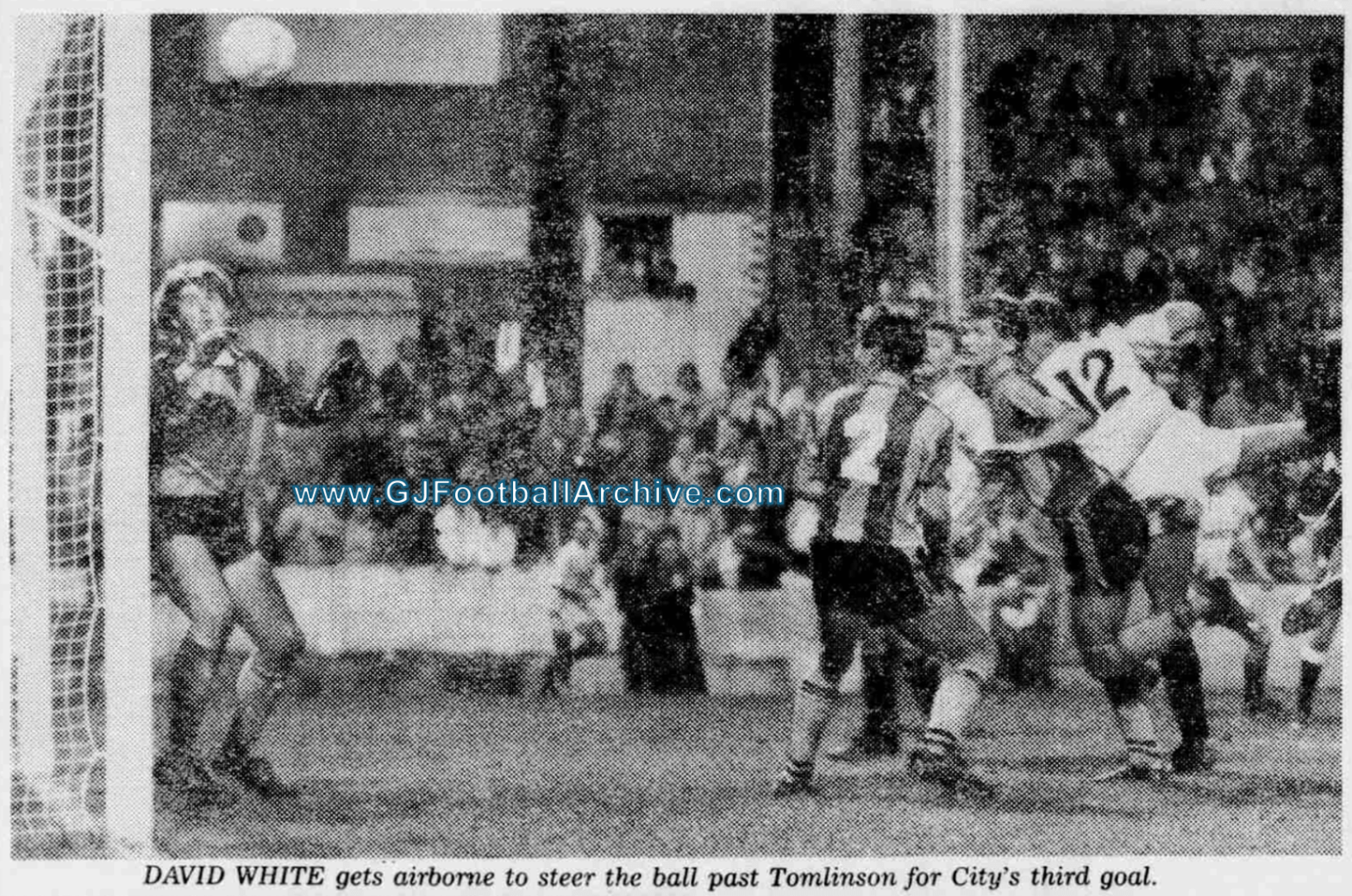
A large away following of around 9,000 filled the Kippax corner terracing and the Platt Lane Stand. In fact this was the last great crowd housed in the old Platt Lane Stand which was demolished a year later, after being designated for away fans only since the mid-80s. The result brought the Wearsiders nothing but disappointment as the Blues won 3-2 thanks to goals from future Sunderland star Niall Quinn (2) and David White.
Little did Quinn and City manager Peter Reid realise that within a few seasons they would be helping to resurrect the fortunes of Sunderland and its passionate supporters. Despite the result in 1991, Reid and Quinn must have been impressed by the positive support given by the Wearsiders.
City ended the season in fifth place behind Arsenal, Liverpool, Crystal Palace, and Leeds, while Quinn was voted City player of the year.
Attendance: 39,194 (the highest Maine Road crowd since 23/9/1989)
While you’re here why not subscribe and read a series of articles covering Manchester City in the 1990s (and other decades too)? Here’s an article on the 1990-91 season when a shock managerial departure could have disrupted the club but ultimately they finished 5th, 3 points ahead of Manchester United: (it’s a 2,700 word article available to subscribers):
Subscribe to get access – Monthly
Read more of this content when you subscribe today. It costs £3 per month (cancel anytime) to access everything posted since 1 October 2022 or there’s a special annual rate below which gives greater access and works out much cheaper.
Read more of this content when you subscribe today. It costs £3 per month (above) or £20 a year (here) to access everything posted since the site was created in December 2020. This special rate works out about £1.67 a week and gives access to everything posted, including PDFs of 3 of my books.
If you enjoy all the free material on my website and would like to support my research and keep this website going (but don’t want to subscribe) then why not make a one-time donation (or buy me a coffee). All support for my research is valued and welcome. It allows me to keep some free material available for all. Thanks.
Here are some highlights of the Manchester City-Nottingham Forest game played on this day (6 April) in 1991 when the Blues won 3-1 with goals from Mark Ward (penalty), Niall Quinn and Steve Redmond (photograph). Future Blue Stuart Pearce scored for Forest. Here’s the clip:
The 1990-91 season had included a shock managerial departure which could have disrupted the club but ultimately the Blues finished 5th, 3 points ahead of Manchester United. Here’s a 2,700 word article on that season:
Subscribe to get access – Monthly
Read more of this content when you subscribe today. It costs £3 per month (cancel anytime) to access everything posted since 1 October 2022 or there’s a special annual rate below which gives greater access and works out much cheaper.
Read more of this content when you subscribe today. It costs £3 per month (above) or £20 a year (here) to access everything posted since the site was created in December 2020. This special rate works out about £1.67 a week and gives access to everything posted, including PDFs of 3 of my books.
This series of articles and features will run throughout March with indepth articles some days and smaller ‘on this day’ style posts on others. There will be flashbacks to great games, players and more. Every day in March will offer something to enjoy.
Subscribers will get access to everything, while some on this day material will be free for all to view.
If you want to know more on this incredible decade for Manchester City Football Club then why not subscribe and read it all? If you’d like to know more about subscribing then see:
Steve Redmond signed professional forms for Manchester City on this day (26 November) in 1984. You can find several articles that mention Steve throughout this website. Start looking here:
On this day (21 October) in 1987 Manchester City’s incredible run of 34 league games away from home without a win finally came to an end with a 4-2 win at Bradford (the first of two consecutive significant results at Bradford for the Blues). Those of us there that night will never forget the feelings of finally winning away from home.
For months we’d been hoping for a win and our travelling support seemed to increase game after game as we waited for that victory. You just had to be there and, fortunately for me, I was there on this Wednesday night in October.
It was however a tense night… Subscribers can read the story below, along with contemporary match reports.
Subscribe to get access
Read more of this content when you subscribe today.
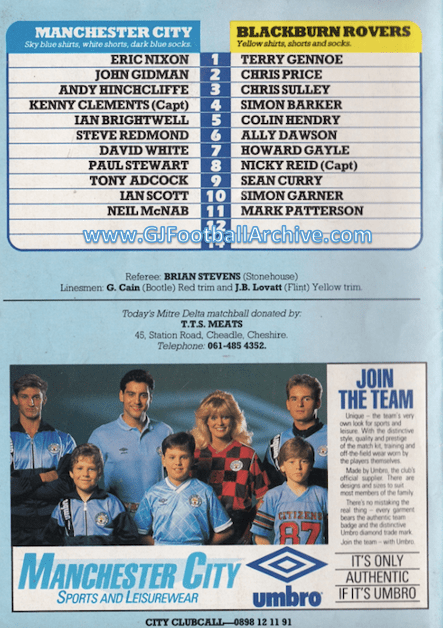
On this day in 1987 Manchester City faced Blackburn Rovers at Maine Road.
Here for subscribers is a flashback piece detailing what features were in the MCFC match programme that day and game information:
Subscribe to get access
Read more of this content when you subscribe today. It costs £3 per month or sign up for a year at the discount price of £20 per year. Why not subscribe for a month and see what you think?
On 27 May 1986 Billy McNeill’s Manchester City defeated Seattle Storm 1-0 as part of their post season North American tour. The City scorer was Mark Lillis and that season’s FA Youth Cup winners David White, Steve Redmond and Andy Hinchcliffe were in the starting 11. Other FA Youth Cup winners such as Ian Brightwell were also part of the official touring party. Here’s the starting 11 from my ledgers:
Here’s a team photo of Seattle Storm soccer team in 1987:
Subscribers can read more on 1985-86 in this 2,500 word feature below:
Subscribe to get access – Monthly
Read more of this content when you subscribe today. It costs £3 per month (cancel anytime) to access everything posted since 1 October 2022 or there’s a special annual rate below which gives greater access and works out much cheaper.
Read more of this content when you subscribe today. It costs £3 per month (above) or £20 a year (here) to access everything posted since the site was created in December 2020. This special rate works out about £1.67 a week and gives access to everything posted, including PDFs of 3 of my books.
The series of articles covering Manchester City in the 1990s continues with a game against reigning champions Arsenal on this day (10 March) in 1990. It was a match City should have won but there were a few jitters and a great deal of banter on the terraces too. It was all connected with that infamous Gary Crosby goal (3 March in 1990) which had caused City to lose 1-0 atNottingham Forest. You can read about that elsewhere on my website but have a read of this match report from the Arsenal game and you’ll see that it was still being referred to and still in the minds of all those connected with City. The Manchester Evening News headline above (mentioning ‘clanger’) wasn’t particularly helpful as it now gave fans the feeling that clangers had happened in consecutive games. That wasn’t fair on either Dibble or on Redmond.
Worth noting that David White scored for City and the Arsenal goal was scored by Brian Marwood, who has spent most of the last 15 years helping the modern day City find success.
For more on that season, have a read of this 1,300 word article on the end of the 1989-90 season. It is available to subscribers below. Enjoy!
Subscribe to get access – Monthly
Read more of this content when you subscribe today. It costs £3 per month (cancel anytime) to access everything posted since 1 October 2022 or there’s a special annual rate below which gives greater access and works out much cheaper.
Read more of this content when you subscribe today. It costs £3 per month (above) or £20 a year (here) to access everything posted since the site was created in December 2020. This special rate works out about £1.67 a week and gives access to everything posted, including PDFs of 3 of my books.
The series of articles covering Manchester City in the 1990s continues today with the 1992-93 season when the Premier League was born. Here’s a 3,200 word article on that season:
Subscribe to get access – Monthly
Read more of this content when you subscribe today. It costs £3 per month (cancel anytime) to access everything posted since 1 October 2022 or there’s a special annual rate below which gives greater access and works out much cheaper.
Read more of this content when you subscribe today. It costs £3 per month (above) or £20 a year (here) to access everything posted since the site was created in December 2020. This special rate works out about £1.67 a week and gives access to everything posted, including PDFs of 3 of my books.
This series of articles and features will run throughout March with indepth articles some days and smaller ‘on this day’ style posts on others. There will be flashbacks to great games, players and more. Every day in March will offer something to enjoy.
Subscribers will get access to everything, while some on this day material will be free for all to view.
If you want to know more on this incredible decade for Manchester City Football Club then why not subscribe and read it all? If you’d like to know more about subscribing then see:





 Gary James' Football Archive