One of the earliest stars of League Football died this month (12th June) in 1902. Jimmy Ross, who was a major figure for almost three seasons with Manchester City and had competed in every season of League football since the League was established in 1888, died with an illness described as “an acute skin disease and a raging fever.”
At the time of his death Ross was a Manchester City player. His last first team appearance was appropriately against Preston North End in the First Round of the F.A. Cup in January 1902.
City helped his mother, whom he was looking after at the time of his death, financially. They also arranged the funeral and he was buried at Southern Cemetery (according to newspaper reports of the time he was buried in a grave that contained another City player – Bride – who had died a couple of years earlier). Several City players/personalities carried the coffin, including Billy Meredith.
I’ve left it a few days to let it all sink in but ‘wow!’ What an achievement for Manchester City! Never in the near 140 years of League football has any club achieved such a remarkable feat of four successive titles. This record, like the domestic treble, will last for an eternity with future generations aware of how brilliant these players and this manager was.
So for today’s piece I thought I’d look back at the successive titles record and see how that has developed. This demonstrates what a truly remarkable achievement this has been, but it also adds to the debate about whether teams have dominated particular eras or not. We’re often told that City’s era of dominance is new and no team has ever done this before – well no team has ever won 4 consecutive titles that’s for certain – but we’re also told that other clubs, Liverpool, Arsenal and United for example, have had greater periods of dominance (though that’s acceptable and City’s is not – that’s odd in itself!). It seems your view depends on which team you support. For neutrals and those prepared to explore the facts, the following can help with all of this assessment.
Record 2 in a row progression
Preston won the first two League titles in 1888-89 and 1889-90 (and were runners up in the three seasons that followed).
Sunderland equalled the record in 1891-92 and 1892-93 (and were runners up in 1893-94 6 points behind Villa) before winning it again in 1894-95
Aston Villa matched the 2-in-a-row twice in 1895-96 & 1896-97 and 1898-99 & 1899-1900. They actually won 5 out of 7.
Wednesday were next winning 2-in-a-row 1902-03 & 1903-04 (pipping FA Cup winners City to the title).
Liverpool were next with successes in 1921-22 & 1922-23
After Liverpool’s 2-in-a-row came a new record:
Record 3 in a row progression
Huddersfield Town were the first to win three successive title. Their successes came between 1923 and 1926 BUT they also were runners-up in 1926-27 & 1927-28 (missing it by 2 points).
Arsenal achieved the feat of 3-in-a-row between 1932 and 1935. The gunners had won the title in 1931 and were runners up in 1932 (missing it by only 2 points – 1 win), so came close to five.
Liverpool matched the 3-in-row between 1981 and 1984 but they’d come close to 5-in-a-row between 1975 and 1980 when they won the League in 1976, 1977, 1979 and 1980 and were second in 1978. In total Liverpool won 7 out of 9 between 1975 and 1983 (8 out of 11 too).
Manchester United were the next to achieve 3-in-a-row between 1998 and 2001. They had also won 7 out of 9 (1992 to 2001) and 8 out of 11. The years they managed 7 out of 9 saw them finish as runners up in the other two seasons, missing it by only 1 point in both 1994-95 and 1997-98. Rightly, this was heralded as a remarkable achievement.
Manchester United matched their own 3-in-a-row with another between 2006 and 2009. They also finished as either champions or runners up in the following four seasons. This meant that between 1992 and 2009 United had won 11 out of 17 titles and finished second in a further three.
Record 4 in a row setting
Manchester City are the only team to win 4-in-a-row English League titles. This remarkable feat has been achieved with title successes in 2020-21, 2021-22, 2022-23 and 2023-24. City also won consecutive League titles in 2018 and 2019 and were runners up in 2020. This means City have won 6 out of 7 Premier Leagues.
There have been a lot of people out there claiming that this year’s League title was a ‘foregone conclusion’ and that it was ‘boring’. As I pointed out last week that all depends on whether things become boring once your own team are unable to challenge, but for many neutrals it’s about title races going to the final day or ones that are close.
Did you know that only 10 of the Premier League’s 32 seasons have finished with 3 points or less separating the top two teams? In exactly 50% of those seasons Manchester City were the champions – more than any other club! Also, if you’re the kind of person who believes City are the ‘only’ team to challenge and that it’s a foregone conclusion then it may surprise you to learn that 62.5% of ALL City’s Premier League titles have been won by 2 points or less! That’s not even a victory – how close do you want it? How much less of a foregone conclusion works for you?
As a comparison only 15% of Manchester United’s Premier League titles have been won by 3 points or less! I know Liverpool have only won one title since the Premier League was created (yes, and many, many more before that of course!) which means that 100% of LFC’s Premier Leagues have been won by 18 points (that was a foregone conclusion and boring if we believe that the earlier the competition is won the more boring it is!).
If you enjoy all the free material on my website and would like to support my research and keep this website going (but don’t want to subscribe) then why not make a one-time donation (or buy me a coffee). All support for my research is valued and welcome. It allows me to keep some free material available for all. Thanks.
On this day (17 April) in 1888 the first meeting of the Football League was held in Manchester. The following report names the clubs accepted and the others who wanted to join the League. It has often been written in Manchester United related books that Newton Heath applied to join the League in 1888 but didn’t receive enough votes to be accepted. That is completely untrue as no one actually had to apply nor was a vote taken. Clubs were asked and some tried to push to get included but Newton Heath were neither asked nor were they pushing for acceptance either. Nor were Ardwick or Manchester Asoociation who, to be frank would’ve been the most famous Manchester club at this time.
Bolton Wanderers were the only team from present day Greater Manchester to be asked/selected for the first League season.
Manchester Courier, 18 April 1888
The plaque is positioned on the corner of Mosley Street and Market Street/Piccadilly in Manchester.
I’m delighted to say that my latest biographical piece for the Oxford Dictionary of National Biography has been published. It’s on the life of Tommy Docherty, the former Preston & Scotland footballer and manager with a whole host of clubs including Manchester United of course. Details of all the people featured by the dictionary this year can be viewed here:
I’ve written several articles for the dictionary in recent years, including biographical pieces on footballers Jimmy Armfield, Ray Wilkins and Frank Swift. It’s a prestigious publication, recording the achievements of the nation’s most important figures. Anyone included within the book has achieved something remarkable, or perceived as an iconic figure in some way.
Hopefully, in the future I’ll be able to contribute biographical pieces on other important figures. Various panels decide who is to be included but I would be interested to know who you think should be covered in future editions. The important aspect to remember is that these figures must now be deceased and have contributed something remarkable or iconic. Those who died in 2021 or the years that have followed will be eligible to be considered for future editions. Sadly, I won’t decide but I have previously been asked my thoughts and have provided names.
This Saturday just gone (24 February 2024) I was down in Cardiff watching the Tri-Nations Cup (a women’s international walking football tournament). The England over 55s team was captained by former Manchester Corinthian and Manchester City player Lesley Wright. Ultimately, England were successful in a tournament involving Wales and Ireland.
It was great to see England (EWFC over 55s pictured above; photo from @Eilis1979) find success, led by a former Corinthian, in a sport that promotes health, exercise and activities. Another Corinthian, Gail Redston, also played for England and it was wonderful to see the Corinthian influence still there in trophy winning teams.
There were players appearing in the tournament who had played for leading clubs across Great Britain and Ireland. This included Mac Barlow, who netted most of England’s goals. Mac’s previous eleven-a-side clubs included Preston.
The whole tournament was a positive example of walking football and supporters came from across the UK too. There was even a group of Crystal Palace season ticket holders who had sacrificed watching their Premier League match to support England.
Lesley Wright and Gail Redston both feature in my new book on Manchester Corinthians. Details here:
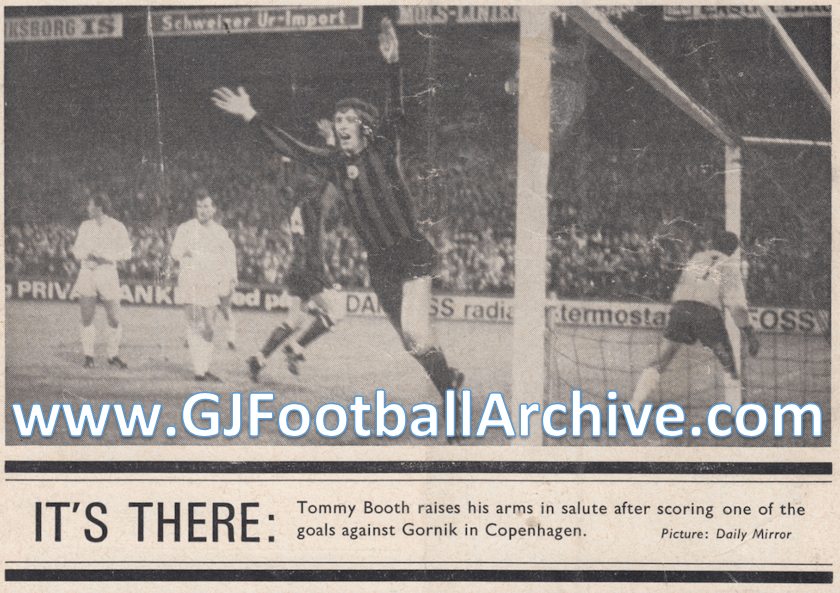
On this day (4 October) in 1981 Longserving Manchester City defender Tommy Booth moved to Preston North End. Tommy had made his City debut against Huddersfield Town (a) on 2 September 1968 in the League Cup with his League debut coming against Arsenal (h) on 9 October 1968. Joe Mercer once described the former Middleton Boys player as the ‘best footballing centre-half since Stan Cullis’ and Joe would know.
The image is of Tommy Booth scoring V Gornik in Copenhagen in 1971.
Driving back from Wembley last Saturday both Talksport and BBC Radio 5 Live had phone-in shows where the question kept being brought up about comparing Manchester United’s treble in 1999 with the possibility of City managing the same achievement this year. Obviously, a football game can go any direction and no success is guaranteed ever, so I am absolutely not going to talk as if something has been achieved when it hasn’t. If City do manage this incredible feat then the comparisons are likely to be made again BUT how sensible is this?
I am against making these comparisons because I think they’re futile. A bit like when I asked former City player Johnny Williamson, who had played with both Frank Swift and Bert Trautmann, which was best. He said: ‘It doesn’t matter. You pick one and I’ll pick the other because the two of them were head and shoulders above the rest!’
United’s treble in 1999 was absolutely incredible and a major achievement. If City manage the same this weekend then that will also be incredible and a major achievement. Which is best doesn’t matter and even if it did can we really do an accurate comparison? 24 years is a long time in football and the game changes so much in that time.
Much has been made about where City were in 1999 (winning promotion from ‘new’ Division Two) when United won their treble. People have said: ‘How can a team go from promotion challengers to potential treble winners in 24 years?’ Well, guess where United were 24 years before their treble…. they were promotion challengers in ‘old’ Division Two!
Martin Buchan and Alex Stepney celebrating United’s promotion in 1975 at Old Trafford
In the years that followed United’s promotion in 1975 they had a few peaks and troughs as City have. It wasn’t until 1993 (18 years after promotion) that they won the League for the first time since the 1960s but they had won the FA Cup 2 years after promotion. It took City only 13 years after their 1999 promotion to win the League but the FA Cup came in 2011 (12 years after the 1999 promotion). Both clubs spent a lot of money to find those first successes with City receiving Abu Dhabi investment and United borrowing heavily (the increasing level of debt was frequently raised by shareholders back then who questioned whether the club could sustain making purchases like they had to create the most expensive British team ever up to that point) to fund Ferguson’s first successful team.
Comparisons would need to look into every aspect of both clubs – for example Pep’s team are the only team to win a domestic treble as well, so does that elevate their current achievements? Similarly, Ferguson led United to a period of sustained success and dominance that no one else has matched so far. Comparisons are really fairly pointless.
To United fans their treble will always be the best and to City fans, if the club is lucky enough to achieve the same, that will be the best. For most neutrals it will be ‘so what?’, although they’ll downplay any success by a rival. I remember in 1999 someone phoning in a BBC radio show after United had won the Champions League for the second time. The caller was a Nottingham Forest fan who had got fed up with all the praise being heaped on United and, like many United fans today about City, he felt his club was more worthy. He said something like: ‘You keep going on about this United team but what have they done? They’ve just matched what Forest and Brian Clough achieved years ago. We’ve had two European Cups for years and our team was better and cheaper than this lot!’
It’s all a game to fill programmes and articles. It’s not needed. If you think about it 24 years is an extremely long time. If both Manchester clubs can go from promotion chasing teams to European finals in those years then that’s some journey. You have to be well into your 30s to stand a chance of being able to compare 1999 and 2023 and for anyone under that age it’s ancient history and another ‘so what?’.
When United won the treble in 1999 I was an adult with two kids and was just in my 30s. I’d written four major books on Manchester football (including the Pride of Manchester on Manchester derby matches) by this time and had researched the history of both clubs in-depth, so I did get interviewed a lot by TV and radio. I was perceived as an expert, but if you’d have asked me to compare United’s 1975 promotion team with City’s 1999 promotion team I would’ve had to admit I was too young to appreciate what United’s 1975 achievement was like. I’d be able to quote journalists and interviewees but I couldn’t give an honest view which group of players was better. It’s the same now, yet we’ve a whole range of people offering views who are either invested in one club or who are too young to be able to talk with knowledge about it. In any case football in 2023 is somewhat different to football in 1999 – just as that was so different from 1975 and that so different from 1951.
Paul Dickov at Wembley 1999
Maybe we should have filled phone-ins after City had won the double on Saturday with questions like: ‘How does City’s League and Cup double compare with past doubles? Was this City team better than Preston in 1889?’ It’s ludicrous to even try.
On this day (28 March) in 1964 legendary Bert Trautmann played his last competitive first team game for Manchester City. At the time he was the Blues’ record appearance holder with a total of 545 first team appearances. Sadly his final game ended in a 2-0 League defeat at Preston and the great man was beaten with a penalty scored by former Manchester United forward Alex Dawson. Brian Godfrey was the last player to score against Trautmann while he was a City first team player.
Interestingly the Guardian match report of the game mentions Trautmann a couple of times. Once when he accidentally kicked an opposition player and the other time it said that ‘Trautmann wears well and delighted the crowd with several fine saves.’ The Preston fans must have given him the kind of respect he deserved.
After a glittering career with Preston, Everton and Liverpool, striker David Johnson joined Manchester City on this day (21 March) in 1984. Johnson scored on his City debut – an 83rd minute equaliser v Cardiff in a game the Blues went on to win 2-1 (Image is of that goal). Unfortunately, despite a reputation as a lethal striker – and hard evidence of achievement – Johnson’s time at Maine Road was not particularly successful. After one goal in four (plus two as substitute) games Johnson moved to play soccer in North America in May 1984.
Johnson died in November 2022 and the following piece was written by Samuel Meade and published in the Mirror:
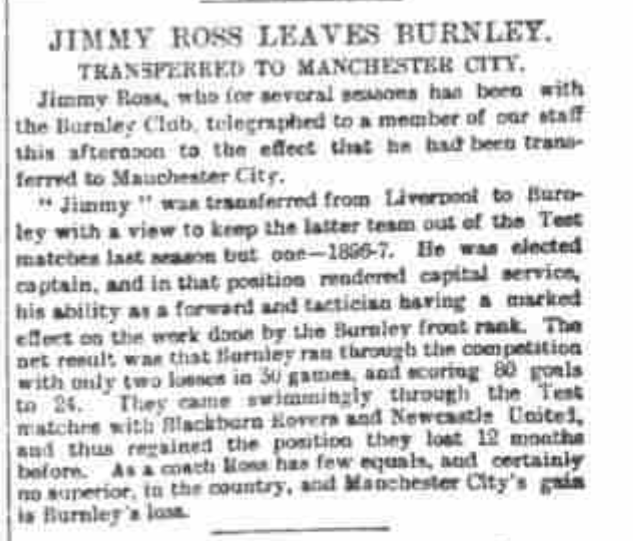
On this day (24 February) in 1899 the great Jimmy Ross signed for Manchester City. Ross was one of football’s leading names and earliest heroes when he played for the famous Preston side that won the League and Cup double of 1889. He had scored an incredible eight goals when Preston beat Hyde 26-0 in the record breaking F.A. Cup tie of 15th October 1887 – a game in which the referee is reputed to have lost his watch and allowed play to last two hours! (you can read about that game here: https://gjfootballarchive.com/2021/02/22/hyde-v-preston-a-record-breaking-day/ ).
In addition, he was the Football League’s top scorer in 1890 (24 goals), and was quite a character.
He signed for Manchester City from Burnley for a reported £50 after previously captaining Liverpool to promotion. He had also played for the Football League.
At City he was influential from the start. He netted an incredible seven goals in the final nine games of the 1898-99 season (his first nine games at City too!) brought the Division Two title for the first time – this was the first national success of either of Manchester’s professional clubs.
Years later the legendary Billy Meredith, looking back on his City days, remembered Ross with great affection: “I must confess that Ross will always be my favourite hero. He was good at everything he put his hand to and what he didn’t know about football wasn’t worth knowing. At billiards and card games he was an expert. Though he must have been thirty-four at least when he joined us, he was able to win seventy yards handicaps with ease and did so. He could talk like a lawyer and on and off the pitch his comic sayings had us in stitches.”
Today many of the heroes of football’s earliest years as a professional sport are forgotten and in Manchester’s case people often talk about Meredith as if he was the first and only hero in the city. But Jimmy Ross was a major figure and he was absolutely essential in City’s early development. Without him they may not have achieved that first Second Division title success. He helped develop Meredith into a star and should never be forgotten.
The leading sports newspaper of the day, the Athletic News, often praised Ross. When the club was making its first steps in the top flight the newspaper talked of City’s right sided players and stressed the importance of Ross and of course Meredith: “For real brilliance the right wing took the biscuit….In fact, there are few, if any, better men at outside right (Meredith). His partner, the veteran Ross, of whom it is predicted every season that he has had his day, is in reality taking a second lease of footballing life, despite the paucity of head-covering, and as a wing the two will cause some trouble”.
At one point a newspaper article claimed that Meredith was absolutely brilliant when he was being well served by Ross but when the going got tough, Meredith disappeared. It seems that at this stage in the Welshman’s career he needed the experienced Jimmy Ross more than Ross needed him. One article claimed that Meredith: “doesn’t like donkey-work and if his partner is off, Meredith is off too.”
By the end of the 1901-02 season it looked as if Ross and Meredith, despite Ross’ age, would go on forever. Sadly, tragedy struck in 1902. Ross died on 12th June that year after an illness described as “an acute skin disease and a raging fever.”
Ross’ last appearance was appropriately against Preston North End in the First Round of the F.A. Cup in January 1902. Ross died of an infectious skin condition. City helped his mother, whom he was looking after at the time of his death, financially. They also arranged the funeral.
Ross helped Meredith develop and over time the legend of Meredith grew, while Ross’ name has slowly faded. This is a major shame as Ross’ influence on Preston, Liverpool and City’s development is immense. Ross helped City establish their name at a time when Meredith was not quite the finished article. So many players have been described as legends in the decades that have followed. Many of them become forgotten over time, but it is important that once in a while we pause and remember those players.
Today let’s think about Jimmy Ross and remember him as one of the men who made Manchester City.
Why not now read about the game when Ross played for Preston against Hyde? It already appears on my blog here:





 Gary James' Football Archive