Today (26 October) is the anniversary of the first ever Manchester Derby shown live on television. The game was the 109th League derby between the teams and ended in a 1-1 draw (Frank Stapleton for United; Mick McCarthy for City). Subscribers can read a feature on the game, including a match report and background, below:
Subscribe to get access – Monthly
Read more of this content when you subscribe today. It costs £3 per month (cancel anytime) or there’s a special £20 Annual subscription (see below).
Read more of this content when you subscribe today. It costs £20 per year (works £1.67) or £3 per month (above). Annual subscribers get access to everything posted since the site started in December 2020, including the entire contents of 3 books and well over 1000 articles/interviews/features. Do a search to see what’s on the site or sign up for a month to see the benefits.
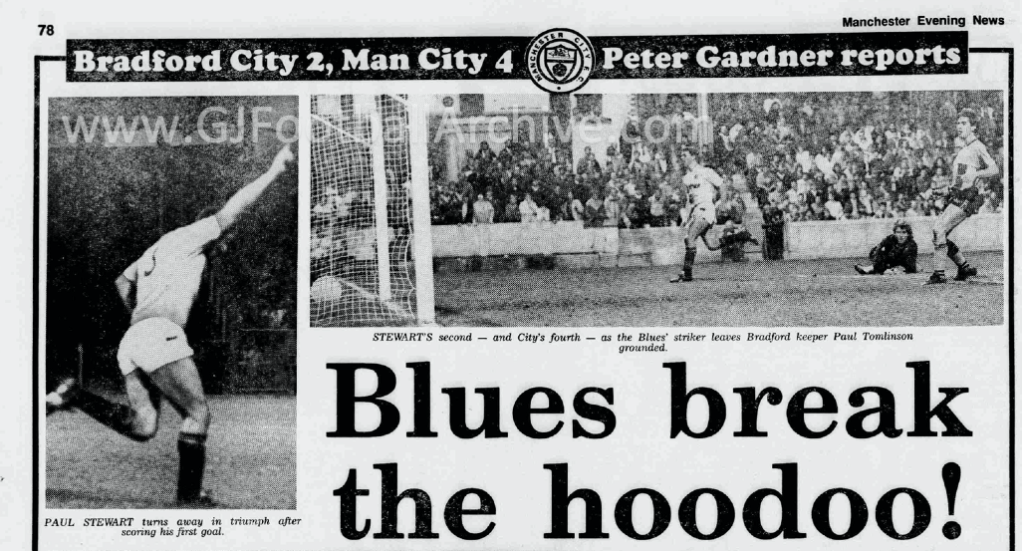
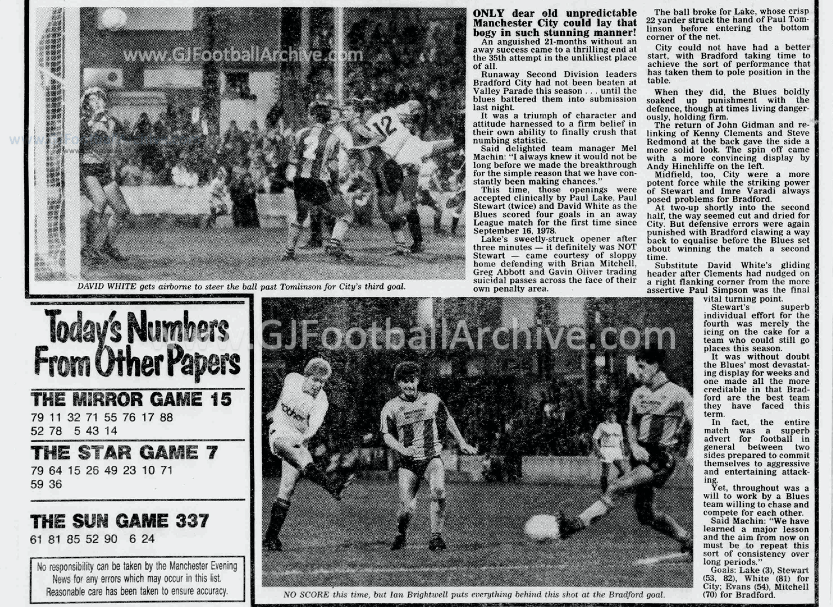
But City did not lose on this day (21 October) in 1987! Why was this remarkable? It was the first time Manchester City had won away from home in over a year. In fact the Blues had gone 34 away League games without victory.
I remember it well and was at Bradford that night when City won 4-2. At the time the buzz amongst those of us who travelled away was ‘will today be the day’ and it got that way that you felt you couldn’t miss an away game. I’m convinced numbers going to away games increased game after game as we were keen to be there on the day we finally found a win.
Throughout this long, long run without an away win the song ‘We never win at home and we never win away…’ seemed to become our anthem. It belted out game after game and, in some ways, was our release from the disappointment of another defeat or draw. The song had begun in the late 1970s (I’ve done quite a bit of research on this and should write it all up one day) but it was the 1980s, in particular the relegation season of 1986-87, when it became a regular chant, game after game. Usually reserved for when City conceded or were losing it was given more opportunities to be sung during that period than ever before.
It faded during the late 1980s and early 1990s, especially when City finished fifth two seasons running, but reappeared later in the 90s when Alan Ball’s management (and everything that followed) brought misery City’s way.
We all got a bit nervy against Bradford, especially when our 2 goal lead disappeared, but we won 4-2 and you can see how giddy those of us behind the nets were in these highlights of the goals. We were stood behind the goals to the right of the camera (the commentator makes a couple of errors but the film should give you a feel for the night):
Well, the first all-Manchester FA Cup final has been and gone but what a day? Before any major fixture you hope that it will live up to the hype and, as a historian, I always hope that something different than normal will occur, or a record will be broken.
I’m always keen on pointing out that history is made every day and that historians have to constantly re-evaluate what stories they are telling if they want to represent and record society as it changes. I am totally against those that think history is something that doesn’t move with the times and I always try to think about those who may be experiencing something for the first time. City’s 2023 FA Cup success could easily be the earliest footballing memory for some and what a memory it will be!
As I entered the stadium the entry gate and stairway I used had the usual years and landmark moments decorating its walls and I did notice the comment about the fastest goal in a FA Cup final (it claimed Di Matteo’s goal after 43 seconds was still the record, so that needed updating even before the game!). I didn’t expect any goal to occur in the first few minutes of the game, never mind the first few seconds. More on that in a moment.
The journey to Wembley was more difficult than normal, due to the rail strike and the fact so many were going down the same routes. The route I took, mostly M1, seemed busier than normal (normal – it’s ‘normal’ going to Wembley now!) but it was mostly City fans I saw. I’m sure others experienced something else but for me there were the occasional United vehicles. Most of the cars and coaches that I saw with colours showing (scarves out the window is an absolute must on days like these for many of us!) were blue not red. That reminded me a lot of the 2011 FA Cup semi final when every City car we saw was full of happy, laughing, smiling City fans pre-match but United fans seemed more serious or concerned with what the day would bring. The similarities between the two days were striking.
Traffic jams meant the journey was longer than anticipated but once we parked up in our usual spot (‘usual’, ‘normal’ – I hope that never changes) we were ready. A quick wander around was followed by buying the programme. I had two articles in this year’s FA Cup final programme – one on City & United’s first FA Cup successes in 1904 and 1909 and another was a peaks and troughs sort of timeline. Both pieces were neutral and I was delighted to be asked to contribute to the programme once more.
Inside the stadium the tickets we had bought were up at the back of level 5 block 546. Coincidentally just before kick off the people on the row behind us arrived and one was Ian Brightwell, one of the players when City defeated United in the only previous All-Manchester FA final (that was the 1986 FA Youth Cup).
As for the game. Well, what an opener! We’d not had chance to settle really when Gundogan netted that wonderful strike. I remember looking straight up to the video screen and seeing the clock change from 12 to 13 seconds. Incredible.
As Brightwell was behind me I couldn’t resist turning to him and saying ‘I see Gundogan “just wellied it!” like you did in 1990.’ For those that don’t remember or are too young Brightwell did a similar goal from several yards out in an Old Trafford derby in 1990. Afterwards while being interviewed he was asked about the goal but the interview kept being interrupted and so he had to answer the question multiple times. On the last occasion he simply answered: ‘I just wellied it!’ and the phrase entered City folklore.
There was the penalty given to United of course – I won’t go into the rights and wrongs of that but i do want to mention VAR. I find it absolutely ridiculous that those of us who have spent considerable time and effort in getting to Wembley and attending the final are the ones who knew least about what was going on. We had nothing on the screen to tell us a check was in progress; we had no opportunity to see the video clips and we only knew it was being reviewed when the ref stopped the game (after some time too! What if a player had been injured or another goal had been scored in the meantime?) and went over to the monitor.
The moment he headed towards the monitor we knew something was going to be given because I can’t think of a time when a ref has stuck to his guns in England (I’m sure it’s happened but I don’t remember).
The penalty changed the mood for a while, but City fans were in good voice when the second half started and it seemed inevitable then that the Blues would score again. I don’t think any of us expected Gundogan to be the man again but over these last few months he’s clearly led by example. He deserved the man of the final award and hopefully he’ll get further honours this season.
So the game ended 2-1 and City have achieved a coveted double again (last time was the only time an English club had won a domestic treble!). Brilliant work City and the season isn’t over yet!
It was wonderful to see the players celebrate. Those celebrations on the pitch demonstrated how much this all meant to them. People often try to suggest a domestic cup isn’t anything special but it absolutely is. How many of us have ever won a FA Cup? These players were outstanding and deserve tremendous praise, as does the manager of course.
People talk about money but City are not the biggest spenders either in actual outflow terms or in net spend terms. Like Alex Ferguson and United in the late 1980s/early 1990s, City have spent money on players to find success. Also, like United at that time trophy success brings additional income, gate receipts, prize money, sponsorship etc. which in turn can be used to invest in youth development and finding ways to sustain success. There’s no point going on about this but I do wish that people looked at the history of football and focused on fact rather than the fiction that often gets spouted.
On the way home there was a lot of talk on the radio about possible trebles and it was interesting that almost every phone-in I could find was trying to compare United’s 1999 treble with the possibility of City winning one this season. Who knows how Saturday will go and I won’t get drawn into that but I do want to say that United winning the treble was an incredible achievement. If City manage to do the same this year then that will also be an incredible achievement. So much has changed in 24 years that comparisons are ridiculous.
Actually, I did hear on the radio one presenter go on about how City have spent because ‘in 1999 when United were winning their treble they were getting promoted’ (paraphrased but basically that comment). Had I been able to call in I might have done because 24 years ago that is true but it is also true that 24 years before 1999 United were also getting promoted. It’s a similarity people have overlooked, but if somehow it is wrong for City to go from struggling team to potential treble winners in 24 years then surely it would also be wrong for United to do the same? Ah well! Facts not fiction.
When City got back to Manchester they were greeted by Elton John who, it has been said, waited to meet and congratulate them. The videos and photos are wonderful to watch. Noel Gallagher may have to watch out – usually he’s the one singing along with Pep and the players after a major trophy success.
While you are here why not have a look at the 100 day countdown I’m doing to mark the centenary of Maine Road’s first game? You can do a search on Maine Road or start by looking at this one:
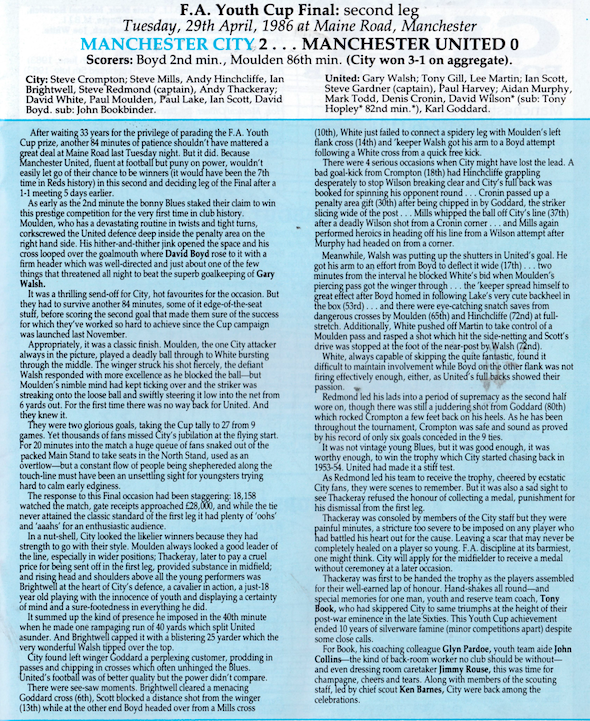
This weekend the 2023 FA Cup final at Wembley will be the first all-Manchester FA Cup final but it is not the first all-Manchester FA Final. That came in 1985-86 when the two Manchester clubs reached the FA Youth Cup final. In the build-up to Wembley this final will probably be overlooked but I wanted to make sure we do remember. Here’s a brief piece on the final.
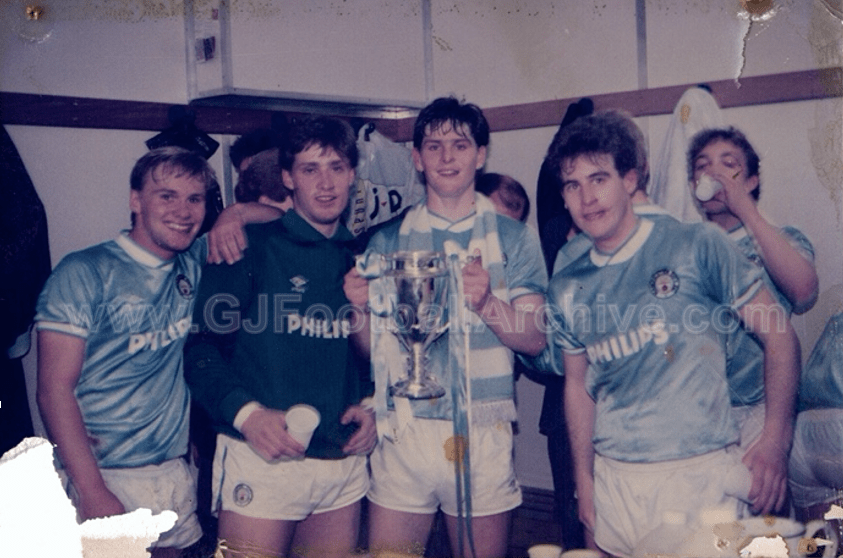
In April 1986 Manchester City’s youth team defeated Manchester United 3-1 on aggregate in the final of the FA Youth Cup. It was a tremendous achievement at the time, and one which proved that it was the Blues, rather than the Reds, who knew how to find and recruit young players – when Alex Ferguson arrived in Manchester later in 1986 he was dismayed that City tended to sweep up all the local talent and put things in place to change the situation. He even chatted to City’s chief scout Ken Barnes about the Blues’ strengths. More on Ken in a moment.
Of the 11 City boys who played in the 1986 final an amazing seven would also appear in the first team. Two of those would captain the Blues; two would play for England; and one would continue to play for the Blues into the late 1990s. For the record the City eleven plus subs were:
Steve Crompton, Steve Mills, Andy Hinchcliffe, Ian Brightwell, Steve Redmond (capt), Andy Thackeray, David White, Paul Moulden, Paul Lake, Ian Scott, David Boyd. Unused subs: Steve Macauley (1st leg) & John Bookbinder (2nd leg).
City’s Chief Scout at the time was 50s Cup winner Ken Barnes and years later I interviewed him about the success. He firmly believed that it was exceptional to find so many young star players at the same time: ‘We were dead lucky. I have to say that I don’t think it will ever happen again. I don’t recall any team having so many of the players coming through from the Youth team. It was only circumstances as such that they all got into the team at the same time. There was no alternative – the club had no money. No money to buy new players – so the young lads were thrown in at the deep end. Maybe if we had had a good team at the time 3 or 4 of them wouldn’t have got into the team and, who knows what would have happened to them. It enlightened me the year they won the Youth Cup. They went throughout the whole season in the Lancashire League and lost only one game.
‘That was a remarkable youth side. In the past we had boys like Tommy Caton, Ray Ranson, Nicky Reid, John Beresford and Darren Beckford but we never had a team like the 1986 one. Most of the youngsters played for our nursery team Midas… Nearly all those who have made it into the first team played with them from the time they were 11 or 12.’
Here is the City first team match programme commenting on the success:
1986 YOUTH CUP STATISTICS
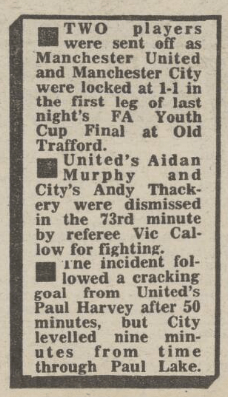
Old Trafford, 24 April 1986 Manchester United – Manchester City 1–1 (0–0) 1-0 49 min. Aidan Murphy 1-1 82 min. Paul Lake (penalty) Attendance: 7,602
Manchester United: Gary Walsh, Tony Gill, Lee Martin, Ian Scott, Steve Gardner (capt), Jon Bottomley, Aidan Murphy (red card, 69 min), Mark Todd, Dennis Cronin, David Wilson (replaced by Tony Hopley), Paul Harvey. Manager Eric Harrison.
Manchester City: Steve Crompton, Steve Mills, Andy Hinchcliffe, Ian Brightwell, Steve Redmond (capt), Andy Thackeray (red card, 69), David White, Paul Moulden, Paul Lake, Ian Scott, David Boyd. Unused sub: Steve Macauley. Manager: Tony Book
Second leg
Maine Road, 29 April 1986 Manchester City – Manchester United 2–0 (1–0) 1-0 02 min. David Boyd 2-0 86 min. Paul Moulden Attendance: 18,158
Manchester City: Steve Crompton, Steve Mills, Andy Hinchcliffe, Ian Brightwell, Steve Redmond (capt), Andy Thackeray, David White, Paul Moulden, Paul Lake, Ian Scott, David Boyd. Unused sub: John Bookbinder. Manager: Tony Book
Manchester United: Gary Walsh, Tony Gill, Lee Martin, Ian Scott, Steve Gardner (capt), Paul Harvey, Aidan Murphy, Mark Todd, Dennis Cronin, Jon Bottomley (replaced by Tony Hopley), Karl Goddard. Manager Eric Harrison.
If you enjoy all the free material on my website and would like to support my research and keep this website going (but don’t want to subscribe) then why not make a one-time donation (or buy me a coffee). All support for my research is valued and welcome. It allows me to keep some free material available for all. Thanks.
Warning! The following 600 word article is the story of Manchester City’s final game of the 1997-98 season. It was against Stoke on 3 May and, well, let’s just say it was a 5-2 easy victory but the consequences were grave for the club. If you have no idea what I’m on about then have a read – or if you want to relive a painful memory then carry on. Fortunately, I’ve made this article available to subscribers only so people won’t just catch site of our misery just by passing! If you can then enjoy looking back and remembering those days!
Subscribe to get access – Monthly
Read more of this content when you subscribe today. It costs £3 per month or £20 for an annual subscription.
Annual subscribers get access to everything (all the books, articles, videos, interviews etc.) posted since the site was created in December 2020. Monthly subscribers get access to everything since 1 October 2022. All subscribers access everything posted throughout their subscription. Why not give it a try for a month and see what you think?
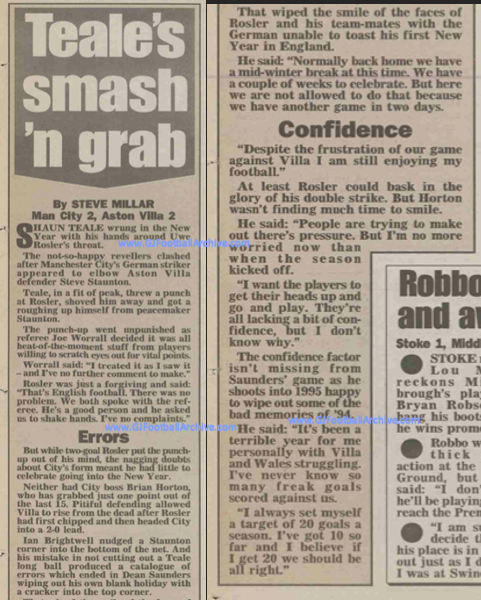
On this day (31 December) in 1994 Uwe Rosler netted twice to help Manchester City to a 2-2 draw at Maine Road. However, the Blues had been 2-0 up at one stage and the general feeling around Maine Road was that this was a couple of points lost, rather than a point gained. Here’s a couple of contemporary reports of the game:
On this day (16 November) in 1991 the Manchester derby ended goalless at Maine Road but so many, many chances went City’s way! It was a frustrating draw for the Blues and came at a time when neither side had won the League since the 1960s (City in 1967-68 if you want to know). It was felt that momentum was building at Maine Road. This is one of those periods when football history could’ve gone in a different direction.
There was pressure on United boss Alex Ferguson. He had brought the ECWC and FA Cup to United by this time but it was the League that the club craved. City had ended 1990-91 in fifth place and United were 6th. Had City had a bit of fortune around this time they may well have found some success.
Arsenal had won the League in 1991 but no team dominated the League year after year. The birth of the Premier League was coming (1992) and the new riches that came with that meant that the teams that did find League success from then on could potentially dominate in a way no club had before. With United’s title success in 1992-93, United and Arsenal became the two clubs that benefited most from the riches of the Premier League. That created a gap that only strong investment could bridge.
Ah well! Money and football is nothing new. Anyway, here are a few highlights of the derby:
After achieving promotion the previous season City embarked on the 1989-90 First Division campaign with a view to consolidate rather than set the world alight. The relatively low-key City manager, Mel Machin, seemed determined to play down expectations, especially as other clubs – in particular Manchester United – were spending millions on strengthening their squad. City could not afford to spend wildly, although they did increase their overdraft by signing Clive Allen and Ian Bishop during the close season for a combined fee of around £1.75m.
Subscribe to get access – Annual
Read more of this content when you subscribe today. It costs £20 per year to access everything posted since December 2020 and throughout your subscription or £3 per month (see below).
Read more of this content when you subscribe today. It costs £3 per month (cancel anytime) to access this post and everything posted since 1st October 2022 & throughout your subscription or £20 per year (see above).
On this day (February 3) in 1990 Manchester City and Manchester United drew 1-1 at Old Trafford. The derby became remembered as the ‘Wellied It!’ derby. Here is the story of that day with quotes from an interview I did with Ian Brightwell a few years ago. He explains how the ‘Wellied It!’ phrase came about and why he said it. Enjoy….
Howard Kendall’s City arrived at Old Trafford for the return derby match on February 3 1990. So much had changed since September when Mel Machin’s City had defeated Alex Ferguson’s United 5-1 and so the game was always going to be a difficult one to call. As the Blues were now supposedly a better side it is true to say most City fans eagerly awaited this particular match. Disappointingly, United only gave City 600 seats and 4,500 terrace tickets, although even that was considerably more than in the years that followed. The eventual attendance was only 40,274 in a stadium holding a minimum of 48,000, as many disenchanted United fans stayed away.
Although there were noticeable gaps in the United sections, the paddock in front of the Main Stand appeared full of City supporters. They were later joined by Blues evacuated from the Stretford End and estimates from impartial observers suggested there were around 12,000 City fans in the 40,000 crowd.
The match was the 100th meeting in the First Division and commenced with City tearing into the Reds as they had in September. The Blues were actually two points better off than United in the League and the difference in position prompted City fans to chant “Fergie in” to annoy the home contingent… Football humour, hey?
Squandering some early chances, City looked the more composed overall but when Clarke missed a sitter some fans still muttered about Everton rejects (it had been a thing ever since Howard Kendall’s arrival and transfer of several former Evertonians to Maine Road). It wasn’t just the Evertonians who should have given City the lead; Ian Brightwell was also guilty of a shocking miss when, with Leighton off his line, the youngster feebly lobbed the ball wide. Don’t worry, he made up for it!
Against the run of play it was actually United who took the lead when Clayton Blackmore was gifted a free header. Fortunately, within five minutes Mark Ward found Brightwell who, from fully 25 yards out, blasted a stunning shot past Leighton for the equaliser. Afterwards the delighted player explained exactly how he’d scored by succinctly telling the media: “I just wellied it!” In May 2010 he remembered how the expression came about: “We totally outplayed them, but Clayton Blackmore scored even though we’d had most of the chances. I had a chance in the first half, but that’s a different story. Once they went a goal ahead you’d normally think it’s going to be difficult, but we still had a lot of chances and I felt we’d still do it. I remember that the ball was out on the right and Mark Ward sort of half-crossed it. It came to me and I’ll never forget this – I heard Steve Redmond on the half way line shout: “Bob…” I’d best not say his exact words, but let’s just say he wanted me to have a go in his strong scouse accent! It was on my left foot, which isn’t my strongest, but I did what Reddo said. It went in the top corner!
“I ran off and jumped about twenty feet in the air – or at least that’s how it looks on the photos. I remember the noise because back then the away fans used to get about 10,000 tickets at Old Trafford and it was phenomenal.
“When we came to do the post-match TV interview I was asked the usual stuff and then was asked about the goal. So I told him what I just told you, being careful not to say what Reddo actually shouted! Just as I was doing it, someone walked past and we had to do the interview again. But then the same happened again. So we had to do it a third time. By this point I thought I had to say it in a different way – inexperience I guess. I didn’t need to, but I ended up saying: ‘the ball came out to me and I just wellied it!’ It’s true I did, but now it’s the phrase that people remember. It summed it up nicely, but it wasn’t what I’d meant to say.”
The match should have brought a City victory, but everyone seemed satisfied with a point. You can watch highlights of the game here:
This is a free taster of the content on my website. If you have enjoyed it why not subscribe? It costs £20 a year (£1.67 per month) or £3 per month if paying a month at a time. You can always sign up for a month and see what you think. Cancel anytime. There are over 500 articles/interviews on the site, including exclusive audio interviews I have performed over the years with Malcolm Allison, John Bond & others. You also get the ability to download PDFs of my entire Manchester A Football History book for free – and my first ever book (published in 1989). You can subscriber here:
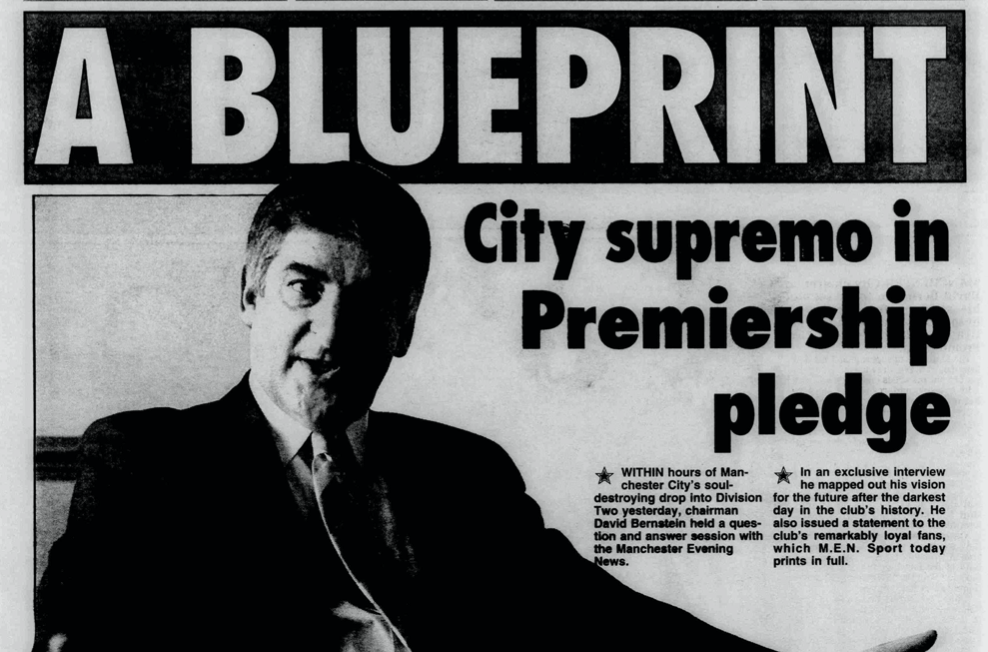
We hear so much about the Premier League era and how the game has changed, so for today’s feature I’ve decided to take a look at the early 1990s and the birth of the Premier League. It’s almost thirty years since the structure of league football changed forever and during that time some clubs have benefitted from the new structure and others have found life difficult. City have experienced both extremes of course.
The narrative that we often hear about the Blues’ journey over the last thirty years is that they’ve gone from a struggling club to a hugely successful one and, while it is true City are highly successful today and that the Blues entered their lowest ever point in the late 1990s, it is wrong to assume that the position the club found itself in by 1999 was typical of the club’s full history.
So, here for subscribers, I’m taking a look back at the early 1990s and remind ourselves where the Blues were; who their rivals were; and the state of football at that time:
Subscribe to get access
Read more of this content when you subscribe today. It costs £3 per month (cancel anytime) or £20 a year. Throughout your subscription you can access ALL content on this site. Have a search to see what’s included.







 Gary James' Football Archive