Maine Road 100 – Day 41

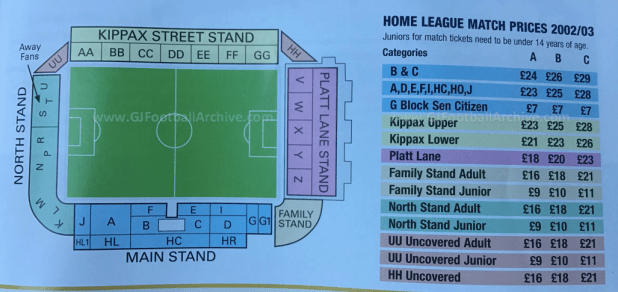
Day 41 of my posts counting down to the centenary of Maine Road’s opening game follows on from yesterday’s feature. Today I cover ticket prices for Maine Road’s last season and provide a bit more on the additional temporary seating. This was of course a Premier League season, but the temporary seating had started to be added several years before, being used in 1998-99 as mentioned yesterday.

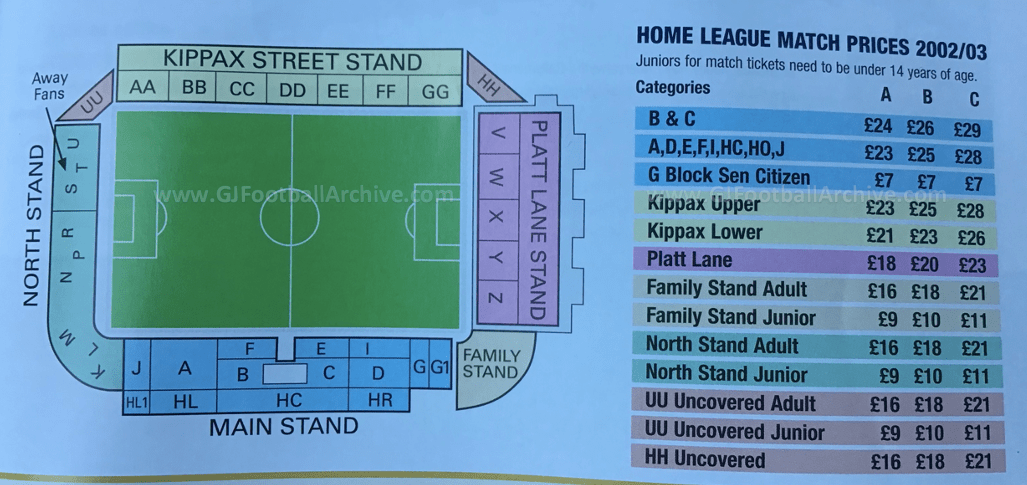
The most expensive seat was in the centre blocks B & C at £29 for the highest category game. The cheapest adult seat was £16 for the uncovered temporary stand UU, also known as the Gene Kelly Stand (see yesterday for naming details), and HH (dubbed the ‘Alan Ball Stand’ by one fanzine as it was small and didn’t make much noise!).

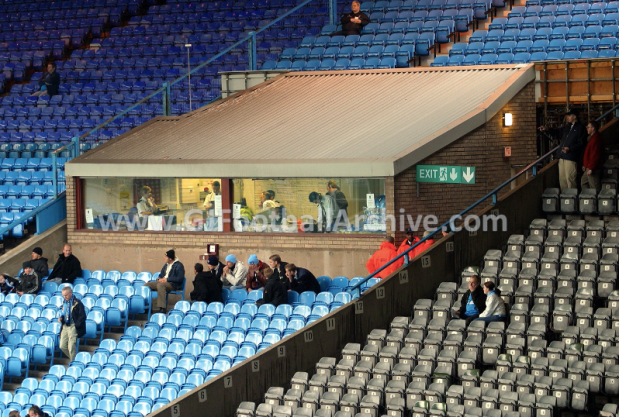
Other temporary stands were now in place in the tunnel between Platt Lane and the Main Stand (block G1 on the plan) and behind the security box (block H1 on the plan). As these were covered they were more expensive than the uncovered temporary stands.

You can see the temporary seating behind the stadium control box here – this would have been an empty space in previous years.

Photo by Ed Garvey

People often forget about these extra temporary stands, focusing only on the Gene Kelly and ‘Alan Ball’ (or Gene Kelly 2 as it was sometimes called). Even those two uncovered stands increased in size over the years. I typically sat in block Y of the Platt Lane this season but I did sit in the ‘Alan Ball’ for the Newcastle game early in the season. It poured down!

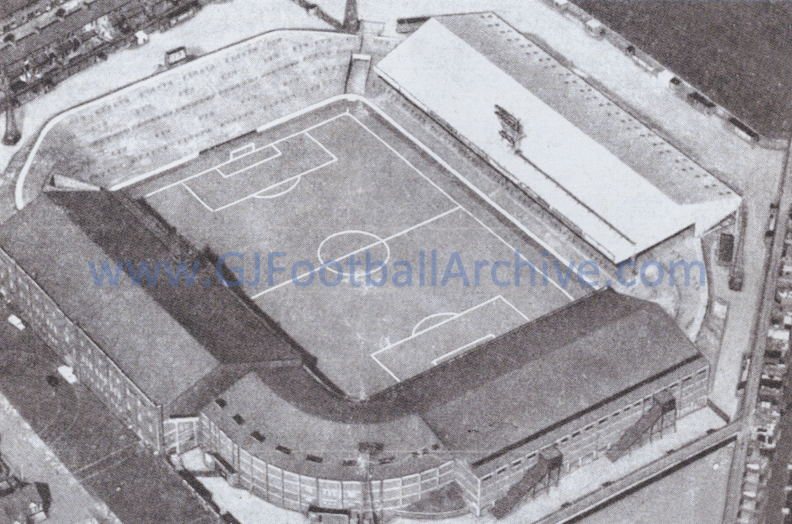
This image shows the ground before any temporary stands were built. This was 1995 (the Kippax is still being completed).

Compare the two plans from 2002 (above) and from 1998 (below) to see the additional temporary stands.:

If you’d like to read more on the history of Maine Road, take a look at Farewell To Maine Road, which can be downloaded from this page:

If you enjoy all the free material on my website and would like to support my research and keep this website going (but don’t want to subscribe) then why not make a one-time donation (or buy me a coffee). All support for my research is valued and welcome. It allows me to keep some free material available for all. Thanks.

Choose an amount

£2.50
£5.00
£7.50

Or enter a custom amount

£

Your contribution is appreciated.

Donate

Maine Road 100 – Day 34

It’s day 34 of my posts counting down to the centenary of Maine Road’s opening game. Today – Bert Trautmann’s testimonial scenes.

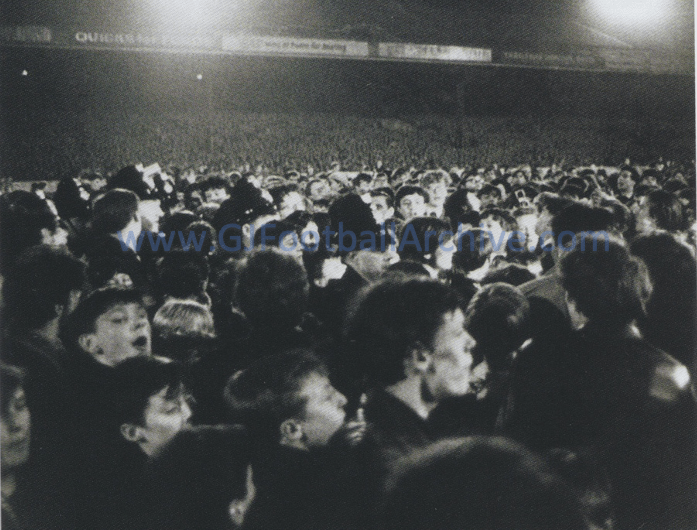
In 1964 Manchester City staged a testimonial game for legendary City goalkeeper Bert Trautmann. Officially there were less than 48,000 there (in a stadium that could hold in excess of 60,000) yet fans and others there that night know the attendance was much higher. My own dad told me last week how him & my mam were going to the game but when they arrived the turnstiles were closed and thousands were locked out a long time before kick off.

There are stories of some fans trying to climb walls to get in and others talk about the packed terraces and stands.

It was truly the biggest testimonial game ever at Maine Road in terms of numbers, even if officially it was short of capacity. In the 90s I often asked players and officials from that era about this attendance, including Bert. No one actually wanted to say much about the discrepancy between the numbers officially reported and the actual volume of people in attendance, so we can leave all of that to the imagination. What they did all agree on is that there must have been well over 60,000 there that night and that Bert deserved whatever was raised from the match.

This image from 1961 shows how the stadium looked at the time of Trautmann’s testimonial.

Below is a view of Maine Road from 1971. The main image of fans on the pitch (above) is taken from near the Main Stand (number 2) looking across to the Kippax (7/8).

Maine Road aerial 1971 from Farewell To Maine Road

If you’d like to read more on the history of Maine Road, take a look at Farewell To Maine Road, which can be downloaded from this page:

If you enjoy all the free material on my website and would like to support my research and keep this website going (but don’t want to subscribe) then why not make a one-time donation (or buy me a coffee). All support for my research is valued and welcome. It allows me to keep some free material available for all. Thanks.

Choose an amount

£2.50
£5.00
£7.50

Or enter a custom amount

£

Your contribution is appreciated.

Donate

Maine Road 100 – Day 32

It’s day 32 of my posts counting down to the centenary of Maine Road’s opening game. Today – A behind the Kippax image from 1993. This photo has so much going on despite it looking fairly bland. I’ll explain:

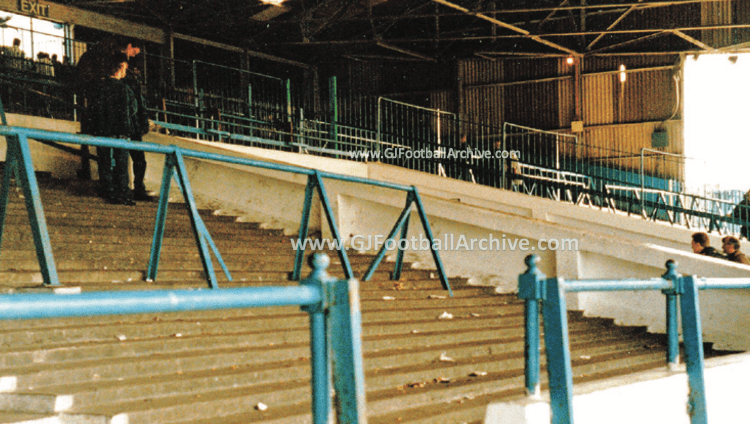
When the Kippax was roofed in 1957 the original terracing had to be squared off and so, instead of reducing the terracing City decided to extend it where its started to curve. You can see in this image that the end of the stand is on stilts/stanchions over the original banking where it was extended.

At the time the stand was enlarged in 1957 local residents objected to it. Some claimed they’d lost TV signal and were no longer able to get Granada TV which had started broadcasting in May 1956.

When this photo was taken in 1993 that area was for away fans and if you look carefully you can see the segregation fence to the left of the tunnel and going up the banking.

The tunnel and steps in the foreground of the photo are the original 1923 construction but these steps were no longer in use as an entry point. They were blocked off at the top and tended to be used as a seating area by fans instead. They’d been blocked off after the Ibrox Stadium disaster in 1971 when steps like these had to be remodelled to prevent a build up of fans flowing down at speed. This staircase was not altered but others were and remained in use.

Notice also the paved slope. This had been a simple slope of grass and rubble (as can be seen on the 1971 image lower down this page) for most of the stand’s life but general crowd disorder at football had led to City deciding to pave this section to prevent fans from grabbing stones and lobbing them over the segregation fence at rival fans. When I spoke with Bernard Halford many years ago, he was quite proud of this ‘flagging’ of the slope and said it did prevent some significant issues which could have had repercussions for the club.

This image from 1961 shows this part of the extended/squared off Kippax to the right of the photo.

Here’s a view from 1971 showing the back of the Kippax as it looked. The away staircase is to the left of number 8 and to the left of that you can see the squared off part of the stand on stilts. The staircase that is on the 1993 image is the one between 7 and 8 below.

Maine Road aerial 1971 from Farewell To Maine Road

If you’d like to read more on the history of Maine Road, take a look at Farewell To Maine Road, which can be downloaded from this page:

If you enjoy all the free material on my website and would like to support my research and keep this website going (but don’t want to subscribe) then why not make a one-time donation (or buy me a coffee). All support for my research is valued and welcome. It allows me to keep some free material available for all. Thanks.

Choose an amount

£2.50
£5.00
£7.50

Or enter a custom amount

£

Your contribution is appreciated.

Donate

Maine Road 100 – Day 26

It’s day 26 of my posts counting down to the centenary of Maine Road’s opening game. Today – the Control Room. It’s something few ever went in but it was an important part of the stadium’s last couple of decades.

It was erected behind the block between the Main Stand and the North Stand. This was an uncovered section of seats until 1982.

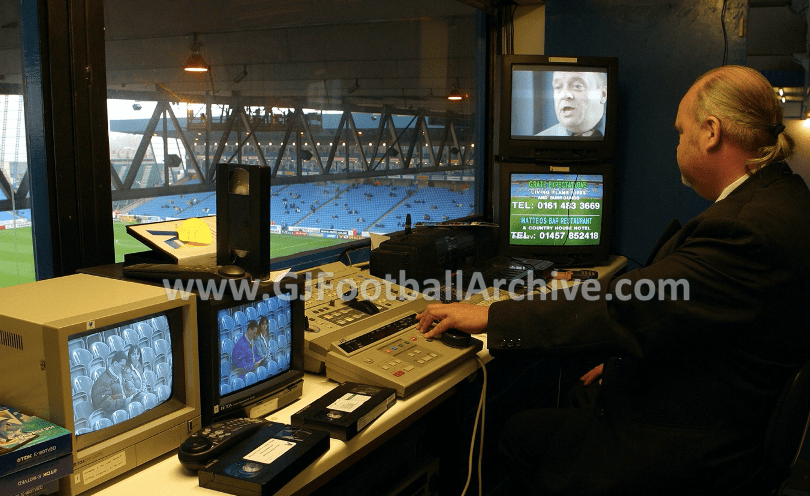
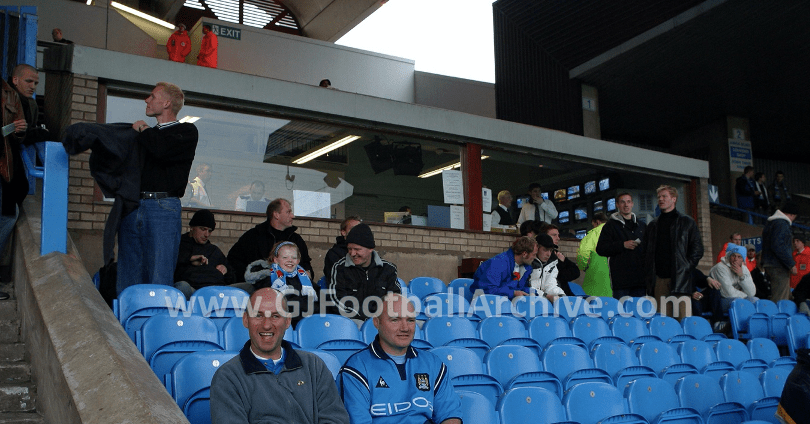
The control room housed the screens monitoring crowd behaviour and the match commander would be sat in there with other staff, police etc. watching the crowd. These images show the control room as it looked during Maine Road’s final season. It had been expanded by then and these photos were taken by Ed Garvey, club photographer, for my book Farewell To Maine Road (though we didn’t use them all).

Photo by Ed Garvey

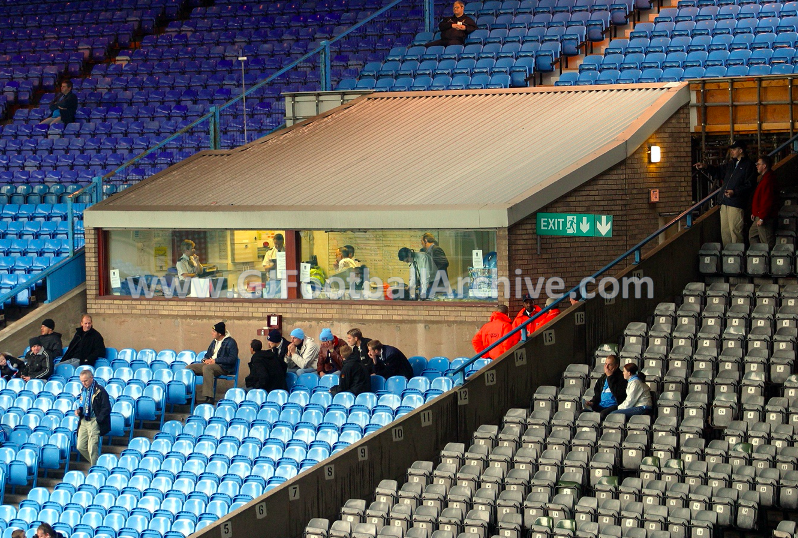
You’ll notice in the following photo that one of the temporary stands had been constructed behind the control box to cope with demand for tickets. This stand was erected on scaffolding and was squeezed in above the control box and next to the Maine Stand. I never sat in that temporary stand, though I was often in the block below the control room (when it was uncovered it was the cheapest seats in the stadium and I was there when Bobby McDonald went in nets in 1982.

Photo by Ed Garvey
Photo by Ed Garvey

For those unfamiliar with Maine Road this photo may help. This shows number 2, the uncovered section, before it was seated. The control room was roughly to the left of the North Stand roof.

Maine Road aerial 1971 from Farewell To Maine Road

If you’d like to read more on the history of Maine Road, take a look at Farewell To Maine Road, which can be downloaded from this page:

If you enjoy all the free material on my website and would like to support my research and keep this website going (but don’t want to subscribe) then why not make a one-time donation (or buy me a coffee). All support for my research is valued and welcome. It allows me to keep some free material available for all. Thanks.

Choose an amount

£2.50
£5.00
£7.50

Or enter a custom amount

£

Your contribution is appreciated.

Donate

Maine Road 100 – Day 22

For day 22 of my posts counting down to the centenary of Maine Road’s opening game I want to talk about the photographs of Iain SP Reid who captured this image of the burger sellers at Maine Road during the 1970s.

This photo and others in Iain’s collection were taken circa 1977. Iain believed that photography could improve lives. His work is full of joy. Sadly he died in 2000, leaving his fabulous archive of photographs filed away in boxes unseen until his family rediscovered them. He tried to capture images around Maine Road and at Old Trafford too, but he wasn’t interested particularly in match action. Instead he focused on the crowd, creating a wonderful collection.

“It was the way in which the football supporters of Manchester United and Manchester City used to dress and treat the whole match as if it were a carnival”
– Iain S. P. Reid

In August 1977 Iain was featured in a local newspaper and gave his views on what the project was. This makes interesting reading and for those who have seen any of his images it is worth pausing to have a read and a think about what he captured. This was for a Trafford based newspaper and so they focused on Old Trafford at times, but his comments about the Stretford End are as significant and would have been replicated by his thoughts on the Kippax etc.

If you appeared in this photo or in any of the others Iain took during this period then please get in touch with Paul Sorene and all involved at info@flashbak.com who are hoping to trace as many of the people on Iain’s photos as possible. You can look through this Facebook page of Iain’s work at:

https://www.facebook.com/media/set/?vanity=IainSPReidu0026amp;set=a.2606932862855473

I’m always passionate about the capturing and preservation of footballing images and stories. For me football simply isn’t about the players on the pitch but the thousands who dedicate significant time – and money – to supporting their club. If you’re a Blue or a Red who attended games around 1976-77 then take a look at Iain’s collection at

https://www.facebook.com/IainSPReid

For those unfamiliar with Maine Road the photo was taken from the street corner above and to the right of number two, looking towards the Development Association built into the external wall of the North Stand to the right of number 2.

Maine Road aerial 1971 from Farewell To Maine Road

If you’d like to read more on the history of Maine Road, take a look at Farewell To Maine Road, which can be downloaded from this page:

If you enjoy all the free material on my website and would like to support my research and keep this website going (but don’t want to subscribe) then why not make a one-time donation (or buy me a coffee). All support for my research is valued and welcome. It allows me to keep some free material available for all. Thanks.

Choose an amount

£2.50
£5.00
£7.50

Or enter a custom amount

£

Your contribution is appreciated.

Donate

Carry On The Glory

‘They’ll carry on the glory of the City, keeping City in first place…’ It was appropriate yesterday that a banner appeared at the front of the South Stand with the words ‘Blue & white they go together, we will carry on forever more’. I’m sure some will think this is an arrogant, modern day boast but most Manchester City fans will recognise that the words come from the 1972 club song ‘The Boys in Blue’. It’s an iconic piece of Mancunian history and another Manchester icon, Alex Williams MBE, presented the Premier League trophy. These things are important. As was the pitch invasion (more of that later). It’s also worth noting, though it was generally missed yesterday, that the victory over Chelsea and trophy presentation came on the anniversary of the club first being accepted into the League as Manchester City back in 1894. No history? See:

Football clubs are often criticised and I get that. People have talked about money spent or the activities of managers and players over the generations but the truth is that a football club is a community of people. It unites a large cross section of society in a way that many other leisure activities do not. From the richest to the most disadvantaged a football club can touch all of society, or at least it can try if it wants to. Manchester City has tried and wanted to for generations now. And that is why selecting Alex Williams to make the presentation, supported by Tom O’Dell (see https://www.mancity.com/citytv/mens/city-2223-citc-trophy-lift-alex-williams-63820275 ), was important.

Alex received racist abuse from rivals throughout his playing career and has spent decades working for Manchester. He is a wonderful man, a truly nice guy and someone who absolutely dedicated his life working for Mancunians and those who for whatever reason needed support in some way. He quietly goes about his business and, though he has a MBE, he deserves national recognition at the highest level. Tom O’Dell is a young man who turned his life around via that connection with City in the Community – an organisation established in 1986 by a club whose community work stretches back many decades before this. In fact the club has been doing community work – though it didn’t see it as ‘work’ just being a responsible Mancunian business – since the start.

Manchester City, and other clubs of course, have a long history and legacy. They are here through the generations as an important element of the life of their city and, most importantly, the people. I am aware of three people (I’m sure there are more) who have witnessed every one of the 9 League titles City have won – Geoffrey Rothband, Eddie Bickerdike and the father of Margaret Core. I’ve interviewed Geoffrey before but I’d love to interview the others about their experiences. That continuity in football is important but it often gets overlooked by those who like to criticise. Incidentally, if you know someone who has seen all nine title successes and can talk about them then please get in touch. It would be great to record their memories of 1937 for example.

Yesterday was a wonderful day and a great celebration. I’d heard stories of potential punishments if there was a pitch invasion (some are still waffling on about that) and so, even though I’ve always supported peaceful, celebratory pitch invasions, I posted a tweet suggesting we heed the club’s warning. In the end I’m glad people didn’t and the pitch invasion is a wonderful exhibition of how much winning this trophy still matters. Some claim City fans have no passion or don’t care. That we’ve been spoilt. We all know that’s absolute rubbish and that pitch invasion, along with the other celebrations proved there is still a beating heart within City’s fan base.

Here’s the start of that pitch invasion:

https://gjfootballarchive.com/wp-content/uploads/2023/05/img_0870.mov

Malcolm Allison once said to me ‘celebrate every success as if it’s your first, because it could be your last’ and I think that’s a valid point. Most fans recognise that no football club dominates for ever (not in England anyway) and that success can be taken away at any point, so let’s make sure we always celebrate these moments as if they are our first.

There were so many positive moments yesterday and throughout the season that it’s impossible to pick out the best yet – and hopefully there’ll be a few more great moments in the weeks to come. Yesterday, I just loved seeing the players celebrate. It’s also telling just how many young fans were around the place or being interviewed by TV… It looks like City’s fanbase is going to continue to grow for some time. Maybe the stadium will need expanding again after the North Stand work is completed?

Oh, and finally, I loved capturing this moment. An excited Rico Lewis running away with the Premier League trophy:

https://gjfootballarchive.com/wp-content/uploads/2023/05/img_0884.mov

A Title Decider? MCFC v Arsenal

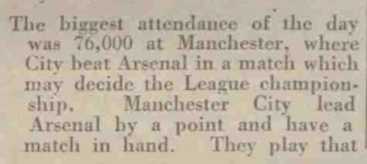
Tonight Manchester City and Arsenal face each other in what some are suggesting is a title decider. Of course, regardless of who wins it definitely isn’t a title decider as there are games to play and points to be won and lost, but it is a significant match in the season. Way back in April 1937 the two clubs met in very similar circumstances. Back then Arsenal were top and Manchester City were second and their Maine Road meeting was also promoted as a potential title decider. So what happened next?

Here for subscribers is the story of that game…

Subscribe annually to get access to the entire site

Read more of this content when you subscribe today. £20 for a year to access to ALL posts, books, interviews, talks etc. posted (site created in December 2020).

Subscribe Monthly

You can subscribe on a monthly basis for £3 (cancel any time). Monthly subscribers get access to all posts, interviews, talks etc. posted since 1 October 2022.

MCFC & LFC: Attendance Malarky

For some reason whenever Manchester City and Liverpool are due to meet at the Etihad there’s quite a lot of nonsense said about attendances so I thought I’d best get some analysis done and post it here. It’s always nice to post the facts not the fiction, so here goes (some of this may surprise those who only listen to the negativity about Etihad crowds and the positivity about Anfield attendances, not the facts).

The general criticism City get is often about ’empty seats’. No club can boast that every single season ticket holder or fan who has bought a ticket attends every game for which they’ve bought the ticket, so inevitably there are ’empty seats’ at most games for all clubs. Family tragedy, illness, emergency, work commitments, travel problems etc. all contribute to missing fans. As we don’t have a system whereby you have to get a note from a family member to pass on to the club’s manager (it seems some think you do need to get permission!) if you’re going to miss a game it is impossible to have an accurate record of who simply cannot be bothered to attend, rather than a specific reason that stops them attending.

Personally, I think it’s all nonsense and I’d much rather focus on tickets sold as that is something that can be compared. So, here are some facts based on attendances at Anfield and the Etihad since City’s new stadium was built in 2003:

Since 2003 City have attracted a higher average attendance than Liverpool in all but 5 seasons. Some will say ‘ah, but the Etihad’s capacity has been larger than Anfield for most of that time’ and that is true, but that’s only significant if Anfield is a sell out every game. So it’s also worth looking at those seasons to see if Liverpool attendances show a full stadium or not.

Well, Anfield was not full every game. In fact Liverpool’s lowest home League crowd of the season has been lower than City’s in every season except five since 2003. Add to that that City’s lowest PL crowd at the Etihad since 2003 is higher than three of Liverpool’s home PL attendances. The four lowest individual League crowds experienced at either Anfield or the Etihad since 2003 are:

34,663 Liverpool v Portsmouth, 17/3/04 (ended the season 4th)

35,064 Liverpool v Portsmouth, 14/12/04 (ended the season 5th & Champions League winners)

35,400 Liverpool v Bolton, 1/1/11 (ended the season 6th)

35,776 City v Fulham, 18/11/06 (ended the season 14th)

That 34,663 Liverpool crowd was some 10,699 below capacity. Had the crowd been 44,163 (still less than season’s highest of 44,374) that would have added another 500 to Liverpool’s average attendance that season.

Away allocations and segregation impact on whether a stadium is full of course, but we can assume that an away allocation is approximately 3,000 for Premier League games. As Anfield’s stated capacity in 2003 was 45,362 (it was reported as 45,522 by 2010), it is fair to assume that the actual maximum number of tickets available to Liverpool fans is about 42,100. So any crowd less than that figure is not a sell out (assuming zero away fans – of course there could be a full away allocation and spaces elsewhere but for the purpose of this let us give Liverpool the benefit of the doubt and assume there are zero away fans).

In 2003-04 there were 6 League games at Anfield that attracted less than 42,100. As we’ve already seen Liverpool’s average could have increased by 500 had their lowest crowd been closer to the season’s highest, so imagine what the increase would have been had all these games been full.

That pattern is repeated in other seasons. In 2004-05 the average crowd at City was less than Liverpool’s stated capacity, and that season Anfield again officially had over 10,000 empty seats for their lowest League crowd of the season. Had they filled Anfield every game then they’d have attracted a higher average than City, but they didn’t.

In 2010-11 there were 6 games attracting less than 42,100 at Anfield with the lowest again officially having over 10,000 empty seats.

Of course City have also had over 10,000 empty seats for some games, though not since 24/8/2008 when 36,635 watched City v West Ham at a time when there were rumours of players’ wages not being paid and even the existence of the club was in doubt.

Anfield last officially had over 10,000 empty seats for a Premier League game in 2011 for the visit of Bolton.

Over the last decade both clubs have tended to enjoy capacity crowds for every game, subject to away allocations and segregation, but that is definitely not true for either club prior to that. I find it ridiculous that City receive so much inaccurate reporting of crowds when actual official figures paint a different picture.

Some will try to make out that official figures are incorrect but of course these things are audited and, in any case, when rival fans criticise City they tend to imply its attendances in recent years that are inaccurate. Yet when comparing Liverpool and City’s crowds it is clear that City were attracting better crowds than Liverpool twenty years ago and that Liverpool’s lowest official crowds were lower than City’s.

Oh, it’s all a load of codswallop. Those who attend games know the truth and the facts and evidence paint a picture somewhat different to those ‘Emptyhad’ and ‘Anfield’s always been full’ jibes aimed at City fans.

A National Crowd Record Set in 1924

A record Manchester City have held for 99 years was set on this day (8 March) in 1924 – the record is the highest attendance on a club ground! Happy anniversary! The record set in 1924 saw 76,166 attend City v Cardiff. City had moved to their new Maine Road stadium in August 1923. The capacity of the venue was estimated at around 90,000 but was actually approximately 83,000 when the stadium opened (it was enlarged in 1931 and 1935).

In its first season the capacity was tested and, on this day (8 March) in 1924 the largest attendance for any footballing fixture (including three FA Cup Finals) in Manchester gathered to watch the Blues. This was also, at the time, the record crowd for any game played on an English club ground. It was beaten ten years later when 84,569 watched City v Stoke. You can read about the remarkable day in 1924 below:

Subscribe to get access

Read more of this content when you subscribe today. It costs £20 a year (access to everything) or £3 per month (see below).

Subscribe to get access

Read more of this content when you subscribe today. It costs £20 a year (see above) or £3 per month (cancel anytime; access to everything posted since 1 October 2022).

You can read about the attendance that brought this record (again by City at Maine Road) here:

A National Record – 84,569

Other record crowd articles can be seen here:

Welcome to Gary James’ Football Archive

Subscribe to get access

This has been a sample of the material on http://www.GJFootballArchive.com If you would like to read all the in-depth articles (including the entire Manchester A Football History book and the audio interview with John Bond) then please subscribe. It works out about £1.67 a month if you take out an annual subscription (£20 per year) or £3 a month if you’d like to sign up for a month at a time. Each subscriber gets full access to the 260+ articles posted so far and the hundreds scheduled to be posted in the coming weeks.

The League Cup: City Women

On this day (March 5) in 2022 Manchester City’s women’s team faced Chelsea in the 11th final of the FA Women’s League Cup at Wimbledon. This was Chelsea’s third appearance in a League Cup final and they had won the previous two editions. City, who had won the competition three times, contested their fifth League Cup final. It was the first time the women’s teams had met in a major cup final. Manchester’s Blues won the final 3-1 with goals from Weir (49 & 69) and White (58).

You can read the BBC material on this final here:

https://www.bbc.co.uk/sport/live/football/60088827

The League Cup is a hugely important trophy to Manchester’s Blues and to commemorate that success here’s a piece looking at the history of the competition from Manchester City’s view point. The League Cup, sponsored by Continental during the seasons Manchester City first won the competition and therefore known as the Continental Cup, was the first national competition won after the relaunch of the women’s team. As such it became highly significant.

City supporter David Sheel explains how the first final was viewed: “The club put on some coaches for us. It was night match – that doesn’t help. It was played at Adams Park, Wycombe Wanderers’ ground. There were two coaches. The first was full of parents and young academy girls and a few supporters with the second just supporters. All free. We went – sadly a lot couldn’t go because it was a week night – and we played against Arsenal. A team full of established top players who had beat us 4-0 at City in the League. But, like semi final win over Chelsea at Hyde, there was just something about that night. Arsenal were all over us at times and did everything but score. Our defence was outstanding but we also had a few chances at the other end. Got to half-time nil-nil and you’re thinking ‘just one chance, please.’ I can remember the goal… Joey Johnston went down the line, whipped the ball in and Izzy Christiansen, the smallest player on the pitch, headed it in. There were four of us sat together – the coaches had arrived just before kick off so we’d had to leg it in and grab the first spaces you could find. The four of us jumped up but we were surrounded by Arsenal fans. They started giving us some abuse. The goal was in the 73rd minute and we hung on. 

“When the final whistle went I was as proud of that achievement as I was in 2011 when the men won the FA Cup. To me personally it was the same. I never ever felt I’d see the men win anything in my life and then the same was true with the women. I was so proud of the club. After that they did the trophy presentation and I picked up some of the tinsel that got fired out of the cannons when they did the presentation. All the players came over to the side afterwards. Jill Scott was showing me her medal. They shared it with the fans. They even let me put my hands on the trophy. We were all there together. A bit like the men and their success in 2011 I think this told the outside world that City were here to do business. Inside the club the ambition was there but until you win a major trophy the other clubs may not take you seriously.”

When I interviewed her in 2018-19 player Abbie McManus remembered: “That feeling of beating Arsenal, who have dominated women’s football for years and years. At the time we were perceived to be a bunch of nobodies that have just thrown a team together and everyone was saying you’re just throwing money at it. I didn’t actually play that game. I got sent off the game before so I missed it! But watching the game and the feeling of that win. Being the underdog. I don’t think that feeling will ever come back.”

Izzy Christiansen scored in the final and told me how she felt: “An amazing feeling to score in that game. There’s no other words to describe it. It was just probably one of the best days of my life, the fact that the ball hit the back of the net. The fact that it meant that we, as a team, and a club, got our first trophy. That kind of set us off on our journey really.  We had a taste of success at the start and that’s where we’ve stayed, wanting success.”

The Blues went on to win the Continental Cup in 2014, 2016, 2019 and then 2022. City’s finals:

2014 City 1 Arsenal 0

Goalscorer: Christiansen (73)

Attendance: 3,697 (Adams Park, High Wycombe).

Referee Nigel Lugg (Surrey)

2016 City 1 Birmingham City 0 (aet)

Goalscorer: Bronze (105)

Attendance: 4,214  (Academy Stadium, Manchester). 

Referee Rebecca Welch (Durham)

2019 Arsenal 0 City 0 (City won 4-2 on penalties)

Attendance: 2,424  (Bramall Lane, Sheffield). 

Referee Lucy Oliver (Newcastle)

2022 City 3 Arsenal 1

Goalscorers: Caroline Weir (49 & 69) and Ellen White (58).

Attendance: 8,004

Referee Lisa Benn

You can find out more about the history of City Women in my book Manchester City Women: An Oral History. Follow the link for details of how to buy: