Manchester City’s Red and Black

On this day (5 October) in 1968 Manchester City wore Red & Black stripes for the first time. Malcolm Allison had suggested adopting AC Milan’s colours and City first wore them for their meeting at Everton on October 5th 1968. The game ended in a 2-0 defeat and the result brought a lot of complaints from fans about the use of the colours.  However, due to a colour clash with Leicester, the new colours were worn in the 1969 FA Cup final. The club won that trophy and the kit soon entered City folklore as an important kit.

City chose to wear the new style for all the successful major finals that followed during Joe Mercer & Malcolm Allison’s time, including the club’s first European trophy in 1970.  At one point Allison suggested making red and black the first choice kit.

There were however plenty of complaints about City adopting the colours. Take a look at an earlier post I made on those complaints here:

51 Years Ago: Peter Swales Becomes Chairman

On this day (5 October) in 1973 Peter Swales became Manchester City’s chairman. There was an initial positive blip but after that it was more or less downhill all the way for City. Bad times!

In 1977 the BBC in the northwest showed the following incredible profile of him. On several occasions over the last decade or so myself & Will McTaggart have included this video profile of MCFC chairman Peter Swales in our Boys In Blue film show. Each time those who missed it have asked if they could see a video of it. That wasn’t possible for years but now it is. You can see the Swales profile here…

I would urge all MCFC fans and others to watch this. Some of you may wish to jump to the David Brent-esque clip at 3 mins 20. Others may want to see the Ian Niven roof plan that was thwarted by signing Dave Watson at 1 min 45 secs. Then there’s the scene where Swales gives Watson financial advice (45 secs) and it ends with Swales telling us he was a bit like Kevin Keegan (4 mins).

This really is MCFC gold. Enjoy:

https://bbcrewind.co.uk/asset/6139d63a544c6f0021171865?q=Manchester%20cityu0026amp;size=75

Corinthians’ Talk

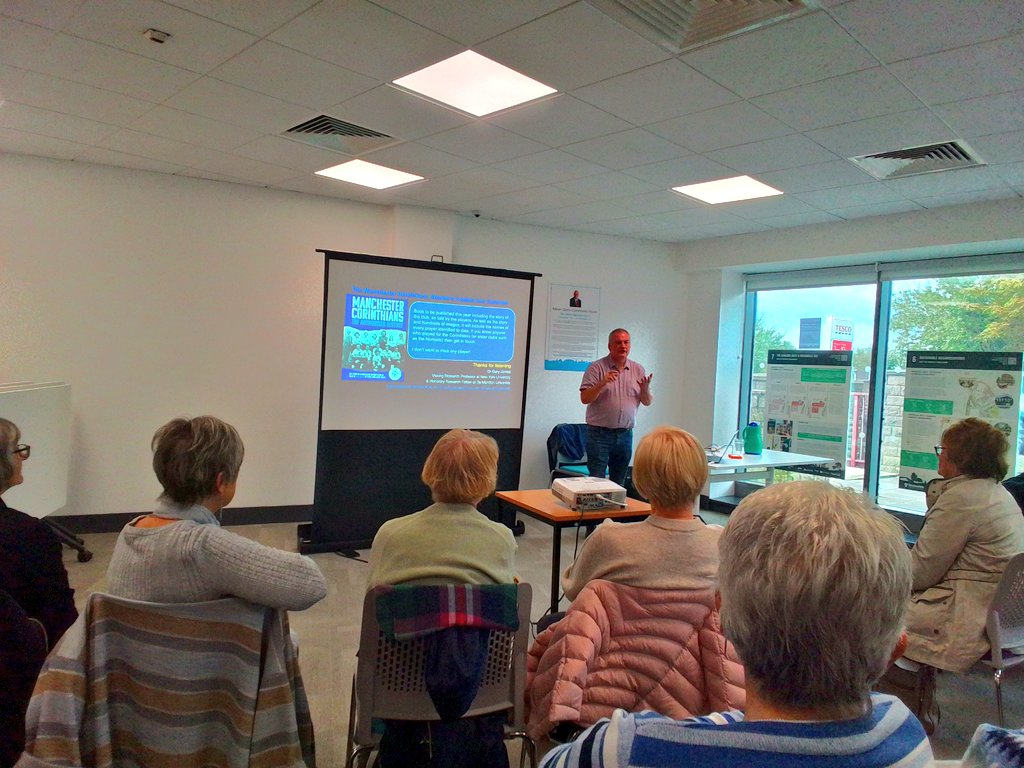
On Wednesday there was a great gathering at Droylsden for the latest talk on the Manchester Corinthians. I’d like to thank everyone who came and it was so great to see a few former players & their families at the talk. I’ve been doing talks on the Corinthians since about 2017 and have always enjoyed the reaction from audiences. Sometimes I’ve talked in the UK about them and sometimes in North America but where ever I’ve discussed their story the interest has always been high. Thanks.

Photo from @MCWFC_OSC

As well as revealing new information about the club (facts not fiction) I also gave some further information on the book. This has been delayed due to family events but will be out before the end of the year. There’s still chance to subscribe to the book. See:

Photo by @CityOnACard1

International Football History Conference 2025 at Belfast

The 2025 International Football History Conference will take place at the National Football Stadium at Windsor Park, Belfast, Northern Ireland and will be held over two days (Friday the 13th & Saturday the 14thof June 2025).

This is a call for papers for those who wish to present at the conference. There will be an opportunity to present on any topic relating to the history of football of all codes. This includes, but is not limited to: Association Football, Rugby Union & Rugby League, Gaelic Football and Aussie Rules. 

  • Main conference proceedings will take place between 8.30 am and 5 pm on Friday the 13th and Saturday the 14th of June 2025.
  • As with previous years, Abstracts are welcomed on any football-related topic (football of ALL codes)
  • Abstracts are welcomed by researchers from any discipline.
  • Presentations must not have appeared at another conference. As our conference does not have parallel sessions, we insist that presentations must not repeat something presented elsewhere.

Abstracts for the following presentation styles are welcomed:

Short Form (7 minutes) – 20 slides (plus a title slide) with a maximum of 20 seconds per slide. Ideal for a summary of research; to present early findings; Image-related research etc.

Twenty Minutes – Those choosing a 20-minute slot will be able to split that time between presentation and questions as they feel appropriate (for example 15 minutes of presentation and 5 minutes of questions or 20 minutes presentation and no audience questions).

Panel – One hour: three presenters and a moderator on a related theme with specific time for individual presentations within the session agreed by the moderator including allowance for questions at the end to the group.

If you wish to present at the conference, please send a 100-to-150-word proposal to footycon@outlook.com by the 6th of January 2025. The selection of presentations will take place by the organising committee and We will ensure confirmation as soon as possible, particularly for those travelling some distance.

Cost of Attendance

The International Football History Conference is a self-funding event. All delegates, whether presenting or not,will need to book their place before attending via our Eventbrite page, which can be accessed via this link: https://bit.ly/FootyCon25

The cost of attendance for full-time delegates will be kept at the 2023 and 2024 conference rates. 

Full Delegate (2 days):  £139. 

Students/unwaged/retired delegates (2 Days): £129

Special Day Rate: £76 (employed) & £67.50 (unwaged/Students/retired)

Travel & Accommodation

Delegates will need to make their own arrangements regarding travel & accommodation for the conference. The organisers of the conference recommend staying in the city centre. The information below will cover how to reach Belfast City Centre and the National Football Stadium at Windsor Park, the venue for our conference. Further information will be listed in the conference pack released closer to the conference. 

For those flying to Belfast, the city is served by two airports: Belfast International Airport (BFS) and George Best Belfast City Airport (BHD). Bus connections from the international airport to Belfast Grand Central Station, the new transport hub of Belfast City Centre, run every fifteen minutes, and from the city airport to Belfast Grand Central Station every twenty minutes. Rail services to and from Belfast Grand Central will be operational by the time of the conference as train services are currently being transferred from the old stations to the new hub. 

Belfast Grand Central Station is also close to many of Belfast City Centre’s hotel options. Pricing will range from 4* options such as the Europa, Leonardo or Fitzwilliam Hotels (all located on Great Victoria Street, close to the station), to more budget-friendly nearby options such as Benedicts Hotel, Travelodge, easyHotel, Maldron, Premier Inn, etc.

For those driving to the National Football Stadium at Windsor Park, the stadium can be accessed from either Boucher Road or Donegall Avenue. The postcode for your satnav will be BT12 6LW. 

Manchester Central

Over 90 years ago Manchester City and Manchester United worked together to help kill off the threat of an ambitious Manchester club, Manchester Central. At the time United we’re struggling, while City we’re riding high, but what exactly happened? I’ve researched the story extensively over the years and here’s an overview I wrote about 16 years ago on it. Enjoy!

In recent years much has been made of the growth of FC United of Manchester and their impact on support, community work and attitudes in Manchester. However, the United offshoot were not the first Mancunian side created following dissatisfaction among supporters. In fact FC United arrived 80 years after a bigger offshoot had seriously challenged the livelihood of Manchester’s two major sides. The difference being that in the Twenties it was Manchester City’s move to Maine Road that prompted the creation of a new forward-looking club – Manchester Central FC, who joined the semi-professional Lancashire Combination in 1928-29. 

One of the main figures behind Central was former City director John Ayrton, who that felt that Maine Road, in the south of Manchester, was too far from City’s old base in the east: “Ever since the City club left the Hyde Road district, I have thought of having a club on this side of Manchester. Our whole object is to develop local talent, and gradually to build up the club so that one day it may take its place in the Third Division of the Football League. Manchester has the biggest sporting community in the provinces. Surely then we have every reason to hope that there is plenty of room for our club.”

Many well known figures in Manchester football were involved in the creation of Central, including the great Billy Meredith, plus Charlie Pringle and Charlie Roberts, former captains of City and United respectively. As with FC United, the side attracted significantly better players than many of their Combination rivals – who included Morecambe, Chorley and Darwen – simply because of who they were. Central was chosen as a name so that the club could use the initials MCFC, which were spelt out on the ironwork above the main entrance of their 40,000-capacity Belle Vue ground on Hyde Road, half a mile from City’s old stadium.

After a couple of failed attempts, Central were on the verge of League football when Wigan Borough withdrew from Division Three (North) during October 1931. Central, now based in the Cheshire League, immediately offered to take over their fixtures. The existing Division Three sides supported Central’s application, including, significantly, Stockport County, who saw Central’s acceptance as being a positive development for local football.

In the Daily Dispatch, journalist ­“Adjutant” commented: “Manchester Central potentially are not merely a Second Division, but a First Division club of the future. There should be room in Manchester for three League clubs.” Second Division United and First Division City did not share the enthusiasm. Working together they complained to the League and, as they were classed as full members of the League while Division Three’s clubs had fewer rights, the League rejected Central.

The local press was appalled, as were many City and United supporters. So why did the two clubs object? At first glance it would seem that Central’s aim to be “the new MCFC” simply upset City. However, the truth is that Central were actually more of a threat to United, who were struggling on and off the pitch. Crowds were small – United’s nearest home gate to Central’s bid was 6,694 (against Notts County), while Central had attracted several crowds higher than this despite being non-League.

Respected journalist Ivan Sharpe of the Sunday Chronicle argued that Central should have been admitted because United were failing: “A third club in Manchester would not damage the City at all seriously. It would build up football interest. I don’t like the way Manchester is slipping back in football. Where are those 30,000 football followers who used to assemble at Old Trafford? The odd 25,000 are missing. It is time something was done about it.” 

Central were hugely disappointed and chairman George Hardman said: “We think there ought to be League football in the Belle Vue area, where there are 440,000 people within two miles, and a million people within four miles. This is surely enough for two League clubs in a place like Manchester.There seems to be a sad lack of enterprise so far as League football is concerned.”

It seems Hardman deliberately ignored United when he talked of “two” clubs as he knew it was the threat to United that was the deciding factor. Ivan Sharpe: “In view of Manchester United’s sorry position I certainly think Manchester Central should have been admitted.” “Nomad”, writing in the Evening Chronicle, held a similar view: “Keen disappointment is expressed that Manchester is not to have a third Football League club, especially as there is a splendid ground available at Belle Vue, and that Manchester United are so signally failing to keep Manchester on the football map.”

Within a year Central folded, feeling the close relationship of City and United would continue to severely restrict their progress. At City the 1930s proved to be a golden era with record crowds and significant success, while United struggled. Post-1945 it all changed, of course, but had Central been accepted into the League during 1931 then football in Manchester today might have been very different.

A more detailed account of Manchester Central’s story appears in my book Manchester A Football History, which subscribers can download and read here:

Sunday Morning Blues

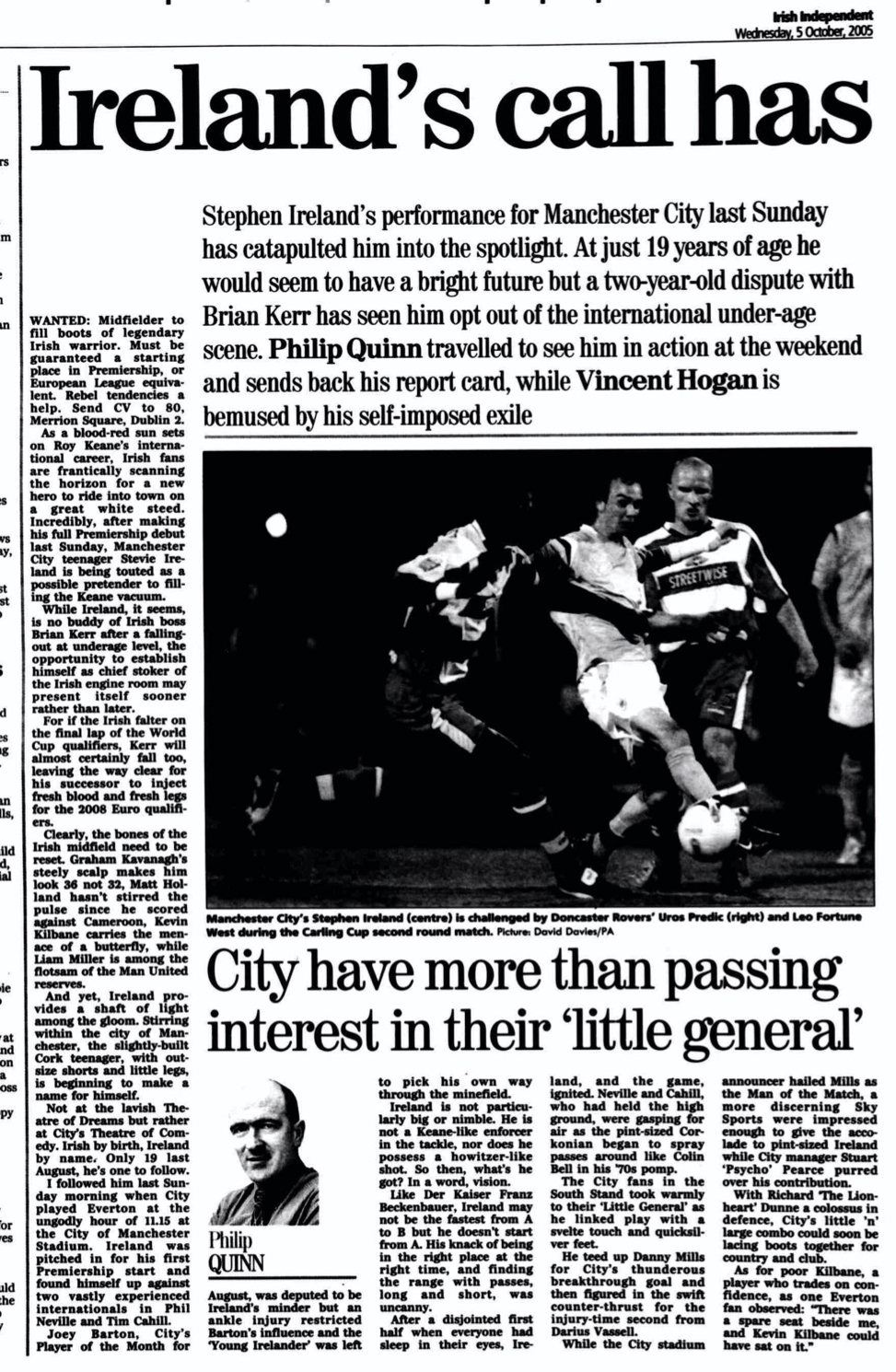
Everton, so often a bogey team back then for Manchester City, were defeated 2-0 on this day (2 October) in 2005.  This was the first Sunday morning kick off in the Premier League and the match commenced at 11.15 with some fans making a point of the early start by wearing pyjamas.  It was also Stephen Ireland’s first full Premiership game.  Before the match he admitted to being “very nervous” and post-match he commented that the rest of the team had supported him:  “That helped me ease my nerves and settle in as one of them.” You can see highlights and read more about the game below:

Subscribe to get access

If you’ve enjoyed this then why not subscribe? Every subscription directly helps support my research and provides the subscriber with access to everything posted on this site, including the entire Manchester A Football History and From Maine Men To Banana Citizens books, plus interviews, articles and more. I am not employed by anyone and all my research is self funded or comes from subscriptions to this site.

Manchester City 3 Bilbao 0

On this day (1 October) in 1969 Manchester City’s first ever home tie in the ECWC (at the time Europe’s second most important competition) ended 3-0 (6-3 on aggregate) as the Blues defeated Athletic Bilbao.  City scorers were Alan Oakes, Colin Bell and Ian Bowyer.  Attendance 49,665. You can read more (and watch a video) about the game here:

Subscribe to get access

Read more of this content and everything else on the site when you subscribe today. It costs £3 per month (cancel anytime). Or you can subscribe on an annual basis for the discounted amount of £20 per year (works out about £1.67 per month).

Sterling 2 V Burnley

On this day (30 September) in 2020 Manchester City defeated Burnley 3-0 in the League Cup at Turf Moor. City’s scorers were Raheem Sterling (2) and Ferran Torres. Here are some highlights of the game:

https://www.mancity.com/citytv/mens/burnley-0-3-city-match-highlights-63737092

Talk at Droylsden on Wednesday

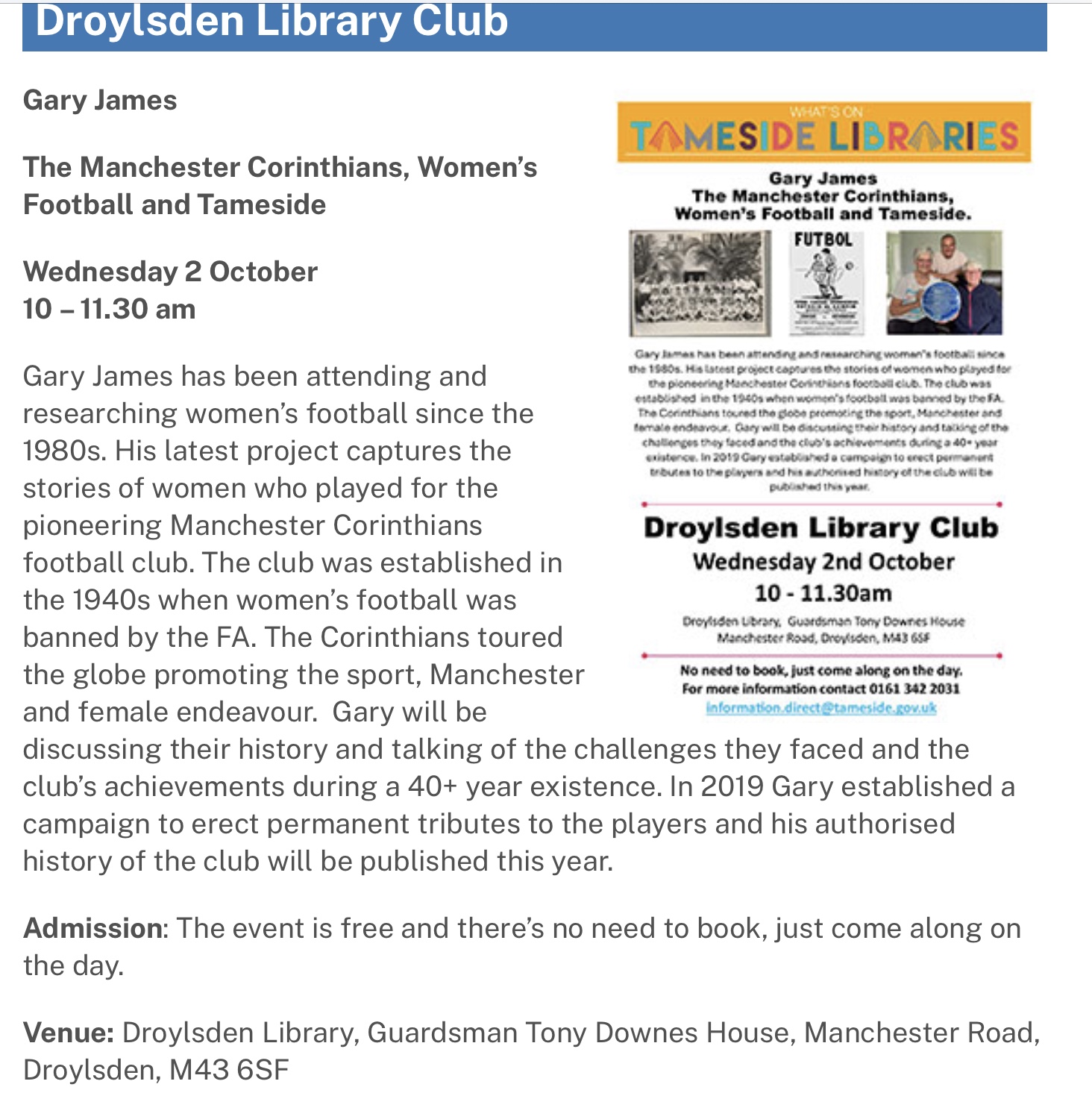
Doing anything on Wednesday? Fancy coming along to Droylsden Library to hear me talk about the Manchester Corinthians? See image for details.

More on the Corinthians here:

https://gjfootballarchive.com/category/manchester-corinthians/

Elano’s Wonder Goal

On this day (29 September) in 2007 goals from Petrov (38 mins), Mpenza (47) and Elano (87) helped Manchester City to a 3-1 victory over Newcastle United.  Elano’s goal came from a truly outstanding free kick and was his first goal for the club. You can see highlights of the game here: