
On this day (22nd January) in 1977 Brian Kidd scored four as Manchester City defeated Leicester 5-0 in the only League game featuring City to be staged during January 1977. Mike Doyle scored the other.
Category Archives: Video Archive
Manchester City Ladies – The Earliest Film
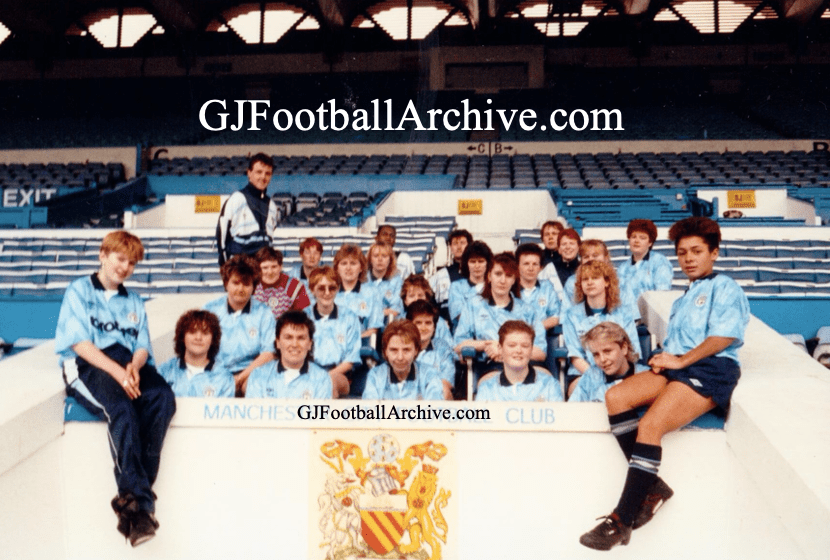
On this day in 1989 Manchester City Ladies (now Manchester City Women) played their third friendly after formation in 1988. Here for subscribers to my blog is exclusive film of the women lining up for their team photo at Burnley. This is the earliest known surviving footage of the team.
Subscribe to get access
If you would like to see this footage then please subscribe. It works out about £1.67 a month if you take out an annual subscription (£20 per year) or £3 a month if you’d like to sign up for a month at a time. Each subscriber gets full access to the 160+ articles posted so far, plus the daily serialisation of Manchester A Football History, and the hundreds of articles scheduled to be posted in the coming months (for as long as you subscribe).
On This Day in 1976 – Manchester City v Middlesbrough, a thrilling semi-final
On this day (21st January) in 1976 goals from Peter Barnes, Ged Keegan, Alan Oakes and Joe Royle in the semi-final second leg against Jack Charlton’s Middlesbrough guaranteed Manchester City an appearance in the League Cup final. The Blues had lost the first leg 1-0 to a Boro side that included Graeme Souness. The aggregate score was 4-1.
Here’s the story of that game and the situation around MCFC at the time with quotes from interviews I have performed with Alan Oakes and Rodney Marsh.
Subscribe to get access
Read more of this content when you subscribe today.
On This Day – The Story And Film of A Maine Road Manchester Derby

On this day (21st January) in 1967 the Blues played the Reds in the first Maine Road derby following City’s promotion in 1966. City had lost the Old Trafford derby 1-0 in September 1966 but had high hopes they could get something out of the return match.
The following article provides the background story to the Maine Road derby, a report, and film of the scenes around Maine Road that day (Mercer, Allison & Busby all appear; plus there’s film of fans outside the ground and then trying to climb into the Main Stand from the area behind the then still open Main Stand/Scoreboard End corner).
If you would like to view this article then please subscribe below. It works out about £1.67 a month if you take out an annual subscription (£20 per year) or £3 a month if you’d like to sign up for a month at a time. Each subscriber gets full access to the 500+ articles posted so far and the hundreds scheduled to be posted in the coming weeks.
Subscribe to get access
Read more of this content when you subscribe today.
Video Talk on History of Football in Manchester

I didn’t realise this was available but here’s film of a talk plus Q&A I did about the early history of football in Manchester. It’s of interest to anyone keen on the origins of football or any of the Manchester clubs… Indeed the social history of Manchester. It lasts about 55 minutes and was part of the promotional work connected with my book ‘The Emergence of Footballing Cultures: Manchester 1840-1919’, published by Manchester University Press.
Here’s the recording:
If you are interested in the book then that can be bought direct from Manchester University Press or via usual retailers, such as Amazon:
You can find a list of my other books here:
#ManchesterDerby – Utd 0 City 2

Here’s a brief clip I took today of City fans at the end of the Manchester Derby at Old Trafford. A dominant day for Manchester’s Blues.
Congratulations Manchester City
Last night Manchester City reached the final of the Champions League for the first time in their history. Manchester has now become only the second non-capital city to have had two teams reach a European Cup final. Manchester was of course the first British city to have two teams competing in the European Cup in the same season (1968-69).
Last night was a remarkable night and other records were established:
- City broke the record for longest winning run by an English club in European Cup history (7)
- They became the first English side to win 11 games in a single European Cup/Champions League campaign (they are one off equalling Real Madrid’s record of 12 games)
This Champions League win is an important step in the club’s journey and to celebrate I’m going to make my special 1 hour audio recording commemorating an earlier important step in this journey free to listen to until May 12th.
This audio recording was made to commemorate the tenth anniversary of Manchester City’s FA Cup semi final victory over Manchester United at Wembley (April 16 2011). To me that game was a crucial step towards the success that came over the ten years that followed, just like last night’s feels like a major step in the club’s development.
The audio recording looks at the years between the 1976 League Cup success and the FA Cup glory of 2011. The 2011 semi-final was a crucial step in City’s journey since the 2008 takeover and I felt it was vital to do a special marking this.
So what’s in this special recording? Well, I’ve included exclusive material from interviews and recordings I’ve done over the years with Garry Cook, Brian Marwood, Roberto Mancini, Peter Barnes and Peter Swales. Why Swales? Well, have a listen and you’ll hear why. Basically though I’m trying to set the tone for why the 2011 FA Cup semi final victory was so significant.
On Mancini… I include a few words from him recorded in 2011 and at one point he talks about the view that was then being expressed that City were ‘trying’ to buy success (now they say City ‘have’ bought success!). His words are a reminder that City have been having that particular criticism thrown at them for over a decade! Oh well, I wonder how long those criticisms were laid at other clubs who had seen major investment which propelled them forward?
Anyway, get yourself a brew and be prepared to be transported back in time. Here’s the recording:
If you enjoy the recording then please let me know, comment or subscribe to the site. If it’s of interest then, over the coming months and years, I’ll produce others like this highlighting key points in Manchester City – and Manchester’s – footballing history. It costs £20 a year to subscribe (it works out £1.67 a month) or £3 if you’d like to sign up a month at a time to get full access for as long as you subscribe (you can always try it for a month). It’s worth bearing in mind that the 2010 Manchester A Football History cost £24.95 and all subscribers will be able to access all of that for as long as they are a subscriber (plus all the other stuff of course). You can subscribe below.
Subscribe to get access to the full site
£20 per year to access everything
The 1970 ECWC Semi-Final

Tonight (May 4, 2021) Manchester City will play the second leg of their Champions League semi final with PSG. It’s not the first European semi final the Blues have played of course, but for those thinking City’s European heritage began after the 2008 takeover here’s the story of City’s first European semi-final. This came way back in 1970!
In 1969-70 City, managed by Joe Mercer, played their first European semi-final. The second leg was was to be the best and most important European victory ever at Maine Road.
Here for subscribers is the story of both the first and second legs of that first European semi-final for the Blues.
Subscribe to get access
Read more of this and all other content on this site when you subscribe today.
Restored 2011: The All-Manchester FA Cup Semi Final
To commemorate the tenth anniversary of Manchester City’s FA Cup semi final victory over Manchester United at Wembley (April 16 2011) I’ve produced Restored 2011: The All-Manchester FA Cup Semi Final. This special 1 hour audio recording looks at the game and the years between the 1976 League Cup success and the FA Cup glory of 2011. The 2011 semi-final was a crucial step in City’s journey since the 2008 takeover and I felt it was vital to do a special marking this.
Following last night’s Champions League victory for City (May 4th – City beat PSG to reach the Champions League final) this will now be free to listen to until May 12th. After that date, as with audio recordings with John Bond, Malcolm Allison and George Graham (and hundreds of articles), it will only be available to subscribers to the site. So, if you don’t subscribe, have a listen now while you can.
So what’s in this special recording? Well, I’ve included exclusive material from interviews and recordings I’ve done over the years with Garry Cook, Brian Marwood, Roberto Mancini, Peter Barnes and Peter Swales. Why Swales? Well, have a listen and you’ll hear why. Basically though I’m trying to set the tone for why the 2011 FA Cup semi final victory and overcoming Manchester United was so significant.
On Mancini… I include a few words from him recorded in 2011 and at one point he talks about the view that was then being expressed that City were ‘trying’ to buy success (now they say City ‘have’ bought success!). His words are a reminder that City have been having that particular criticism thrown at them for over a decade! Oh well, I wonder how long those criticisms were laid at other clubs who had seen major investment which propelled them forward?
Anyway, get yourself a brew and be prepared to be transported back in time. Here’s the recording:
If you enjoy the recording then please let me know, comment or subscribe to the site. If it’s of interest then, over the coming months and years, I’ll produce others like this highlighting key points in Manchester City – and Manchester’s – footballing history. It costs £20 a year to subscribe (it works out £1.67 a month) or £3 if you’d like to sign up a month at a time to get full access for as long as you subscribe (you can always try it for a month). It’s worth bearing in mind that the 2010 Manchester A Football History cost £24.95 and all subscribers will be able to access all of that for as long as they are a subscriber (plus all the other stuff of course). You can subscribe below.
Subscribe to get access to the full site
£20 per year to access everything
Match Stats for the 2011 FA Cup Semi-final
City 1-0 United (HT 0-0)
Yaya Toure 52
City: 25 Hart 04 Kompany (yellow card), 05 Zabaleta (yellow card), 13 Kolarov, 19 Lescott, 11 Johnson (Wright-Phillips 79), 18 Barry, 21 Silva (Vieira 86), 34 De Jong (yellow card), 42 Y Toure, 45 Balotelli (yellow card). Substitutes 12 Taylor, 38 Boyata, 07 Milner, 08 Wright-Phillips, 24 Vieira, 10 Dzeko, 27 Jo
United: 01 Van der Sar, 03 Evra, 05 Ferdinand, 15 Vidic, 22 O’Shea (Fabio Da Silva 84), 13 Park Ji-Sung, 16 Carrick, 17 Nani, 18 Scholes (red card), 25 Valencia (Hernandez 65), 09 Berbatov (Anderson 74). Substitutes 29 Kuszczak, 12 Smalling, 20 Fabio Da Silva, 08 Anderson, 28 Gibson, 07 Owen, 14 Hernandez
Referee: Dean
Attendance: 86,549
The 108th Manchester Derby in the League

On this day (22nd March) in 1986 Manchester United hosted Manchester City in the 108th League derby between the teams. The fixture was the first of two high profile games for the Blues in consecutive days with the other game coming on Sunday at Wembley (see: https://gjfootballarchive.com/2021/01/02/wembley-wembley-86-mcfc-v-chelsea/for details).
Here for subscribers are the match stats, background, match report, film and other details from that day.
Subscribe to get access
To access this please subscribe. It works out about £1.67 a month if you take out an annual subscription (£20 per year) or £3 a month if you’d like to sign up for a month at a time. Each subscriber gets full access to the 280+ articles and audio interviews posted so far and the hundreds scheduled to be posted in the coming weeks.
 Gary James' Football Archive