United’s European Cup Ban

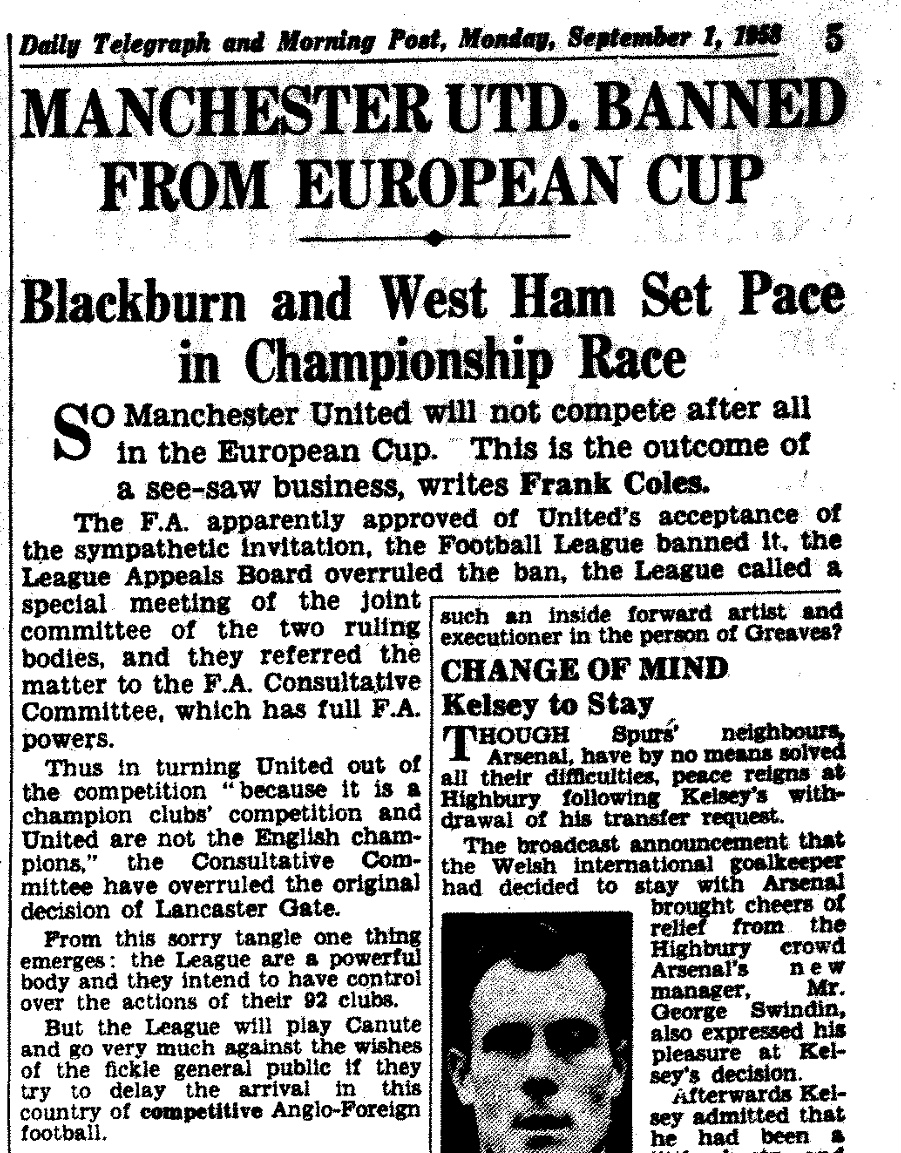
On this day (1 September) in 1958 it was revealed that Manchester United were to be prevented from taking a special place that had been awarded to them in the European Cup. UEFA had offered United the place as a mark of sympathy following the Munich Air Crash and the FA had approved the move but then discussions within the League proved problematic, leading to the Football League banning the move.

This cutting even quotes an unnamed official who basically said the European Cup is for champions and United ‘are not the English champions.’ It was all a mess and distasteful.

To understand the full story/impact of the Munich Air Disaster and how it affected all of Manchester then have a read of this:

Fleecing Fans – 1992 Style

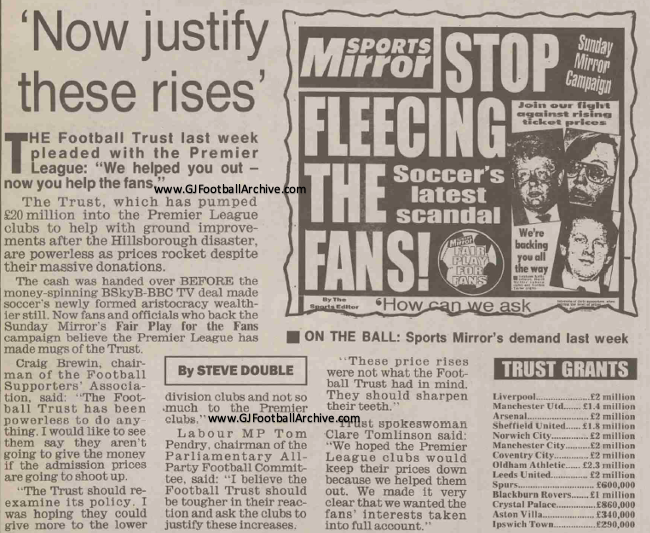
As the Premier League’s first season neared some newspapers challenged those behind football’s new league. Here’s a cutting from 14 June 1992 which quotes the Football Trust. They were unhappy because money had been given to clubs to help transform their stadia into all-seater grounds and then the clubs imposed significant price rises. The Mirror article speaks for itself:

FA Cup All-Time Eleven

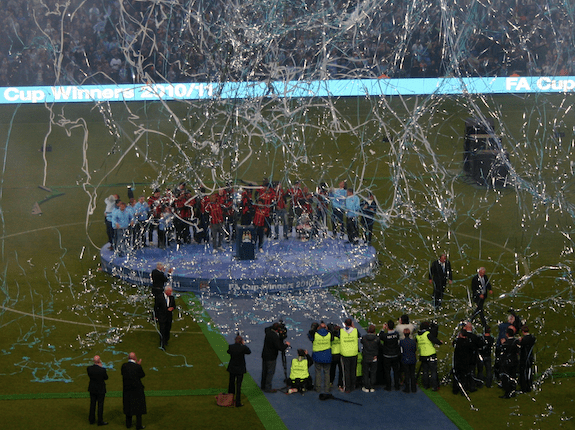
This weekend Manchester City and Manchester United meet in the FA Cup final. It’s only the second FA Cup final between the two teams and follows on from last year’s City victory. I have been asked to select Manchester City’s best ever FA Cup winning eleven for the FA Cup final match programme. The rules were: They couldn’t be a current City player and they had to have physically appeared for City in a FA Cup final winning team (i.e. no unused subs; only starting 11 or subs who came on in a winning final).

I wanted to make sure every era was included as well. So the eleven has been picked and that will appear in this weekend’s match programme. It was a difficult task. So who would make your eleven? Remember they had to play in a winning final for City.

Feel free to comment on who you would pick below and then on Saturday don’t be afraid to challenge my selection (I’m not Pep, so my team may not be the best to coach!).

Champions City!

On 11 May 1968 Manchester City won the League title and on that same day in 2021 the Blues became Premier League champions. In 2021 City won the League after nearest rivals Manchester United lost 2-1 at home to Leicester City.

It was the Blues seventh League title with their first coming in 1937.

It was an astonishing season with City already winning the League Cup that season, plus they also reached the Champions League final where they were defeated in Porto by Chelsea. Manchester’s Blues also appeared in the FA Cup semi-final season but sadly lost to Chelsea.

The League and League Cup double meant that City had won six major trophies in three seasons.

City’s trophy success in 2021 meant that domestically counting the League, FA Cup and League Cup only United, Liverpool and Arsenal have won more English major trophies. Similarly, only United, Liverpool, Arsenal and Everton havd won more League titles than Manchester’s Blues.

2020-21 was an odd season because of Covid (as was 2019-20) and no fans in the stadium (though some clubs, including those on Merseyside, were allowed a limited number of fans in earlier this season), but the football City played was breathtaking.

Apart from a difficult opening period and a few odd results along the way, City delivered week after week (or should that be weekend after midweek after weekend after midweek – it was a busy season!). They thoroughly deserved the title.

So, by the end of the 2020-21 season City had won the following major honours:

European Cup Winners’ Cup (1)

1970

League/Premier League (7)

1937, 1968, 2012, 2014, 2018, 2019 & 2021

(runners up: 1904, 1921, 1977, 2013, 2015 & 2020)

FA Cup (6)

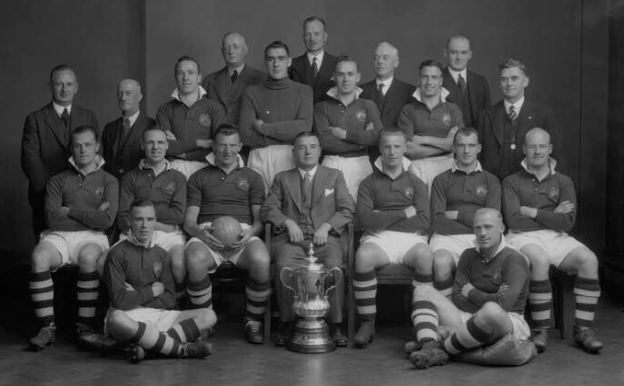
1904, 1934, 1956, 1969, 2011 & 2019 

(runners up: 1926, 1933, 1955, 1981 & 2013)

League Cup (8)

1970, 1976, 2014, 2016, 2018, 2019, 2020 & 2021

(runners up: 1974)

In 2019 the Blues became the first English men’s team to win a domestic treble. In 2020-21 City achieved a domestic double of the League Cup and the League (a feat they also achieved in 2014 & 2018). Back in 1970 they achieved a European and domestic cup double when they won the League Cup and the European Cup Winners’ Cup.

City’s trophy haul made them the fifth most successful English club of all time based on major domestic and European trophies won (United, Liverpool, Arsenal and Chelsea are ahead of the Blues). In addition only Liverpool and Blackburn had a greater span between their first English trophy and their most recent.

Since 2020-21 so many other trophies have come of course, including in 2023 when City became the first team ever to win the FIFA Club World Cup, UEFA Super Cup, UEFA Champions League, the Premier League and the FA Cup in a calendar year.

If you enjoy all the free material on my website and would like to support my research and keep this website going (but don’t want to subscribe) then why not make a one-time donation (or buy me a coffee). All support for my research is valued and welcome. It allows me to keep some free material available for all. Thanks.

Choose an amount

£2.50
£5.00
£7.50

Or enter a custom amount

£

Your contribution is appreciated.

Donate
The 1980s: City 4 Wolves 0

Here’s a nice Christmassy Manchester City match programme cover from today (27 December) in 1980. This was for City’s game with Wolves. Some of the players look happy others seem to have a fixed stare as if to say ‘do we really need to hold this banner?’

That day City defeated Wolves 4-0 with goals from Tommy Hutchison (2 goals; holding the banner above the ‘a’ in Christmas), Bobby McDonald (3rd player from right) and Kevin Reeves (4th player from right).

You can find out more on the 1980s, John Bond (including a fairly frank audio interview I did with him years ago) and City elsewhere on this website. Subscribers get access to a lot of extra content. To subscribe see the following:

If you enjoy all the free material on my website and would like to support my research and keep this website going (but don’t want to subscribe) then why not make a one-time donation (or buy me a coffee). All support for my research is valued and welcome. It allows me to keep some free material available for all. Thanks.

Choose an amount

£2.50
£5.00
£7.50

Or enter a custom amount

£

Your contribution is appreciated.

Donate
The 1980s: Why Did Bond Sit In The Directors’ Box?

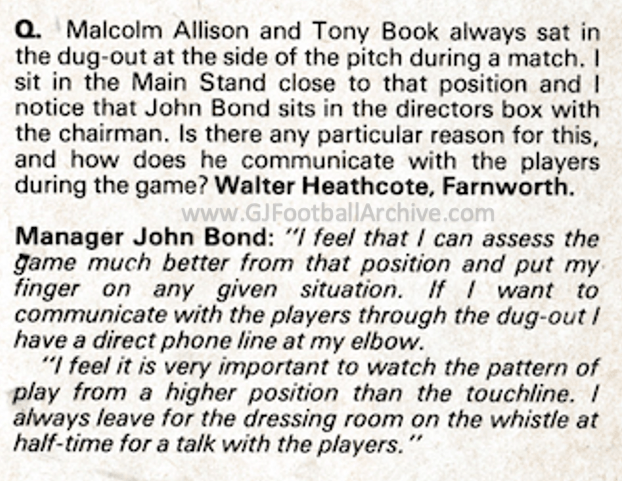
It’s December 1980 and the City match programme’s letters page contained this letter about new City boss John Bond. Back then many managers would prefer to sit in the directors’ box at games as it would give them a good view and John Bond chose to do that for many games during his opening months as manager (often throughout his actual time at City to be fair). It wasn’t so unusual but this fan wanted to understand why and wrote to the City programme looking for an answer.

It’s actually the sort of question that would seem more appropriate today as few managers ever really spend time in the directors’ box. I certainly wouldn’t expect Pep to sit up there on a regular basis.

Just one of the many things that has changed over the decades. The letter writer claimed that Malcolm Allison never sat in the directors’ box – that’s not true. There are plenty of occasions in the 60s & 70s when Allison sat up there.

You can find out more on the 1980s, John Bond (including a fairly frank audio interview I did with him years ago) and City elsewhere on this website. Subscribers get access to a lot of extra content. To subscribe see the following:

If you enjoy all the free material on my website and would like to support my research and keep this website going (but don’t want to subscribe) then why not make a one-time donation (or buy me a coffee). All support for my research is valued and welcome. It allows me to keep some free material available for all. Thanks.

Choose an amount

£2.50
£5.00
£7.50

Or enter a custom amount

£

Your contribution is appreciated.

Donate

The 1980s: Alan Oakes to Play Again?

Continuing the series of articles on the 1980s and today it’s a newspaper article on a possible return to FA Cup action at the age of 40 for Alan Oakes. Oakes, the former Manchester City FA Cup winner, was expected to make his debut for Northwich Victoria. This report comes from this day (8 December) in 1982.

Oakes did indeed play one FA Cup game for Northwich and later still he played a League game for Port Vale.

You can read more on the 1982-83 seasonarticle is a 3,500 word feature on the 1982-83 season. Enjoy (well, if you know the outcome of this season you can enjoy this memory refresh while reflecting on the modern day successes of the Blues!).

Subscribe to get access – Monthly

Read more of this content when you subscribe today. It costs £3 per month (cancel anytime) to access everything posted since 1 October 2022 or there’s a special annual rate below which gives greater access and works out much cheaper.

Subscribe to get access – Annual

Read more of this content when you subscribe today. It costs £3 per month (above) or £20 a year (here) to access everything posted since the site was created in December 2020. This special rate works out about £1.67 a week and gives access to everything posted, including PDFs of 3 of my books.

If you’d like to know more about subscribing then see:

Tomorrow’s feature is on the 1983-84 season. If you missed the earlier features then start here:

The 1980s: 1980-1981 Gow, Hutchison & McDonald

Newton Heath/MUFC’s First Game and Their Colours

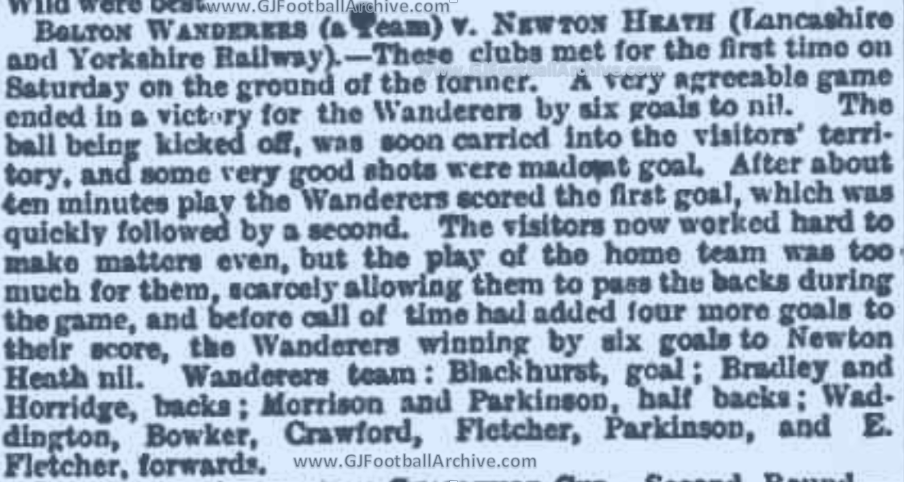
On this day (20 November) in 1880 as Newton Heath L&Y Railway Manchester United played their earliest known game. It was against Bolton Wanderers 2nd team and United lost 6-0. In the years that have followed some have claimed they wore green and gold at this game but the contemporary references given do not say anything of the sort.

It is still repeated often that a newspaper report in the Bolton Evening News mentioned the colours of green and gold were worn for Newton Heath’s first reported match. The origin of this is unclear but the Manchester United Pictorial History and Club Record (Charles Zahra, Joseph Muscat, Iain McCartney and Keith Mellor; Nottingham: Temple Press, 1986) specifically refers to the match report on page 11 as being published on 24 November 1880 and implies it stated the team colours. It also suggests that Bolton wore scarlet shirts. 

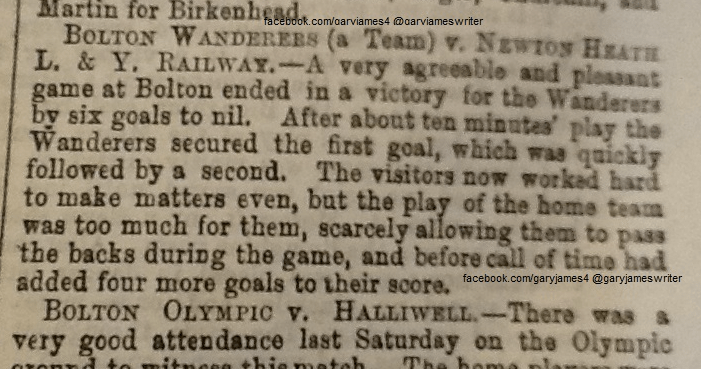
My research over the decades has included a review of every Bolton newspaper for that period and I did discover a match report in the Bolton Evening News on the date mentioned in the above book but this did not include any reference to the colours worn.  This is actually the report that gets quoted. You can see there’s no mention of colours:

Like so many football clubs the early history of Newton Heath has lots of myths associated with it. The facts are that at the railway works in Newton Heath various sporting activities were established during the 1870s. In 1922 Herbert Dale, a railway worker who played football for a decade from the formation of what became Newton Heath, was asked how football became established at the works. He explained that the club when initially formed had been a cricket team (suggesting it was established in 1878), and that after some time a member of the committee bought a football from a shop on Market Street in the city centre. This appears to be in 1880 and, according to Dale, the instigator of the club was Sam Black and that the original colours were red and white quartered shirts (NOT green and gold; quartered shirts meant 2 panels on front and 2 on back with a red and a white panel on both the front and the back). Those colours may surprise some but I do provide references and explain more in a book The Emergence of Footballing Cultures: Manchester 1840-1919 published by Manchester University Press. In that I talk about all the early clubs of the Manchester area such as Hulme Athenaeum, Manchester Association and Hurst.

Black was seventeen when the club played its earliest known game on 20 November 1880 and his age then seems consistent with others, such as those at St Mark’s (Manchester City) who are known to have played in November 1880.

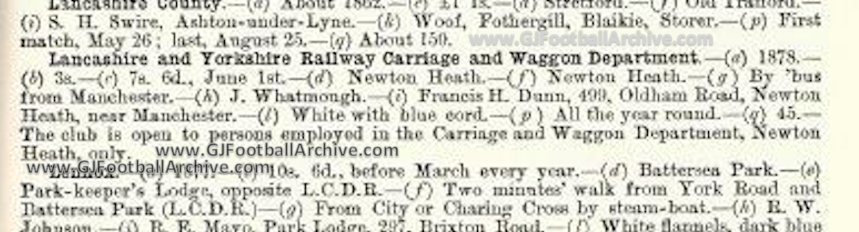
The was a Sportsman’s Yearbook for 1880 produced which the Newton Heath club was mentioned in. It appeared in both the cricket and football sections. Here are the details published in the cricket section:

Sportsman’s year book 1880 Newton Heath cricket section

You’ll notice mention there of the cricket whites/kit to be worn: white with a blue cord. Typically, this is believed to mean ‘white cricket shirts and trousers’ with a blue cord as belt (to differentiate between opponents). Some cricket clubs wore different coloured belts/cords; some wore specific caps with their whites and some wore badges (or even different colours).

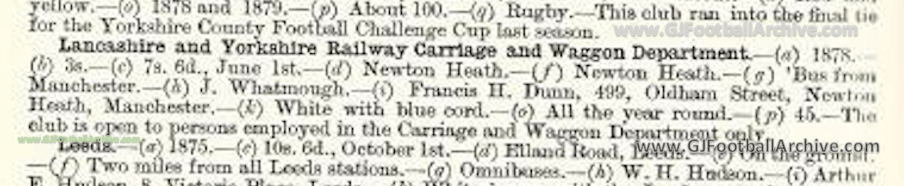
In that same yearbook the following appeared in the football section (back then a football section had rugby and association football clubs alongside each other):

Sportsman’s year book 1880 Newton Heath football section

You’ll notice the details are simply a repeat of the cricket section and it may well be that the club had decided to be listed in both sections without thinking specifically about football, or it could even be that it was a mistake to publish in both sections. For me it does seem that having the club’s details in both sections was deliberate, afterall it says the club is all year around and not specific to the cricket or football/rugby season. But I don’t believe the colours can be trusted for the association football team, especially as Dale talks of red and white being the club’s earliest football colours. Whatever is true it is important to recognise that to date no contemporary evidence has been found saying the club wore green and gold when they played their earliest games. They did wear those colours at times later on though.

Newton Heath reformed as Manchester United in 1902, winning the club’s first major trophy in 1908 (the League).

Incidentally Bolton Wanderers’ first team beat Irwell Spring (Bacup) 7-1 in the Lancashire Cup on the same day as the earliest known game for the Heathens. A good day all round for the Wanderers it seems.

For those wondering the earliest known MCFC game took place one week earlier (St Mark’s v Macclesfield Baptists).

Bobby Charlton

There have been many wonderful tributes and there are definitely people who can talk better than I can about the great Bobby Charlton. However, I do want to mark this sad time with a brief story about him which I think shows the character of the man. It’s a personal story from 30 years ago.

Back in November 1993 we were preparing for the book launch of my biography of Joe Mercer, which was to take place at the start of December. As well as those that had been interviewed for the book, such as Colin Bell, Tom Finney, Francis Lee etc. Norah Mercer asked me if she could invite a few others. Obviously she could but I didn’t know who she was inviting. I just left it to her.

About a week before the launch I received a phone call at home. I answered it and the voice on the other end said: ‘Hello Gary. It’s Bobby Charlton here. I’ve just spoken with Norah Mercer and told her I can’t make it to your book launch because I’ll be in Kuala Lumpur. She said I should let you know. Sorry I can’t make it. Is that okay? I really am sorry and would be there if I could.’

I was absolutely stunned. Bobby really didn’t need to phone either of us but he certainly didn’t need to call me. He was so polite and apologetic too. It was appreciated and added to the high esteem that I already held him in.

Often it’s the simplest of things that make the biggest impression. There were several people who had been invited who didn’t come to the launch and hadn’t let us know – I don’t expect everyone to be interested or to call – so when Bobby took the time and trouble to phone us both it really was something I treasured (and still do).

I did meet him a few times in the years that followed but it’s the 1993 phone call that remains my strongest non-footballing memory of Bobby.

Without doubt Bobby was a wonderful England international and a major global footballing figure. He was also a wonderful ambassador for Manchester (the reason he was going to Kuala Lumpur too) but most significantly he was a humble, nice man.

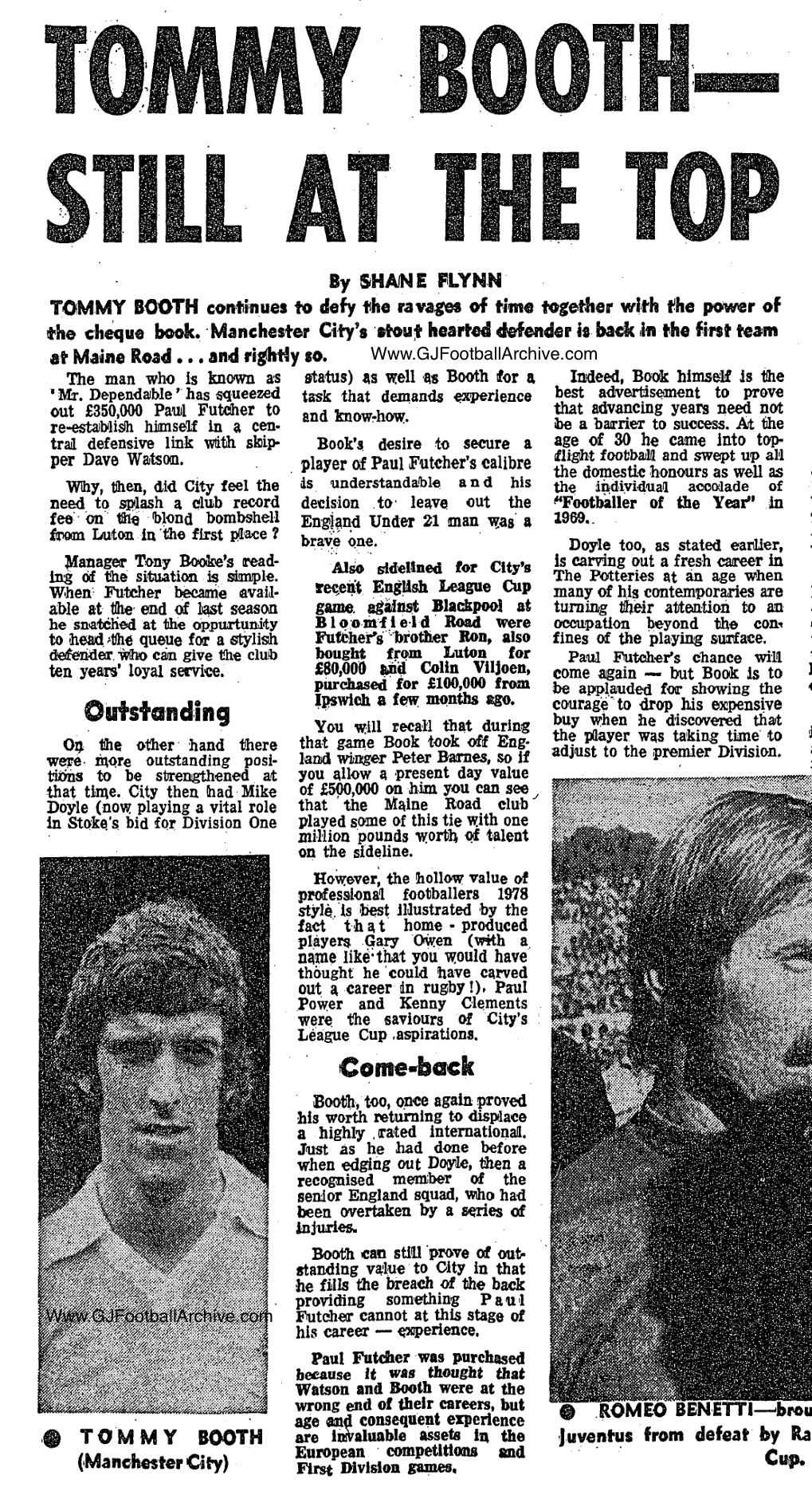
Tommy Booth Return

Here’s an interesting article about Tommy Booth and Manchester City from 14 October 1978. It talks about him being ‘Mr Dependable and back in the City first team despite the big spending of the Blues. Actually it’s really interesting how the City spend. spend, spend view exists in this article from all those years ago. Anyway, enjoy this flashback to a time when Tommy Booth remained a key member of City’s first team.