The Second All-Manchester FA Cup Final

Well, the Premier League is now over for another year and we know who the Champions (4-in-a-row) are and who has qualified for Europe etc. so it’s time to look forward to the second all Manchester FA Cup final. The first was of course last season and started off wonderfully for Manchester’s Blues with that record-making Gundogan opener.

Prior to this last year’s final, the closest Manchester City and Manchester United got to playing each other in a Wembley FA Cup final were the FA Cup semi finals in 1926 and 2011. I wasn’t around in 1926 but I definitely was in 2011! A few years back I made this special audio recording talking about the years building up to the semi and the day itself from a Manchester City perspective. Many of you have listened to this already but if you haven’t then it tells the story of the 2011 FA Cup semi final and the years between 1976 and that moment in 2011 for City.

I included audio from interviews I did with a variety of people including Khaldoon, Peter Swales, Garry Cook, Brain Marwood and many others.

If you have heard it before then maybe you should listen again to remind yourself of how we all felt and why that game was so significant.

I included a few words from Roberto Mancini recorded in 2011 and at one point he talks about the view that was then being expressed that City were ‘trying’ to buy success (now they say City ‘have’ bought success!). His words are a reminder that City have been having that particular criticism thrown at them for over a decade! Oh well, I wonder how long those criticisms were laid at other clubs who had seen major investment which propelled them forward?

Anyway, get yourself a brew and be prepared to be transported back in time. Here’s the recording:

If you enjoy the recording then please let me know, comment or subscribe to the site. If you don’t fancy doing that then there’s also the option to make a welcome donation to keep this site going (see below). I’ve produced videos/talks like this highlighting key points in Manchester City’s footballing history which subscribers can watch too. 

If you enjoy all the free material on my website and would like to support my research and keep this website going (but don’t want to subscribe) then why not make a one-time donation (or buy me a coffee). All support for my research is valued and welcome. It allows me to keep some free material available for all. Thanks.

Choose an amount

£2.50
£5.00
£7.50

Or enter a custom amount

£

Your contribution is appreciated.

Donate


Subscribe to get access – Annual

Read more of this content when you subscribe today. It costs £20 a year to subscribe (it works out £1.67 a month) or £3 if you’d like to sign up a month at a time. Annual subscribers get full access for as long as you subscribe (you can always try it for a month). It’s worth bearing in mind that the 2010 Manchester A Football History cost £24.95 and all subscribers will be able to access all of that for as long as they are a subscriber (plus all the other stuff of course).

Subscribe to get access – Monthly

It costs £3 a month to subscribe a month at a time. Why not give it a try! Monthly subscribers get access to everything posted since 1 October 2022 for as long as you subscribe.

Match Stats for the 2011 FA Cup Semi-final

City 1-0 United (HT 0-0)

Yaya Toure 52

City: 25 Hart 04 Kompany (yellow card), 05 Zabaleta (yellow card), 13 Kolarov, 19 Lescott, 11 Johnson (Wright-Phillips 79), 18 Barry, 21 Silva (Vieira 86), 34 De Jong (yellow card), 42 Y Toure, 45 Balotelli (yellow card). Substitutes 12 Taylor, 38 Boyata, 07 Milner, 08 Wright-Phillips, 24 Vieira, 10 Dzeko, 27 Jo

United: 01 Van der Sar, 03 Evra, 05 Ferdinand, 15 Vidic, 22 O’Shea (Fabio Da Silva 84), 13 Park Ji-Sung, 16 Carrick, 17 Nani, 18 Scholes (red card), 25 Valencia (Hernandez 65), 09 Berbatov (Anderson 74). Substitutes 29 Kuszczak, 12 Smalling, 20 Fabio Da Silva, 08 Anderson, 28 Gibson, 07 Owen, 14 Hernandez

Referee: Dean

Attendance: 86,549
A Record Greater Manchester Club Attendance

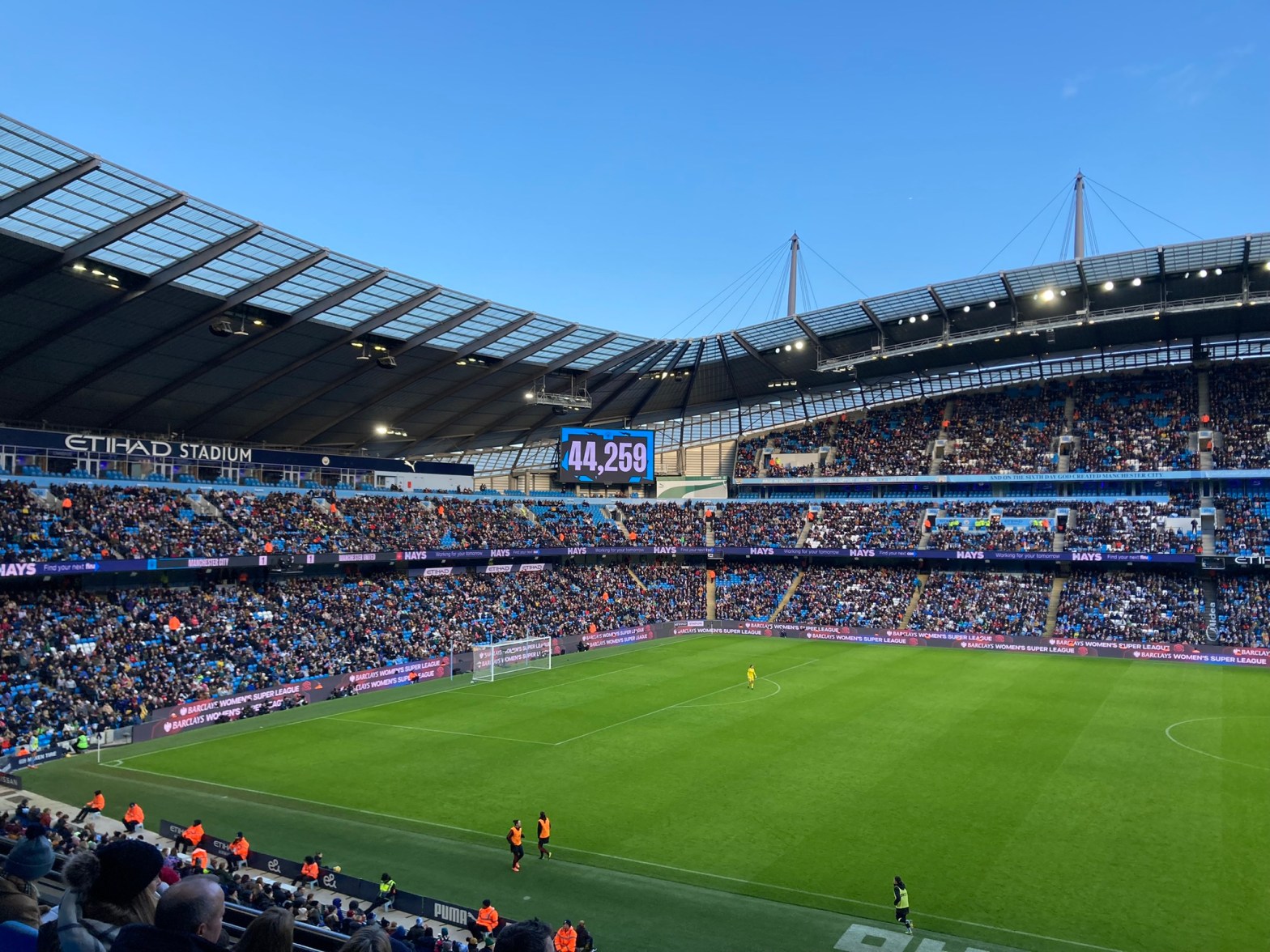
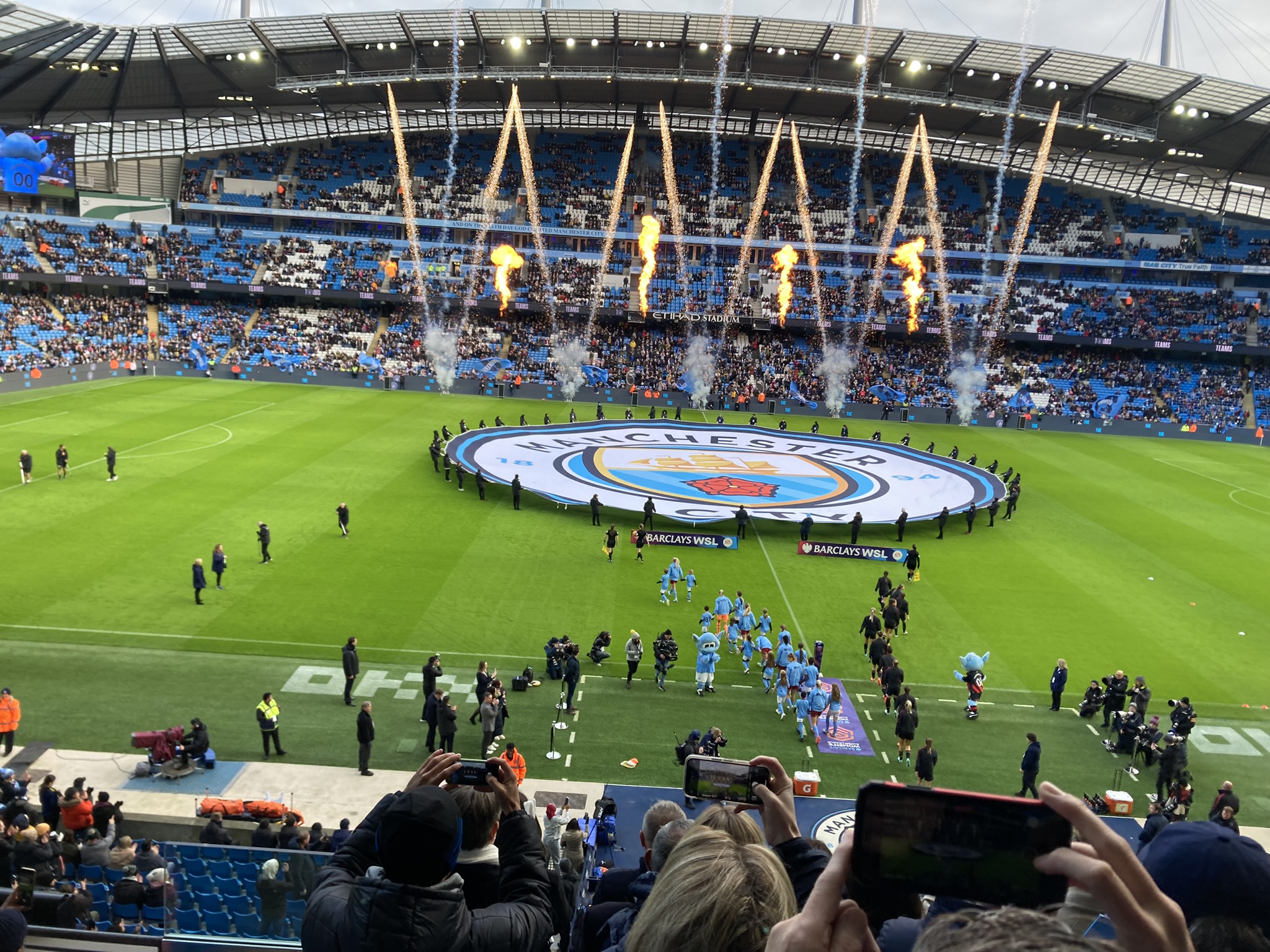
On this day (11 December) in 2022 I was at the Etihad Stadium when a new record crowd for a women’s club game in Greater Manchester was established. 44,259 watched Manchester City’s women’s team draw 1-1 with Manchester United. The attendance best all home games by Greater Manchester’s clubs; WFA Cup finals played in the area and games played by Dick, Kerr Ladies and other prominent women’s clubs over the previous 140 years or so. For those wondering the top five highest club attendances as recorded in Greater Manchester by the end of December 2022 were:

  • 44,259 City v United, Etihad, December 2022
  • 43,615 United v City, Old Trafford, November 2023
  • 31,213 City V United, Etihad, September 2019
  • 31,000 (occasionally reported as 35,000) Dick, Kerr Ladies v Bath Ladies, Old Trafford, January 1921
  • 30,196 United V Aston Villa, Old Trafford, December 2022

You can read about the first competitive women’s Manchester Derby, which occurred in 1990, here:

6-3 Manchester Derby

It was a highly memorable day for Manchester City fans as Pep Guardiola’s Blues defeated Manchester United 6-3 before 53,475 on this day (2 October) in 2022. You can watch highlights here:

https://www.mancity.com/citytv/mens/manchester-city-united-premier-league-extended-highlights-63800321

The City scorers were Phil Foden (3) and Erling Haaland (3). What a great day to be a Blue!

Mancini Leaves

Roberto Mancini has left his role as Italy’s men’s football manager. Hopefully, he’ll be back in club management soon and maybe in the Premier League too. His contribution to Manchester City’s history is huge and so I think it’s worth reposting this audio special I did a couple of years ago. It’s a special audio recording talking about the years building up to the 2011 FA Cup success brought to City by Mancini. It includes some audio I did with him back in 2011 too. Enjoy this reminder of a time when Mancini helped transform City’s fortunes.

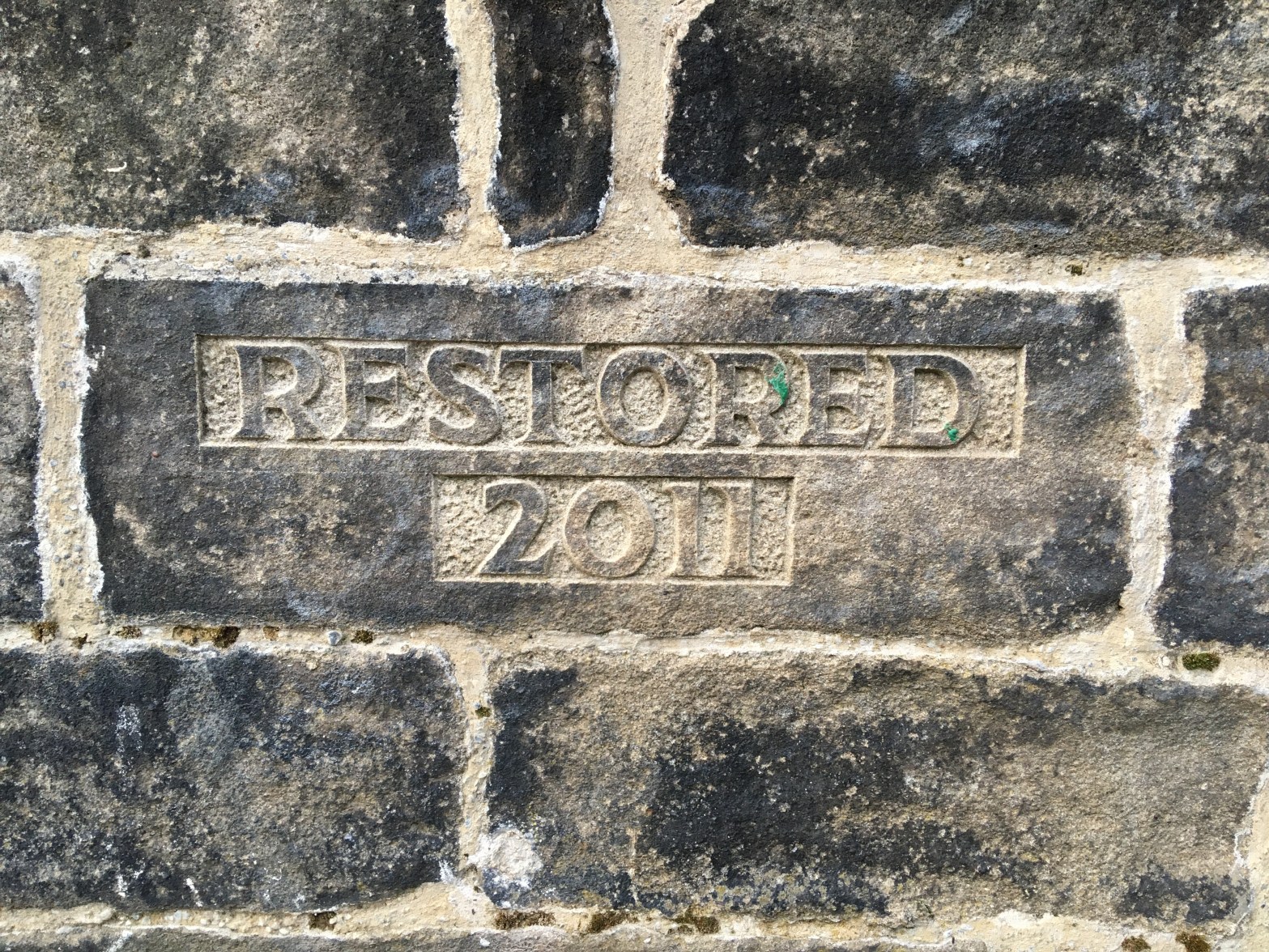
Restored 2011: The All-Manchester FA Cup Semi Final is a special 1 hour audio recording looks at the game and the years between the 1976 League Cup success and the FA Cup glory of 2011. The 2011 semi-final was a crucial step in City’s journey since the 2008 takeover and I felt it was vital to do a special marking this.

So what’s in this special recording? Well, I’ve included exclusive material from interviews and recordings I’ve done over the years with Garry Cook, Brian Marwood, Roberto Mancini, Peter Barnes and Peter Swales.  Why Swales? Well, have a listen and you’ll hear why. Basically though I’m trying to set the tone for why the 2011 FA Cup semi final victory and overcoming Manchester United was so significant.

On Mancini… I include a few words from him recorded in 2011 and at one point he talks about the view that was then being expressed that City were ‘trying’ to buy success (now they say City ‘have’ bought success!). His words are a reminder that City have been having that particular criticism thrown at them for over a decade! Oh well, I wonder how long those criticisms were laid at other clubs who had seen major investment which propelled them forward?

Anyway, get yourself a brew and be prepared to be transported back in time. Here’s the recording:

If you enjoy the recording then please let me know, comment or subscribe to the site. I’ve produced videos/talks like this highlighting key points in Manchester City’s footballing history which subscribers can watch. 

Subscribe to get access – Annual

Read more of this content when you subscribe today. It costs £20 a year to subscribe (it works out £1.67 a month) or £3 if you’d like to sign up a month at a time. Annual subscribers get full access for as long as you subscribe (you can always try it for a month). It’s worth bearing in mind that the 2010 Manchester A Football History cost £24.95 and all subscribers will be able to access all of that for as long as they are a subscriber (plus all the other stuff of course).

Subscribe to get access – Monthly

It costs £3 a month to subscribe a month at a time. Why not give it a try! Monthly subscribers get access to everything posted since 1 October 2022 for as long as you subscribe.

Match Stats for the 2011 FA Cup Semi-final

City 1-0 United (HT 0-0)

Yaya Toure 52

City: 25 Hart 04 Kompany (yellow card), 05 Zabaleta (yellow card), 13 Kolarov, 19 Lescott, 11 Johnson (Wright-Phillips 79), 18 Barry, 21 Silva (Vieira 86), 34 De Jong (yellow card), 42 Y Toure, 45 Balotelli (yellow card). Substitutes 12 Taylor, 38 Boyata, 07 Milner, 08 Wright-Phillips, 24 Vieira, 10 Dzeko, 27 Jo

United: 01 Van der Sar, 03 Evra, 05 Ferdinand, 15 Vidic, 22 O’Shea (Fabio Da Silva 84), 13 Park Ji-Sung, 16 Carrick, 17 Nani, 18 Scholes (red card), 25 Valencia (Hernandez 65), 09 Berbatov (Anderson 74). Substitutes 29 Kuszczak, 12 Smalling, 20 Fabio Da Silva, 08 Anderson, 28 Gibson, 07 Owen, 14 Hernandez

Referee: Dean

Attendance: 86,549
If you enjoy all the free material on my website and would like to support my research and keep this website going (but don’t want to subscribe) then why not make a one-time donation (or buy me a coffee). All support for my research is valued and welcome. It allows me to keep some free material available for all. Thanks.

Choose an amount

£2.50
£5.00
£7.50

Or enter a custom amount

£

Your contribution is appreciated.

Donate

Fastest Manchester Derby Goal

I’ve been asked whether Gundogan’s goal in the FA Cup final was the fastest Manchester City goal of all time. Sadly, it’s impossible to prove as we do not have accurate times for the majority of goals scored throughout football history. Often in the past reports would say things like: ‘From the kick-off City rushed forward and scored.’ No time and even when this is said in reports highlights that have been found often show that this was not the case, so it’s impossible to say conclusively.

We know it’s the fastest FA Cup final goal of all time and, at 12 seconds, it’s also the fastest goal in a Manchester derby. Back in 1975 Dennis Tueart netted what was claimed to be the fastest derby goal at 35 seconds. I interviewed him about it a few years ago:

GJ: ‘You played in lots of significant derbies over the years, but there is one, above all others, that we should mention – the November 1975 League Cup tie at Maine Road.

DT: ‘I scored the first goal after about 35 seconds and that is the fastest goal in a Manchester derby.  It was a midweek game at Maine Road and I loved night matches, under the floodlights, packed stadium.  Incredible.  The lights meant that the stadium shone out amongst the dark streets – it was the whole focus.

Dennis Tueart scores after 35 seconds v United, 1975

‘We were 1-0 up and played great football.  3-0 up after 36 minutes when I got my second goal after Asa Hartford had got City’s second. Colin Bell was injured and stretchered off which was by far the worst moment of the evening and would impact us for the next few years. 

‘After the game we went to Cellar Vie in the city centre, and I walked in and I got a standing ovation from everyone in there.  Again it hit home how important the derby was to the city of Manchester.’

Now Gundogan holds the record but we should also mention Shaun Goater who in 2003 netted after only 9 seconds of coming on as substitute. You can read about that here:

Gundogan’s goal is the fastest in a derby, while Goater’s goal was the fastest ever netted in a derby from a player’s arrival on the pitch, regardless of stage of the game.

If you’d like to read the indepth material on this website, or download the entire Manchester A Football History, Farewell to Maine Road or my first book then why not subscribe? Details here:

If you enjoy all the free material on my website and would like to support my research and keep this website going (but don’t want to subscribe) then why not make a one-time donation (or buy me a coffee). All support for my research is valued and welcome. It allows me to keep some free material available for all. Thanks.

Choose an amount

£2.50
£5.00
£7.50

Or enter a custom amount

£

Your contribution is appreciated.

Donate

The Span of Success 2023: Updated

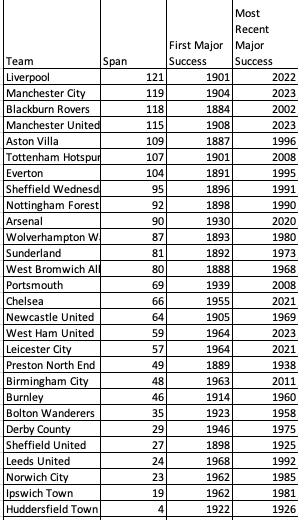
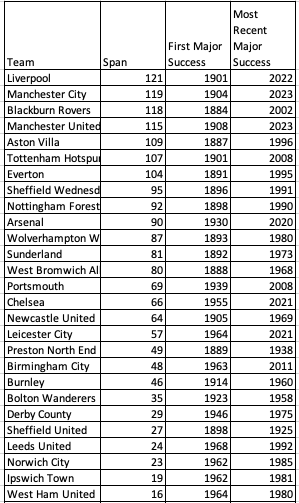
Congratulations to West Ham on your success in last night’s Europa Conference League. Great news for your club and for those clubs who wonder whether competitions like this are a drain or something to aim for. I’ve now updated the table showing the span of success – i.e. the number of years between a club’s first major success (FA Cup, League, League Cup, European trophy) and their most recent. West Ham have jumped some way up that list.

Okay, the span of success does not show how many trophies each club has won or how frequently that club has experienced great eras of success, but it does demonstrate how wrong those people are who believe certain clubs were unsuccessful until recent years, or those who think certain clubs have always been giants. The column on first major success helps to show when some clubs first became trophy-winning significant (often after transformational investment).

West Ham have proved that if you’re a club that hasn’t won a major trophy for a while putting your focus on achieving trophy success ahead of the odd Premier League position can bring significant reward. In future decades no one will remember who finished seventh, tenth or fifteenth but they will remember the trophies.

I know clubs focus on their financials but winning a trophy has longevity, gaining the odd Premier League place provides a bit of extra cash now but no long term kudos. Winning a trophy attracts new fans and brings money-spinning opportunities too.

If I was a supporter of Everton, Aston Villa or any of the other major clubs who have not found significant success in recent decades then I would absolutely want my team to go for whichever cup competition seems most likely to win. That’s what I always wanted from City before they were able to compete for the League again. Winning the FA Cup in 2011 helped everything that followed happen.

While you’re here… why not take a look at the free to read daily Maine Road features counting down to the old stadium’s 100th anniversary of its first game? Here are a sample couple of features (follow the Maine Road tag or search for more):

The Span of Success 2023

Ahead of West Ham’s European final tomorrow night (7 June) I thought I’d post the latest update to the table showing the span of success – i.e. the number of years between a club’s first major success (FA Cup, League, League Cup, European trophy) and their most recent. If West Ham win tomorrow they will leap ahead of Leicester City.

This season has seen City overtake Blackburn Rovers and they are now second to Liverpool.

Okay, the span of success does not show how many trophies each club has won or how frequently that club has experienced great eras of success, but it does demonstrate how wrong those people are who believe certain clubs were unsuccessful until recent years, or those who think certain clubs have always been giants. The column on first major success helps to show when some clubs first became trophy-winning significant (often after transformational investment).

While you’re here… why not take a look at the free to read daily Maine Road features counting down to the old stadium’s 100th anniversary of its first game? Here are a sample couple of features (follow the Maine Road tag or search for more):

The 2023 FA Cup Final – All Manchester

Well, the first all-Manchester FA Cup final has been and gone but what a day? Before any major fixture you hope that it will live up to the hype and, as a historian, I always hope that something different than normal will occur, or a record will be broken.

I’m always keen on pointing out that history is made every day and that historians have to constantly re-evaluate what stories they are telling if they want to represent and record society as it changes. I am totally against those that think history is something that doesn’t move with the times and I always try to think about those who may be experiencing something for the first time. City’s 2023 FA Cup success could easily be the earliest footballing memory for some and what a memory it will be!

As I entered the stadium the entry gate and stairway I used had the usual years and landmark moments decorating its walls and I did notice the comment about the fastest goal in a FA Cup final (it claimed Di Matteo’s goal after 43 seconds was still the record, so that needed updating even before the game!). I didn’t expect any goal to occur in the first few minutes of the game, never mind the first few seconds. More on that in a moment.

The journey to Wembley was more difficult than normal, due to the rail strike and the fact so many were going down the same routes. The route I took, mostly M1, seemed busier than normal (normal – it’s ‘normal’ going to Wembley now!) but it was mostly City fans I saw. I’m sure others experienced something else but for me there were the occasional United vehicles. Most of the cars and coaches that I saw with colours showing (scarves out the window is an absolute must on days like these for many of us!) were blue not red. That reminded me a lot of the 2011 FA Cup semi final when every City car we saw was full of happy, laughing, smiling City fans pre-match but United fans seemed more serious or concerned with what the day would bring. The similarities between the two days were striking.

Traffic jams meant the journey was longer than anticipated but once we parked up in our usual spot (‘usual’, ‘normal’ – I hope that never changes) we were ready. A quick wander around was followed by buying the programme. I had two articles in this year’s FA Cup final programme – one on City & United’s first FA Cup successes in 1904 and 1909 and another was a peaks and troughs sort of timeline. Both pieces were neutral and I was delighted to be asked to contribute to the programme once more.

Inside the stadium the tickets we had bought were up at the back of level 5 block 546. Coincidentally just before kick off the people on the row behind us arrived and one was Ian Brightwell, one of the players when City defeated United in the only previous All-Manchester FA final (that was the 1986 FA Youth Cup).

As for the game. Well, what an opener! We’d not had chance to settle really when Gundogan netted that wonderful strike. I remember looking straight up to the video screen and seeing the clock change from 12 to 13 seconds. Incredible.

As Brightwell was behind me I couldn’t resist turning to him and saying ‘I see Gundogan “just wellied it!” like you did in 1990.’ For those that don’t remember or are too young Brightwell did a similar goal from several yards out in an Old Trafford derby in 1990. Afterwards while being interviewed he was asked about the goal but the interview kept being interrupted and so he had to answer the question multiple times. On the last occasion he simply answered: ‘I just wellied it!’ and the phrase entered City folklore.

There was the penalty given to United of course – I won’t go into the rights and wrongs of that but i do want to mention VAR. I find it absolutely ridiculous that those of us who have spent considerable time and effort in getting to Wembley and attending the final are the ones who knew least about what was going on. We had nothing on the screen to tell us a check was in progress; we had no opportunity to see the video clips and we only knew it was being reviewed when the ref stopped the game (after some time too! What if a player had been injured or another goal had been scored in the meantime?) and went over to the monitor.

The moment he headed towards the monitor we knew something was going to be given because I can’t think of a time when a ref has stuck to his guns in England (I’m sure it’s happened but I don’t remember).

The penalty changed the mood for a while, but City fans were in good voice when the second half started and it seemed inevitable then that the Blues would score again. I don’t think any of us expected Gundogan to be the man again but over these last few months he’s clearly led by example. He deserved the man of the final award and hopefully he’ll get further honours this season.

So the game ended 2-1 and City have achieved a coveted double again (last time was the only time an English club had won a domestic treble!). Brilliant work City and the season isn’t over yet!

It was wonderful to see the players celebrate. Those celebrations on the pitch demonstrated how much this all meant to them. People often try to suggest a domestic cup isn’t anything special but it absolutely is. How many of us have ever won a FA Cup? These players were outstanding and deserve tremendous praise, as does the manager of course.

People talk about money but City are not the biggest spenders either in actual outflow terms or in net spend terms. Like Alex Ferguson and United in the late 1980s/early 1990s, City have spent money on players to find success. Also, like United at that time trophy success brings additional income, gate receipts, prize money, sponsorship etc. which in turn can be used to invest in youth development and finding ways to sustain success. There’s no point going on about this but I do wish that people looked at the history of football and focused on fact rather than the fiction that often gets spouted.

On the way home there was a lot of talk on the radio about possible trebles and it was interesting that almost every phone-in I could find was trying to compare United’s 1999 treble with the possibility of City winning one this season. Who knows how Saturday will go and I won’t get drawn into that but I do want to say that United winning the treble was an incredible achievement. If City manage to do the same this year then that will also be an incredible achievement. So much has changed in 24 years that comparisons are ridiculous.

Actually, I did hear on the radio one presenter go on about how City have spent because ‘in 1999 when United were winning their treble they were getting promoted’ (paraphrased but basically that comment). Had I been able to call in I might have done because 24 years ago that is true but it is also true that 24 years before 1999 United were also getting promoted. It’s a similarity people have overlooked, but if somehow it is wrong for City to go from struggling team to potential treble winners in 24 years then surely it would also be wrong for United to do the same? Ah well! Facts not fiction.

When City got back to Manchester they were greeted by Elton John who, it has been said, waited to meet and congratulate them. The videos and photos are wonderful to watch. Noel Gallagher may have to watch out – usually he’s the one singing along with Pep and the players after a major trophy success.

While you are here why not have a look at the 100 day countdown I’m doing to mark the centenary of Maine Road’s first game? You can do a search on Maine Road or start by looking at this one:

Getting Ready For Wembley

Looking forward to the first ever all Manchester FA Cup final at Wembley tomorrow. To get in the mood why not watch the highlights of the 2011 FA Cup semi here (follow the link):

Prior to this year’s final, the FA Cup semi finals in 1926 and 2011 were the closest we got to one. I wasn’t around in 1926 but I definitely was in 2011! So a couple of years ago I made this special audio recording talking about the years building up to the semi and the day itself from a Manchester City perspective. Many of you have listened to this already but if you haven’t then it tells the story of the 2011 FA Cup semi final and the years between 1976 and that moment in 2011 for City.

I include audio from interviews I did with a variety of people including Khaldoon, Peter Swales, Garry Cook, Brain Marwood and many others.

If you have heard it before then maybe you should listen again to remind yourself of how we all felt and why that game was so significant.

I include a few words from Roberto Mancini recorded in 2011 and at one point he talks about the view that was then being expressed that City were ‘trying’ to buy success (now they say City ‘have’ bought success!). His words are a reminder that City have been having that particular criticism thrown at them for over a decade! Oh well, I wonder how long those criticisms were laid at other clubs who had seen major investment which propelled them forward?

Anyway, get yourself a brew and be prepared to be transported back in time. Here’s the recording:

If you enjoy the recording then please let me know, comment or subscribe to the site. If you don’t fancy doing that then there’s also the option to make a welcome donation to keep this site going (see below). I’ve produced videos/talks like this highlighting key points in Manchester City’s footballing history which subscribers can watch too. 

If you enjoy all the free material on my website and would like to support my research and keep this website going (but don’t want to subscribe) then why not make a one-time donation (or buy me a coffee). All support for my research is valued and welcome. It allows me to keep some free material available for all. Thanks.

Choose an amount

£2.50
£5.00
£7.50

Or enter a custom amount

£

Your contribution is appreciated.

Donate


Subscribe to get access – Annual

Read more of this content when you subscribe today. It costs £20 a year to subscribe (it works out £1.67 a month) or £3 if you’d like to sign up a month at a time. Annual subscribers get full access for as long as you subscribe (you can always try it for a month). It’s worth bearing in mind that the 2010 Manchester A Football History cost £24.95 and all subscribers will be able to access all of that for as long as they are a subscriber (plus all the other stuff of course).

Subscribe to get access – Monthly

It costs £3 a month to subscribe a month at a time. Why not give it a try! Monthly subscribers get access to everything posted since 1 October 2022 for as long as you subscribe.

Match Stats for the 2011 FA Cup Semi-final

City 1-0 United (HT 0-0)

Yaya Toure 52

City: 25 Hart 04 Kompany (yellow card), 05 Zabaleta (yellow card), 13 Kolarov, 19 Lescott, 11 Johnson (Wright-Phillips 79), 18 Barry, 21 Silva (Vieira 86), 34 De Jong (yellow card), 42 Y Toure, 45 Balotelli (yellow card). Substitutes 12 Taylor, 38 Boyata, 07 Milner, 08 Wright-Phillips, 24 Vieira, 10 Dzeko, 27 Jo

United: 01 Van der Sar, 03 Evra, 05 Ferdinand, 15 Vidic, 22 O’Shea (Fabio Da Silva 84), 13 Park Ji-Sung, 16 Carrick, 17 Nani, 18 Scholes (red card), 25 Valencia (Hernandez 65), 09 Berbatov (Anderson 74). Substitutes 29 Kuszczak, 12 Smalling, 20 Fabio Da Silva, 08 Anderson, 28 Gibson, 07 Owen, 14 Hernandez

Referee: Dean

Attendance: 86,549
The All-Manchester FA Cup Final

Well, the Premier League is now over for another year and we know who the Champions are and who has qualified for Europe etc. so it’s time to look forward to the first ever all Manchester FA Cup final. There have been FA Cup finals between two teams from present day Greater Manchester before (the first one being City v Bolton in 1904) but this is the first to involve both Manchester clubs.

Prior to this year’s final, the closest Manchester City and Manchester United have got to playing each other in a Wembley FA Cup final were the FA Cup semi finals in 1926 and 2011. I wasn’t around in 1926 but I definitely was in 2011! So a couple of years ago I made this special audio recording talking about the years building up to the semi and the day itself from a Manchester City perspective. Many of you have listened to this already but if you haven’t then it tells the story of the 2011 FA Cup semi final and the years between 1976 and that moment in 2011 for City.

I include audio from interviews I did with a variety of people including Khaldoon, Peter Swales, Garry Cook, Brain Marwood and many others.

If you have heard it before then maybe you should listen again to remind yourself of how we all felt and why that game was so significant.

I include a few words from Roberto Mancini recorded in 2011 and at one point he talks about the view that was then being expressed that City were ‘trying’ to buy success (now they say City ‘have’ bought success!). His words are a reminder that City have been having that particular criticism thrown at them for over a decade! Oh well, I wonder how long those criticisms were laid at other clubs who had seen major investment which propelled them forward?

Anyway, get yourself a brew and be prepared to be transported back in time. Here’s the recording:

If you enjoy the recording then please let me know, comment or subscribe to the site. If you don’t fancy doing that then there’s also the option to make a welcome donation to keep this site going (see below). I’ve produced videos/talks like this highlighting key points in Manchester City’s footballing history which subscribers can watch too. 

If you enjoy all the free material on my website and would like to support my research and keep this website going (but don’t want to subscribe) then why not make a one-time donation (or buy me a coffee). All support for my research is valued and welcome. It allows me to keep some free material available for all. Thanks.

Choose an amount

£2.50
£5.00
£7.50

Or enter a custom amount

£

Your contribution is appreciated.

Donate


Subscribe to get access – Annual

Read more of this content when you subscribe today. It costs £20 a year to subscribe (it works out £1.67 a month) or £3 if you’d like to sign up a month at a time. Annual subscribers get full access for as long as you subscribe (you can always try it for a month). It’s worth bearing in mind that the 2010 Manchester A Football History cost £24.95 and all subscribers will be able to access all of that for as long as they are a subscriber (plus all the other stuff of course).

Subscribe to get access – Monthly

It costs £3 a month to subscribe a month at a time. Why not give it a try! Monthly subscribers get access to everything posted since 1 October 2022 for as long as you subscribe.

Match Stats for the 2011 FA Cup Semi-final

City 1-0 United (HT 0-0)

Yaya Toure 52

City: 25 Hart 04 Kompany (yellow card), 05 Zabaleta (yellow card), 13 Kolarov, 19 Lescott, 11 Johnson (Wright-Phillips 79), 18 Barry, 21 Silva (Vieira 86), 34 De Jong (yellow card), 42 Y Toure, 45 Balotelli (yellow card). Substitutes 12 Taylor, 38 Boyata, 07 Milner, 08 Wright-Phillips, 24 Vieira, 10 Dzeko, 27 Jo

United: 01 Van der Sar, 03 Evra, 05 Ferdinand, 15 Vidic, 22 O’Shea (Fabio Da Silva 84), 13 Park Ji-Sung, 16 Carrick, 17 Nani, 18 Scholes (red card), 25 Valencia (Hernandez 65), 09 Berbatov (Anderson 74). Substitutes 29 Kuszczak, 12 Smalling, 20 Fabio Da Silva, 08 Anderson, 28 Gibson, 07 Owen, 14 Hernandez

Referee: Dean

Attendance: 86,549