The 2009-10 Manchester League Cup Semi-finals

On this day (19th January) in 2010 it was the first leg of the all-Manchester League Cup semi final… Back in 1991, together with Steve Cawley, I published The Pride Of Manchester (the history of the Manchester Derby). Ever since then there’s been a desire to update the book to include recent seasons. A few years ago Steve and I did start the process of updating the book but, sadly, we could not find a publisher prepared to produce the book. So, as we’re about to see another League Cup semi-final between City and United, I’ve decided to post here the text we wrote for the 2009-10 League Cup semi-finals. Both legs are covered in this piece which is available to anyone who subscribes to this site (£3 per month or £20 per year – about £1.67 per month – for that subscribers get full access to all posts published so far plus all new posts for the period of their subscription).

Here goes…

Subscribe to get access

Read about the 2009-10 League Cup semi-final and all other content when you subscribe.

‘False Number 9s’

Today I’m going to discuss an element of Manchester City’s 1950s period that bears significance to today. In essence a tactical innovation that the Blues – and star player Don Revie – became renowned for: The Revie Plan or, using modern day phraseology, the False 9.

This is a subscriber article. It costs £3 a month to subscribe OR take out an annual subscription at £20 (works out about £1.67 a month). All subscribers get full access to everything throughout their subscription.

Subscribe to get access

Read more of this content when you subscribe today.

Premier League Domination?

Recently it has been fashionable for some to talk of the Premier League being dominated by a single club or that the competition is no longer as entertaining as it was because the same old club(s) win the League. Well, this is absolute balderdash of course, but rather than simply say that I thought I’d look at the facts and the supporting evidence. So, if you’re someone who thinks football is more one sided today than it’s ever been, or someone who wants to challenge those who do, then please read on…

The idea that the League is a one club competition is usually stated in relation to Manchester City these days and recently, as City have increased their lead at the top, the view has been expressed over and over again by rivals and some journalists. Yet, the evidence shows otherwise. 

Firstly, at the time of writing Manchester City are 10 points clear of second placed Chelsea. However, if Liverpool win their game in hand then City will be only 8 points clear. I say only because 8 points is less than 3 victories difference and City still have to play both Chelsea and Liverpool, plus of course other potential rivals including Manchester United. 

I also say ‘only’ because we can all come up with seasons when one club has been eight points or more ahead and still lost the League – Manchester United fans will not need reminding about how far ahead they were in the 2011-12 title race as it entered its final weeks, only to see City snatch the title in dramatic fashion. 

Eight point leads are great to have but, at this point in a season, they do not mean you will be successful. Personally, I hope City are successful but no one seriously believes the title race is over and if they do then they really have not watched enough football!

Alongside the ridiculous view that the League is over there has been a frequently aired view that the League title is less competitive now than at any other time in history. Again, this is a ridiculous view that does not match with the evidence.

Much has been said by City’s rivals and others about how having one team dominating can be boring for English football. Whether that’s true or not is debateable but it’s worth pointing out that since City first won the Premier League in 2012 then five different clubs have won the competition (three of these being first time Premier League champions too!).

Five teams in a decade may not sound like much variety to some but it is better than the 2000s (1999-00 to 2008-09) when only three clubs won the League. Even worse between 1995 and 2004 either United or Arsenal won the title and their duopoly was only broken up when Chelsea became a force following their investment. Even then only those three teams won the League between 1994 and City’s first PL title in 2012! 

Had Chelsea not come along would United and Arsenal still be the only teams winning the League? The investment in both Chelsea and City has helped open up the League and, with a greater variety of clubs challenging, the League is now much more open. At the start of each season there are more teams perceived as potential title challengers than in the 2000s.

Did anyone say back when United and Arsenal had a duopoly at the top that the League was boring because it was the same old champions? I don’t remember leading journalists say that then so why now when the PL has had more variety of winners?

Even if City’s rivals or those critical of City’s success accept that United and Arsenal dominated the League back in the 2000s until the ‘new money’ of Chelsea and City came along they tend to suggest that previous decades had enjoyed more variety. Well some did but not all. The 1980s are perceived as an era when the League was varied yet only four clubs won the League during that decade (1979-80 to 1988-89). 

So the last decade has not been such a one-sided race after all and is better than the 1980s and 2000s for a start.

Those figures may surprise or shock some who believe City’s rivals or those who promote the view that City dominate the League like no other club ever has. However, I’m sure some will say ‘but it’s not just about League titles, it’s about trophy hauls too!’

Well, as a Manchester City fan I am proud of the success City have achieved during the last decade and I also recognise that they have not dominated in a way that other clubs have in previous periods. 

In terms of the most successful club of each era, well, Chelsea and City have clearly been the most successful during the 2010s (2009-10 to 2018-19). Their trophy hauls during this time are (excluding one-off competitions like the Community Shield or European Super Cup):

Chelsea: 10 major trophies (includes 3 major European trophies).

City: 10. 

Thinking of domination, it is worth highlighting that neither side has yet won as many trophies in a single decade as Manchester United did between 1989-90 and 1998-99 when they won 12 trophies. They also won ten trophies in the decade that followed. 

Again, I don’t remember negative coverage of United’s domination but somehow it seems fair to say Manchester City dominate today yet their trophy haul has not reached the heights of United yet, plus their trophy haul during the 2010s was the same as Chelsea’s anyway (and since then Chelsea have won another European Champions League of course!).

But what about earlier decades and domination? Well, the 1970s (all trophies won in 1969-70 and 1978-79) – an era generally regarded as one of great variety with several clubs challenging – Liverpool won three times as many trophies as their nearest rivals (Manchester City were actually joint-second most successful English club during that period!). 

Those who have claimed in recent seasons that having one team dominating is boring may want to think back to how they felt during previous decades. 

Each era has its own successful teams but these vary over the decades with no club being regarded as a dominant club throughout its entire history. We’ve all experienced fallow periods or times of struggle, though some may not want to remember that.

Today, no team dominates English football (who remembers all those voices earlier this season telling us how open the League would be or that Liverpool/Chelsea/City/United/Tottenham would be victorious? All of whom could still win the League this year of course!).

There are plenty of issues with English and European football but can we all please remember that football domination has happened in the past and that the situation today is not as one (or two) sided as it was in some past decades. 

Subscribe to get access to further content

Read more of this website when you subscribe today. It costs £3 per month or £20 a year and you get PDFs of the entire Manchester A Football History plus hundreds of other articles, interviews etc.

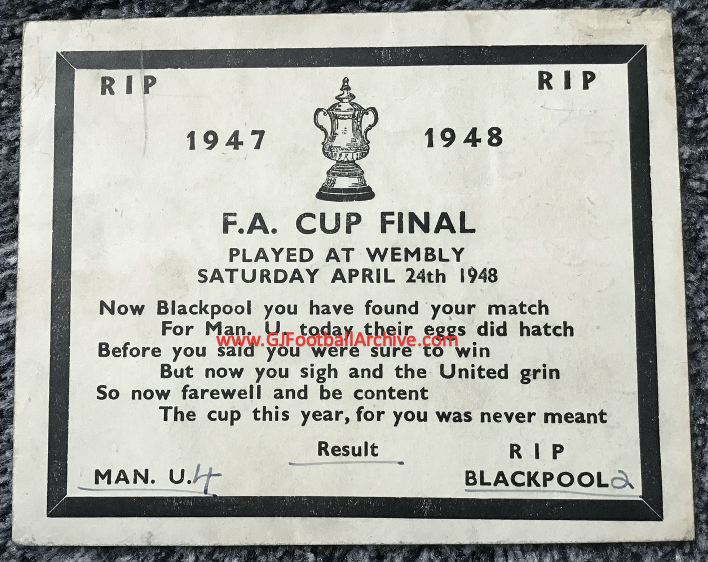
Memorial Cards: Sledging Rivals in 1912

It is believed the memorial card seen here was printed to mark Manchester United’s 2-0 victory over Manchester City on December 28 1912. Cards like these were popular at most high profile games and in Manchester there was a significant industry behind football funeral cards.

They seem a bit macabre today in our half-half friendship version of professional football but back then cards were used to highlight games frequently. I’ve written and talked a lot on this over the years.

Here for subscribers I’d like to provide an overview of the industry, how it existed, what activities were carried out and provide a potted history of the funeral card business. This is about 3,500 words, so get yourself a brew and settle down to read…

Subscribe to get access

Read more of this and everything else on the site when you subscribe. It costs £20 a year or £3 a month to subscribe and you can access exclusive interviews, articles and more.

Climbing the Golden Stairs

I’ve always liked this cartoon since finding it during research back in 1989. It represents a game played on Boxing Day between Manchester City and Newton Heath (who later reformed as Manchester United in 1902). Manchester’s Blues won the match 4-0 and the cartoon was captioned ‘Climbing the Golden Stairs’. That caption referred to a promotion challenge.

At the season’s end City were promoted as Second Division champions, becoming the first Manchester side ever to gain promotion and the first to win a national competition of course. Newton Heath finished fourth in the Second Division while near neighbours Glossop were promoted in second place behind City.

Search the archive to read more about 1898-99 and about some classic derby matches too.

‘The “Missus” gets her wages’ – Christmas Day 1904

Here’s an interesting snippet from an article I found while researching something else. It was published in the Umpire newspaper on Christmas Day 1904. John Bentley, more commonly known as JJ Bentley, was a Manchester United & Bolton manager who also wrote for a variety of newspapers. He was often perceived as a knowledgeable football man and his views influenced many. If ‘JJ’ said something it was usually accepted as fact. So, when in 1904 there had been criticism of the money working class men were spending on football he spoke out.

As you can see by this brief cutting Bentley used his column to claim that the wives of working class men benefited by their husbands going to football because it meant he didn’t go and spend his money in the pub! Consequently, she got her housekeeping! What a ridiculous argument!

Can you imagine the justifiable furore today if Gary Lineker or similar said something like this? There are so many aspects to this simple piece that could be explored but perhaps I’ll save that for another day. It is also worth noting that many women did attend football matches themselves back then too.

Ah well! Happy Christmas.

Review of Barnes Biography

For those still wondering whether my biography of Peter Barnes is worth getting, here’s a fairly typical review that appeared last month. Enjoy! Also thanks to Ian Farrell for reviewing this in When Saturday Comes. Ta!

On This Day in 1913 – MCFC v MUFC

A ticket that may interest a few MCFC & MUFC collectors. This is for the Lancashire Cup semi final replay between City and United played at Hyde Road on this day (November 24) in 1913.  Both the initial semi final and the replay were played at Hyde Road with the first game ending in a 1-1 drawn before approximately 8,000. The replay was watched by 12,000 and ended in a United 2-0 win.

November 1920 and A Controversial Offer by MUFC

Back in November 1920 Manchester City’s main stand at Hyde Road was destroyed by fire. City asked United if they could move to Old Trafford but their terms were prohibitive according to the media of the day. This report was typical of the reaction. You can read the full story in Manchester A Football History which subscribers to GJFootballArchive.com get as part of their subscription. For more details see: https://gjfootballarchive.com/2021/01/09/manchester-a-football-history-part-one/

Historic Name That Ground – Week 21 Answer

On Monday I asked if you could name this ground. I said: ‘I know it’s a tough one BUT… there’s a reason I’ve chosen this week to post this image plus eagle-eyed visitors to this site may notice that I have actually used part of this image before in connection with another story. So where is it?’ The answer is…

Manchester City’s old Hyde Road ground. So did you work out why I’ve posted the image this week and what the previous story I’d used part of this image for was in connection with? Well this equivalent week in 1920 saw the stand featured being built. This is the only known surviving photo of Hyde Road’s temporary Main Stand built in the week following the Hyde Road fire.

The Main Stand was destroyed on the night of the November 6 by fire and, after attempts to move to United’s Old Trafford failed as a result of United demanding an exorbitant rent. For the full story of this see this chapter of Manchester A Football History (available with the rest of the book as a download for subscribers):

Manchester A Football History part 13

City didn’t think the rent was fair (neither did the media – again see that chapter of Manchester A Football History) and so they decided to soldier on at Hyde Road. A new stand – the one seen from the back here – was constructed using wood.

So, what about the previous story part of the image was used for? That was a piece about Billy Meredith returning to City in July 1921. Meredith is the player on the far right and this photo was taken to show him back at Manchester City.

Watch out for another Historic Name That Ground on Monday.

While you’re here why not subscribe to my site and you can then access every article, interview, audio recording etc. already posted and those that will be posted during your subscription. It costs £20 per year (about £1.67 a month) or you can sign up on a monthly basis at £3 per month (you can cancel at any time, so you could sign sign up for a month, access everything you want and then cancel). You can subscribe below:

Subscribe to get access

Read more of this website including all of Manchester A Football History and my first book, From Maine Men To Banana Citizens, when you subscribe today.