Video Talk on History of Football in Manchester

I didn’t realise this was available but here’s film of a talk plus Q&A I did about the early history of football in Manchester. It’s of interest to anyone keen on the origins of football or any of the Manchester clubs… Indeed the social history of Manchester. It lasts about 55 minutes and was part of the promotional work connected with my book ‘The Emergence of Footballing Cultures: Manchester 1840-1919’, published by Manchester University Press.

Here’s the recording:

If you are interested in the book then that can be bought direct from Manchester University Press or via usual retailers, such as Amazon:

You can find a list of my other books here:

Where Were You?

On this day (January 20) in 1900 the attendance stats (see image) seen here were published in various newspapers. Of course, as a historian who researches these sorts of things it does not surprise me at all that Manchester City were the best supported club at this stage. However, I can understand why some may have been surprised back then. City had only just been promoted for the first time the previous season.

In the end Manchester’s Blues ended the season as the third best supported club with an average of 16,000 (League champions Aston Villa attracted 19,825 and 5th placed Newcastle 16,725). City ended the season 7th in the top division.

For those wondering Newton Heath (Manchester United) averaged 6,225 and were the 16th best supported club. Liverpool averaged 11,325 and were 5th best supported club.

The First ‘Manchester Derbies’

Back in 1881-82 the two teams that would eventually become Manchester City and Manchester United met for the first time with the first fixture occurring on this sate (12th November 1881). To mark this anniversary here’s a free article on the first two derby matches. Both were friendlies of course!

The First Time

Back in 1881-82 the two teams that would eventually become Manchester City and Manchester United met for the first time. This was only a year after the first reported games played by the clubs, then known as St Mark’s (MCFC) and Newton Heath (MUFC). The first St Mark’s game to make it into print was against Macclesfield Baptists on 12th November 1880 while Newton Heath’s earliest known game came seven days later against Bolton Wanderers’ 2nd team.

On the anniversary weekend of St. Mark’s first reported game, 12th November 1881, Newton Heath and West Gorton (St Mark’s) met for the first time.  The game, played at North Road, Newton Heath, attracted an attendance of around 3,000 (according to details recorded many years later – I’m dubious about the number but we have nothing contemporary that’s accurate so we’ll go with that).  

The ‘Heathens’, who went on to become Manchester United in 1902, defeated West Gorton (St. Mark’s) 3-0 in what was described as a ‘pleasant game’.  I wonder what the reporter would make of 21st Century derby matches!  Two goals were scored in the first half, one being an own goal by one of West Gorton’s ‘backs’.  It is not reported who scored the goal, all the ‘Ashton Reporter’ match report says is that the player was “attempting to stop a shot by E. Thomas”.  

One of the significant aspects of the way this game was reported which has created some confusion over the years concerns the St. Mark’s name.  It was recorded as West Gorton (St. Mark’s) as opposed to St.Mark’s (West Gorton) and that change has caused some to suggest that the church were unhappy in some way with the club.  There was a suggestion that the club was attracting players from outside of the parish and that was an issue, but none of this now appears to be correct.  The church appeared to be happy with the way the side was developing and, if anything, the selection of Kirkmanshulme Cricket ground actually meant the team were playing fairly close to the St. Mark’s rectory.  The move potentially increased the opportunity for spreading the church’s work and that may be why the person sending in the match reports to the local newspaper changed the emphasis.

The Return Match

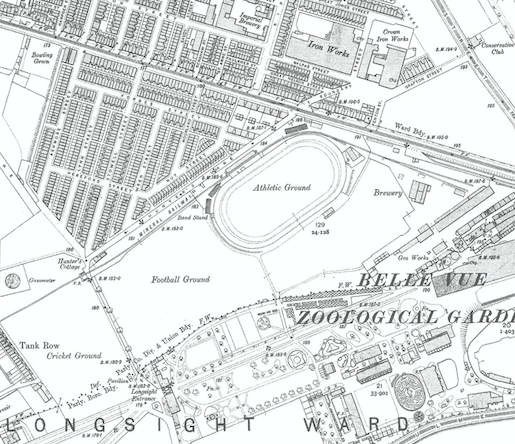
The return match took place at the Kirkmanshulme Cricket ground (West Gorton’s home) on 4th March 1882. On the image above this is the cricket ground to the right of Tank Row (and left of Belle Vue Zoo).  

West Gorton (St Mark’s) gained revenge for the 3-0 defeat in their first encounter, as they overturned Newton Heath 2-1. The Gortonians had managed to take the lead, via Charles Beastow, as early as the eighth minute, and then had to hold off the Heathens who had been awarded a couple of consecutive corners.  The second actually lead to West Gorton’s second goal.  James Collinge obtained possession in front of the West Gorton goal then proceeded to run the full length of the pitch, before sending the ball flying between the Heathens’ posts amid loud cheering.  

The score remained 2-0 until late in the game when, according to reports, the Heathens baffled the home ‘keeper Edward Kitchen by performing several good passes before the ball entered the goal.  Exactly how baffled Kitchen was we don’t know, but we do know that this game was well attended.

Years later the attendance that day was reported as ‘around 5,000’, although it would be unfair and ridiculous to suggest that this was the actual attendance.  It seems incredible that around a sixth of Gorton’s population would have been able to attend a game which, at that point, was not regarded as a ‘derby’ or an important fixture whatsoever.  Nevertheless. it does provide an indication that football in West Gorton was becoming popular.

Subscribe to access everything else

This has been a sample of the material on http://www.GJFootballArchive.com If you would like to read all the in-depth articles (including the entire Manchester A Football History book and the audio interview with John Bond) then please subscribe. It works out about £1.67 a month if you take out an annual subscription (£20 per year) or £3 a month if you’d like to sign up for a month at a time. Each subscriber gets full access to the hundreds of articles posted so far and the hundreds scheduled to be posted in the coming weeks.

Manchester A Football History part 5

This is the fourth chapter of the 2010 edition of the book Manchester A Football History (Gary James, published by James Ward). Subscribers get full access to this; every earlier chapter; every upcoming chapter; and all other material on http://www.GJFootballArchive.com for as long as they subscribe.

As with everything else on this site copyright laws apply. The book is published here for the personal use of subscribers to this site. For any other use please email the publishers at info@manchesterfootball.org

Subscribe to get access

If you would like to view Manchester A Football History then please subscribe below. It works out about £1.67 a month if you take out an annual subscription (£20 per year) or £3 a month if you’d like to sign up for a month at a time. Each subscriber gets full access to the 150+ articles posted so far and the hundreds scheduled to be posted in the coming weeks.

Manchester’s Footballing Pioneers, 1863–1904: A Collective Biography

ABSTRACT: Association football had become a prominent part of Manchester’s sporting landscape by 1904 when Manchester achieved its first national success. Its journey had been difficult, relying on the efforts of several key individuals whose relentless determination to widen the sport’s participation ensured the game succeeded. This paper provides an analysis of three pioneering figures, John Nall, Fitzroy Norris, and Joshua Parlby, who took the game from its formalized inception in the region through to its first national successes, considering their class, experience, shared history, and connections, while analyzing what these narratives add to the wider origins of football debate. The author concludes that football’s emergence depended primarily on the activities of key individuals from varying backgrounds who provided the energy, enthusiasm, and organizational structures necessary, while relying on cross-class connections, to establish the game within a region.

If you would like to read the full article and other pieces like this then please subscribe below. It works out about £1.67 a month if you take out an annual subscription (£20 per year) or £3 a month if you’d like to sign up for a month at a time. Each subscriber gets full access to the 100+ articles posted so far and the hundreds scheduled to be posted in the coming weeks.
Subscribe to get access

Read this article when you subscribe today.

FA Cup success, football infrastructure and the establishment of Manchester’s footballing identity

ABSTRACT: Contemporary Manchester is recognized internationally as a footballing city, with both Manchester United and Manchester City acknowledged as prominent clubs. However, the city has not always been a force in the game, nor has the game always been important across Manchester’s social spectrum. This paper examines how Manchester first became established as a footballing city, identify- ing that success in the FA Cup in 1904 stimulated interest in the game and con- siders how the legacy of that victory enabled the game to develop in terms of participation and spectating. It also considers the social mix of attendees at pro- fessional games in the city, and closes by concluding that footballing success generated increased interest and was the catalyst for improvement in the infra- structure for both participation and attendance, enabling Manchester’s footballing identity to become established.

If you would like to read the full article and other pieces like this then please subscribe below. It works out about £1.67 a month if you take out an annual subscription (£20 per year) or £3 a month if you’d like to sign up for a month at a time. Each subscriber gets full access to the 100+ articles posted so far and the hundreds scheduled to be posted in the coming weeks.
Subscribe to get access

Read this article when you subscribe today.

The First Competitive Manchester Derby (Season 1891-1892)

DATE 3rd October 1891

COMPETITION FA Cup 1st Rd (Qualifying)

VENUE North Road

ATTENDANCE 10,000

NEWTON HEATH 5 (Sneddon, Doughty, Farman 2, Edge)

ARDWICK 1 (Pearson)

Subscribe to get access

Read more of this content when you subscribe today. If you’d like to support my research then why not subscribe? Every subscription directly helps support my research and provides annual subscribers with access to everything posted on this site, including the entire Manchester A Football History and From Maine Men To Banana Citizens books, plus interviews, articles and more. I am not employed by anyone and all my research is self funded or comes from subscriptions to this site.

Subscribe to get access

Read more of this content when you subscribe today. You can subscribe at either £20 per year (above) or at £3 per month here (cancel any time). For those subscribing £3 per month you will be able to access all content from October 2022 onwards for as long as you are a subscriber. Those subscribing £20 a year have access to everything posted since December 2020.

Stephen Preston

Mancunian Stephen Preston was, apparently, playing football near the New Inn, Ancoats, when United official Fred Palmer was walking by.  Palmer stopped to watch and was impressed with centre-forward Preston.  The player was signed up and on 7th September 1901 he made his mark with two goals on his debut against Gainsborough Trinity.

Subscribe to get access

Read more of this content when you subscribe today.

Subscribe to get access

Read more of this content when you subscribe today.

Tom Leigh

After a career that had seen him play for Burton Swifts and New Brighton Tower Tom Leigh joined Newton Heath in March 1900.  He made his debut in snowy conditions at Bank Street against Barnsley on 17th March 1900.  He scored in a 3-0 win (Joe Cassidy netted twice) before a crowd of about 6,000.

Subscribe to get access

Read more of this content when you subscribe today.

Subscribe to get access

Read more of this content when you subscribe today.

Henry Boyd

The first player to pass the twenty goals a season mark for the Heathens in the League, Scotsman Henry Boyd arrived at Bank Street in January 1897.  Previously he had developed a decent reputation at West Bromwich Albion and Royal Arsenal.

He made his Newton Heath debut on 6th February 1897 against Loughborough Town a memorable one as he scored one of the Heathens goals in a 6-0 victory.  He ended his first season with five goals from ten appearances but it was the following season when he really made his mark.

Boyd’s hat-tricks in the opening two games of the 1897-98 season set the standard, and he ended the campaign with 22 goals from 30 games (he was an ever-present) overshadowing hero Joe Cassidy who had netted 14.

Despite the positives behind the scenes there were a few issues with the Club’s new goalscoring star.  He missed training at the start of 1898-99 and was suspended for a week as a result.  The story goes that he was so appalled at the suspension that he went missing with the Club only learning of his whereabouts when he sent officials a telegram from Glasgow.  Further suspensions followed and he was placed on the transfer list.

In August 1899 he became a Falkirk player.  His last season at Bank Street had seen him make 12 appearances and score five goals.  His last goal came in the 2-0 defeat of Small Heath on 25th February 1899.

Leading Newton Heath League Scorer in: 1897-1898 – 22 goals, 30 appearances