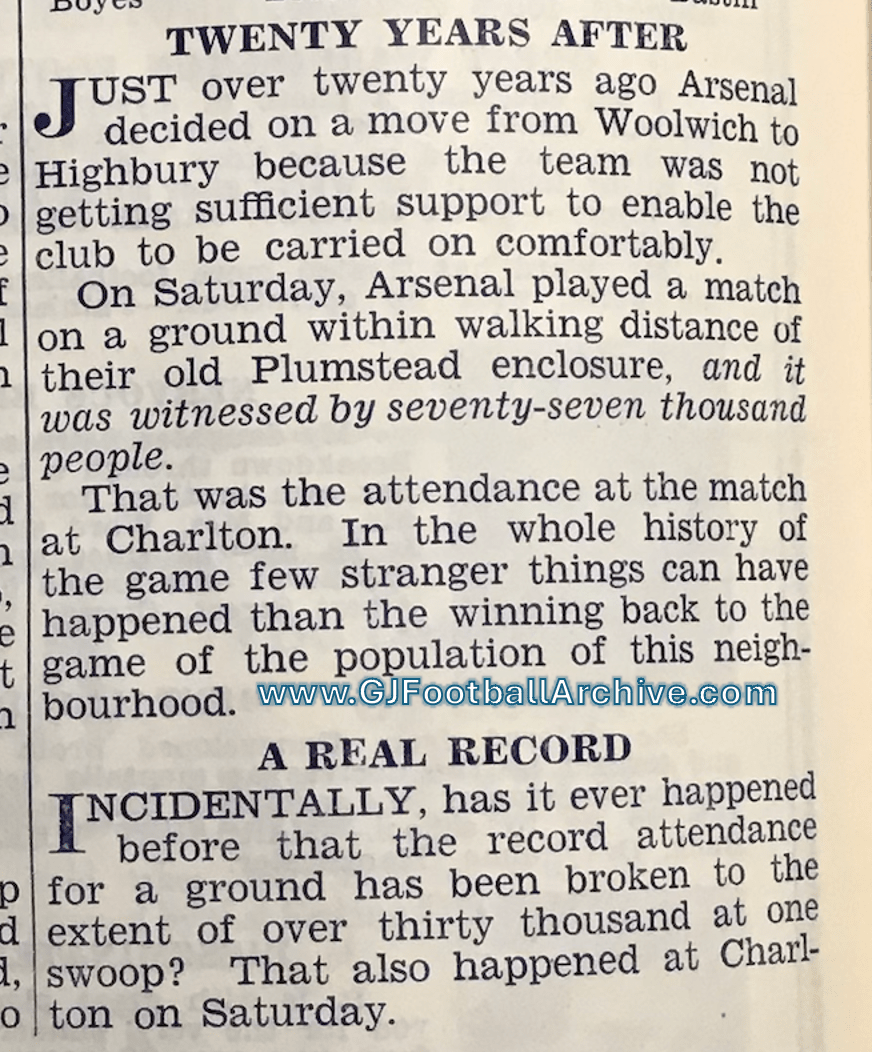
Here’s a cutting from a Manchester City match programme in October 1936 which talks of a game between Charlton and Arsenal, played on 17 October 1936. The official attendance that day was 68,160 for the League game. Note how it talks of Arsenal leaving their original base south of the Thames due to issues attracting crowds and then the mention of Charlton’s popularity in south London.
Incidentally, Manchester City’s record League attendance at this time was 79,491 and record attendance was 84,569.
You can find out all about Manchester City during the 1936-37 season by reading the following 2,500 word subscriber article on that season. If you subscribe (see below) I hope you enjoy it. If you don’t subscribe then why not try it for a month (£3 per month or sign up for a year at a discounted £20 per year)?
Here’s the article:
Subscribe to get access
Read more of this content when you subscribe today. It costs £3 a month (cancel anytime) or sign up for a year at £20 per year. Subscribers have access to the 1000s of articles, features, interviews etc. posted so far and all those posted during your subscription.
It’s been over a month since Ricky’s death and I just wanted to get a few thoughts down which have been crossing my mind a lot recently. Ricky was – and will remain – rightly a significant hero to many. His career and life have touched so many Mancunians, boxing fans and the wider public too. He lived his early life on the same council estate as me (Hattersley) and I think it’s important to talk a bit about Hattersley and the town of Hyde. There was a photo that appeared the day before Ricky’s funeral which showed him as a young boy in front of a white fence – those white fences were familiar to residents of Hattersley and I think we all probably had a photo with one in the background. I know I did.
It was actually that photo that set me off thinking about my own childhood and life.
The young Gary wearing his first City kit, with a Hattersley white fence behind
Hattersley is a large overspill estate built in the 1960s to house families moved out of Manchester as part of the awfully named slum clearance programme. Before I was born my parents lived in Bradford (Manchester) close to where the present-day Etihad Stadium is and they were told their house would be demolished as part of the clearance programme. They were moved to Hattersley, a new estate built in what was at the time Cheshire. Their new house was almost ten miles from their old one. Communities were ripped apart and the new estate at that time offered little in the way of employment, forcing many (like my dad) to look towards Manchester for employment. Like all overspill estates it has had its problems but there have always been many, many good people living there.
Many of the established residents living in Hattersley’s neighbouring village of Mottram or in Hyde itself resented the new estate full of Mancunians being dropped onto their green fields. Nowadays, planning permission would probably never get granted for such a large estate to be plonked there. The artist LS Lowry, a well-known Mancunian/Salfordian (actually born in Stretford and also a prominent Manchester City fan who talked of his love for City), lived at Mottram and was quoted once comparing Hattersley’s tower blocks (since demolished) to New York. He wasn’t impressed.
I was born a few years before Ricky, but those of us living on the estate as children and young adults in the 70s and 80s were often labelled in some way. There was a bit of prejudice against us, and this wasn’t helped by the fact that the Moors Murderers were living on Hattersley at the time of their arrest (and had murdered there too). Their house was demolished in 1987, over 20 years after their arrest, and was behind the New Inn, the pub where I first saw Ricky. His dad was the landlord, and I used to go there with Paul Alexander (who has also died in the last year or so) as our ‘regular’ pub (I won’t say our age when we first started going there!). Ricky was a young boy occasionally seen in the pub or at the pool table. Back then the fact that Ricky’s dad Ray was a former City apprentice/reserve was probably a factor in drawing Paul and me to the pub – it wasn’t the nearest pub to either of our homes on the estate.
The New Inn as it looked during the 1980s
From an identity point of view those of us growing up on the estate were usually children of Mancunian parents, living on a Manchester council estate (the rent book said Manchester City Council for many, many years) in Cheshire, except it was no longer Cheshire by the mid 70s. It was an invented metropolitan borough called Tameside, linking several towns from parts of northeast Cheshire and southeast Lancashire. We looked towards Manchester and saw ourselves as Mancunians, but we were living ten miles away and some Mancunians said we weren’t Mancs at all, while some from Mottram said we were not locals either back then!
Looking towards Mottram With part of the Hattersley estate in the foreground
When meeting someone or going for job interviews those who knew Hattersley would often make a judgement. You’d feel a change sometimes in the way people would talk to you. I started work in Hyde at 16 (Youth Training Scheme at a prominent building society of the era) and I heard negative comments frequently from managerial figures about the estate; the people who lived at Hattersley and so on. In later years Hyde suffered from Dr Shipman’s crimes too and, nationally, Hyde and Hattersley tended to be known for Brady, Hindley and Shipman and not for the incredible things the people of the town have achieved. Judgement can be an awful thing.
Identity and role models are important to us all and we need to look for others like us who can act as role models. It’s so important to see people achieve something that are as ordinary as we are, living in the places we live and experiencing the things we experience. That’s why Ricky Hatton is so important to many people. He’s rightly idolised by the people of Hattersley and Hyde because he was the local boy who did well. He always seemed to be a positive influence and for anyone growing up in the years after Ricky’s first successes he was someone to look up to. He came along at a time when Hattersley and Hyde needed a hero, and he delivered time and time again.
There are other Hattersley role models of course, for example Chris Bird became the Managing Director of Manchester City and Shayne Ward (singer/actor) lived there before the age of ten and went to the same primary school as me (many, many years after I left the school!). But Ricky was always the People’s Champion and a man who remained firmly fixed in our minds as the lad from Hattersley who took on the world and brought major glory home. He also continued to be seen in and around Hattersley and Hyde, adding to his status as a man of the people.
Let’s not forget too that at a time when it was unfashionable to support Manchester City Ricky made sure everybody knew he was a Blue. Like Noel and Liam he was often seen promoting the club and talking about life as a City fan.
So much has been said about Ricky and my words add nothing I guess (If anyone’s interested, I wrote something elsewhere on the site about the time I interviewed Ricky in his training boxing ring a few years back as part of a Manchester City academy session), but I think it’s worth getting things off our chest at times. It’s important to talk.
On a personal level my thoughts are with his family and close friends. I’m delighted that Ricky’s name keeps being chanted at Manchester City games (and that a banner and other tributes continue to appear) but, of course, like so many others I wish he was still here. We’ve lost quite a few Blues this year including in recent weeks broadcaster John Stapleton and Corinthian footballer Margaret Allen. My thoughts are with all who have suffered a loss recently.
I’ve posted this before but it’s always worth another look. It is believed the memorial card seen here was printed to mark Manchester United’s 2-0 victory over Manchester City on December 28 1912. Cards like these were popular at most high profile games and in Manchester there was a significant industry behind football funeral cards.
They seem a bit macabre today in our half-half friendship version of professional football but back then cards were used to highlight games frequently. I’ve written and talked a lot on this over the years.
Here for subscribers I’d like to provide an overview of the industry, how it existed, what activities were carried out and provide a potted history of the funeral card business. This is about 3,500 words, so get yourself a brew and settle down to read…
Subscribe to get access
Read more of this and everything else on the site when you subscribe. It costs £20 a year or £3 a month to subscribe and you can access exclusive interviews, articles and more.
When Archie Gemmill scored a last minute penalty on this day (18 October) in 1980 to give Birmingham all the points at Maine Road Manchester City were struggling at the foot of Division One. Malcolm Allison had been sacked, and these were the first few days of John Bond’s reign. Looking back on City at this time Bond said: “They’d only got 4 points out of 10 games, hadn’t won a match, hadn’t got a left-back of any description on their books, and the players lacked direction and confidence. To be honest any fool could have turned them around to a limited extent.”
Bond soon turned City around and he was named manager of the month for both November and December. You can read more on the 1980-81 season by subscribing. Here’s a ten thousand word long read on that season. Enjoy!
Subscribe to get access – Monthly
Read more of this content when you subscribe today. It costs £3 per month (cancel anytime) to access everything posted since 1 October 2022 or there’s a special annual rate below which gives greater access and works out much cheaper.
Read more of this content when you subscribe today. It costs £3 per month (above) or £20 a year (here) to access everything posted since the site was created in December 2020. This special rate works out about £1.67 a week and gives access to everything posted, including PDFs of 3 of my books.
If you enjoy all the free material on my website and would like to support my research and keep this website going (but don’t want to subscribe) then why not make a one-time donation (or buy me a coffee). All support for my research is valued and welcome. It allows me to keep some free material available for all. Thanks.
I’ve researched a lot on the history of Manchester’s prominent clubs and so I know how the history of those teams has often been incorrectly reported. So, I’m just going to post this and make no further comment today. This is an article from October 1912 which talks of Manchester City as Manchester’s oldest football club. You can find out all about the history of Manchester’s clubs in my academic book ‘The Emergence of Footballing Cultures: Manchester 1840-1919’ if you’re interested.
Fifty years ago today (11 October 1975) a goalless draw with Burnley led to lots of issues at Maine Road. Dressing room disagreements (some say fights) led to captain Rodney Marsh being placed on the transfer list. Some fans protested but new captain Mike Doyle spoke out, explaining that the players supported the manager. Marsh never played for City again and in the games that followed Dave Watson and Tommy Booth both filled in as forwards in games (and both scored). Centre forward Joe Royle was injured as well.
While you’re here why not subscribe and read a 5,320 word article on the entire 1975-76 season – a season which saw Tony Book guide the club to major success. You can read this below.
Subscribe to get access – Monthly
Read more of this content when you subscribe today. It costs £3 per month (cancel anytime) to access everything posted since 1 October 2022 or there’s a special annual rate below which gives greater access and works out much cheaper.
Read more of this content when you subscribe today. It costs £3 per month (above) or £20 a year (here) to access everything posted since the site was created in December 2020. This special rate works out about £1.67 a week and gives access to everything posted, including PDFs of 3 of my books.
If you enjoy all the free material on my website and would like to support my research and keep this website going (but don’t want to subscribe) then why not make a one-time donation (or buy me a coffee). All support for my research is valued and welcome. It allows me to keep some free material available for all. Thanks.
I’m doing some clearing out of my collection and keep rediscovering some random Manchester football memorabilia. I’ll post some images of them on here from time to time. Today here’s an image of my medal, number and related material from the first City 10K run. It took place on 29 April 1984 (the next one was to be staged on 7 October 1984) and I decided to take part. I won’t tell everybody my time though!
Watch out for more odd items from my collection over the coming weeks.
On this day fifty years ago (8 October 1975) the draw for the fourth round of the League Cup was made. Manchester City were to face newly promoted Manchester United at Maine Road in what would turn out to be both a thrilling night and a deeply saddening night too!
You can find out what happened by reading the following 5,320 word article on the entire 1975-76 season for Manchester City – a season which saw Tony Book guide the club to major success. You can read this below.
Subscribe to get access – Monthly
Read more of this content when you subscribe today. It costs £3 per month (cancel anytime) to access everything posted since 1 October 2022 or there’s a special annual rate below which gives greater access and works out much cheaper.
Read more of this content when you subscribe today. It costs £3 per month (above) or £20 a year (here) to access everything posted since the site was created in December 2020. This special rate works out about £1.67 a week and gives access to everything posted, including PDFs of 3 of my books.
If you enjoy all the free material on my website and would like to support my research and keep this website going (but don’t want to subscribe) then why not make a one-time donation (or buy me a coffee). All support for my research is valued and welcome. It allows me to keep some free material available for all. Thanks.
On this day (7 October) in 1995 this report of the Manchester City-Wycombe League Cup tie played on 4 October. The report was written by journalist Simon Mullock, well-known in the press areas at City and to City fans of course. His report seems a fair reflection of the tie that night. If you’re interested, you can now read more on City’s 1995-96 season below. This was a hugely significant season and this article is almost 5,500 words long.
Yes, I know but we can look back and remember from a position of relative comfortability now!
It’s available to subscribers, so why not subscribe and relive this extraordinary season? As with many of these subscriber features it contains material from interviews I’ve performed with key figures from that time.
Here’s the 5500 word article on that season:
Subscribe to get access
Read more of this content when you subscribe today. It costs £3 per month or £20 a year to access everything posted since the site was created in December 2020. This special rate works out about £1.67 a week and gives access to everything posted, including PDFs of 3 of my books.
If you want to know more on this incredible decade for Manchester City Football Club then why not subscribe and read all the other articles? If you’d like to know more about subscribing then see:
This map shows the Maine Road area, where Manchester City’s former ground was, before any of the terraced housing was built. The dark blue shape I’ve placed on the map is approximately where the stadium was built. Maine Road was initially known as Dog Kennel Lane and was renamed in stages as terraced housing was built on it. The lane originally had a bend where the current Maine Road ends and the old lane veered off towards modern day Princess Parkway.
I explain a lot more about this in Farewell To Maine Road and in the Big Book of City. In the MCFC match programme a few years back I explained:
Maine Road itself was a relatively insignificant street in 1923, but in the previous century the road had the name ‘Dog Kennel Lane’ and it had for many decades been a fairly significant but meandering route south of the city. The street was renamed in stages when the area was developed during the late 1800s. For years the reason Maine Road was picked was not clear, but in 2009 I discovered the truth.
The Maine Road name came indirectly from the US State of Maine but this was a compromise. The following newspaper article explains: ‘Dog Kennel Lane took its name from the kennel where hounds were kept. It stood on the right-hand side at the bend about a thousand yards from Moss Lane, opposite to the road which tracked off to the left and led to Demesne Farm. The common name of this lane is so common and unattractive that when the Temperance Company bought the Trafford land they asked the local board to change the name to Demesne Road, and the subject was compromised by calling it Maine Road out of compliment to the Temperance principles of the petitioners.’
The idea of the Temperance movement was to discourage people from drinking alcohol. On 2 June 1851 the State of Maine passed the first recognised prohibition law, and two years later the United Kingdom Alliance was founded in Manchester, pledging to badger Parliament to outlaw liquor in England.
The ‘Temperance Company’ mentioned in the article was actually part of the movement and had bought some land at the top of Dog Kennel Lane – this area is close to the junction with Moss Lane East. They wanted to create a better standard of living and within that area they erected buildings in keeping with their approach to life, such as the Temperance Billiard Hall. However, the ‘Dog Kennel Lane’ name was clearly an issue and so the selection of the name ‘Maine Road’ was made. So the name Maine Road refers to the US State and the part that Maine played in the Temperance movement.
An early 20th century interpretation of an older map, showing modern streets (dotted) with the original roads.
If you’d like to read more on the history of Maine Road, take a look at Farewell To Maine Road, which can be downloaded from this page:
If you enjoy all the free material on my website and would like to support my research and keep this website going (but don’t want to subscribe) then why not make a one-time donation (or buy me a coffee). All support for my research is valued and welcome. It allows me to keep some free material available for all. Thanks.


 Gary James' Football Archive