No surprise that treble-winning City’s first Premier League game of 2023-24 will be against Vincent Kompany’s Burnley. I think we could all have predicted that.
Here are the fixtures in full. Obviously, many of these will be changed for TV and also clashes with FA Cup ties and so on. Interesting reading though.
It’s day 28 of my posts counting down to the centenary of Maine Road’s opening game. Today – that odd Main Stand roof replacement (no, not the white barrels, the earlier one!).
The original Main Stand rood was a traditional style roof with a central circular gable. Though it was huge (at the time of it’s construction it was claimed to be the largest roof at a club ground, it seemed quite pleasant. It wasn’t a cheap affair or particularly a problem but as the 1960s wore on the number of stanchions it had holding up the roof was seen as being an issue by the directors. They decided that they could no longer watch games with their view obstructed by stanchions and so they decided to replace the middle section with a new section that allowed the removal of the stanchions that blocked the directors’ views. They didn’t seem to care about the problems other fans may have experienced! You can read all about that and the other Main Stand roof developments in Farewell To Maine Road.
In the end only two stanchions were removed but the gable was lost forever and the strange raised section of the stand looked so odd. Here’s an image of the original roof from an aerial photo:
Note the Trumanns for Steel advert on the following image. Another iconic part of Maine Road. Also the floodlight in the Platt Lane corner.
The ‘second’ Main Stand roof appears on the following aerial photo from 1971. It’s numbered number 1 and you can see how odd it looks.
Maine Road aerial 1971 from Farewell To Maine Road
If you’d like to read more on the history of Maine Road, take a look at Farewell To Maine Road, which can be downloaded from this page:
If you enjoy all the free material on my website and would like to support my research and keep this website going (but don’t want to subscribe) then why not make a one-time donation (or buy me a coffee). All support for my research is valued and welcome. It allows me to keep some free material available for all. Thanks.
I’ve been to plenty of games over the decades where fans have been treated badly. I’ve been stuck in car parks; locked in stadia; pushed and prodded by Police & stewards and much worse, so I’m not someone who has never been to a major game as a regular fan coming along saying ‘look this was disgraceful’. I know some rival fans have said: ‘you won, just suck it up’ or words to that effect but what City fans (and I assume Inter Milan too) experienced both before and after the final was not acceptable at all. It wouldn’t be acceptable at a sixth tier game, never mind Europe’s showpiece footballing occasion.
I had an absolutely incredible 40 odd hours in Istanbul, much of which was stuck on buses or desperately searching for transport, and I enjoyed Istanbul as a city. Seeing your team win Europe’s major trophy for the first time is pretty special and nothing will detract from that BUT it is important that our negative experiences are remembered. Hopefully, UEFA will listen and do something about this, but I doubt it.
This is just my experience and I know many fans will have experienced worse. I’m not trying to say ‘look at me’ or anything like that, I’m just trying to get it recorded and I would absolutely love fans to post their own stories as comments at the bottom of this page. I’m just one fan and there are multiple stories.
On the day of the final my wife, youngest daughter and I went to the fan park at Yenikapi about 2pm (my phone has recorded the time of photos, so I can work out specifics if needed). It was more geared towards non-attending fans rather than those who had match tickets and so we decided to head off to the stadium on the buses provided by UEFA.
There were searches and drinks, food etc were taken from fans at this point. One young guy in front of me had his roll-on deodorant taken (it was 75ml instead of the maximum 50ml allowed). He was somewhat upset as he’d only just bought it and felt he was already somewhat in need of using it after a long sticky journey to get to Yenikapi. I tried to avoid getting close enough to see if he did need it or not but he was convinced!
After going through the searches we got on a bus that was already fully seated but those given the task of filling buses by UEFA insisted we fill the standing area too.
I was uncertain about that as I’d heard about general traffic issues, but thinking I’d like to get there as soon as possible we boarded the bus and stood near the back.
There was no air conditioning and there were only a couple of windows capable of being opened but which didn’t seem to want to be opened. Someone managed to force one and a bit of a breeze came in occasionally.
Unfortunately, our bus driver seemed to have no idea of how to get to the stadium and he frequently took the wrong turning. Some fans near the front had the route on google maps and were trying to tell him but it seemed a pointless exercise. There were also road signs, which we all saw but somehow he missed them.
There were long traffic jams at times but the anticipation of the final kept spirits high.
On the bus to the stadium before the driver got lost, tried reversing on a busy motorway, got lost again and before the breakdown!
We chatted to other fans about their experiences. Two guys near me had landed at SAW airport about 5am and been on buses for most of the day. They hadn’t seen much of Istanbul. They were understandably concerned about post-match transport back to their hotel, which was near SAW, and we discussed whether it would be better for them to get a bus back to SAW and then a taxi from there to their hotel. To be fair, we were already talking as if it would be chaos after the match. I’m not certain if any of us had a premonition or whether we just thought ‘it’s UEFA!’
The journey took a lot longer than expected and without air conditioning or any water available it was difficult for some of the passengers. The driver continued to get lost but our spirits remained fairly high – though frustration was creeping in. As we went around roundabouts many of us on the bus started to do that ‘wwwwooooooooo’ noise that’s done when we’re anticipating a trophy lift or similar. If the driver missed (I should say ‘when’ as he seemed to miss it more often than not) the turn off the ‘Wwwwoooo’ became a boo. If he got it right it was a cheer.
Another time we missed the turning off the motorway and the driver started trying to reverse. Fortunately for our safety a police motorcyclist just happened to be on the hard shoulder and he waved to the driver to move forward.
When we got to the stadium we ended up at the Milan end. I’m not certain if that was the intended route but from hearing others it wasn’t. From there the bus moved on to another dual carriageway as we had to travel around again. This time it was all too much for the bus and we stopped. None of us knew why and then someone heard that we’d broken down and the bus could not move off. The driver kept the doors closed and without water, air conditioning, a breeze the conditions worsened. It looked as if the driver was never going to let us out and so some started trying to force open the doors.
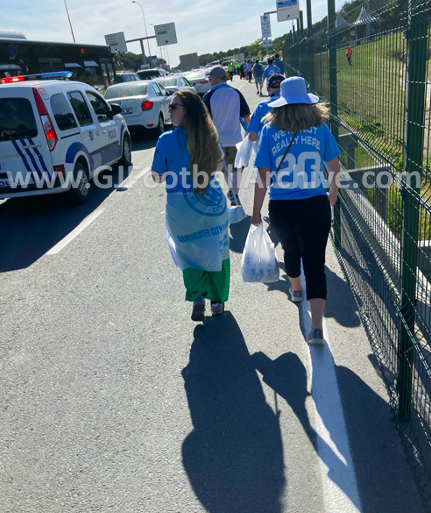
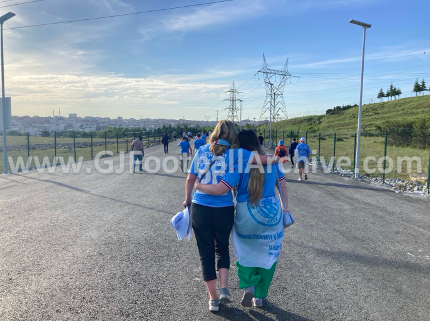
I think the driver then relented and the doors opened. We all climbed out and then started walking along the busy dual carriageway (which had no pavement, only the tarmac road) up hill towards the stadium.
Midway there was a boy with bottles of water he was selling to drivers and he suddenly hit the jackpot as we all started buying from him. He was only charging 5 Turkish lira each bottle which was a bonus. Post match some were demand well over 10 Euros for one small bottle.
The bus journey and walk up hill had taken over three hours. It should’ve been about 1 hour we were told.
At the stadium we entered the City fan park. Queues for drinks and food seemed extremely long, while the merchandising operation looked haphazard with no queueing system at all.
After a short while in the fan park we decided to head into the stadium as it was now open. The thought being that food and drink would be easier to buy in there.
We got in about 6.40pm. We bought a programme and scarf from the merchandising store there. Our fan pass was supposed to give us 10% off in the fan park. As it was impossible to buy anything there due to the general disorganisation of their merchandising operation we asked about the discount in the stadium. We were told the discount/fan pass was not valid. I’m not certain whether that’s true or not but none of the staff seemed even aware of what a fan pass was so I guess it was true.
We bought some basic food and drink. The cost was as extortionate as everything UEFA do and the staff basically gave us half a cup. When we asked for the full measure that was advertised and we’d paid for we were made to feel we were in the wrong. We still didn’t get the full measure advertised but gave up as the queue was getting longer behind us and the staff did not think we were right, even though the sign was there with prices and measurements.
Once in our seats everything for us was as it would normally be at a game like this and I have no complaints about that whatsoever. It was wonderful being at the final and we were excited by it all. We’d bought the cheapest unobstructed seats we could at 70 Euros (we can quibble about prices but that’s not a logistical issue on the day).
I’ve talked about the game elsewhere and it was magical and wonderful to see City win this historic and greatest of all European trophies. The Blues truly are Europe’s greatest team. It’s as simple as that.
After the celebrations we left the stadium. For us it was a fairly short journey compared to others to the coach park. Before the game we’d checked where we needed to be for the ride back to Yenikapi as I wanted to have a plan in my head.
We left the stadium via and extremely narrow exit gate. Fans were funnelled through it and it was totally inadequate. I’ve experienced worse at football games but these was Europe’s most prestigious game. It shouldn’t be like this.
We had to walk across a roadway which was supposed to be free of traffic but a black VIP style car pushed through the crowd with the police and stewards more worried about getting the car out than fan safety. We were expected to jump into the deep gutters on the road’s side or elsewhere.
When we arrived back at the coach park it was total chaos. Barriers were not where they’d been pre-match and the entire coach park was full of people desperately trying to find a bus to get on. Buses were full and everything was at a standstill. Nothing moving forward and no hope of getting on a bus.
We found a bus to Yenikapi but it was full. Then we decided to walk down. aline of buses thinking that we’d eventually get to one that had space, but it seemed like a fruitless task. Eventually, we decided to head back to the fan park and wait for things to calm down.
When we got to the fan park the stewards were holding everyone back who was in there and there seemed no way in or out. We walked over to a UEFA representative who seemed to be an information/help point. We asked about the metro thinking that might. be a better option. She told us it would be open and that it was on the other side of the stadium, past the Milan fan park. She showed us a map with it on and so we headed for that.
Desperate for a drink we saw someone selling water (there were lots of people selling flares and beer too) and we asked him how much. I honestly cannot remember how much he said but assuming the figure he gave was in Turkish lira like the boy earlier, I remember thinking it was excessive but we were desperate so we’d pay it.
We were given 3 bottles and then he demanded the money but this time the amount he’d said was in Euros, increasing it significantly. Thinking back it was something like 20 Euros each but I can’t honestly remember the specific amount. We then said ‘no thanks’ and handed the bottles back but he took my bottle and unscrewed the top and told me I’d have to pay. I pointed out that he’d opened it not me and we walked away but he grabbed me and was trying to demand money from him. I made it absolutely clear that he had opened it and I pulled myself away.
I think he realised that so many people had seen this that he couldn’t get away with his con and I walked away.
We continued to walk up towards the Milan end and after we had passed it we met a few fans coming the other way who said the metro was closed. A family, which included. a young, exhausted boy, were by this time walking with us. Their experience had been similar and we agreed to carry on for a while because there were a lot of mixed messages.
More fans started to come back saying the police had turned them away as it was closed. We were told the next metro was at 6am in the morning and one of the family walking with us checked his phone and found the same information on there.
A beer seller then offered to get us all a taxi at over 450 Euros which we refused. We debated carrying on to the metro but so many were saying it was closed or that they’d been turned away that we reluctantly decided to return to the coach park.
Loads of Blues passed us heading away from the coach park and to the metro. We told them what we’d heard and some turned around but others carried on. I have since heard that some people did find the metro open but I don’t know if this was earlier than we had got close to it or not.
None of the police, who were mostly sat on the grass, could help and UEFA representatives were nowhere to be seen by this point.
I started suggesting we could bed down for the night on the grass verge and get the metro at 6am. I was even looking for the best space possible, but we decided to carry on and if we couldn’t get on a bus then maybe we’d go back to the grass.
Back at the coach park and it was still chaotic. Buses seemed stuck. Fans were milling around not knowing what to do. One of the MCFC staff coaches was there and a City staff member genuinely seemed to want to help, especially as there was a young boy with us, but he couldn’t do anything about the UEFA buses.
We walked in between the stationary, packed buses looking for any bus that had space. A driver opened his window and said: ‘Where you going?’ We said ‘Yenikapi’ and he let us on to his packed bus. It was the first time anyone had been able to help and I think it was the sight of the small exhausted boy that influenced his thinking.
There was some standing space at the back of the bus and we went there. We managed to sit down, squashed in, and just felt relief at being on a bus. We didn’t care how long we’d be there.
There were a couple of Blues on there that I knew. I should’ve asked how long they’d been stuck there but didn’t get chance.
The bus didn’t move for ages but when it did our driver seemed to be determined we’d get off the coach park as quickly as possible. He cut other drivers off, grabbing every inch he could. Normally, I’d be worried about safety and the possibility of a bus not stopping in time etc. but I didn’t care by this point. Just get us back to Yenikapi.
About 3am on the Champions League return buses. Sat on the floor
I’ve been a restless leg sufferer for many years and have been on medication for over a decade. I hadn’t brought my medication to the stadium and so I was somewhat uncomfortable and my legs and arms were suffering BUT this was minor to what many others struggled with on the night. How disabled, elderly or young fans coped I don’t know. There was no help, other than from other fans.
Our driver was clearly a local as he took us off the official route and cut some time off the journey, but we didn’t get back to Yenikapi until 4am. Others were much later. Some would have been earlier.
From Yenikapi we had to walk to our hotel which wasn’t too far away. Others, including the family with the small boy, had to go to Taksim or other areas.
That’s the general story of the journeys to and from the stadium. I know others had worse ones. UEFA totally let fans down and had no organisation whatsoever post match. They didn’t seem to care about what we went through. What makes this worse is the knowledge that there were issues like this when LFC were in the final there back in 2005. This means that either UEFA haven’t learned anything from staging that game or that they simply don’t care. Surely someone at UEFA should have said: ‘Can we get the transport and logistics right if we go back to that stadium?’ and if the answer was no then it’s really simple: Either get the logistics right or don’t stage the game there.
Istanbul is a wonderful city and the other stadia appear to be in much better locations, but I guess their capacities are too small. I get why UEFA would want to stage. a final there but to get so much wrong is not acceptable. It’s not as if they’ve had this final thrust upon the stadium 0- it’s been scheduled to be there for several years!
One of the things that became abundantly clear to me during the early hours of Sunday morning was that the behaviour of the City and Inter fans ensured that this final did not end with significant injuries and issues. Had either set of fans decided to create issues then who knows how bad things could have got.
UEFA need to explain why they are inept at staging games like these – and if they don’t feel they are inept then they need to explain why fans are treated like they are. Something as simple as water should be available. We’d paid 70 Euros for our tickets – others had paid 7 times that – surely a free bottle of water was possible? They’d taken all our plastic bottles off us before we went in, so it was impossible even to get tap water. Clearly thye wanted us to spend, spend, spend but without adequate drink stalls we couldn’t even if we had the cash to afford their ridiculous prices.
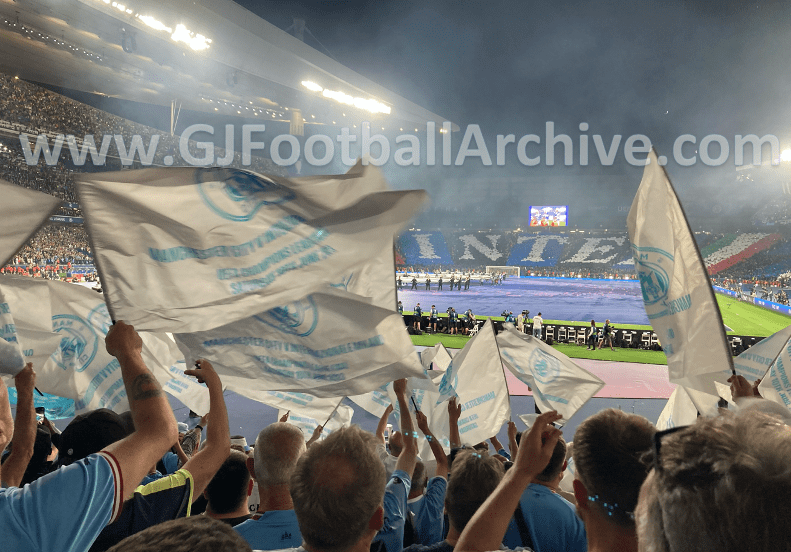
Every day I wake up and remember that Manchester City have won the Champions League final. What an incredible night! Here are some of the celebration scenes filmed by me & the members of my family who were with me. We were in block 327 row 12 and this is what we managed to capture. I hope those who couldn’t make it can get a feel for how it felt in the 70 Euros seats (though we of course stood throughout the game). If you were there feel free to get in touch with your own video clips and maybe we could get more of them posted?
The sound level on my old phone is not great and doesn’t quite capture how passionate and loud these celebrations are but i hope it gives enough of a taste of that night. I particularly like the players celebrating directly in front of our barriers.
If you enjoy all the free material on my website and would like to support my research and keep this website going (but don’t want to subscribe) then why not make a one-time donation (or buy me a coffee). All support for my research is valued and welcome. It allows me to keep some free material available for all. Thanks.
Here are a few images from last night’s parade. I will be posting some video and other stuff later in the week, including material from Istanbul, but hopefully this will be of interest.
If you enjoy all the free material on my website and would like to support my research and keep this website going (but don’t want to subscribe) then why not make a one-time donation (or buy me a coffee). All support for my research is valued and welcome. It allows me to keep some free material available for all. Thanks.
Following Sevilla’s, West Ham’s and Manchester City’s successes in major UEFA competition this season I’ve updated the UEFA European Span of Success table. What is this? It’s a list of those clubs who have won two or more major UEFA tournaments showing the span between their first UEFA success and their most recent. The list may surprise some who think that football is all about those perceived as European giants with ‘history’.
The ‘history’ ‘no history’ thing really irritates me. All clubs have history and even when that’s recognised some still go on about history as if it started in 1992, 1999 or 2008 etc. depending on whether your club was successful or your rivals were failing. Both West Ham and Manchester City found major European success before some of those clubs recognised today as Europe’s elite and while this table does not show the number of major trophies won, it does give an indication of trophy winning longevity for those who obsess on ‘my cup’s bigger than yours’ and similar debates. Personally, I think we should all be proud of our club’s achievements and not worry about what a rival has won.
West Ham have the second longest span of all Europe’s clubs and City have the fifth. Nice work Hammers and Blues!
Anyway, here’s the table showing all those with two or more successes:
European span of success 2023, showing EC/CL, ECWC, UEFA/Europa & Europa Conference
The table includes the four major UEFA tournaments: European Cup/Champions League; European Cup Winner’s Cup; UEFA Cup/Europa League & the Europa Conference League. It does not include non-UEFA tournaments such as the Mitropa Cup and Fairs Cup. Nor does it include the Intertoto Cup or similar.
I’m sure some will say but why aren’t the Mitropa or Fairs Cups in there? It’s a good point but these were not UEFA tournaments, though I recognise that the Mitropa Cup had some significant clubs competing in it. It was predominantly an East European competition and participants were not spread over the entire continent.
With the Fairs Cup… It is true that this was later transformed into the UEFA Cup and I have included all UEFA Cup finals in my analysis. But the Fairs Cup had an odd series of entry rules at times. Cities, rather than clubs, often entered with Barcelona beating London in one final for example. It was set up as a friendly type of competition with cities that had staged trade fairs playing each other. As time wore on entry came via the League Cup or League position in England, which added significance to it. But two teams from the same city were not allowed to participate, which meant that teams finishing way down the table could be (and were) included if those above them were multiple clubs from the same city.
In 1970 Manchester City’s Mike Doyle joked that by winning the League Cup he was satisfying his aim of ‘keeping United out of Europe’ (he joked about creating car stickers with that slogan!) because it appeared at that time that United’s only chance of Europe had gone with City’s qualification for the Fairs Cup.
1970 ECWC
City went on to win the ECWC that season, meaning that Fairs Cup place was opened up to League position, but United had finished lower down the table anyway and qualified for the Watney Cup instead. Actually, the Watney Cup is one worth talking about, but I’ll save that for another day. In 1970 Fourth placed Derby County qualified for the Watney Cup, while 5th to 7th (Liverpool, Coventry and Newcastle) all got a Fairs Cup place, alongside 12th placed Arsenal (Fairs Cup winners). I’ve not investigated this fully but it does seem odd that the Watney Cup took precedence over the Fairs Cup.
Arsenal’s 1970 Fairs Cup success was their first European trophy but is not included in the span, neither are those Fairs Cup wins of Barcelona. As an example of the odd qualification rules at times it’s worth looking at the 1969 qualification via the English League system.
In 1969 champions Leeds entered the European Cup. The ECWC place went to FA Cup winners Manchester City and the Fairs Cup places went to: Arsenal (4th), Southampton (7th) and Newcastle (9th). Swindon had won the League Cup, beating Arsenal in the final, but the Fairs Cup organisers wouldn’t allow them to participate as they were not a top flight club! This adds to the reason the competition is not included.
Similarly, Everton (3rd), Chelsea (5th), Spurs (6th) and West Ham (8th) who all finished above Newcastle were denied because of the rule that only one club from each city be allowed. So Liverpool and Arsenal’s inclusion meant their rivals stood less chance of winning the trophy than Newcastle simply because there were multiple clubs in their cities.
That rule does make me wonder what would have happened if both Manchester clubs had qualified for the competition as City are within the city of Manchester boundaries and United are not. Would the two clubs have challenged any decision not to include one of them based on the age old argument of Manchester’s boundaries?
Maybe I’ll post more on the odd rules of football competitions and tell the story of some of those long forgotten competitions.
If you enjoy all the free material on my website and would like to support my research and keep this website going (but don’t want to subscribe) then why not make a one-time donation (or buy me a coffee). All support for my research is valued and welcome. It allows me to keep some free material available for all. Thanks.
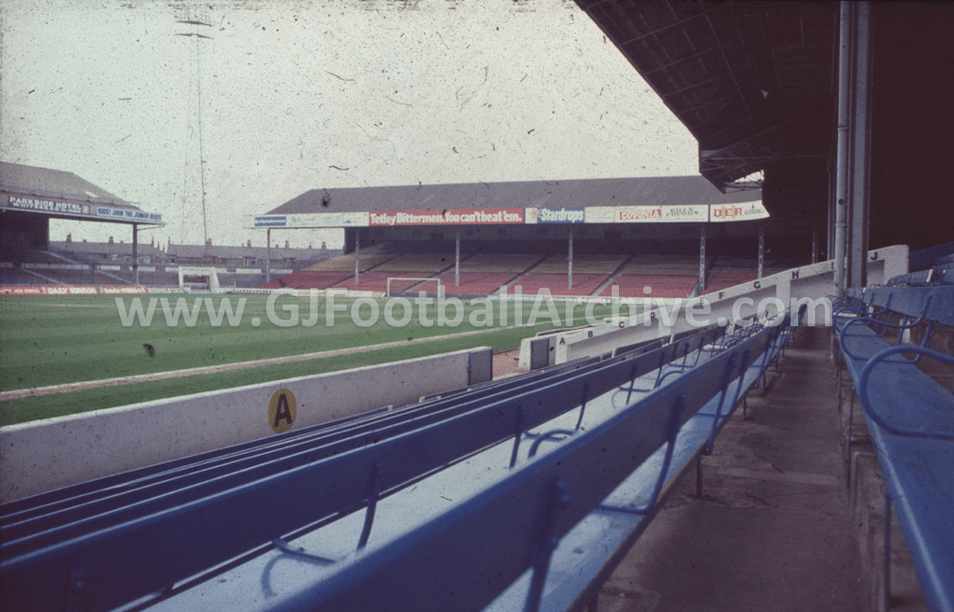
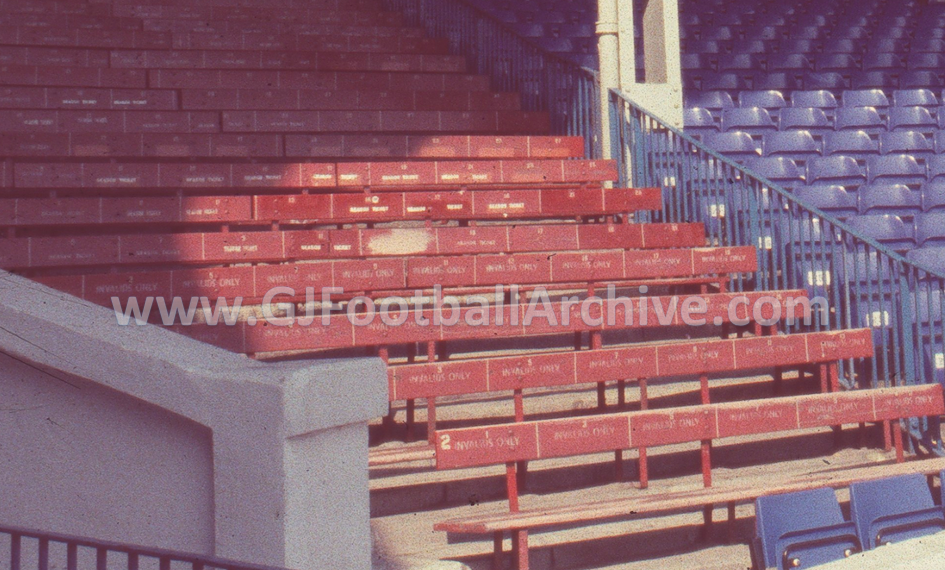
It’s day 27 of my posts counting down to the centenary of Maine Road’s opening game. Today – the wooden benches! Many a fan’s first experience of Maine Road was sitting on the benches in the old Platt Lane Stand.
These images may bring back a few memories. The Platt Lane benches were painted maroon and yellow for many years – I’m not certain if they were originally that colour. Older fans may know the answer but if they were maybe it was because they were installed at a time, the early 1960s, when those two colours had been used as City’s second choice kit?
Maroon is City’s traditional away colour but in 1959 a yellow shirt with maroon cuffs and V was used. If there was a link then that was not obvious by the time my Dad was taking me on to the Platt Lane as a young boy.
For me it seemed so odd, but then again the new North Stand had grey seats, and back in 1923 much of Maine Road was painted green. So I suppose there was never much logic around football grounds.
City used to paint on to the seats whether they were for season ticket holders, ‘invalids’ (obviously the wording back then, not today’s wording!) or if they were just numbered you could either sit there if it was an unreserved seating game or the number would match a ticket holder.
Platt Lane corner benches – note the wording on the seats. Some say season ticket; some ‘invalid’ and some are numbered/unreserved.
Most of the benches lasted about 40 years, but some were destroyed when Leeds United fans visited in November 1990 and were replaced for the stand’s final season or so with blue plastic seats. The stand was demolished in 1992.
November 1990: Jimmy Frizzell inspects the damage after Leeds fans smashed up some of the Platt Lane benches.
The Main Stand also had benches for much of its existence. These were painted blue and in some cases had arm rests. They had been part of the original build in 1923 and were replaced in phases during the 1970s and 1980s.
The Main Stand’s benches with the Platt Lane Stand’s maroon and yellow benches in the background
For those unfamiliar with Maine Road this photo may help. This shows the original Platt Lane Stand corner (number 3) where the maroon seating with ‘invalid’ wording image was taken. The benches damaged by Leeds fans were near the front of the stand under number 5. The Main Stand bench image is taken to the left of number 2 looking towards the floodlight near 5 and 6.
Maine Road aerial 1971 from Farewell To Maine Road
If you’d like to read more on the history of Maine Road, take a look at Farewell To Maine Road, which can be downloaded from this page:
If you enjoy all the free material on my website and would like to support my research and keep this website going (but don’t want to subscribe) then why not make a one-time donation (or buy me a coffee). All support for my research is valued and welcome. It allows me to keep some free material available for all. Thanks.
It’s the final part of the weekly series on Manchester City’s seasons from 1999-2000 through to 2008-09. Each week I’ve published here the story of a different season of that remarkable ten-year period. Today we conclude with the largest article on this decade to date. It’s a 11,300 word article on the 2008-09 season (below) – not much happened that year did it? As always, this includes material from exclusive interviews I have performed with various figures associated with the club over the years. The article, like everything else on this site is under copyright and cannot be posted elsewhere without my express permission.
Subscribe to get access – Annual
This article is for subscribers to my website. It costs £20 a year to access everything on the site since creation in December 2020. That includes articles, history talks, videos, interviews & more. There’s also a monthly option below.
Monthly subscription costs £3 per month to access everything on the site since 1 October 2022 (cancel anytime). All subscribers access all new material until their subscription ends. Why not give it a try for a month?
On Saturday June 10 2023 I attended the Champions League final in Istanbul. It was a wonderful experience and I’m absolutely delighted with City’s success. People will talk about this team and these players for ever.
It’s brilliant being at these history making moments and I cannot stress how much ‘us’ fans have enjoyed this journey (the wider journey, not the travel on the night – more of that later!).
I’ve decided to post here my story of the weekend and I hope you don’t mind this indulgence. I know every one of us who attended had a different experience but I hope this gives those who were unfortunately not able to be there a taste of what the trip was like. I know many Blues who would have loved to have been there but simply could not afford it, or take the time off work or were physically unable.
If you did attend and would like to talk about your experiences then please post them as comments to this piece. I’m contemplating doing a special history session on the journey and maybe would involve fan stories in that. Not certain yet but if I do I’ll mention it here soon.
Istanbul 2023 was always anticipated to be a historic moment in the history of Manchester City and, unlike, Porto two years earlier it felt the time was right. I shouldn’t care too much about opposition clubs but in truth playing Chelsea in 2021 did not have the glamour of Inter in 2023. Also, it always seemed to feel that when we played an English club in past seasons – LFC, Spurs and Chelsea – there was always going to be something fairly mundane and typically PL about it all. I always felt that when the day came for City to win another major European honour that they had to face a Real Madrid, Bayern Munich, Barcelona or one of the Milan clubs to achieve it. This season City not only faced three of these giant clubs but, especially against Bayern and Real, they proved they were more than ready to be European champions.
When we qualified for the final I, like all fans, worried about cost, flights, hotels and, most significantly, match tickets. I didn’t know if I’d be able to buy tickets and held off for a while booking anything but then I decided to take the plunge and book flights etc. To keep costs down I booked flights from Heathrow airport for the Friday morning, with return flight on Sunday about 1pm. I managed to get a cheap Travelodge near Heathrow and I then searched for hotels in Istanbul.
Initially, I found hotels via Booking.com but after being let down once before when we arrived at a UK hotel to find the owner had ‘double booked’ us (this was just after things started opening up post Covid and we got it cheap, by the time we went there several weeks later he could command a higher price and I think some profiteering went on), I decided to book direct with the hotel we’d seen. It actually turned out cheaper to go direct.
In recent weeks I’ve heard lots of tales from Blues of Istanbul hotels being cancelled at the last minute by owners saying there were issues with bank cards etc.
Eventually I managed to buy tickets and was fortunate to buy the cheapest unobscured view. I was in block 327 (row 12) with a 70 Euros ticket. I just had to be there.
View towards the main stand from row 12 block 327
Somehow it seemed appropriate that this journey to the Champions League final was to take place in Istanbul – the city of City’s first away European Cup tie in 1968 when I was a few months old.
The journey down to Heathrow was disrupted with lots of traffic issues (the weekend had many more of those!) but after a decent sleep I was able to drop off my car at Heathrow and wait for the flight.
At the airport everything went smoothly and several other City fans were waiting for this flight too. As was the commentator Alastair Mann who I’ve known for many years and it was nice to have a few words with him.
The flight was fine and once we landed we made use of the free City fan bus to Taksim Square. We were actually staying near the Grand Bazaar across the river but we wanted to see the other side and felt this would be a good way to do it. So, we walked through Taksim and down the side streets with our cases. The number of City themed bars for the day was great and the mood was extremely positive. Every one was having a great time and each shop, restaurant or bar seemed to have some staff member wearing a City shirt, obviously trying to get our business but it was nice to experience.
We had something to eat and then we walked towards the river and on beyond the back streets to our hotel. It was great to see so many City fans in and around Istanbul, not just in one or two areas but everywhere. Inevitably there would have been as many Milan fans at the stadium but the day before the game it felt as if there was only one team in town.
We spent the night enjoying the city and taking in the sights.
On Saturday I couldn’t wait for the game and we wandered the bazaar, enjoying the banter with locals and rival fans. We went to the blue mosque area and other sites too. Everything was positive, good natured and wonderful.
With Inter fans
After lunch we went down to Yenikapı to see the Champions League festival stuff, but mostly to get our bus to the stadium. We boarded it about 14.45 and then the fun started! Lots of travel and UEFA chaos – I’ll post a separate piece on that. I don’t want to distract us from what an incredible night this was.
On the bus to the stadium before the driver got lost, tried reversing on a busy motorway, got lost again and before the breakdown!
At the stadium we were sat on row 12 behind the goal and got in as early as we could after the earlier UEFA issues. I saw quite a few Blues I know of course, including Simon Clegg from the West Yorkshire supporters club and Will McTaggart from the North West Film Archive. A couple of rows in front was ‘Badger’ – a 70+ year old Blue many will know who used to wear a scarf with lots of badges (not Pete the Badge). Sadly, he told me one of his usual travel companions to City games had died and another had medical issues, and so he was travelling on his own. He’d had all sorts of issues with logistics and so it was great to see that he had made it. It was nice to see several regular away Blues go and say ‘hi’ to him and to check in with him.
The prematch entertainment was, as always, not really for the fans in the stadium. I don’t think the sound system was set up for us to hear it and while I personally wasn’t that bothered – and most people wanted to chant our own City/Inter songs anyway – there will have been some in the stadium who did want to listen. It seems to be all geared around the global audience not the ones who have paid to be there.
UEFA fooled us by getting a pianist to play the Champions League anthem – I think we all expected the usual fanfare recording and those who wanted to show their displeasure at UEFA didn’t get their usual chance.
The match itself was quite tense. I don’t need to go into it all but I did feel much more nervous than I was pre-match. Kevin De Bruyne going off injured felt like a deja vu moment. Fortunately it wasn’t but things didn’t seem to click. Maybe the significance of the occasion affected the players and us fans? Whatever it was, it was one of those tense days where we just needed to see a goal to lift things. When it came it was delirium in 327 and all other City blocks around me.
The bloke who stood next to me was on his own and we hugged and celebrated as if we’d known each other for decades. It’s really odd but, for those of us who go to games regularly, there are often those people you stand or sit next to who become your best buddy for a couple of hours and then you don’t see them again. That’s how it was – sorry I didn’t get your name but you were sat in 327 row 12 seat 241, though you mostly stood at seat 242. Thanks for sharing this experience.
Things were tense even after the Rodri goal. Ederson’s knee and the bar kept us safe at times! At 85 minutes the bloke next to me said ‘ten minutes to go’. I said ‘5!” He said ‘and 5 minutes of added time. Keep with the script!’ Sure enough he was right.
After the whistle. 2023 Champions League Final Istanbul v Inter Milan
When the whistle went it was another marvellous celebration. The lads behind had been muttering about getting on the pitch for a celebratory pitch invasion but there was no way that was possible with the set up. In the end the players climbed over the adverts and photo positions to get as close to us as possible. That was certainly appreciated and it was wonderful to see them all get so giddy with the success.
Winning the Champions League is a major landmark. I remember a decade or so ago people were saying: ‘you may have won the League but you’ll only be considered a great team when you retain it.’ City retained it. Then it became: ‘you’ll only be considered a great team when you win three in a row.’ City managed that. Then it became: ‘you’ll only be considered a great team when you win the Champions League and the treble’. Well, this means that Manchester City are a truly great team then!
It finally happened!
The celebrations were superb and everyone left the stadium buzzing. What a night! Then it was chaos again (as I said earlier, more on that another day).
About 3am on the Champions League return buses. Sat on the floor
After the bus journey we arrived back at Yenikapi about 4am (we were out of the stadium about 12.35am). Walking back to our hotel I saw Noel Bayley, who I’ve known since the 80s when he first created the fanzine Blue Print. It seemed fitting in some way that I’d bump into someone who was there with us in the 80s demanding Swales Out on a night when we’d achieved our biggest success.
Just after 4am after City’s Champions League final win – Noel Bayley and Gary James
Hardly any sleep followed as we had to be on our way to the airport at 9.30. Our taxi was late – no surprise the way transport had been this weekend – and as we waited two lads who had clearly been out all night staggered into the hotel. Two match programmes were in one lad’s back pockets but they seemed somewhat lost. They weren’t. They were in the right hotel but they’d lost the key to their room and had no identification either for some reason, so we tried to help and they got a duplicate key. They’d certainly had a good night in Istanbul!
We shared our taxi with another fan who had heard there were problems with his flight, so. he was heading to the airport early.
At the airport everything seemed to go well. Both Shaun Wright-Phillips and Peter Crouch were on our flight, and by coincidence I was sat next to a City fan I know via twitter: https://twitter.com/BertiefulSouth
Getting home from Heathrow yesterday brought its own traffic issues but the knowledge that City had won the Champions League and the treble kept us positive throughout.
So City have won the trophy after 15 years of planning, building and development. This is a major achievement and lifts things considerably – and it stops Villa singing that song to us!
City’s first major European trophy came in 1970 before Liverpool, Juventus and Chelsea for example. Now, 53 years later they have added the Champions League to their impressive trophy haul. Only Liverpool have a longer span of success from their first major trophy to their most recent, proving that City have. a rich footballing history.
1970 ECWC
Finally, I know this has been a lengthy piece but I just wanted to throw a few thoughts, memories and comments down. If you’re one of the people who managed to get to Istanbul I hope you managed to stay safe and enjoy it. It was difficult for many to be there and so I am so grateful that I managed to get the chance to buy tickets and afford travel to attend this landmark moment in football history.
Thanks to all those involved in the journey over the years. This has been special and I’m glad I saw so many Blues from various phases of my life out there and I feel for those who couldn’t make it this time.
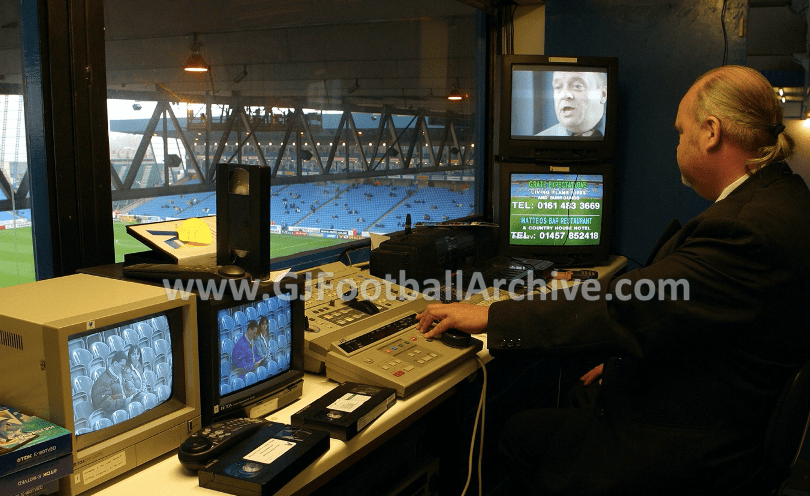
It’s day 26 of my posts counting down to the centenary of Maine Road’s opening game. Today – the Control Room. It’s something few ever went in but it was an important part of the stadium’s last couple of decades.
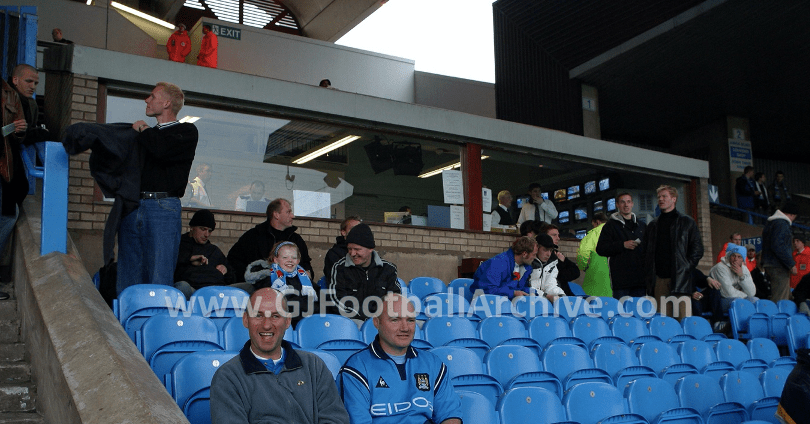
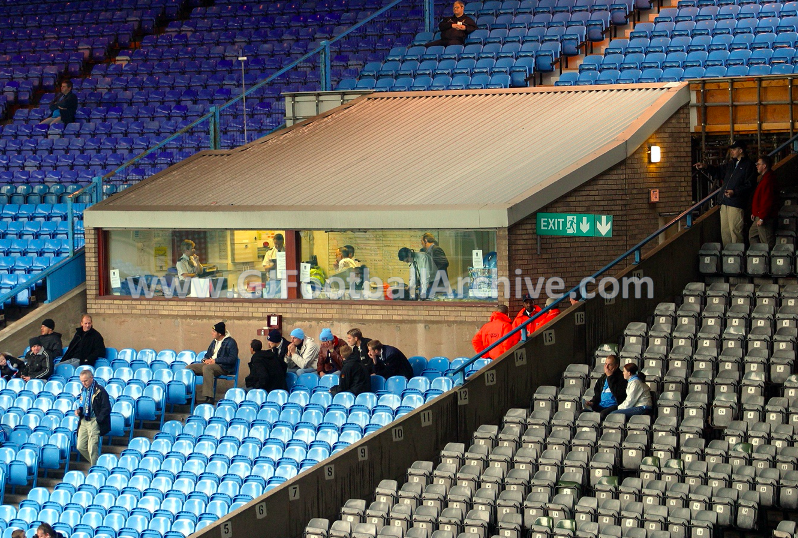
It was erected behind the block between the Main Stand and the North Stand. This was an uncovered section of seats until 1982.
The control room housed the screens monitoring crowd behaviour and the match commander would be sat in there with other staff, police etc. watching the crowd. These images show the control room as it looked during Maine Road’s final season. It had been expanded by then and these photos were taken by Ed Garvey, club photographer, for my book Farewell To Maine Road (though we didn’t use them all).
Photo by Ed Garvey
You’ll notice in the following photo that one of the temporary stands had been constructed behind the control box to cope with demand for tickets. This stand was erected on scaffolding and was squeezed in above the control box and next to the Maine Stand. I never sat in that temporary stand, though I was often in the block below the control room (when it was uncovered it was the cheapest seats in the stadium and I was there when Bobby McDonald went in nets in 1982.
Photo by Ed GarveyPhoto by Ed Garvey
For those unfamiliar with Maine Road this photo may help. This shows number 2, the uncovered section, before it was seated. The control room was roughly to the left of the North Stand roof.
Maine Road aerial 1971 from Farewell To Maine Road
If you’d like to read more on the history of Maine Road, take a look at Farewell To Maine Road, which can be downloaded from this page:
If you enjoy all the free material on my website and would like to support my research and keep this website going (but don’t want to subscribe) then why not make a one-time donation (or buy me a coffee). All support for my research is valued and welcome. It allows me to keep some free material available for all. Thanks.








 Gary James' Football Archive