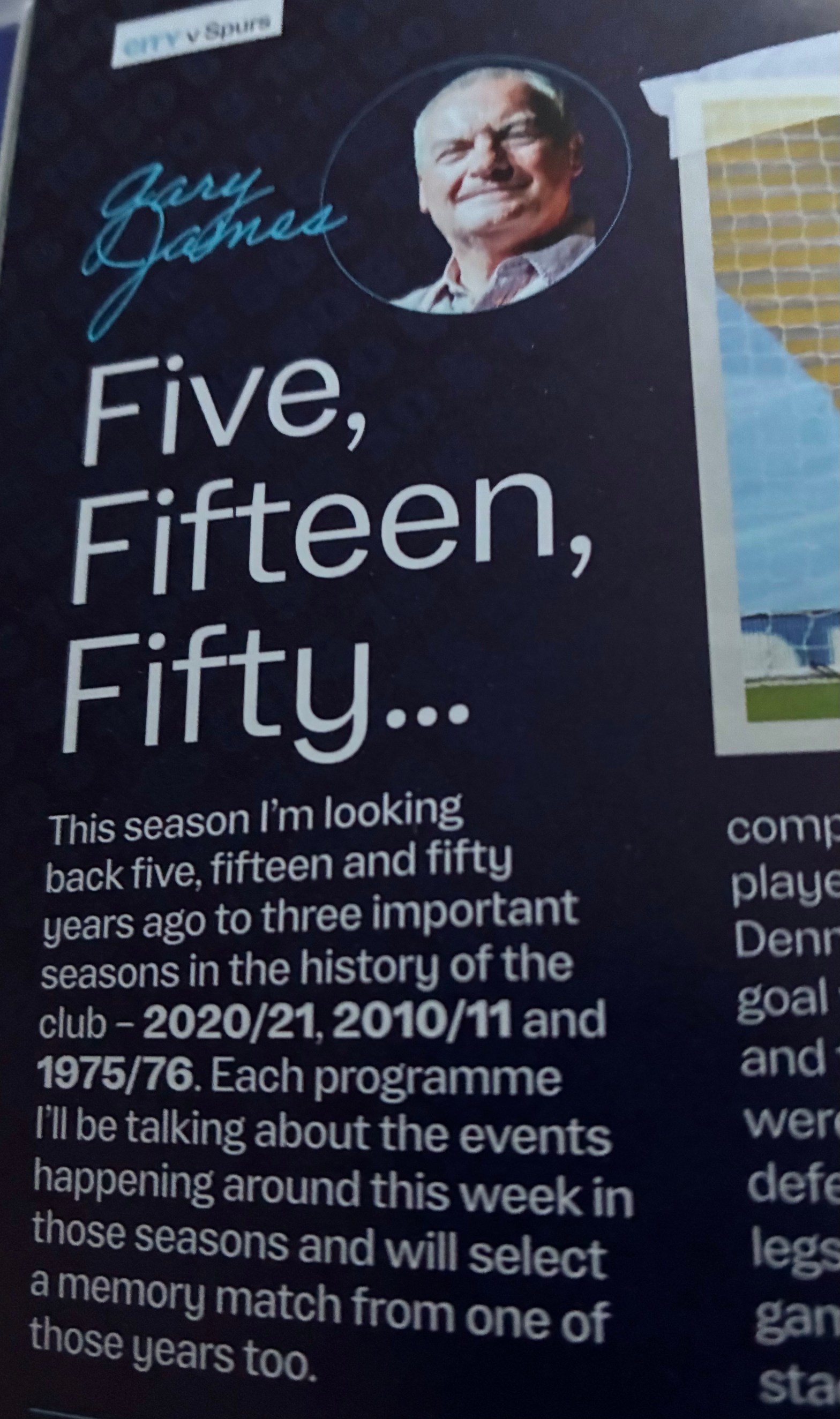
Those who saw the Manchester City v Tottenham match programme at weekend May have noticed my new series of articles. This year I’m doing a season tracker feature and have chosen the seasons 1975-76, 2010-11 and 2020-21. Each issue will cover those seasons plus I’ll write a Memory Match feature on a game from that week in one of the three seasons. The three seasons are all important ones in the history of Manchester’s Blues (every season is important of course!) and I hope I can do them justice. The reason I’ve chosen those seasons….
Typically season tracker pick seasons that are a multiple of five and usually focus on 5, 10, 25 years but I felt it was important to look at a season further back, so chose fifty years ago (1975-76 – one of my own personal favourite seasons). I also wanted to recognise the 2010-11 season as that saw Roberto Mancini’s team win their first major trophy. The 2020-21 season was of course a major trophy winning season unde Pep Guardiola.
The Memory Match I chose for the first issue was from 2010 and a day when Liverpool were defeated.
I hope everyone who gets chance to see the programme enjoys the four page feature. Thanks, as always, to those who support my writing.
With Oasis back doing what they do best this week, it feels an appropriate time to re-release this… Back on Thursday May 20 2021 I interviewed Noel Gallagher about his support of Manchester City, Pep, Europe and more. It was great for two Mancs of a similar age to get together to chat about City. I really enjoyed it.
Thanks to Noel and the staff at his studios & office for making this happen.
Subscribe to get full access to GJFootballArchive.com
Fancy subscribing to my website? Subscribers get access to all the 1600+ articles, interviews etc. that have been posted so far on my site and all those posted during your subscription period. It costs £20 a year (works out about £1.67 a month) or £3 a month if subscribing a month at a time.
Four years ago (Saturday May 29 2021) I attended the Champions League final in Porto. This was Manchester City’s first CL final. In the days that followed I wrote this article on that final and the experiences. I’m republishing it here as I wrote it then. Enjoy!
Despite the result (a 1-0 victory by Chelsea) it was a wonderful experience and so I’ve decided to post here my story of the weekend. I know every one of us who attended had a different experience but I hope this gives those who were unfortunately not able to be there a taste of what the trip was like.
Porto 2021 was always going to be a historical moment in the history of Manchester City but, because of Covid and the worldwide situation, it was one of the most challenging finals to stage, participate in and attend. All of us who travelled to Porto had to have numerous covid tests (and I have seen on the Bluemoon forum that some fans on various official and unofficial flights have received news that they need to isolate– I feel for anyone on there in this situation).
Fans travelling on the official day trip were told that if they took a Covid PCR test after 1pm on Thursday that should see them through for the journey out, stadium entry and return journey as a test had to be performed for each of these within 72 hours. I was flying out on Friday and returning on Sunday so initially I arranged for my PCR test to occur after 1pm with a company called Dam. At the time of booking they guaranteed that the result would be with me before midnight on the day of the test so that seemed fine but then, on the Bluemoon forum, fans were talking about a change in Dam’s level of service which meant results were no longer guaranteed that same day. Instead 24 hours was being stated by Dam, though when I discussed this with their helpline even the 24 hours could not be guaranteed. Panic followed!
I eventually moved my test to Wednesday afternoon and booked another via the Official Supporters Club offer with Blindspot which I intended dropping off at Bar Pop on Friday morning on my way to Manchester airport.
The Dam test came back on Thursday, meaning I could fly out, and I dropped off the second test at Bar Pop on my way to the airport. There were a few issues at Dam with the booking but eventually everything was sorted. The Supporters Club/Blindspot test and drop off went really well (though the Day 2 return test result has still not arrived – we’re on Day 5 at the moment) and I am grateful to those involved for sorting this all out. You did an excellent job at short notice and in a pressured environment. Thanks.
After leaving Bar Pop I travelled to the airport, making a detour to take a look at Maine Road and surrounding areas. Somehow it seemed appropriate that this journey to the most significant European final the club has ever been involved with should include a brief look at the site of so many wonderful moments over the decades. I saw my first European match at Maine Road (which also staged the first European Cup game ever played in England as well!) in the early 70s.
At the airport everything went smoothly and I was delighted when I realised that I would be flying out on the Etihad Manchester City plane. I had received an invitation from the club (for which I will be eternally grateful and I know how lucky I am) and to experience that flight, while seeking to chronicle this landmark historical moment, added enormously to the occasion. Thanks to those involved (you know who you are. Thanks).
The Manchester City Etihad plane
The flight included several former players, officials and key figures in the club’s development. Knowing City’s history, personalities, and key moments I recognise that it was no mean feat to have some of these on the same flight. It was remarkable that City remembered and acknowledged the contribution made by these people, which included Chris Bird, Garry Cook, Paul Dickov, Brian Horton, Francis Lee, Andy Morrison, Ian Niven, Dennis Tueart and Alex Williams. Others, including Pablo Zabaleta joined the group in Porto and stayed at the same hotel.
Once in Porto it was great to see so many City fans in and around the city, especially the historic area near the river. Over the weekend I bumped into several friends and faces from my City-supporting life including Jon Bell (Colin’s son), Howard Burr (and other Reddish Blues), Geoff Homer, Will Perry, John Stapleton, Kate Themen (one of the original Manchester City Women/Ladies players who played with my wife back in the late 80s and she was a drummer with The Fall), Dave Wallace, Steve Welch and of course lots of City staff.
On Friday night I was invited to a club event which saw most of the official party board boats at the riverside for a cruise. We had to walk through many crowds of Blues to board the boats and it was great to see and hear fans bursting into song whenever they saw Morrison, Dickov, Zabaleta and other members of the group.
The boats then dropped us off at a venue where City chairman Khaldoon Al Mubarak made a brilliant, heartfelt speech about his journey with Manchester City, recalling the moment he was asked by HH Sheikh Mansour to become chairman and his first day in Manchester when he was taken to Carrington, Platt Lane and the stadium. He talked with real passion for the club, its people and the fans. He recognised the history of the club and the journey that we’ve been on paying particular attention to some of the people who had helped along the way, including many of the officials and former officials in the room, as well as fans of course.
There was also a speech by CEO Ferran Soriano about the development of the City Football Group and a video was played about the Champions League journey over the last decade.
DJ Yoda put together an excellent mix of City related music, videos etc. including the recent footage of Pep and his cigar (if you don’t know what I mean do a few internet searches, it will soon appear). It was a definite highlight and something that added a bit of humour to the event too.
Saturday was of course match day. I spent some time in the City Fanzone, where I chatted to a few longstanding Blues I know, but also time around the city. Close to the bars at the historic centre there was a small group of local musicians going around playing City chants/songs such as ‘Singing the Blues’ and Blue Moon. Fans were joining in and it seemed quite bizarre hearing these musicians belt out most of the words to ‘Singing the Blues’, hoping to engage a few fans. A little later, as I wandered further down the river I spotted the same musicians doing similar with Chelsea chants/songs – you’ve got to admire their entrepreneurial skills! I can imagine them on the night the final was moved to Porto rushing to the internet to seek out MCFC & CFC songs. They must have made a few Euros from us all.
The entire atmosphere, as far as I could see and experienced, was positive with City and Chelsea fans enjoying being there. Personally, this was my first trip outside of England and Wales since November 2019 (when I talked at a film festival in St Gallen about the Bert Trautmann film I was a consultant on and then met up with a few Blues in Zurich). It was great to be outside of the UK and wonderful to finally get to see other human beings and to share an experience with fellow City fans.
I loved the way former players like Paul Dickov, Andy Morrison, Pablo Zabaleta and Shay Given were spotted by fans who, without fail, would burst into a chant or song about them. Some were mobbed too of course. At one point, I saw a group of fans opposite our hotel do an impromptu Poznan which I know was loved by the former players and staff who saw it.
Porto seemed like a fairly normal environment. Obviously, like all those attending I tried to ensure I kept to the usual social distancing rules and wore my face mask etc. but this was not always possible, especially when queuing to get into the stadium. I know others were on crowded buses too.
In comparison with the League Cup final at Wembley, it did feel as if UEFA had picked the wrong stadium. Looking around the venue it also made me realise how fantastic the Etihad Stadium is. We take it for granted but our facilities are considerably better than the majority of venues.
If we consider all the extra requirements placed on fans then UEFA definitely picked the wrong stadium and it seems so obvious, particularly with some of the stories coming from Chelsea and City fans about being told to isolate on their return, that the final should have been held in the UK.
The decision to stage the game at Porto was made exceptionally late and, because of this, both clubs were unable to prepare in the way they would have liked. I am aware from City personnel of the short notice they received about tickets, travel and so many other logistical areas. I can only admire the work they have done and the efforts they made to ensure they could get fans to the final and back again. Inevitably, there will be some who had issues (I’m aware of the delays to flight 12 which, from what I hear, has created a sort of Dunkirk spirit amongst those involved) but I do think the ordinary staff and management at City deserve praise for all they did.
As I arrived at the stadium on the coach, which had been delayed due to a traffic accident, we saw Jeremy Clarkson rushing down towards the turnstiles.
Security seemed tight and men and women were separated into different queues with somewhat zealous security types objecting to many, many items. Inflatable bananas, lipsticks, perfumes and many other items were cast aside before intrusive searches were performed (it reminded me of Leeds away back in 1983!). After security we got into the ground with about fifteen minutes to spare.
The Marshmello video was shown; the UEFA anthem was played (City fans started booing it and the volume seemed to be turned up to drown out the booing!); fireworks went off and then we were ready.
The game itself… Ah, I think we all know how we feel about that. I was on a coach going to the ground, close to a couple of former players when the team news came through. I read it out to those around me and one of the former players immediately asked about Fernandinho. He described how things would go and predicted the result immediately. Sad to say, he called it spot on. He wasn’t the only one of course.
The segregation in some areas of the ground seemed somewhat questionable. I was in level one on the side opposite the tunnel, close to the corner. On both sides at that level there seemed to be alternate Chelsea then City blocks. The block I was in was close to the main Chelsea end (to our right as we looked at the pitch) and there was another Chelseablock to our left. The same seemed to occur in the opposite stand. Why UEFA did this I don’t know but common sensewould say that these blocks should’ve had all Chelsea closest to Chelsea fans and all City closest to City fans with genuine neutral blocks in the middle (like Wembley does for major finals).
There were no major issues where I sat but we did feel somewhat drowned out by celebrating Chelsea fans from the moment the goal was scored.
At the end of the game Fernandinho came over to the section I was in; climbed over the barriers and hugged his son. Understandably, they were both emotional and the sight of a player searching for his son so that he could comfort him really got to me. As a parent seeing your child upset is one of the hardest things to experience and I loved how in this moment Fernandinho was not a footballer, he was a dad. Other players, including Ederson and Kyle Walker also came over to console family members.
I think we all saw how emotional our team was, especially Sergio. Like all fans I wish his City journey had ended with Champions League success.
As soon as it seemed right I left the stadium, went to my coach and waited to travel back to the city centre. I was invited back to a post-game event where the mood was understandably and appropriately muted. Wingman (Nigel Clucas), who had worked hard in the fanzone earlier in the day, got the mood spot on by playing The Smiths ‘Heaven knows I’m Miserable Now’; The Cure ‘Boys Don’t Cry’ and similar songs. Wingman did an excellent job that day and must have been exhausted.
The next morning we boarded our coaches and headed back to the airport. Both check in and security were somewhat time-consuming but, to be fair, many staff at the airport had probably been overworked for much of the night.
Compared to Porto, security at Manchester airport seemed a doddle (so long as the correct documentation had been completed beforehand) and within minutes of arriving at security I was on my way home.
Since then I have performed my Day 2 covid test, as required, and sent that off. Now, on day 5, I am still waiting for the results. From many Blues I’ve heard from it does seem like this part of the process is failing and may be something the Government needs to address if they expect UK residents to do these tests when they return from holiday overseas over the coming months.
There’s been the news that Portugal has now been removed from the UK Government’s green list. The cynic would say that the decision to stage the final in Porto influenced the decision to make Portugal a green list country in the first place. For me I don’t know what political decisions have been made and how they’ve been influenced but it does seem somewhat odd. Of course, we all know that logically a final between two English clubs which would see in excess of 12,000 travelling from the UK in the middle of a pandemic should have been staged in the UK. UEFA can say all it wants about fans being at the heart of the game but the bottom line was that the final was staged outside of the UK for the benefit of UEFA officials, sponsors and their friends. If they really wanted to help fans it would have been staged in the UK.
Ah well… Politics, hey?
So Chelsea won the trophy and while the result was a painful one for City fans it must be stressed that Chelsea are one of Europe’s elite and have now won more European trophies than Manchester United. In fact they are the second most successful British club in Europe after Liverpool and, like City, they won a major European trophy BEFORE Liverpool, Juventus and many other clubs. Chelsea’s fans, like City, have seen some dark days (most notably in the 80s) and we should all remember that their development, since the investment, is a few years ahead of City’s. If their achievements in Europe are an indicator of progress then clearly City are not too far behind.
Finally, I know this has been a lengthy piece but I just wanted to throw a few thoughts, memories and comments down. If you’re one of the people who managed to get to Porto I hope you managed to enjoy it despite the result. I was extremely fortunate this year (this is the first time I have ever been a guest of any football club for an away fixture and I know how lucky I was – I will never forget it).
Here’s to the next major final featuring Manchester City who, let’s face it, have won more trophies in 2020-21 than any other English club and have been incredible champions. It could be argued that the ONLY club that stopped them from winning all four major trophies was Chelsea (though Leicester may have in the FA Cup final of course) and they are the European champions.
On this day (24 May) in 2021 Pep Guardiola won the League Managers Association Manager of the Year Award. Here’s the origins. press release from Manchester City issued that day…
Pep Guardiola wins LMA Manager of the Year award • Pep Guardiola has been named LMA Manager of the Year for the second time in four seasons • Guardiola’s team has already completed a League and Cup double and now have their sights set on Saturday’s Champions League final • The Catalan manager acknowledged the importance of sharing his award with the players and staff who have guided City to success this season Pep Guardiola has been named Manager of the Year by the League Manager’s Association.
Adapting to the challenges posed by the Covid-19 pandemic, Guardiola guided Manchester City to a third Premier League title in four seasons and a fourth consecutive League Cup.
On Saturday, Guardiola and his players will compete in a first Champions League final in the Club’s history.
Voted for by fellow managers, it is the second time the City boss has been awarded the prize, having previously done so in recognition of the 2017/18 Centurions season.
Pep Guardiola: “I am delighted to win this award for the second time, but an award like this is only possible if a manager is surrounded by top professionals.
“My players have been fantastic – their dedication and professionalism never waver, even in a season that has been the most challenging we have ever faced.
“And my staff are also deserving of the highest praise. I am so lucky to have a team of people who give everything they have every single day to make sure Manchester City are the best we can be.
“This award is dedicated to and shared with them.”
Director of Football Txiki Begiristain added: “Pep deserves this award, absolutely. To win the Premier League and Carabao Cup, as well as reach the final Champions League final, in the most trying season we’ve ever seen, says everything about his quality as a manager.
“He has shown an outstanding ability to constantly innovate. With the challenges presented by COVID-19, he’s had to adapt to a new way of working. He’s done it brilliantly and our results say everything you need to know.
On this day in 2021 Manchester City became Premier League champions. They won the League after nearest rivals Manchester United lost 2-1 at home to Leicester City. One nice quirk of fate was that this was also the anniversary of City’s 1968 League title success.
The 2021 success was the Blues seventh League title with their first coming in 1937. Others have followed since of course!
It was an astonishing season with City already winning the League Cup that season, plus they also reached the Champions League final where they were defeated in Porto by Chelsea. Manchester’s Blues also appeared in the FA Cup semi-final season but sadly lost to Chelsea.
The League and League Cup double meant that City had won six major trophies in three seasons.
City’s trophy success in 2021 meant that domestically counting the League, FA Cup and League Cup only United, Liverpool and Arsenal have won more English major trophies. Similarly, only United, Liverpool, Arsenal and Everton havd won more League titles than Manchester’s Blues.
2020-21 was an odd season because of Covid (as was 2019-20) and no fans in the stadium (though some clubs, including those on Merseyside, were allowed a limited number of fans in earlier this season), but the football City played was breathtaking.
Apart from a difficult opening period and a few odd results along the way, City delivered week after week (or should that be weekend after midweek after weekend after midweek – it was a busy season!). They thoroughly deserved the title.
So, by the end of the 2020-21 season City had won the following major honours:
European Cup Winners’ Cup (1)
1970
League/Premier League (7)
1937, 1968, 2012, 2014, 2018, 2019 & 2021
(runners up: 1904, 1921, 1977, 2013, 2015 & 2020)
FA Cup (6)
1904, 1934, 1956, 1969, 2011 & 2019
(runners up: 1926, 1933, 1955, 1981 & 2013)
League Cup (8)
1970, 1976, 2014, 2016, 2018, 2019, 2020 & 2021
(runners up: 1974)
In 2019 the Blues became the first English men’s team to win a domestic treble. In 2020-21 City achieved a domestic double of the League Cup and the League (a feat they also achieved in 2014 & 2018). Back in 1970 they achieved a European and domestic cup double when they won the League Cup and the European Cup Winners’ Cup.
City’s trophy haul made them the fifth most successful English club of all time based on major domestic and European trophies won (United, Liverpool, Arsenal and Chelsea are ahead of the Blues). In addition only Liverpool and Blackburn had a greater span between their first English trophy and their most recent.
Since 2020-21 so many other trophies have come of course, including in 2023 when City became the first team ever to win the FIFA Club World Cup, UEFA Super Cup, UEFA Champions League, the Premier League and the FA Cup in a calendar year.
If you enjoy all the free material on my website and would like to support my research and keep this website going (but don’t want to subscribe) then why not make a one-time donation (or buy me a coffee). All support for my research is valued and welcome. It allows me to keep some free material available for all. Thanks.
On this day (5 December) in 2020 in front of an official crowd of zero (these were the days when no fans were allowed to attend due to Covid) Raheem Sterling (5th minute) and Kevin De Bruyne (penalty after Sterling had been brought down) gave City a 2-0 victory at home to Fulham. You can watch highlights here:
I’m always keen to find links between today’s Manchester City and the key players of the past and so a while back I set myself the task of trying to find connections from the club’s first competitive game in 1890 through to the Premier League successes of today. The idea was to see how few players I could find to form a chain through the decades.
I did this in 2021 and today (December 2024) the same number of players still link that first year of competitive football 134 years ago with today. For those wondering how many players I’ve used to link the beginning to today: the answer is 16. But who are they and can you do better?
Subscribers can read the players and the result of my efforts below:
Subscribe to get access
Read more of this content and all the other 370+ articles posted so far when you subscribe today.
On this day (30 September) in 2020 Manchester City defeated Burnley 3-0 in the League Cup at Turf Moor. City’s scorers were Raheem Sterling (2) and Ferran Torres. Here are some highlights of the game:
If you enjoy all the free material on my website and would like to support my research and keep this website going (but don’t want to subscribe) then why not make a one-time donation (or buy me a coffee). All support for my research is valued and welcome. It allows me to keep some free material available for all. Thanks.
As Manchester City visit West Ham today (31st August 2024) in the Premier League I thought I’d post a small feature remembering a relegation game in 1987 that entered folklore as the You’ll Be Back game. What was it all about? Here goes…
City and West Ham fans have developed a special relationship over the years. There has been a mutual recognition of the journey our clubs have been on.
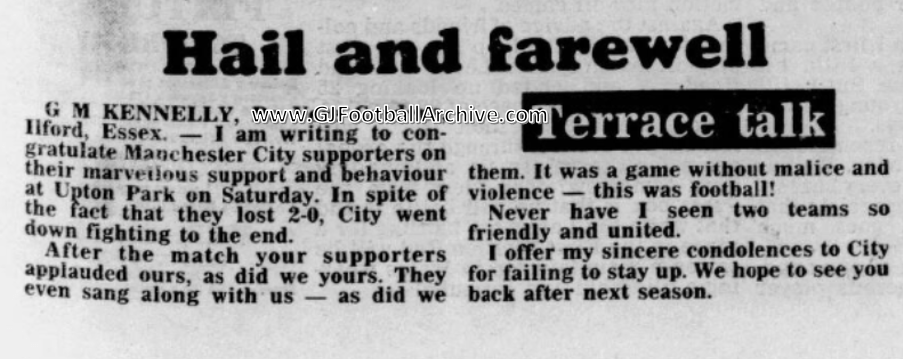
The biggest demonstration of the special relationship between the fans of the two clubs came in May 1987. City were relegated after a 2-0 defeat at West Ham. At the end of the game City supporters and West Ham fans climbed over the fences and onto the pitch. Some thought that the two sets of supporters were about to confront each other, but the fans knew differently. The Hammers began chanting “You’ll be back” and both groups swapped scarves and souvenirs on the pitch. It was the kind of moment that should have been widely reported in the media but at the time focus tended to be on hooliganism and confrontation rather than the positives of football support. City had been relegated, but their supporters did not seek revenge. The West Ham fans could have ridiculed, but they didn’t. If only those condemning football fans at the time could have seen the two sets of loyal supporters genuinely appreciating and understanding each other.
The relationship between the fans of the two clubs is not something that is widely discussed or promoted but it is something that has endured. City fans have never forgotten the ‘You’ll be back’ game and in recent years, as others have unfairly mocked both sets of fans, the supporters of both the Blues and the Hammers seem to understand and respect each other. Inevitably, there will always be banter during a game but outside of the match the mutual recognition and respect always seems to win through.
To many West Ham are the City of the South – a proud football club with a great history and heritage, combined with a loyal and passionate fanbase.
I reckon that City and West Ham fans have a shared understanding of football history, status and achievements with supporters aware of their club’s traditions, rivalries and shared history. The two clubs’ roots are very much based around hardworking working class areas of their cities with the supporters of both the Hammers and the Blues coming traditionally from the working classes. In recent years an analysis of the original shareholders at the majority of Football League clubs identified that by 1900 City’s shareholders came mostly from the working class – a larger percentage than at any club other than West Ham who had a slightly higher percentage. This demonstrates that those who owned both City and West Ham were representative of the fans on the terraces and that these clubs were similarly organised and run. As a result of this both clubs were representative of their communities in ways in which their nearest local rivals were not at the time.
Both clubs have enjoyed stylish, attractive football over the years with a belief that the game should be an entertainment. The roots of this go back decades at both clubs with West Ham’s Ted Fenton and Ron Greenwood influencing men such as Malcolm Allison and John Bond who managed the Blues.
Recently, City fans were delighted to see Manuel Pellegrini and Pablo Zabaleta become Hammers following a line that includes other popular Blues such as Ian Bishop and Trevor Morley.
Want To Read More Like This?
If you would like to read more like this and all the in-depth articles on this site (including the entire Manchester A Football History book and the audio interview with John Bond) then please subscribe. It works out about £1.67 a month if you take out an annual subscription (£20 per year) or £3 a month if you’d like to sign up for a month at a time. Subscribers get full access to the 1600+ articles posted so far and the hundreds scheduled to be posted in the coming weeks.
It seems an appropriate time to re-release this… Back on Thursday May 20 2021 I interviewed Noel Gallagher about his support of Manchester City, Pep, Europe and more. It was great for two Mancs of a similar age to get together to chat about City. I really enjoyed it.
Thanks to Noel and the staff at his studios & office for making this happen.
Subscribe to get full access to GJFootballArchive.com
Fancy subscribing to my website? Subscribers get access to all the 1600+ articles, interviews etc. that have been posted so far on my site and all those posted during your subscription period. It costs £20 a year (works out about £1.67 a month) or £3 a month if subscribing a month at a time.




 Gary James' Football Archive