Earlier today (May 20) I interviewed Noel Gallagher about his support of Manchester City, the Champions League and more. I’ll be posting it here in the next few days.
Thanks to Noel and the staff at his studios & office for making this happen.
Watch this space for details of the interview over the next few days. The interview will be free to listen to.
Subscribe to get access
Fancy subscribing to my website? Subscribers get access to all the 350+ articles, interviews etc. that have been posted so far on my site and all those posted during your subscription period. It costs £20 a year (works out about £1.67 a month) or £3 a month if subscribing a month at a time. Whichever method you choose you access everything in the archive and posted during your subscription.
This press release from MCFC has just arrived (great news)… Ruben Dias wins Football Writers’ Player of the Year award
• Ruben Dias has been named Football Writers’ Player of the Year for 2020-21. • The 24-year old becomes the first defender to win the award since Steve Nicol in 1989. • Dias also becomes one of only three players ever to win the award in their first season at a club, following Jurgen Klinsmann (1995) and Gianfranco Zola (1997). Ruben Dias has been named Player of the Year by the Football Writers’ Association. The centre-half topped the poll of a 400-strong FWA membership, following in the illustrious footsteps of team-mate Raheem Sterling who won the award in 2019.
Only the third player ever to win the prestigious honour in his first season at a club, following Jurgen Klinsmann and Gianfranco Zola, Dias has quickly established himself in the heart of a defence that has conceded fewer goals than any other in this season’s Premier League [32].
Joining from Benfica only last September, the 24-year-old has made 48 appearances for City across all competitions and played an instrumental role in the club securing the Premier League title, lifting the League Cup and in reaching a first ever UEFA Champions League final. The Portuguese international becomes the first defender to win the award since Steve Nicol, over three decades ago.
Ruben Dias said: “It’s a huge privilege. I’m very, very happy. It’s the same as always: obviously, I could not have done it without the success of the team – everyone in the team being able to deserve this award. Only by that was I – as a defender – able to be here to receive this prize.
“It means something special because normally, the ones who finish the plays are the ones getting the spotlight but me receiving this prize is a major example of our team and the way we work – the way we build our game. It reflects all the togetherness we have on the pitch, the spirit in the team and how we perform.
“With these players, for me to be receiving this award, it shows how we play like a family.”
Today (May 11 2021) on the anniversary of Manchester City’s 1968 title triumph the Blues have become Premier League champions again. City have won the League after nearest rivals Manchester United lost 2-1 at home to Leicester City.
It is the Blues seventh League title with their first coming in 1937. Congratulations to Pep, the squad and everyone associated with Manchester City.
It has been an astonishing season with City already winning the League Cup this season, plus they’ve reached the Champions League final where they will face Chelsea. They also appeared in the FA Cup semi-final this season but sadly lost to Chelsea. This means that City have won six major trophies in three seasons and still have chance of another, the Champions League, of course.
City’s trophy success today means that domestically counting the League, FA Cup and League Cup only United, Liverpool and Arsenal have won more English major trophies. Similarly, only United, Liverpool, Arsenal and Everton have won more League titles than Manchester’s Blues.
It has been an odd season with Covid and no fans in the stadium (though some clubs, including those on Merseyside, were allowed a limited number of fans in earlier this season), but the football City have played has been breathtaking. Apart from a difficult opening period and a few odd results recently as Pep has rotated his team, City have delivered week after week (or should that be weekend after midweek after weekend after midweek – it’s been a busy season!). They thoroughly deserve the title. Well done!
City have now won the following major honours:
European Cup Winners’ Cup (1)
1970
League/Premier League (7)
1937, 1968, 2012, 2014, 2018, 2019 & 2021
(runners up: 1904, 1921, 1977, 2013, 2015 & 2020)
FA Cup (6)
1904, 1934, 1956, 1969, 2011 & 2019
(runners up: 1926, 1933, 1955, 1981 & 2013)
League Cup (8)
1970, 1976, 2014, 2016, 2018, 2019, 2020 & 2021
(runners up: 1974)
In 2019 the Blues became the first English men’s team to win a domestic treble. This season City have achieved a domestic double of the League Cup and the League (a feat they also achieved in 2014 & 2018). Back in 1970 they achieved a European and domestic cup double when they won the League Cup and the European Cup Winners’ Cup.
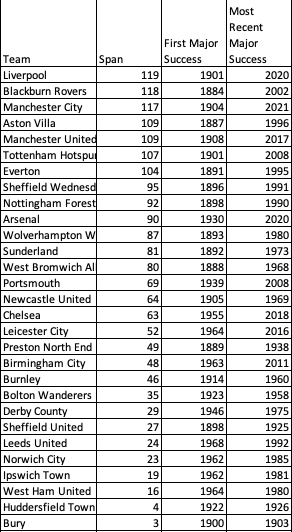
City’s trophy haul makes them the fifth most successful English club of all time based on major domestic and European trophies won (United, Liverpool, Arsenal and Chelsea are ahead of the Blues). In addition only Liverpool and Blackburn have a greater span between their first English trophy and their most recent. See:
Don’t forget you still have time to subscribe to my forthcoming biography of Peter Barnes. Order before May 20th and you’ll get your name (or someone else’s if you’re buying this as a gift) plus your book will be signed by me and Peter Barnes. For details see:
Last night Manchester City reached the final of the Champions League for the first time in their history. Manchester has now become only the second non-capital city to have had two teams reach a European Cup final. Manchester was of course the first British city to have two teams competing in the European Cup in the same season (1968-69).
Last night was a remarkable night and other records were established:
City broke the record for longest winning run by an English club in European Cup history (7)
They became the first English side to win 11 games in a single European Cup/Champions League campaign (they are one off equalling Real Madrid’s record of 12 games)
This Champions League win is an important step in the club’s journey and to celebrate I’m going to make my special 1 hour audio recording commemorating an earlier important step in this journey free to listen to until May 12th.
This audio recording was made to commemorate the tenth anniversary of Manchester City’s FA Cup semi final victory over Manchester United at Wembley (April 16 2011). To me that game was a crucial step towards the success that came over the ten years that followed, just like last night’s feels like a major step in the club’s development.
The audio recording looks at the years between the 1976 League Cup success and the FA Cup glory of 2011. The 2011 semi-final was a crucial step in City’s journey since the 2008 takeover and I felt it was vital to do a special marking this.
So what’s in this special recording? Well, I’ve included exclusive material from interviews and recordings I’ve done over the years with Garry Cook, Brian Marwood, Roberto Mancini, Peter Barnes and Peter Swales. Why Swales? Well, have a listen and you’ll hear why. Basically though I’m trying to set the tone for why the 2011 FA Cup semi final victory was so significant.
On Mancini… I include a few words from him recorded in 2011 and at one point he talks about the view that was then being expressed that City were ‘trying’ to buy success (now they say City ‘have’ bought success!). His words are a reminder that City have been having that particular criticism thrown at them for over a decade! Oh well, I wonder how long those criticisms were laid at other clubs who had seen major investment which propelled them forward?
Anyway, get yourself a brew and be prepared to be transported back in time. Here’s the recording:
If you enjoy the recording then please let me know, comment or subscribe to the site. If it’s of interest then, over the coming months and years, I’ll produce others like this highlighting key points in Manchester City – and Manchester’s – footballing history. It costs £20 a year to subscribe (it works out £1.67 a month) or £3 if you’d like to sign up a month at a time to get full access for as long as you subscribe (you can always try it for a month). It’s worth bearing in mind that the 2010 Manchester A Football History cost £24.95 and all subscribers will be able to access all of that for as long as they are a subscriber (plus all the other stuff of course). You can subscribe below.
Following Manchester City’s victory in the League Cup last Sunday (April 25 2021) I’ve updated the table showing the span of success (above) – i.e. the number of years between a club’s first major success (FA Cup, League, League Cup, European trophy) and their most recent.
Despite the win City remain third behind Liverpool and Blackburn Rovers, though the gap with Blackburn is narrowing year on year at the moment.
Tottenham missed out on not only winning a major trophy last Sunday but also on leapfrogging City, Blackburn and Liverpool to take top spot! I doubt it would’ve made national headlines if they’d topped the span of success table though.
Okay, the span of success does not show how many trophies each club has won or how frequently that club has experienced great eras of success, but it does demonstrate how wrong those people are who believe certain clubs were unsuccessful until recent years, or those who think certain clubs have always been giants. The column on first major success helps to show when some first became significant (often after transformational investment).
While you’re here… You can now order my new book, Peter Barnes: The Authorised Biography, and get your name printed in it (if ordered before May 15 2021). All orders before May 15 will also have their copy signed by me & Peter Barnes. To order see:
Sunday April 25 2021 brought the first League Cup Final played during any form of Covid lockdown in England. The 2020 final had been the last major final played in the country before the pandemic led to various lockdowns and then the continuation of football without fans.
Some football clubs, including Tottenham, had been allowed to have a limited number of supporters at their home games during the early stages of the 2020-21 Premier League season, but Manchester City had not as they were in a regional tier that prevented crowds. So, for many of us, the last physical game we attended was the 2020 League Cup final (some City fans did of course attend the 1-0 FA Cup victory at Sheffield Wednesday on March 4 and the Old Trafford derby of March 8).
In the period between our last ‘live’ match and the 2021 League Cup final we had to sit at home watching City’s games played in empty stadia or, occasionally, at grounds with a small number of fans in but never with any ordinary City fans in. Former City star Mike Summerbee, the club’s ambassador, would often be seen, masked-up, at games when TV camera crews recognised him and it was always nice to know there was at least one person steeped in MCFC history there.
When the announcement came that the delayed League Cup Final (it was postponed until April in the hope that fans could attend) was to have up to 8,000 fans at Wembley there were then several dilemmas for fans. This was to be a test event and almost 2,000 tickets were to be issued to each competing club, which fans would have to pay for, and 4,000 would be given away to residents around Wembley and some NHS staff.
Many fans felt it was unfair that Wembley residents would be given tickets (each could apply to bring a guest too) while fans paid and there were the usual concerns about balance of support – would the fact that tickets were to be given to local residents benefit Spurs for example?
Most fans had no issue with NHS staff being given tickets with some Blues suggesting that NHS staff (and other key workers) who were season ticket holders of the two clubs should be offered the tickets. Lots of other suggestions were made plus, of course, some fans felt it would only be appropriate to attend a major game like this when ALL fans would be allowed back, though that still seemed some way off in April 2021.
To attend the final Manchester City used their loyalty points system and cup scheme as usual but then there was an added layer where fans had to live in certain postcodes: M, SK, BL, OL, WA, WN, PR, FY, BB, LA, CH, CW, BD, HD and HX and Greater London. In addition we had to have covid tests in the build-up to the final, including a lateral flow test that had to be performed at a test centre after 1.30pm on the Saturday before Sunday’s final.
This was difficult for many to arrange as, for example, some of the councils within the postcodes allowed did not have test sites available at weekend. Some booked to have tests close to Wembley, which caused some logistical issues on cup final day, and others had to travel in to Manchester on the Saturday. Inevitably, some did not get negative tests back in time and missed out.
Those lucky enough to get hold of tickets also had to state their method of travel with a limited number of car parking spaces meaning that option simply was not available for some fans. Specific coach and train travel was set up but the costs were prohibitive for some. Others pointed out their concern that once the trains arrived at Euston (or Watford) there would still be a need to travel to the stadium itself. To some this negated the need for travel on specific trains or coaches, but of course the conditions had been imposed by the Government and footballing authorities, not by the competing clubs.
At the stadium on match day the surrounding area seemed full of shoppers trying to pick up a bargain at the retail store but fans seemed few and far between. The photo above (Wembley Way looking towards the stadium) was taken about one hour before kick off. This would normally be packed at this time.
Close to the stadium the Wembley Way ramps that used to carry people up to the stadium have been demolished and a series of steps have been erected instead. Fans had to show their lateral flow test results, tickets, and photographic ID before being allowed up the steps to the stadium. They had to queue at these checkpoints and then, once they’d been allowed through they could make their way up to the stadium turnstiles. They were discouraged from waiting outside the stadium and were encouraged to go to the turnstile.
In previous years drinks had been allowed into the stadium if they were in plastic bottles and the lids were removed. This year no drinks, not even water, were allowed in the stadium, but staff did allow fans to carry in plastic bottles (without lids) as there were water fountains inside (typically positioned near the disabled toilets) and these could be filled up there. This is well worth remembering if you need to have drinks for medical purposes but do not want to pay Wembley’s expensive prices.
In the stadium bars and catering outlets were open as usual and while there was a considerably smaller number of fans within the concourse area, social distancing was not particularly in evidence. Having said that all fans had been tested but supporters were unclear whether Wembley staff, security, stewards and so on had been tested.
In the bowl of the stadium all fans had been positioned in the same stand plus the corners. This was the stand containing the Royal Box and directly opposite the TV cameras. The cynic would suggest that this demonstrated, as always, that some think the TV spectacle is more important than those in the stadium. Surely congestion in the toilets and other areas could have been eased had fans been spaced out in a wider area, or even if they’d have chosen blocks around the stadium with perhaps Spurs fans on one side or end and City in the opposite stand? If it’s pure safety then that would be the logical thing to do.
In the seats we were positioned predominantly in alternate seats with the row behind and in front of us following a pattern which was supposed to mean that there would be no one directly in front or behind of you. As some fans were in groups/families who had travelled together they sometimes moved next to others in their group on the same row – officially we were told that wasn’t allowed but inevitably it happened (we all wanted to be next to the people we’d gone to the game with and didn’t want the seat gap) and no one tried to stop it.
During the game stewards regularly reminded fans that they had to wear face masks throughout – from the moment we had shown our test results and tickets through to leaving the stadium after the presentations we had to be masked up. Of course, when eating or drinking masks were lowered.
Throughout our time in the bowl of the stadium fans would be moving along the rows to their places, and so social distancing was not possible at those times.
After the game we were free to leave en masse if we wanted. As City won the cup most City fans stayed for the presentations and left at various points during the celebrations, meaning there wasn’t a crush to get out. Spurs fans seemed more keen to leave of course, but whether this caused any issues I do not know. Presumably, social distancing is impossible to manage when an entire section chooses to leave at the same time.
If you were one of the lucky ones who had managed to get a car parking space it was refreshing to travel away from Wembley without the huge traffic jams we normally experience. There were roadworks and a few problems on the motorway but nothing like normal.
So, that was the general experience of attending as a Manchester City fan at the first game we’ve been allowed to attend as City fans in over a year. It’s not the story of the game but I hope it gives an idea as to how the crowd management happened.
I know he didn’t manage to appear in the League Cup Final last night but it was great to see Tommy Doyle participate in Manchester City’s celebrations. Tommy is of course the grandson of City legends Mike Doyle and Glyn Pardoe, both of whom scored in the 1970 League Cup final for the club.
It’s an incredible link between the first City success in the competition and the most recent. I’ve not done the analysis but I can’t imagine there’s any other player in England who had both his grandfathers score in the same final for the same club as he now appears. If Tommy’s career develops like either of his grandfathers then he will truly have a glittering and remarkable career.
Here’s film of Tommy participating in yesterday’s celebrations (I’ll be posting more from yesterday’s final over the coming days):
There are plenty of articles on here that mention both Glyn and Mike. Search their names or use the tags below. Mike Doyle also captained City to the 1976 League Cup success which saw Peter Barnes score the opener for the Blues. You can subscribe to Peter Barnes’ authorised biography here (orders by May 15 get your name printed in the book and your copy signed by both me and Peter):
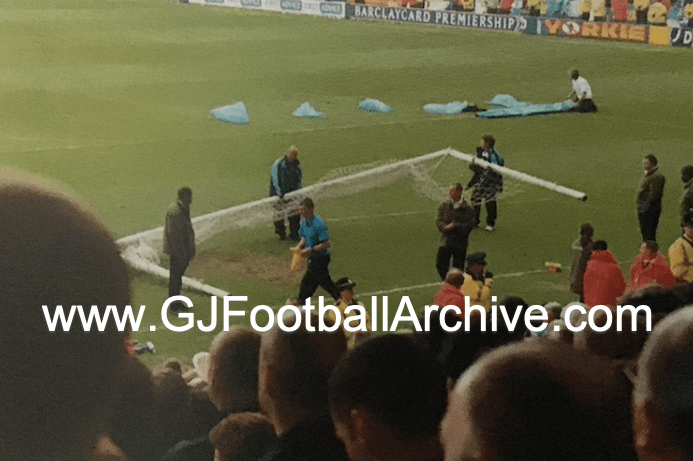
They’ve been a part of football history since the beginning and we often take them for granted but over the years the goals – nets, posts and crossbar – have changed. For this subscriber feature I decided to try to understand what Manchester City’s current goals are constructed of and provide a bit of background on the development of them.
Subscribe to get access
If you would like to read this and all the in-depth articles on this site (including the entire Manchester A Football History book and the audio interview with John Bond) then please subscribe. It works out about £1.67 a month if you take out an annual subscription (£20 per year) or £3 a month if you’d like to sign up for a month at a time. Each subscriber gets full access to the 250+ articles posted so far and the hundreds scheduled to be posted in the coming weeks.
To mark today’s (20th March 2021) FA Cup meeting between Manchester City and Everton here are a few historical facts, memories and video highlights of games between the clubs.
Feature Match
The December 1989 meeting between the two sides was memorable because of events off the field rather than on it. The match ended goalless but the attention the game received from the national media was incredible, and it was all because 20th placed City had appointed the former Evertonian Howard Kendall as manager.
Earlier that season Peter Swales had dismissed the rather quiet, unassuming Mel Machin despite him guiding City to promotion and a memorable 5-1 victory over United. He publicly approached Joe Royle, who turned the club down, and then turned to Kendall.
Almost immediately the ex-Evertonian stamped his authority on the side and quickly brought in Peter Reid and Alan Harper to make their debuts at Goodison. Disappointingly, the highly popular Ian Bishop was named as a substitute. Kendall: “It was not a popular move. I walked out at 2.55pm to hear my supporters chanting, ‘There’s only one Ian Bishop’. Nice welcome that was. The Bishop situation developed into a saga, the like of which I have never experienced in football before.”
It wasn’t long before the long-haired Bishop was sold to West Ham. Earlier in his career Kendall had transferred him out of Everton.
Kendall’s new look City managed to keep ninth placed Everton at bay in a rather dour televised match to earn only their second point in six games. City ended the season in 14th place while Everton finished 6th.
The first League game between the two sides was a 2-1 Everton win on 23rd December 1899 in Division One. The match was played at Hyde Road with Billy Meredith scoring for the newly promoted City, while Jimmy Settle and R Gray netted for the Toffees. City ended their first season in the top division in 7th place while Everton finished 11th.
Television
The first meeting of the two clubs to be televised on BBC’s Match Of The Day was the 1-1 draw on 23rd August 1969. Film here:
The first ‘live’ televised meeting was the famous Howard Kendall match played on 17th December 1989 (see above). The game was shown on ITV.
When Everton appeared in their first FA Cup final it was played at Fallowfield, Manchester. The 1893 final against Wolves was the first, other than the 1886 replay, to be played outside London. Wolves won the match 1-0 and a row of houses in Wolverhampton were given the name Fallowfield Terrace in celebration.
The Fallowfield site now forms part of Manchester University’s student campus.
Well I Never!
City fans demonstrated against the transfer of their hero, Tommy Johnson, to Everton in March 1930 for £6,000. At City Johnson entered the record books by scoring most goals in a season – he netted an incredible 38 in 39 League games during the 1928-9 season. He was a popular player and lived amongst the fans in Gorton. He was often seen drinking draught Bass at The Plough on Hyde Road, and was something of a trend-setter in the area. As soon as he was spotted wearing a wide brimmed trilby hat it quickly became the fashion all young men wanted to follow!
His greatest individual game for City must have been the 6-2 defeat of reigning champions Everton in September 1928, when he scored five goals. Eric Brook scored the other while Dunn and Weldon netted for the Toffees.
In the 1960s Tommy was a regular attender at Maine Road where he and Billy ‘Dixie’ Dean would watch Joe Mercer’s City side. On 28thJanuary 1973 Tommy died at Monsall hospital aged 71.
Record defeat
Everton beat City 9-1 on 3rd September 1906 to record their record victory and City’s record defeat. This was only City’s second match following the findings of the FA investigation into illegal payments which resulted in the suspension of 17 players, the manager Tom Maley, the chairman, and two other directors. The entire summer had been spent finding a new manager and new players – any would do – to fill the void. City’s consolation goal was scored by debutant A.Fisher. The great Sandy Young had netted 4 of Everton’s 9 that day.
Two days before this game, the Blues had been defeated 4-1 by Arsenal in an incredible match that saw City leave the field with only six men. The rest were mainly suffering from heat exhaustion – it was 90 degrees in the shade!
The Young Royle
When Joe Royle made his debut in January 1966 against Blackpool he became the youngest player to appear for Everton in the League. He was 16 years and 282 days. His first game against City was the on 29th April the following year – only his 6th League appearance.
Joe Mercer
Obviously I’m biased but I’d urge everyone reading this article to also read:
The first Premier League meeting between these sides ends in a comfortable City win before 20,242 at Goodison Park. Two goals from Sheron and one from David White gave the Blues a 3-0 lead before an own goal from Brightwell made it 3-1 on Halloween.
1993 – Last Day
On the last day of the season Everton win 5-2 in a frustrating match for City fans. Goalscorers for Everton included future Blues Beagrie (2 goals) and Beardsley. White and Curle (penalty) scored for the home side.
1993 – Rideout Goal
The first away match of the season ends in a 1-0 City defeat. Rideout scored for the Toffeemen on 17th August before 26,025.
1994 – Double Double
Two goals each from Rosler and Walsh give City a 4-0 home win on 27th August. The Maine Road sell out crowd of 19,867 is City’s 3rdlowest crowd in the Premiership. The Kippax Stand was in construction and the capacity was severely restricted as a result.
1996 – Former Blue Scores
Former City hero Andy Hinchcliffe scores a 47th minute penalty to ensure a 2-0 Everton win in February 1996.
2000 – Five Stars
Wanchope (14), Howey (23), Goater (42), Dickov (54), and Naysmith (own goal in 67th minute) give City a thrilling 5-0 victory over Everton at Maine Road in December.
2002 – Anelka hat-trick?
City fans celebrate an Anelka hat-trick but his 14th minute opener is later ruled an own goal, scored by Everton’s Radzinski. In addition, Wright-Phillips is controversially sent off in the 28th minute but this is later downgraded to a yellow card. Despite the controversy and confusion City win the match 3-1 on 31st August.
2003 – New Year’s Day
Over 300 million fans watch this 2-2 draw on Chinese television. Everton took the lead in the 6th minute, City made it 2-1 in the 82ndbefore Everton equalised 2 minutes into injury time on January 1st.
2004 – Keegan’s Disappointment
On the season’s final day, City beat Everton 5-1 with goals from Wanchope (16 & 30), Anelka (41), Sibierski (89) & Wright-Phillips (90). The victory caused the two sides to swap League places. The Blues ended the campaign on 41 points, eight more than relegated Leicester, Leeds and Wolves. A decent enough margin in the end, but that did not change the way most felt about the season.
Prior to that final match Keegan explained truthfully how he felt: “We are just about at the end of the most disappointing season of my managerial career. I haven’t enjoyed it and I am sure the same goes for everyone connected with Manchester City.”
2005 – Early Morning Blues
Everton, so often a bogey team during the previous decade or so, were defeated 2-0 on 2nd October. This was the first Sunday morning kick off in the Premier League and the match commenced at 11.15 with some fans making a point of the early start by wearing pyjamas. It was also Stephen Ireland’s first full Premiership game. Before the match he admitted to being “very nervous” and post-match he commented that the rest of the team had supported him: “That helped me ease my nerves and settle in as one of them.”
2006 – Richards the Hero
One player, who would help City win the FA Cup and Premier League a few years later, was beginning to be seen as one of the club’s most positive assets this season – Micah Richards. He performed to a consistent standard and, on 30th September, he actually netted an equaliser for the club in the dying seconds against Everton to ensure an away point. The 18 year old Richards made his first full international appearance a few weeks later when he played for England against Holland on 15th November. Henry Winter, writing for the Telegraph, claimed: “England may well have discovered Gary Neville’s long term successor.” By this stage in his career Richards had only made 23 Premier League starts.
At Everton Richards’ goal was very important but City’s dominance during the final minutes of the match should have seen the Blues snatch a winner according to goalkeeper Nicky Weaver: “The last five minutes we absolutely battered them and every time the ball went in the box we looked as though we were going to score. Then when [Samaras] hit the post, you’re thinking ‘is it not going to be our day?’ But we kept going and deep, deep into injury time, we got something out of the game.”
Everton’s captain Phil Neville admitted: “It feels like a defeat… we should have got the second goal and killed off the game.”
2011 – Super Mario
In September City defeated Everton 2-0 with goals from substitute Mario Balotelli and James Milner. It was an important victory over a team that continued to be a bit of a bogey side in recent seasons, and ensured the Blues were now back on equal points with Ferguson’s Manchester United, who had drawn 1-1 at Stoke despite leading at half time.
Subscribe to get access
If you would like to read all the in-depth articles and watch all the videos/sound recordings etc. on this site (including the entire Manchester A Football History book) then please subscribe. It works out about £1.67 a month if you take out an annual subscription (£20 per year) or £3 a month if you’d like to sign up for a month at a time. Each subscriber gets full access to the 230+ articles posted so far and the hundreds scheduled to be posted in the coming weeks.
In the build up to Manchester City’s League Cup final against Aston Villa last year (2020) I was somewhat deflated by the way in which some in the media were critical of City fans. There wasn’t any one thing in particular that prompted this but it was something that had been growing for some time. It was all connected with the general stereotyping of City fans and the language being used by some to write negatively about them. I decided to write a lengthy piece on how I felt about this and I published it on my Facebook and twitter accounts the day after the League Cup final (the final was on 1st March 2020).
Sadly, one year on and little has changed. Ah well! So for those who missed it last year here is the piece:
If you would like to read other in-depth articles on this site (including the entire Manchester A Football History book) and listen to my 1995 interview with John Bond, then please subscribe. It works out about £1.67 a month if you take out an annual subscription (£20 per year) or £3 a month if you’d like to sign up for a month at a time. Each subscriber gets full access to the 260+ articles posted so far and the hundreds scheduled to be posted in the coming weeks.