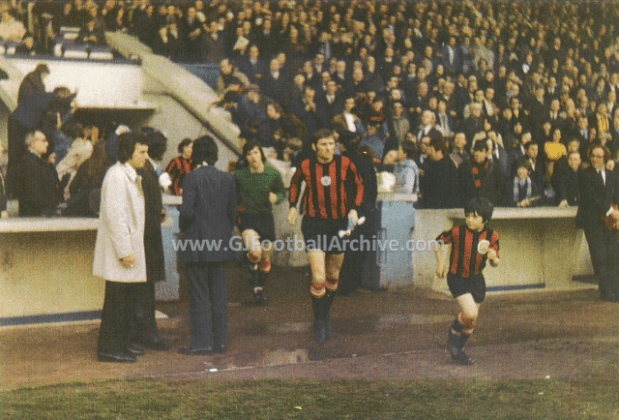
On this day (1 February) in 1986 Manchester City defeated West Bromwich Albion 2-1 with goals from Gordon Davies and Paul Power.
The 1980s was a truly important decade in the history of Manchester City Football Club and you can find out more on this season by reading the following 2,500 word feature on 1985-86 (available to subscribers). Enjoy!
Subscribe to get access
Read more of this content when you subscribe today. It costs £3 per month (cancel anytime) to access everything posted since 1 October 2022 or £20 a year to access everything posted since the site was created in December 2020. This special rate works out about £1.67 a week and gives access to everything posted, including PDFs of 3 of my books.
Over the years I met and interviewed Tony Book on many occasions. I last spoke with him at the MCFC Former Players Dinner earlier this season. As a tribute to him I’m posting here an interview I did with him back in May 2015. It wasn’t the first interview I did with him (that was in 1992 about Joe Mercer), but it is a reflective piece with Tony talking about his career. I always think it’s important when someone passes away to use their words where possible to talk about their career. You can read it below.
I’ve posted this exactly as it was written and published in 2015 so, obviously, references are to that era and before.
TALKING CITY WITH GARY JAMES
Tony Book joined City in 1966 and went on to become manager, winning the League Cup in 1976.
Let’s start with your birth certificate and the story that this was altered to give the impression you were a bit younger when signing. Is this true?
Ah, it’s true, but I didn’t actually alter it. My birth certificate had been folded with a heavy crease down it, and I needed it when I was moving from Bath to join Plymouth where Malcolm Allison was the manager. He told them I was 28 but I was 30. Luckily, when I opened out my birth certificate the fold had meant that the final number in the year wasn’t clear, so they just took Malcolm’s word for it! When I came here in 1966 I was 32 – for real – and we never hid my age.
It’s a good job, otherwise you’d have been celebrating your 80th two years late! When you signed for City Malcolm had to persuade Joe Mercer to ignore your age didn’t he?
Yes. Joe was a similar age when he joined Arsenal, as you know Gary, and Malcolm said “look at what you did at Arsenal Joe” – he captained them to a couple of League titles and the FA Cup. Little did we realise that something similar would happen to me at City. I always wanted to be a full time professional footballer and Malcolm gave me the chance. I went playing in Toronto – it was the first time I’d trained in the day because I was a bricklayer by trade and had to train at night back home – before Plymouth and Malcolm came and talked with me after I’d played against a team of Italians over there. He told me how much he liked my play and, well, after that he signed me for Plymouth and then City. I was always grateful to Malcolm, but joining City was perfect. The club under Joe and Malcolm was about to take off and I recognised as soon as I got here that there was a good nucleus of young lads who were ready. Doyle, Pardoe, Oakes, Dowd, Young… the list goes on. I came in just after they’d got promoted and everything felt right. I made my debut at Southampton on 20 August 1966 and, although that match ended goalless, it was clear those lads were enjoying their football. Of course, Summerbee and Bell had been added and then Francis came in October 1967. That’s when we really took off.
Tony Book 1969
How did it feel to be made captain of this team?
When Johnny Crossan left I was made captain because of my experience in football, not because of experience at the highest level because I didn’t have that. But what I did know was football and the way a team operates. I came to professional football late, but back then non-league teams did have quite a few former League players. Some actually gave up League careers because, in the end, they could earn more in non-League and regular employment. I always felt I had something to offer the younger guys because of that experience.
Being totally honest, what did you feel you’d do at City? Did you think you’d be there for as long as you were?
I hoped I’d get a couple of years. That’s all I felt I could get and I would have been very happy with two years at Manchester City, of course. Back then City owned some club houses and I went in one – paying about £2.50 a week! Because of what happened and the way the success came in my second year, Gary, I felt I could go on again. Winning the League in 1968 was like a spark and I wanted to keep the flame going.
Thinking about the title winning season of 1967-68, there were quite a few standout games. What are your memories of those?
There was the Spurs game at Christmas when we sharpened our studs to keep a grip on the surface and we really played a graceful, stylish game. There was the derby at Old Trafford when I made a mistake. I was playing the sweeper role, I let the ball bounce, and George Best went through and stuck it right in the net in the first minute! I couldn’t believe it and the lads lifted me and, Gary, we went on to play a brilliant game. We won 3-1 and that set us on course, but we still had nine games to play. None of us had ever won a major trophy, but Malcolm and Joe were brilliant during that period. Malcolm was great at relaxing us and there was never a doubt in his mind, and then in our minds, that we wouldn’t win it. We believed in ourselves and with Colin Bell, Mike Summerbee and Francis Lee we knew we had that something special that champions need. I always felt that if we went behind one of those three would get us out of trouble. We had a great team throughout of course, and we complimented each other well across the park. We all knew our roles.
After winning the League you suffered an Achilles injury, did you think that was the end?
No, but I was desperate to get back. I tried everything. My leg was in plaster and as soon as they took it off I tried. I played in a reserve game and Sidney Rose, the doctor who was also a director, saw me struggle. I felt it go again. He stuck a needle in me and I had to rest. In the end I went to Christie’s, had a shot of radium, and that seemed to take the sting out of it all. I don’t know whether that was the right treatment or not, but I began training and came back to the first team in January.
Clearly, losing your influential captain for such a large period of the season had its effect on City in the League and in their first European Cup campaign, but once you returned you guided City to FA Cup success. Was this another fairytale season for you?
I guess it was because winning the FA Cup was amazing. It was important for us to keep our success going and the FA Cup was viewed as something special, but I have to tell you Gary, that now, when I look back, I realise that we were not consistent in our challenge for the League. We consistently challenged for trophies, but not in the League. Today, we have such a wonderful team that has been able to challenge for the League season after season, but back then we were more inconsistent. We had good days and bad days, but almost any team in the division could challenge back then. There were no easy games. In 1969 I also shared the FWA player of the year with Dave Mackay, so it was a good season. People had suggested I’d win it the year before because I’d played every game and we’d won the League. I was getting a lot of praise but George Best won it that year. So, the year I won it, it was a surprise. A great feeling and I remember being at the award dinner. For me though, it was an achievement for the entire team. You need a good team around you to win awards like these, and we certainly had a great team.
What are your memories of City in Europe during that time?
There was Malcolm’s boast about scaring Europe which set us up, but then in the ECWC 1969-70 we did. The final is the strongest memory but mostly because of the rain. We had a great following of fans, but few locals and Gornik fans were there, and they were all drenched. I felt so sorry for them. We won the cup, of course, and that season we’d also won the League Cup. I wanted to go on forever by that time. I was enjoying it and those two years became four and I was 36. I couldn’t wait for the next season. I was like an 18 year old who had just been given his chance.
1971 ECWC v Chelsea. Tony Book and mascot Paul Todd. Photo by Alan Jubb
Is there anything from your playing career that you would change if you could?
Ah, yes. I gave the referee an elbow at Ipswich! He’d disallowed a goal. At Ipswich, you had to go down a corridor as you went in at half time and as I turned I deliberately elbowed him. He went down. I was called to an FA disciplinary meeting and the first question they asked was “would you like your past record to be taken into consideration?” Well, I’d only been a pro for a couple of years so I said yes, thinking it’ll be great. They then brought out information going years back from my non-league days and it all worked against me!
When it came time to retire from playing, was that your choice?
No. Johnny Hart had been manager but was ill and Peter Swales asked me to take over on a temporary basis in October 1973. I managed the team for about five weeks until Ron Saunders came in and he had a chat with me suggesting I was needed more as a coach/assistant than a player. I wish now I’d said I wanted to finish playing at the end of the season because I think that would have helped him more. There were issues between him and some of the playing squad and I think I could have helped him, had I been a player. He was insistent though.
Ron Saunders, Peter Swales and Tony Book at Saunders appointment in November 1973
It’s a shame because we got to the League Cup final (1974) and with you in that team, maybe things would have gone differently. Saunders didn’t last as manager and was gone in April that year. How did you feel?
You see things happening but are unable to change it. It was tough. I ended up being given the manager’s job and it was a strange period because we’d had turmoil over that season. I also had to start looking at my pals, the players I had won trophies with, and explain that they needed to move on. I didn’t want to do that and I found it very hard. Awful!
As a manager I was proud that in the five years that followed we won the League Cup, finished runners up by a point to Liverpool, and we were in Europe for three consecutive seasons. I had some good players that came in – Dave Watson, Brian Kidd, Asa Hartford – and did an excellent job for me. I felt we were on our way.
From the moment you took on the job it was progress all the way through and, just before Malcolm returned as ‘coaching overlord’ in January 1979, we had reached the UEFA Cup quarter finals. What was it that made you a success in that role?
The players. It’s always about the players you manage to sign and what they do for you. I was more like Joe Mercer as a manager and had good coaches working with me. Bill Taylor was recommended to me by Don Revie and he was a great coach.
Tony Book, Peter Swales and Kaziu Deyna at Deyna’s signing for Manchester City
City may not have won many trophies during your spell as manager, but we came close, had some great players and, significantly, this was an exciting period to watch. Then Malcolm came back. Did you welcome the return?
Malcolm is such an important figure in my life that I cannot say anything but positives about him as a man. I will always be indebted to him. But I knew that it couldn’t work when he came back. I knew the chairman, I knew Malcolm, and I knew how they both worked. There was no way they would have been able to work together. It was as simple as that. That’s what the main difference was between the 60s and 1979. In the 60s we had Albert Alexander as chairman who worked wonderfully with Joe and Malcolm, but it was different in 1979. It was such a shame, because I thought we were going somewhere.
Silkman, Allison & Book after Peter Barnes scored v Tottenham 3 February 1979
On a day to day basis, what was it like working during that period?
It varied but there were players like Gary Owen and Peter Barnes who I felt had a lot to offer, but they were moved on. It’s difficult to go through it all, but as we know it failed and we were dismissed in October 1980. I stayed briefly and then became Cardiff manager. I missed Manchester but was delighted that under John Bond that season ended with the FA Cup final against Spurs. I got a phone call from John Bond asking me back to City to look after the youth team and I said I’d think about it. In the meantime there was the FA Cup final and as it was the 100th final they invited all surviving captains of cup winning sides. Myself, Roy Paul, and Joe Mercer (Arsenal) were on the pitch with the others and all of a sudden they announced my name and the City fans erupted into song. It really got to me, emotionally, and I knew I had to come back. It was one of the best feelings I ever had. Returning to City was the right thing and I had a wonderful time working with Ken Barnes, Glyn Pardoe and all those talented young lads. We won the Youth Cup in 1986 and it was a real pleasure being there at the start of so many careers.
This year I’ve interviewed quite a few of the players who had progressed through the youth team while you were there. Every one of them has talked with affection about your approach, driving them on. I think it’s amazing really that your influence has been there at City year after year since 1966. How does it make you feel to have had three great distinct careers at the club?
I love this club and am grateful to all those who brought me here and involved me for so long. Whenever I’ve been given a job to do I’ve always tried to give my best. When it all came to an end in the 90s it hit me hard and there were issues that were well documented, but since then Francis Lee and I have resolved our differences. Actually, I think it says something that so many of our former players come to games these days, and all of those players from that Mercer-Allison team are so proud of how this club is challenging once more. We’re enjoying the success and the consistency season after season. Having said that I loved my days as a player and would never swap them… I would have loved us to have these pitches though. They’re perfect. How great would the likes of Colin Bell have been on these surfaces?
If you enjoy all the free material on my website and would like to support my research and keep this website going (but don’t want to subscribe) then why not make a one-time donation (or buy me a coffee). All support for my research is valued and welcome. It allows me to keep some free material available for all. Thanks.
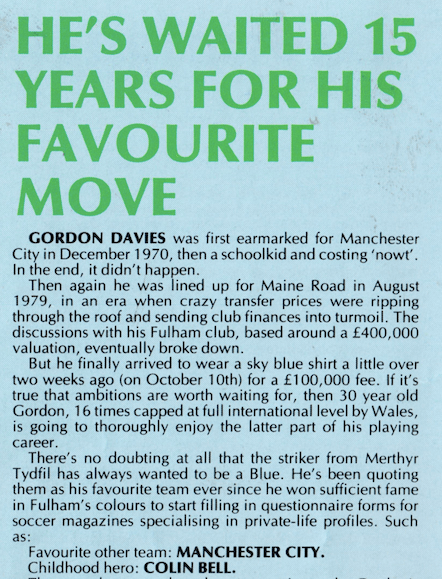
On this day (10 October) in 1985 Chelsea forward Gordon Davies joined Manchester City (the team he supported; his hero was Colin Bell). Davies made 3 Welsh international appearances while at City. There was a chant connected with him which was, err, well, typical 1980s. It was based on the ‘Woo Gary Davies, woo Gary Davies, woo Gary Davies on the ra-di-o’ jingle used by Radio One DJ Gary Davies (of course). The chant (I’m sure you can guess) went ‘Woo Gordon Davies, woo Gordon Davies, woo Gordon Davies in the ar-e-a’ (meaning penalty area of course!). Those were the days, hey?
Subscribe to get access
Enjoying this website? Fancy supporting my research into Manchester football history? Why not subscribe? Every subscription directly helps support my research and provides each annual subscriber with access to everything posted on this site, including the entire Manchester A Football History and From Maine Men To Banana Citizens books, plus interviews, articles and more. I am not employed by anyone and all my research is self funded or comes from subscriptions to this site.
If you enjoy all the free material on my website and would like to support my research and keep this website going (but don’t want to subscribe) then why not make a one-time donation (or buy me a coffee). All support for my research is valued and welcome. It allows me to keep some free material available for all. Thanks.
On 27 May 1986 Billy McNeill’s Manchester City defeated Seattle Storm 1-0 as part of their post season North American tour. The City scorer was Mark Lillis and that season’s FA Youth Cup winners David White, Steve Redmond and Andy Hinchcliffe were in the starting 11. Other FA Youth Cup winners such as Ian Brightwell were also part of the official touring party. Here’s the starting 11 from my ledgers:
Here’s a team photo of Seattle Storm soccer team in 1987:
Subscribers can read more on 1985-86 in this 2,500 word feature below:
Subscribe to get access – Monthly
Read more of this content when you subscribe today. It costs £3 per month (cancel anytime) to access everything posted since 1 October 2022 or there’s a special annual rate below which gives greater access and works out much cheaper.
Read more of this content when you subscribe today. It costs £3 per month (above) or £20 a year (here) to access everything posted since the site was created in December 2020. This special rate works out about £1.67 a week and gives access to everything posted, including PDFs of 3 of my books.
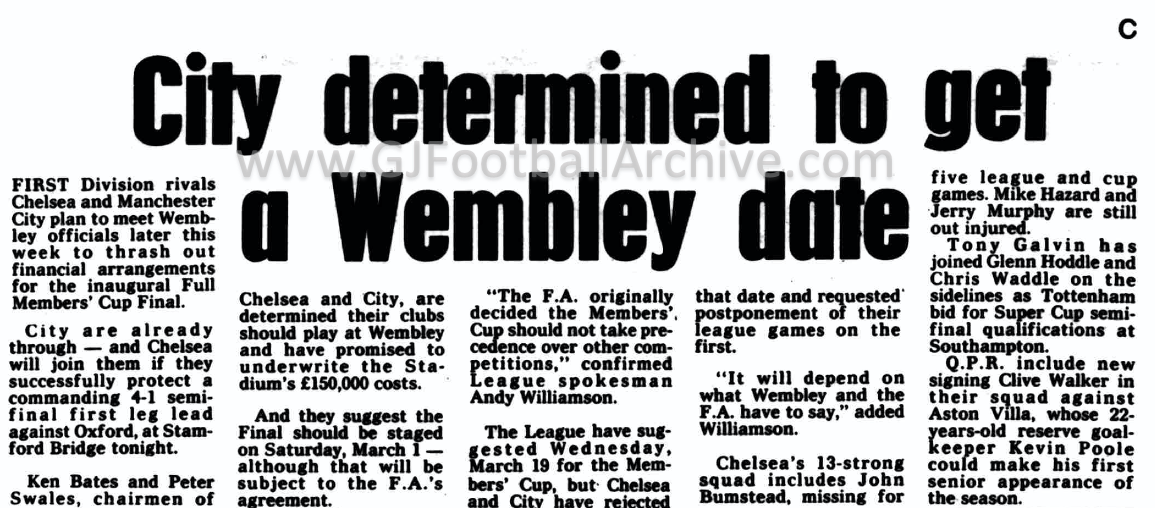
Today’s 1980s flashback is an on this day (17 December) from 1985 when newspapers carried the news that Full Members’ Cup finalists Manchester City and potential finalists Chelsea planned to meet to set a date for the competition’s final. These were strange days and I guess there are many younger fans who have no idea what the Full Members’ Cup was all about. Elsewhere on this site you can find material on it or you can read the article on this season below (see boxes on subscribing below).
The issue was that the competition needed a Wembley final to add some credibility to it and both City and Chelsea were determined this would take place at a weekend. The preferred date was 1 March 1986 but this required clubs to postpone fixtures as the article suggests. What was not realised on 17 December 1985 was that City’s opponents on 1 March would object. Why? Well, City’s opponents were Oxford and they were the team that Chelsea had to beat to reach the national final. Had Oxford won then it seems likely they would have had no objection to rearranging their League game with City, but once Chelsea beat them the chance of City getting their preferred date was never going to happen.
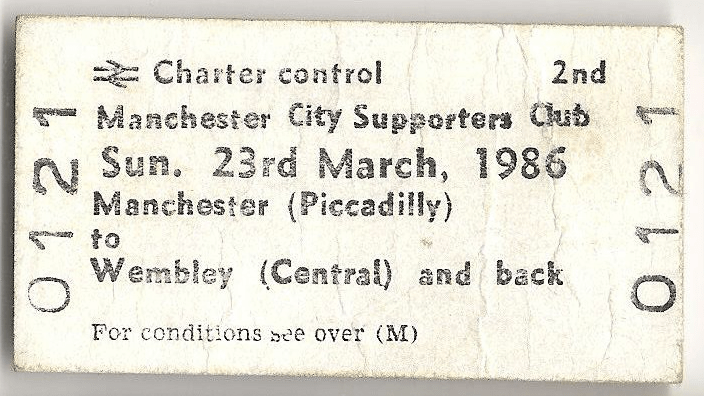
In the end the final was played on Sunday 23 March, the day after an Old Trafford Manchester derby!
The 1980s was a truly important decade in the history of Manchester City Football Club and you can find out more on this season by reading the following 2,500 word feature on 1985-86. Enjoy!
Subscribe to get access – Monthly
Read more of this content when you subscribe today. It costs £3 per month (cancel anytime) to access everything posted since 1 October 2022 or there’s a special annual rate below which gives greater access and works out much cheaper.
Read more of this content when you subscribe today. It costs £3 per month (above) or £20 a year (here) to access everything posted since the site was created in December 2020. This special rate works out about £1.67 a week and gives access to everything posted, including PDFs of 3 of my books.
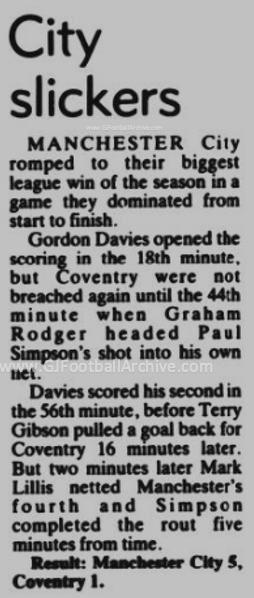
Today’s 1980s flashback is an on this day (14 December) from 1985 when Manchester City thrashed Coventry City 5-1 at Maine Road. ‘Woo Gordon Davies’ opened the goalscoring in the 18th minute. Paul Simpson made it 2-0 (though some reports claimed it was an own goal). In the end Davies (2), Simpson (2) and Mark Lillis scored with Coventry’s goal coming from Terry Gibson.
The 1980s was a truly important decade in the history of Manchester City Football Club and you can find out more on this season by reading the following 2,500 word feature on 1985-86. Enjoy!
Subscribe to get access – Monthly
Read more of this content when you subscribe today. It costs £3 per month (cancel anytime) to access everything posted since 1 October 2022 or there’s a special annual rate below which gives greater access and works out much cheaper.
Read more of this content when you subscribe today. It costs £3 per month (above) or £20 a year (here) to access everything posted since the site was created in December 2020. This special rate works out about £1.67 a week and gives access to everything posted, including PDFs of 3 of my books.
A new daily series of articles for subscribers started last week covering the 1980s. This is a seasonal journey through a truly important decade in the history of Manchester City Football Club. Today’s article is a 2,500 word feature on the 1985-86 season. Enjoy!
Subscribe to get access – Monthly
Read more of this content when you subscribe today. It costs £3 per month (cancel anytime) to access everything posted since 1 October 2022 or there’s a special annual rate below which gives greater access and works out much cheaper.
Read more of this content when you subscribe today. It costs £3 per month (above) or £20 a year (here) to access everything posted since the site was created in December 2020. This special rate works out about £1.67 a week and gives access to everything posted, including PDFs of 3 of my books.
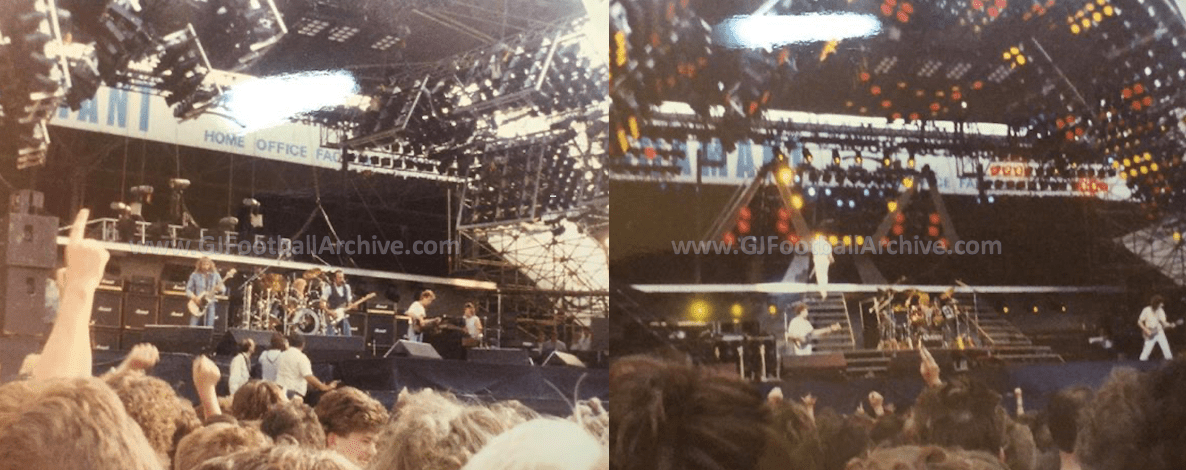
It’s a kind of magic! For day 45 of my posts counting down to the centenary of Maine Road’s opening game I’ve posted these images of Queen & the Rolling Stones at Maine Road. These images are the copyright of Garry Lippett who attended the Queen concert in July 1986.
Garry loaned his photos to me to be used in features about the concert and I’m eternally grateful. It’s quite often the fan photos that capture moments like these. In the days before mobile phones these type of photos are rare and the person taking the image has no idea how good or bad the image may be until it’s developed. Thankfully Garry managed to capture both acts on stage. Status Quo are on the left image and Queen on the right.
Status Quo (left) & Queen 1986 concert at Maine Road. Copyright Garry Lippett
Here’s an aerial photo of Maine Road from 1971. The Queen stage was placed in front of the Platt Lane Stand (numbers 3 to 5). If you look carefully at Garry Lippett’s images you can see the advertising boards at the front of the Platt Lane roof.
Maine Road aerial 1971 from Farewell To Maine Road
If you’d like to read more on the history of Maine Road, take a look at Farewell To Maine Road, which can be downloaded from this page:
If you enjoy all the free material on my website and would like to support my research and keep this website going (but don’t want to subscribe) then why not make a one-time donation (or buy me a coffee). All support for my research is valued and welcome. It allows me to keep some free material available for all. Thanks.
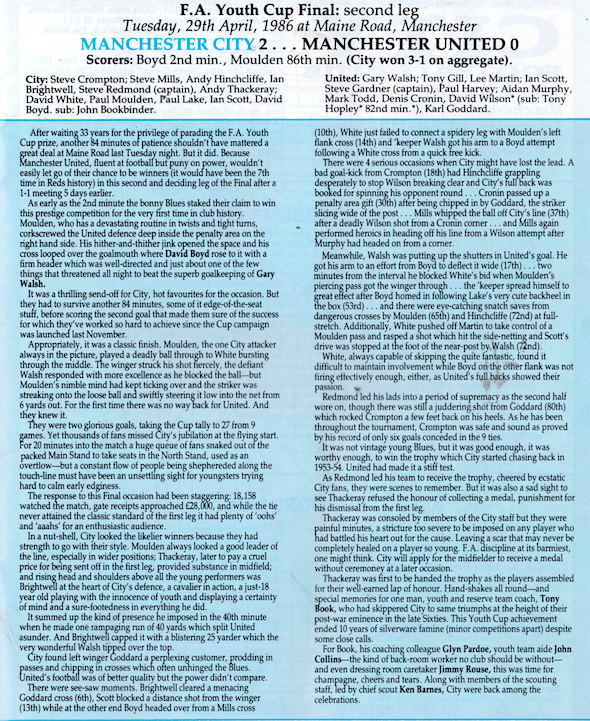
This weekend the 2023 FA Cup final at Wembley will be the first all-Manchester FA Cup final but it is not the first all-Manchester FA Final. That came in 1985-86 when the two Manchester clubs reached the FA Youth Cup final. In the build-up to Wembley this final will probably be overlooked but I wanted to make sure we do remember. Here’s a brief piece on the final.
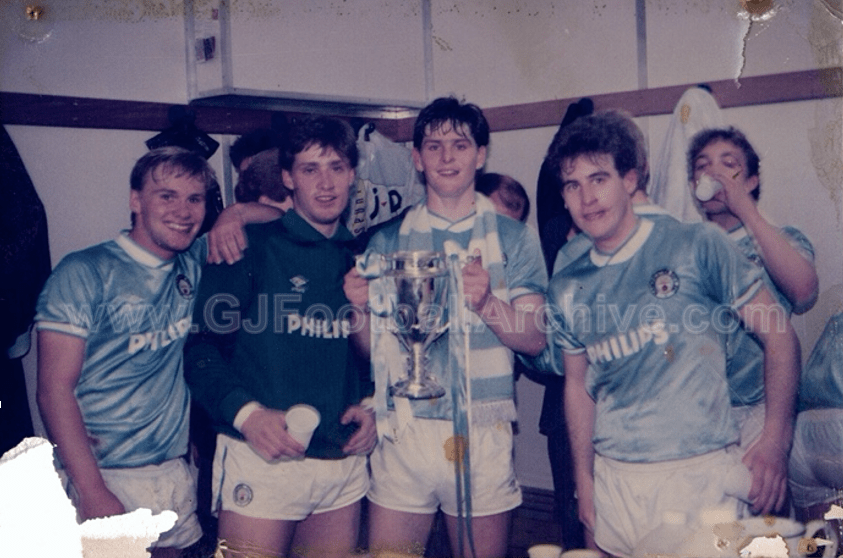
In April 1986 Manchester City’s youth team defeated Manchester United 3-1 on aggregate in the final of the FA Youth Cup. It was a tremendous achievement at the time, and one which proved that it was the Blues, rather than the Reds, who knew how to find and recruit young players – when Alex Ferguson arrived in Manchester later in 1986 he was dismayed that City tended to sweep up all the local talent and put things in place to change the situation. He even chatted to City’s chief scout Ken Barnes about the Blues’ strengths. More on Ken in a moment.
Of the 11 City boys who played in the 1986 final an amazing seven would also appear in the first team. Two of those would captain the Blues; two would play for England; and one would continue to play for the Blues into the late 1990s. For the record the City eleven plus subs were:
Steve Crompton, Steve Mills, Andy Hinchcliffe, Ian Brightwell, Steve Redmond (capt), Andy Thackeray, David White, Paul Moulden, Paul Lake, Ian Scott, David Boyd. Unused subs: Steve Macauley (1st leg) & John Bookbinder (2nd leg).
City’s Chief Scout at the time was 50s Cup winner Ken Barnes and years later I interviewed him about the success. He firmly believed that it was exceptional to find so many young star players at the same time: ‘We were dead lucky. I have to say that I don’t think it will ever happen again. I don’t recall any team having so many of the players coming through from the Youth team. It was only circumstances as such that they all got into the team at the same time. There was no alternative – the club had no money. No money to buy new players – so the young lads were thrown in at the deep end. Maybe if we had had a good team at the time 3 or 4 of them wouldn’t have got into the team and, who knows what would have happened to them. It enlightened me the year they won the Youth Cup. They went throughout the whole season in the Lancashire League and lost only one game.
‘That was a remarkable youth side. In the past we had boys like Tommy Caton, Ray Ranson, Nicky Reid, John Beresford and Darren Beckford but we never had a team like the 1986 one. Most of the youngsters played for our nursery team Midas… Nearly all those who have made it into the first team played with them from the time they were 11 or 12.’
Here is the City first team match programme commenting on the success:
1986 YOUTH CUP STATISTICS
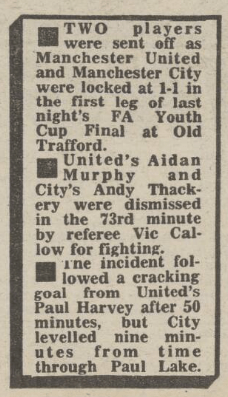
Old Trafford, 24 April 1986 Manchester United – Manchester City 1–1 (0–0) 1-0 49 min. Aidan Murphy 1-1 82 min. Paul Lake (penalty) Attendance: 7,602
Manchester United: Gary Walsh, Tony Gill, Lee Martin, Ian Scott, Steve Gardner (capt), Jon Bottomley, Aidan Murphy (red card, 69 min), Mark Todd, Dennis Cronin, David Wilson (replaced by Tony Hopley), Paul Harvey. Manager Eric Harrison.
Manchester City: Steve Crompton, Steve Mills, Andy Hinchcliffe, Ian Brightwell, Steve Redmond (capt), Andy Thackeray (red card, 69), David White, Paul Moulden, Paul Lake, Ian Scott, David Boyd. Unused sub: Steve Macauley. Manager: Tony Book
Second leg
Maine Road, 29 April 1986 Manchester City – Manchester United 2–0 (1–0) 1-0 02 min. David Boyd 2-0 86 min. Paul Moulden Attendance: 18,158
Manchester City: Steve Crompton, Steve Mills, Andy Hinchcliffe, Ian Brightwell, Steve Redmond (capt), Andy Thackeray, David White, Paul Moulden, Paul Lake, Ian Scott, David Boyd. Unused sub: John Bookbinder. Manager: Tony Book
Manchester United: Gary Walsh, Tony Gill, Lee Martin, Ian Scott, Steve Gardner (capt), Paul Harvey, Aidan Murphy, Mark Todd, Dennis Cronin, Jon Bottomley (replaced by Tony Hopley), Karl Goddard. Manager Eric Harrison.
If you enjoy all the free material on my website and would like to support my research and keep this website going (but don’t want to subscribe) then why not make a one-time donation (or buy me a coffee). All support for my research is valued and welcome. It allows me to keep some free material available for all. Thanks.
Back in March 1986 City drew 2-2 with United at Old Trafford one day and then faced Chelsea in the inaugural Full Members’ Cup final the following day. The competition was one of two competitions created in response to the ban on English clubs playing in Europe following the Heysel European Cup Final of 1985. Here’s the story of that Wembley final…
Subscribe to get access
Read more of this content and everything else in the archive when you subscribe today.