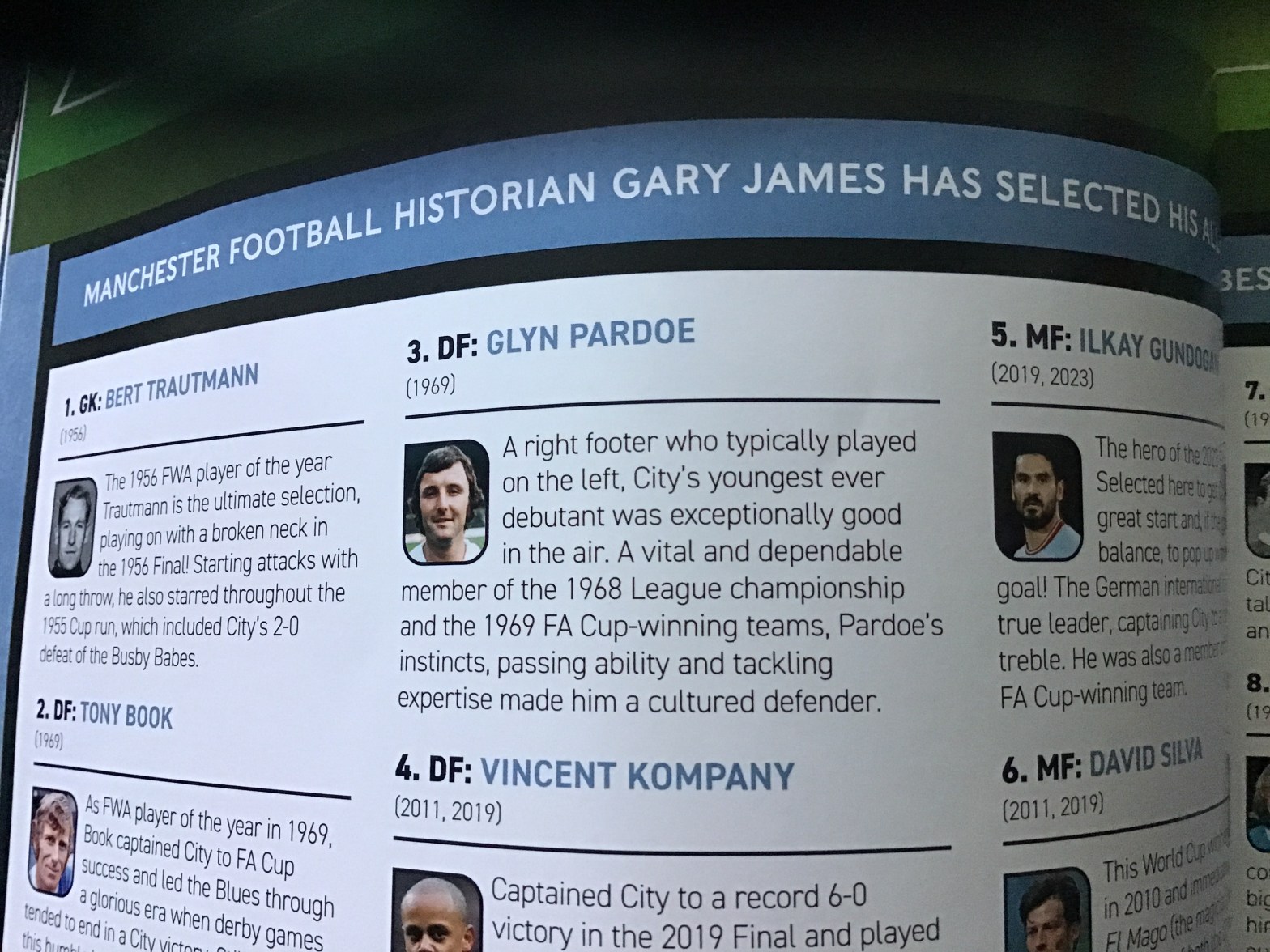
Glyn Pardoe was born on this day (1 June) in 1946. He rightfully made it into my all time MCFC FA Cup winning 11, published in last week’s FA Cup final match programme.
Football writing, thoughts and more by Gary James
Glyn Pardoe was born on this day (1 June) in 1946. He rightfully made it into my all time MCFC FA Cup winning 11, published in last week’s FA Cup final match programme.
On this day (23 May) in 1947 Roy Clarke signed for Manchester City. His debut came on 14 June when the Blues defeat Newport 5-1. Until the Covid affected seasons, this was the latest finish to a season for the Blues. It had been delayed due to poor weather causing postponements.
Years ago I wrote the Manchester City Hall of Fame book and as part of that I featured Roy. The game selected for his ‘most significant’ was the 1955 FA Cup semi final and subscribers can read that below.
City 1 Sunderland 0
FA Cup Semi-Final at Villa Park
26th March 1955
Goalscorer: Clarke
City Team: Trautmann, Meadows, Little, Barnes, Ewing, Paul, Fagan, Hayes, Revie, Johnstone, Clarke.
Attendance: 58,498
If you would like to read this and all the in-depth articles on this site (including the entire Manchester A Football History book and the audio interviews with Malcolm Allison & John Bond) then please subscribe. It works out about £1.67 a month if you take out an annual subscription (£20 per year) or £3 a month if you’d like to sign up for a month at a time.
On 10 May in 1947 a solitary goal from Alec Herd against Burnley was enough to give Manchester City promotion. The attendance for this Second Division game was recorded by the media at the time as 67,672 but official records reviewed almost sixty years later showed that City actually recorded the attendance as 69,463.
Typically, the attendance figures City used to give the media for League games through to the 1960s tended to exclude season tickets. So the Blues’ management would give the figure of tickets or pay on the gate admission for the game but exclude season ticket holders. Back in 1946-47 City had around 1,800 season ticket holders and almost every League attendance back then is understated by that amount.
FA Cup games were the actual attendances as these were always sold game by game.
As this practice of excluding all season ticket holders continued for many, many decades at Maine Road attendance figures for League games are usually understated (they were often understated in the 1970s & 1980s as well but for different reasons and back then Peter Swales, Bernard Halford and the others involved in calculating attendances would deny any discrepancy despite many fans, fanzines and others challenging them often).
For comparison purposes it’s worth looking at the attendances of the Division One champions in 1947 to see how the Blues compared. This attendance against Burnley was almost 17,000 higher than Division One champions Liverpool’s highest crowd that season (52,512 v Wolves in December) and the Merseyside Reds nearest home game to City’s Burnley match was watched by 48,800 and that was Liverpool v Manchester United (May 3). Liverpool did average 45,732 that season, whereas City averaged 39,283 but they were a Second Division club.
The City-Burnley crowd was the Second Division’s record at the time and it was higher than every First Division crowd since the 1937-38 season (The Second Division record is now held by Tottenham v Southampton which had 70,302 in 1949-50).
Film of City v Burnley does exist but it’s in a most unlikely place. It was actually filmed as part of a Mancunian Films drama called Cup Tie Honeymoon. The company was run by a Manchester City fan who made this film, which starred Sandy Powell and Pat Phoenix (under her original name of Pilkington). A football game is crucial to the plot and scenes were filmed at Maine Road and interspersed with real action from the City-Burnley game to add credibility.
Myself and Will McTaggart have shown these scenes in our Boys In Blue film shows which have been staged at the Dancehouse and Cornerhouse in Manchester over the last decade. Maybe I’ll explain more about the film and those talks another day.
You can access all of the content on this site, including the in-depth articles, audio recordings/interviews and entire content of my Manchester A Football History book by subscribing. It costs £20 a year (about £1.67 a month) and you have full access throughout your subscription. You can also give it a try by signing up for £3 a month (again full access throughout your membership). Thanks Gary.
Here’s an interesting photo of Manchester City chairman Bob Smith in 1947 pondering putting up ticket prices. Smith had been chairman for about 12 years at this point – a period that had seen City win the League but also suffer relegation. There was also World War Two of course.
Attendances had increased post WW2 and so it does seem odd that the question of putting up admission prices was raised at all. City, in particular, were a hugely profitable club at this time and Maine Road staged high profile rugby games as well as United renting the stadium (on terms they had suggested).
This photo was taken at the League AGM and shows Smith with John Sarjantson (Southampton). Smith remained chairman for another 8 years after this. I’ve posted the photo because it does seem like an interesting snapshot of City’s boardroom leader at the meeting.
It’s Day 98 of my Maine Road 100 countdown to the centenary of Maine Road’s first game. I hope you’ve enjoyed these. Today it’s about the players who have scored most goals in individual games at Maine Road. Any ideas who may be heading the list and how many goals they may have scored in a single game at Maine Road?
The following are the players who have scored most in a single game for each of the domestic competitions at Maine Road:
League: 5 goals – scored by Tommy Browell v Burnley 24/10/25 & George Smith v Newport 14/6/47
FA Cup: 5 goals – scored by Frank Roberts v Crystal Palace 20/2/26
League Cup: 4 goals – scored by Dennis Tueart v Notts County 29/10/80. You can see stuff on this here:
You can read about Frank Roberts v Palace here:
If you have enjoyed this series of articles and posts on Maine Road then why not become a subscriber and access all the other great content. To find out more see:
For day 42 of my posts counting down to the centenary of Maine Road’s opening game I’ve posted a then and now style feature on Maine Road from the air.
The angles are not quite the same but I hope the following gives you enough of a feel to recognise the differences between Maine Road c.1946 and Maine Road about a year or so ago.

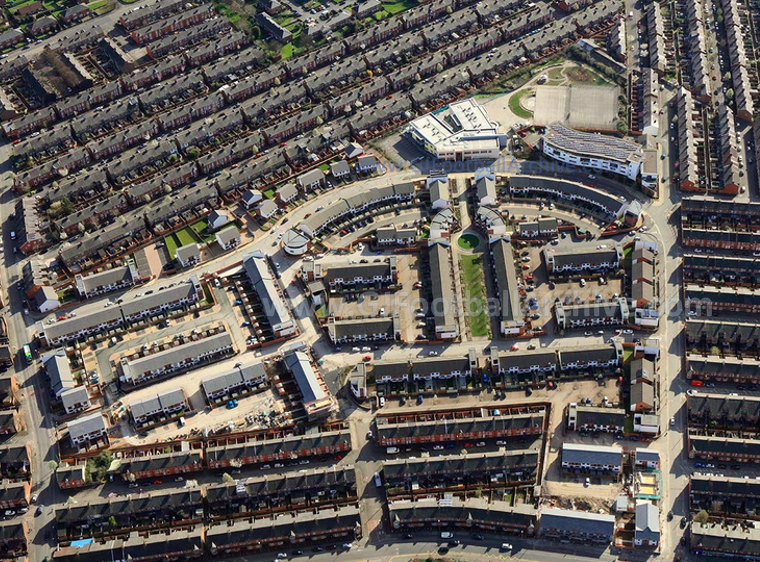
There are a few obvious consistencies between the two photos – mostly the old terraced streets which predated the building of the stadium. Maine Road itself is on the right and Kippax Street is the street that heads towards the terracing (from the bottom/Claremont Road) in the older image. In the newer image it leads into part of the new housing estate. Note the centre spot/circle in the new image. It appears further north than in the older image but that’s mostly the angle (having said that I’m not entirely convinced it’s in exactly the right spot – I’ve not yet compared actual plans but I guess the architects and planners did).
It’s nice to see that the old directors car park (top right) is now a school playground/facility. This seems appropriate as the players often used that car park as a training area during the week. It’s nice to see some continuity. A passageway, known as ‘Pink Passage’ for many years, existed between the directors car park and the external wall of the Platt Lane Stand – you can just about see it on the old photo going from the back of Thornton Road around the Platt Lane to Maine Road.
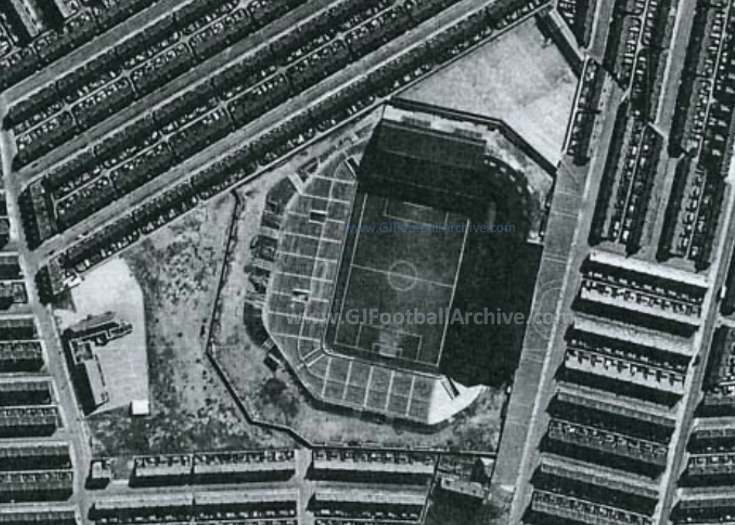
Notice how the Kippax/Popular Side terracing in the old photo is narrower the closer it gets to Thornton Road (top)… In a previous post I’ve talked about how they had to square off this terracing when they put a roof on in 1957 and how residents objected because they lost the Granada TV signal! See:
Here’s another aerial photo of Maine Road. This is 1971. Notice the away section of the Kippax built on stilts (to left of number 8). The directors car park is the space behind the Platt Lane (numbers 4 & 5) with the Pink Passage between the two walls of the car park and the Platt Lane Stand. Kippax Street itself (the street not the stand) is just visible on the far right (to the right of number 9 on the edge of the photo).

If you’d like to read more on the history of Maine Road, take a look at Farewell To Maine Road, which can be downloaded from this page:
Choose an amount
Or enter a custom amount
Your contribution is appreciated.
DonateIt’s day 33 of my posts counting down to the centenary of Maine Road’s opening game. Today – Notice anything odd about this image? Look at the Main Stand roof….
This photo was taken shortly after World War Two at a time when the adverts and notices on the Main Stand roof had been blacked out to avoid being picked up by enemy bombers during the war.
We all know about Old Trafford being bombed and while the Maine Road stadium did not suffer major damage houses on Thornton Road and other streets around the ground were bombed during the war.
The semi-circular gable on the roof of the stand carried adverts for much of its existence, though initial plans had been to have the club’s name proudly displayed there. I’ve yet to find an image showing any MCFC wording painted on to it but I do believe it did have this early in the stadium’s life, before adverts took over.
This photo shows the gable from the back/air:

This 1971 view shows the second Main Stand roof (actually just the middle section was replaced) and the original gable would have appeared where number 1 is.
If you’d like to read more on the history of Maine Road, take a look at Farewell To Maine Road, which can be downloaded from this page:
Choose an amount
Or enter a custom amount
Your contribution is appreciated.
DonateHappy New Year! On this day (1 January) in 1947 future Liverpool manager Joe Fagan made his debut as a Manchester City player in the 4-0 victory over Fulham, watched by 49,449.
The goalscorers were Andy Black (2) and Alec Herd (2)
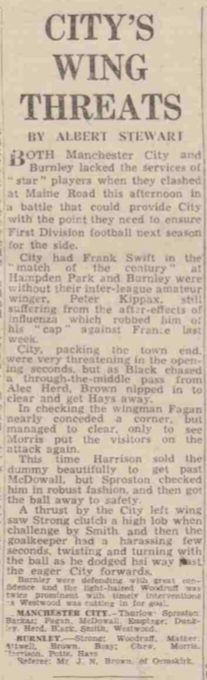
The 4-0 victory sent City to the top of the Second Division (2nd tier) table in style. The Blues were playing as champions and, more importantly, looked like a typical First Division club. Here’s a contemporary report of the game:

The only problem was the weather. Postponements dragged the season through to mid-June, by which time City started to drop a few points but it hardly mattered. The Blues won the title with 62 points – four more than second placed Burnley.
You can read more on the 1946-47 season here:
https://gjfootballarchive.com/category/manchester-city/seasons/1946-47/
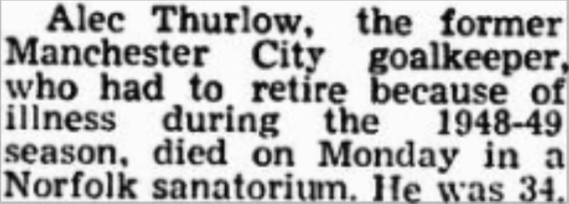
On this day (26 September) in 1946 goalkeeper Alec Thurlow signed for Manchester City with the hope that the young ‘keeper would be a permanent replacement for Frank Swift. Sadly, Alec was forced to retire from the game in 1950 through tuberculosis. He went on to have major surgery with seven ribs removed. He also had a collapsed lung. Alec died in a sanatorium at the age of 34 in 1956. You can read more on Thurlow here:
Read more of this content when you subscribe today. It costs £20 (about £1.67 a month) per year and you get full access to all the interviews, books and other material already posted to the site.
On this day (June 16) in 1947 the Western Mail carried this match report of Manchester City’s 5-0 victory over Newport County, which was played on June 14. The game was remarkable for a number of reasons:
https://gjfootballarchive.com/2021/05/10/69463-watch-mcfc-and-burnley-in-division-two/




 Gary James' Football Archive