On this day in 1913: Frank Swift was born. Here for subscribers is a detailed article I wrote on Swift a few years back:
Swift, Frank Victor (1913-1958), footballer and journalist was born in Blackpool, Lancashire on 26 December 1913, the second son of five children. From his earliest memories, he was always obsessed with the game of football, playing at every opportunity with his brothers, one of whom, Fred, became first team goalkeeper for a variety of clubs, most notably Blackpool, Oldham Athletic and Bolton Wanderers.
Subscribe to get access
Read more of this content when you subscribe today. It’s £20 for an annual subscription or £3 per month (cancel anytime, see below).
On this day (20 October 1934) King Charles III’s grandad attended Maine Road to watch Manchester City face Derby County in the League. It wasn’t the first time a senior member of the royal family attended a City home game, nor was it the last time a future monarch or monarch attended Manchester City’s home. You can read about those visits here:
Subscribe to get access – Monthly
Read this 1,600 word article when you subscribe today. It costs £3 per month (cancel any time) or £20 a year. As well as this article you get to access books, videos, history talks, interviews and other articles.
Annual subscribers access everything since the site went live in December 2020. Monthly subscribers get everything since 1 October 2022. All subscribers access new posts throughout their subscription.
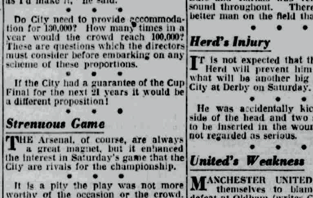
Day 57 of my posts counting down to the centenary of Maine Road’s opening game is a follow on from yesterday. It’s a cutting from the same newspaper, which was produced shortly after City and Arsenal had met at Maine Road in February 1935. It also follows on from some recent articles about stadium improvements. Here, the rumour was that City were planning to make Maine Road a 130,000 capacity venue.
February 1935 City v Arsenal Maine Road extension plans
Maine Road was only 12 years old but already it held a record individual crowd (84,569) for a game on a club ground that still stands today and it held the record League crowd (set at the game with Arsenal in February 1935). It had been expanded a little with the extension to the Platt Lane Corner (near the Main Stand and numbered 3 on the 1971 aerial photo lower down the page).
There was a development plan being developed which would see both the Platt Lane End and Scoreboard End have roofs added and be extended and then attention would turn to the Kippax where a double deck stand was suggested. By that time it was felt the stadium would hold 130,000. As it was the 1930s extensions meant it’s capacity was viewed as about 86,000.
The Platt Lane Stand (number 5 below) was built in 1935 (the old terracing was extended at the back on wooden steps and a roof was erected over the terracing) to the plan but World War Two meant the other plans were put on hold. They were eventually dropped and the next major development would be the Kippax roof and terracing extension in 1957.
Back in February 1935 the local media debated how often City would need a 100,000 capacity venue. The view was that, unless City could persuade the FA to move the FAC Final to Maine Road, then only one game a season would attract that kind of figure to the ground. With United in Division Two for much of the 1930s, and being watched by exceptionally low crowds, the game that most fans saw as the biggest meeting back then was the visit of Arsenal. How times change!
This 1971 aerial image shows the proximity of the housing on Thornton Road (bottom left, near number 6) and behind the North Stand (number 10). They were planned to be demolished in Lee’s 1994 plan.
Maine Road aerial 1971 from Farewell To Maine Road
If you’d like to read more on the history of Maine Road, take a look at Farewell To Maine Road, which can be downloaded from this page:
If you enjoy all the free material on my website and would like to support my research and keep this website going (but don’t want to subscribe) then why not make a one-time donation (or buy me a coffee). All support for my research is valued and welcome. It allows me to keep some free material available for all. Thanks.
Day 56 of my posts counting down to the centenary of Maine Road’s opening game is a simple reminder of the days when local newspapers would highlight faces in the crowd and offer cash prizes to those ringed, squared or triangled. The top row of photos here are from the Manchester City v Arsenal game at Maine Road of February 1935 and the bottom row is from Mossley v Wigan Athletic. Oddly, a bloke who looks uncannily like my granddad appears triangled in the bottom right. He’d have been about 20 when this photo was taken, so it can’t be him as he looks as he did in the 70s but they had it tough in those days! This is my granddad back in early 70s (I think it was 70s; could have been late 60s).
And the man I’m talking about…
Fans at MCFC v Arsenal and Mossley v Wigan, February 1935
Anyone worked out why the City-Arsenal game of February 1935 is still regularly referred to these days? This might help:
If you enjoy all the free material on my website and would like to support my research and keep this website going (but don’t want to subscribe) then why not make a one-time donation (or buy me a coffee). All support for my research is valued and welcome. It allows me to keep some free material available for all. Thanks.
On this day (23 February) in 1935 Manchester City established a new Football League record crowd of 79,491. Here’s the story of that day and cuttings. Enjoy!
Subscribe to get access
If you would like to view this article then please subscribe. It works out about £1.67 a month if you take out an annual subscription (£20 per year) or £3 a month (See below) if you’d like to sign up for a month at a time. Annual subscribers get full access to everything posted so far and the hundreds scheduled to be posted during the next year.
If you would like to view this article then please subscribe. It costs £3 a month (cancel anytime) if you’d like to sign up for a month at a time. Monthly subscribers get full access to everything posted since 1s October 2022 and everything scheduled to be posted during the next year.
On this day in 1913: Frank Swift was born. Here for subscribers is a detailed article I wrote on Swift a few years back: Swift, Frank Victor (1913-1958), footballer and journalist was born in Blackpool, Lancashire on 26 December 1913, the second son of five children. From his earliest memories, he was always obsessed with the game of football, playing at every opportunity with his brothers, one of whom, Fred, became first team goalkeeper for a variety of clubs, most notably Blackpool, Oldham Athletic and Bolton Wanderers.
Subscribe to get access
Read more of this content when you subscribe today. It’s £20 for an annual subscription or £3 per month (cancel anytime, see below).
On this day (25th August) in 1934 West Bromwich Albion played Manchester City. Nothing particularly unusual about that I guess, but that match was filmed and this is now the earliest known surviving film of WBA v MCFC at the Hawthorns.
It’s a curious little film and it does show one of the goals (Albion’s not City’s) and so you will see Frank Swift making an attempt to save it. Notice at the start the way the two teams enter the field (more like the way teams entered the pitch following the arrival of Covid than what became typical in the 2010s).
WBA’s shirts are interesting with their extra white section on the front.
This game is from 25 August 1934 and ended 1-1 with Sam Barkas scoring for MCFC.
Subscribe to get access to the rest of GJFootballArchive
This was a brief sample of the content available on GJFootballArchive.com. If you would like to view the much longer articles and everything else on this site then please subscribe. It works out about £1.67 a month if you take out an annual subscription (£20 per year). Each subscriber gets full access to the hundreds of articles posted so far and the hundreds scheduled to be posted in the coming months.
These days pre-season tours are an expected part of a football club’s activities but that’s not always been the case. Pre-1939 it was highly unusual for English teams to travel for friendlies before a season, but some clubs did enjoy post-season tours. The idea was that a trip to mainland Europe was a reward for first team players after an arduous season. Here for subscribers to my site is a brief overview of some of Manchester City’s European tour firsts.
Subscribe to get access
If you would like to read this and all the in-depth articles on this site (including the entire Manchester A Football History book and the audio interview with John Bond) then please subscribe. It works out about £1.67 a month if you take out an annual subscription (£20 per year) or £3 a month if you’d like to sign up for a month at a time. Each subscriber gets full access to the 250+ articles posted so far and the hundreds scheduled to be posted in the coming weeks.






 Gary James' Football Archive