Guest Blog – Noel Bayley: To Be Retained

For my first guest blog I’m delighted to say that a writer I’ve admired for years has agreed to contribute. Noel Bayley, the editor of the Manchester City fanzine Bert Trautmann’s Helmet, tells us about the role Covid has played in him sharing the stories of his match tickets. Noel writes…

High up on a shelf in the spare room there is a shoe box. To be honest it’s a trainers’ box but that doesn’t sound quite right. Although, if I’m being pedantic, it’s a blue and white adidas Samba trainers’ box (reduced to £42.49) that has been there for the 17 years I’ve lived in this house. It came with me from the last house so it’s probably more like 20 years old. Maybe older.

The trainers are long gone (lifespan six to 12 months in my hands… or on my feet since we’re being pedantic!) but the very thing that you’re supposed to throw away – the box – lives on. Inside are match tickets. I just throw them in there whenever I get one. But since I haven’t had one for a while (Aston Villa at Wembley on 1 March last year, since you asked) the box should have just sat there quietly doing nothing throughout lockdown.

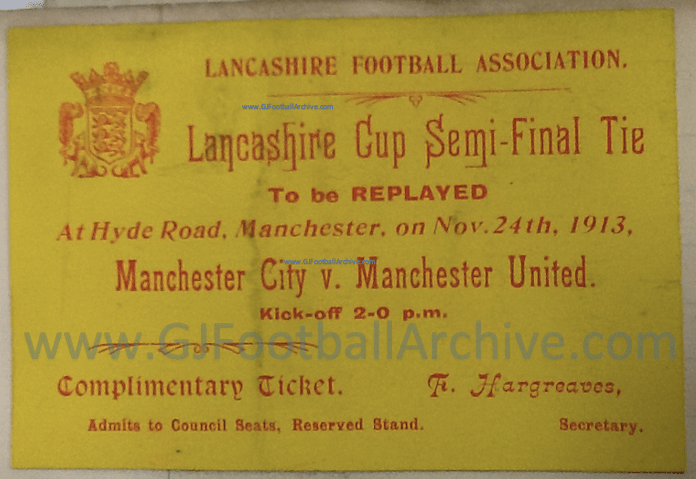
But then I had an idea. Who hasn’t during lockdown? I’d get them all out, put them in order and, scan them. I’d had an idea to put them on my FaceBook page but as I had a City fanzine FB page, that was the obvious place to put them.  So I started doing that at the start of the season. It started off slowly and picked up momentum. Nostalgia’s big business on the internet… “Remember when…” And what might have been a meaningless game to you might have great meaning for someone else. Many of us measure out births, deaths and marriages in football matches; the ticket is the proof positive of the day when all the other details have melted away.

I’m not a ticket collector, you understand. Collectors eschew shoeboxes in favour of A4 folders with transparent pockets and dividers, all neatly arranged. Many years ago at Maine Road, a ticket collector turned up at ‘Fanzine Corner’ happy to show anyone who was even mildly interested his fantastic collection of tickets, going back years – as neat as a new pin. 

He was proudly showing someone a ticket from a pre-season friendly in Italy in 1992. “I’ve got that one too,” I told him, “only I went to the match.” That was an understatement. My mate and I had spent a week hitch-hiking to Italy only to find that this very match against Cremonese on a mountain top in the Dolomites had kicked off half an hour early. We got to see an hour of the game anyway! My mate died in the intervening years, but I still have some great memories and a tiny slip of a ticket to mark the highwater mark (literally!) of our great adventure almost three decades ago.

And that’s the thing about tickets and programmes and much of the – mainly paper – ephemera that people collect: it tells a story, and if it’s going to tell a story it might as well be your story! Not that I’m a ticket collector, you understand.  

There were several hundred tickets in the box. Easily enough for one every day of a nine/ten-month season, I thought naively. As I painstakingly scanned them I realised that there were some dates when I was spoilt for choice (Boxing Day, for example, and early January when the FA Cup Third Round kicks in) and some days when there were none at all. Not that City hadn’t played, but I’ve had a season ticket for 40 years and for many years all-ticket games were something of a rarity; pay on the gate, no questions asked. Now, of course, every game is all-ticket.  

I roped my mate Josh in for a few more – not that he’s a collector either; more of a curator – but there are still gaps. Even so, most days I can put a match ticket on FB with a story to go under it. Remember when indeed! Derby matches, important matches and games that had memorable incidents like last-gasp goals are the most popular ones I have found: Ian Brightwell’s Derby Day equaliser, York away, Blackpool away in the Cup in 1988…

The author Hunter Davies said: ““There is the serious collector, who goes out of their way and actively searches for items. Then there is the accumulator, a much more passive beast. He or she accumulates by never knowingly throwing things away.”

Davies is, without question, a serious collector. I’m more of an “accumulator.” I’m certainly not a ticket collector. No way, not me. They can be found on trains. 

Which reminds me: I’ll have to tell you about the model train collection I’ve accumulated over the years when I’ve got more time…

To see Noel’s, err um, collection (not that he’s a collector!) have a look at https://www.facebook.com/leonyelyab It’s updated every day and provides a great ephemeral record of a football goer’s life. Every ticket tells a story.

Watch this space for other guest blogs soon.

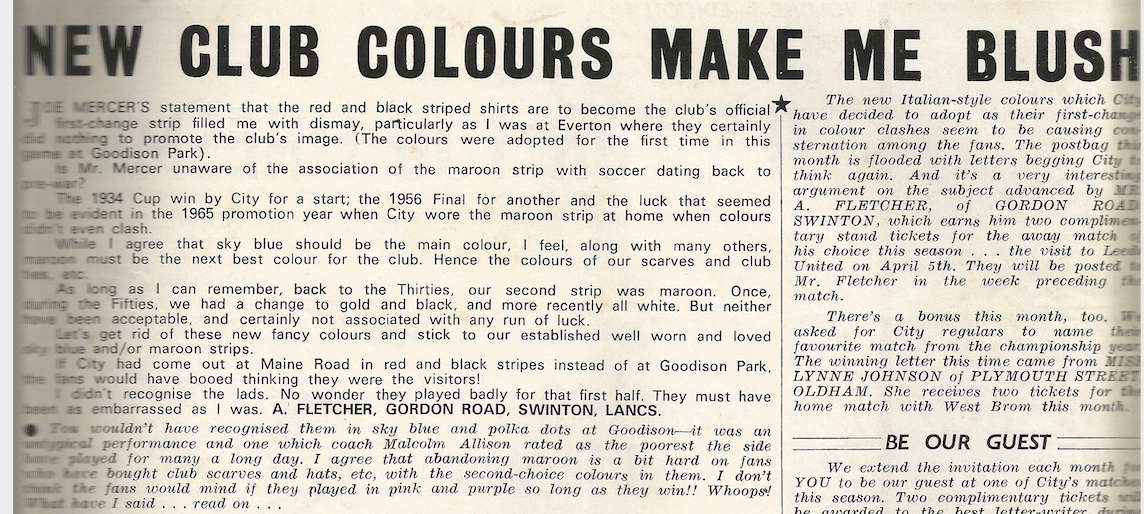
The Day Manchester City Chose To Wear Scarlet!

With City playing Everton this week (17th February 2021) here for subscribers is an in-depth piece on the time the Blues chose to wear scarlet in a crucial match with the Toffees.

Here is the story of the game:

Subscribe to get access

If you would like to read this in-depth article and all the others on this site (including the entire Manchester A Football History book) then please subscribe. It works out about £1.67 a month if you take out an annual subscription (£20 per year) or £3 a month if you’d like to sign up for a month at a time. Each subscriber gets full access to the 230+ articles posted so far and the hundreds scheduled to be posted in the coming weeks.

Ray Goble: Manchester City Statistician

In September 2019 I was informed of the death of Ray Goble, one of the most significant researchers into Manchester City’s history (and on West Indies cricket too). Ray’s widow Joyce informed me of the news.

Subscribers to this blog can read below the obituary I wrote on Ray at the time and understand why he was such an important figure in Manchester City’s history.

Subscribe to get access

Read more of this content when you subscribe today.

Johnny Bond, Johnny Bond, Johnny Bond

On September 25 2012 former City manager and West Ham FA Cup winner John Bond died at the age of 79. Bond followed Malcolm Allison as manager of the Blues in October 1980 and within his first seven months he turned a struggling side into one that reached the FA Cup final and the League Cup semi-final. I wrote an obituary to John in the days that followed.

Here, for the benefit of subscribers to my blog, is that obituary.

Subscribe to get access – Annual

If you would like to listen to read this and the other in-depth articles on this site (including the entire Manchester A Football History book) then please subscribe. It works out about £1.67 a month if you take out an annual subscription (£20 per year) or £3 a month (see below) if you’d like to sign up for a month at a time.

Subscribe to get access – Monthly

If you would like to listen to read this and the other in-depth articles on this site (including the entire Manchester A Football History book) then please subscribe. It costs £3 a month (cancel anytime) if you’d like to sign up for a month at a time or there’s the special price of £20 a year (see above).

I’ve also posted an audio interview I performed with John back in 1995. For details see: https://gjfootballarchive.com/2021/02/12/the-john-bond-interview/

The John Bond Interview

Back in November 1995 I interviewed the former Manchester City manager John Bond. At the time I was researching my in-depth history of the club called Manchester The Greatest City (later updated as Manchester The City Years).

I met John at his home and spent a good few hours with him chatting about the Blues and his career. I loved doing this interview and was always grateful for the time he gave me. He was quite frank, open and honest – which delighted me because he was a great talker. He was also happy for me to quote everything he said in the interview. I did end up quoting him extensively in the book (and in others I’ve produced) but, until now, none of the interview has ever been heard by the wider public.

Now, for the first time ever you can hear the opening 17 minutes of the interview. Here he talks about the steps taken by City to appoint him; the interview (and the directors involved in that notorious filmed interview for the City documentary in 1980-81); the signing of Tommy Hutchison, Bobby McDonald and Gerry Gow. As I said earlier, he is quite frank in his comments and that may surprise a few.

This audio recording of the first 17 minutes of the interview is available to subscribers of my blog until 19th February 2021. If you want to hear it then please subscribe below. If subscribers enjoy this piece then please let me know and, if you do, I will release other sections of the interview over the coming weeks.

Of course as this interview was recorded on my old cassette recorder the quality isn’t the best but I’m working on improving that for future pieces.

Subscribe to get access

If you would like to listen to this frank interview and read the in-depth articles on this site (including the entire Manchester A Football History book) then please subscribe. It works out about £1.67 a month if you take out an annual subscription (£20 per year) or £3 a month if you’d like to sign up for a month at a time. Each subscriber gets full access to the 220+ articles posted so far and the hundreds scheduled to be posted in the coming weeks.

The second part of the interview is now available here: https://gjfootballarchive.com/2021/02/22/john-bond-interview-part-two/

I’ve also posted an obituary I wrote to John here: https://gjfootballarchive.com/2021/02/12/johnny-bond-johnny-bond-johnny-bond/

Manchester A Football History part 35

This is the final part of the 2010 edition of the book Manchester A Football History (Gary James, published by James Ward). As with everything else on this site copyright laws apply. The book is published here for the personal use of subscribers to this site. For any other use please email the publishers at info@manchesterfootball.org

Subscribe to get access

Read more of this content when you subscribe today.

Manchester City v Manchester United

It’s another Manchester derby on Friday (12 February 2021) – this one is in the Women’s Super League and kicks off at 7pm. To mark this game I wanted to give a bit of focus to the early history of Manchester derbies in women’s leagues. The history of women’s football in Manchester does not always get the attention it deserves and many of us have been determined to change that for years. So hopefully the following will be of interest. It includes a few quotes from those involved in previous decades…

While the perception will always exist that Manchester United’s women’s team has always been City’s rivals and vice versa, for both clubs the real rivals have varied over the years. Derby matches have been played against Manchester Belle Vue and other prominent local clubs. However, any game between City and United takes on extra significance. United fans established a Manchester United Ladies team in the 1970s with close ties to the men’s club. This eventually was closed down by the men’s club before re-emerging in 2018 as a WSL 2 club. In September 2019 the first WSL Manchester derby between City and United occurred at the Etihad following United’s move into the top flight. This was a truly special day for both clubs and for those of us present.

The first competitive derby between City and United was actually in September 1990 in the North West Women’s Regional Football League Second Division when Neil Mather was City’s manager: “I was nervous for weeks on end, and it was coming and coming and coming. I thought ‘we’ve got to beat United in the first competitive Derby.’ Being a big blue it was like ‘whatever we do we’ve got to beat them.’ We were 4-1 up with about five minutes to go and then had a five minute collapse where I thought we’re going to blow this. At one point it had looked like we were going to get five or six and annihilate them and then we nearly lost it! Thank God we hung on for a 4-3 win, but I’ll never forget that game. We had a girl called Jenny Newton who was a manic City fan and scored and I don’t think I’ve ever seen anything like it. When she scored her eyes were bulging and it meant the world and a lot of our girls were City fans. It meant the world to beat them.”

Lesley Wright: “The first time we played United in a competitive game there was about 150 there. They were a really strong team. Better than us at the time and they’d been established a lot longer.”

Rita Howard: “Despite being a United fan I loved playing as City Ladies against United. I absolutely loved it. Even though I’m a United fan I never contemplated joining them because the support from City, even when it waned a little, was far superior to anything United got. At best they’d get a kit and then it was ‘on your way.’ I know our closeness to City came from that beginning with Neil. His enthusiasm got us the kit, the tracksuits, the minibus…. All sorts of things. I know that wasn’t happening at United and at that time I don’t think any club connected in any way to a Football League side were as close as we were then. I think we got a lot more recognition from the beginning and that has carried on to today. Look at what City have done.”

Jane Morley: “I’m a season ticket holder at Manchester United but I was a manager at City Ladies. One day I’d been with City at a tournament and then went straight to Old Trafford for a men’s game. I was sat there when the bloke next to me – who I didn’t know – said ‘what you doing with that on!’ I realised I still had my City jacket on. I had to explain to him that I managed City Ladies.”

Bev Harrop was a Manchester United fan playing for City: “I had a United shirt underneath my City shirt! (laughs) Most of the time.  Not later on, I grew out of it eventually, but at first, I did.”

Jane Morley: “It angers me when people say that Manchester United now have their first women’s team. As with City when the relaunch happened that implies the stuff we did for the club years before doesn’t count. I played for United in the 70s and 80s before a few of us broke away to set up FC Redstar. We left United because we wanted to test ourselves. We had some great players and wanted to progress but those who ran United wanted to stay in a Manchester League and not join the North West League. So we broke away in 1985 and formed FC Redstar.

“Many of the teams we know today as WSL clubs are actually men’s clubs that have taken over established women’s clubs. Teams like Leasowe Pacific became Everton. I have to bite my lip sometimes when some clubs claim they created a women’s team… no, you took and rebranded a team. There were quite a few big teams around the time City Ladies started such as Broadoak with Tracey Wheeldon.” 

These snippets are from my book on Manchester City’s women’s team. Copies (signed by me) can be ordered here: https://gjfootballarchive.com/shop/

If you’d like to read more on women’s football in Manchester then take a look at: https://gjfootballarchive.com/category/womens-football-2/

Subscribe to get access

If you would like to read all the in-depth articles on this site (including the entire Manchester A Football History book) then please subscribe. It works out about £1.67 a month if you take out an annual subscription (£20 per year) or £3 a month if you’d like to sign up for a month at a time. Each subscriber gets full access to the 500+ articles posted so far and the hundreds scheduled to be posted in the coming weeks.

Manchester City’s Support: The Facts

Over the last few years there’s been a growing tendency by rival fans to mock the support of Manchester City. It’s an extremely odd thing to do, especially as for most of the period between 1981 and 2011 they talked of the loyalty of City fans. It seems, once the Blues started winning trophies again, rival supporters had to find something else to focus on. 

Recently, this myth about City’s support has been used by some in extremely strange ways, for example following the Blues 4-1 thrashing of Liverpool at Anfield (see: https://gjfootballarchive.com/2021/02/07/the-last-time-mcfc-scored-4-or-more-at-anfield/ ) some Liverpool fans (and even some journalists!) started to make the point that City’s recent form is down to the fact that ‘they’re used to playing in front of no fans’ with the suggestion being that if Anfield had had fans present then City wouldn’t have won. They go on and suggest that Liverpool would have gained more wins in general and that City would not be top of the League and that Liverpool would be. 

This is an extremely strange view, especially as the 2019-20 season (which included some games without fans of course) was the only time Liverpool have won the Premier League since its formation in 1992. In each of those seasons prior to LFC’s first Premier League title crowds were allowed at Anfield. During that same time City have won the League on four occasions. It’s a preposterous idea that ignores the facts.

So for this article I’ve decided to produce evidence of City support in recent decades along with a few comparisons with other leading sides. It makes interesting reading and may embarrass the supporters of certain clubs who constantly ridicule City’s fanbase, despite the evidence. The following in-depth piece can be accessed by subscribing to this blog below.

Subscribe to get access

If you would like to read this in-depth article and all the others on this site (including the entire Manchester A Football History book) then please subscribe. It works out about £1.67 a month if you take out an annual subscription (£20 per year) or £3 a month if you’d like to sign up for a month at a time. Each subscriber gets full access to the 220+ articles posted so far and the hundreds scheduled to be posted in the coming weeks.

Consecutive Win Records – Facts or Fiction?

Manchester City’s victory over Swansea last night in the FA Cup (3-1 on 10th February 2021) caused a number of fans, media outlets and statisticians to question the record set by City in 2017. Between August 26 and December 3, 2017 Pep’s Blues managed a 20 game winning run that included a League Cup penalty shootout win over Wolves in in October 2017. 

In 2017 the International Football Association Board (IFAB) – the body that is the ultimate rule maker and sits above FIFA – stated that wins via penalty shootouts count in sequence records, hence City establishing the record at 20 consecutive wins. Some statisticians argue this point but IFAB are the rule makers while statisticians, fans, the media and historians are merely observers. We may have views but ultimately IFAB are the ones who set the rules regardless of whether we like them or not.

So where does this leave last night’s record? Well, to solve all future debates and arguments it’s fairly simple to me. Last night’s win means that City currently hold two records that no one can quibble with. These are:

Most Consecutive Wins (including penalty shootouts): 20, 2017.

Most Consecutive Wins (excluding penalty shootouts): 15, 2021.

Over the coming weeks hopefully the record established last night will increase and, who knows, it may even overtake the 2017 record but, for common-sense sake, it’s clear to me that regarding it as two records resolves the issue.

One point worth making though concerns Pep’s 200th win. This was regarded as last night’s game by many of the same organisations who do not count the 2017 record due to the penalty shootout. Well, we can’t have it both ways. If 2017 does not count at all because of the penalty shootout then Pep hasn’t yet reached 200 wins – that’s a nonsense of course. I’d love to see what happens when someone from the media, a rival club or a statistician tells him that his single game wins via shoot-outs don’t count. Anyone who thinks differently should have a chat with Pep and tell him what they think.

Incidentally, back in 2017 when City’s penalty shootout win v Wolves was counted as a win by IFAB there had also been a few precedents, for example concerning a consecutive away record Arsenal had (see https://www.arsenal.com/news/features/consecutive-away-wins for the details) and Sir Alex Ferguson’s own win records. These predated City’s 20 game record and remained classified as records. These are clearly precedents that were widely reported at the time.

There are anomalies – people widely point to two-legged ties that are ‘won’ on penalties or extra-time – and whenever people raise these they really should speak with IFAB and seek a definitive decision. Ultimately, as I said earlier, statisticians, media and fans are observers not rule makers.

Statistics hey? 

Subscribe to get access

If you would like to view the other in-depth articles on this site then please subscribe. It works out about £1.67 a month if you take out an annual subscription (£20 per year) or £3 a month if you’d like to sign up for a month at a time. Each subscriber gets full access to the 220+ articles posted so far and the hundreds scheduled to be posted in the coming weeks.

Manchester A Football History part 34

This is the thirty-third chapter of the 2010 edition of the book Manchester A Football History (Gary James, published by James Ward). As with everything else on this site copyright laws apply. The book is published here for the personal use of subscribers to this site. For any other use please email the publishers at info@manchesterfootball.org

Subscribe to get access

Read more of this content when you subscribe today.