IN SEARCH OF THE BLUES – Johnny Hart (interviewed December 2004)

Johnny Hart joined City at the age of 16 in December 1944 and went on to make a total of 177 League and Cup appearances, scoring 73 goals.  A skilful inside-right, Hart later had a highly successful coaching career with the Blues, and a spell as manager in 1973.  Here’s an interview I did with him at City’s stadium shortly before Christmas 2004

Subscribe to get access

Read more of this content when you subscribe today.

IN SEARCH OF THE BLUES – Roy Little (interviewed August 2004)

Roy Little was a key member of the exciting FA Cup final sides of 1955 and 1956.  Born in Manchester in 1931, Roy made his City debut in 1953 and went on to play 186 League and FA Cup games for the Blues. Here for subscribers is an interview I did with him in August 2004

Subscribe to get access

Read more of this content when you subscribe today.

Manchester City Fans

While searching through my articles earlier this week I spotted a piece I wrote in 2019-20 on Manchester City’s support. Back then I became somewhat frustrated with a series of articles criticising City’s support. There were a number of ridiculous comments by some and so I wrote a piece challenging some of these views.

I’m not certain all the points are still valid (though City fans have received some significant abuse since 2020 too!) but readers can be the judge of that. Anyway, here’s the article for those who missed it back then:

Bananarama – The Inflatables Craze

In the 1980s Manchester City fans demonstrated the positive side of football during a troubled decade for the sport. Despite being one of England’s top four clubs and the third best supported side in the League, the Blues suffered a shock relegation in 1983. Financial issues and an inability to invest meant the club relied on two of its greatest strengths – youth football and the loyalty of City’s fans.  Young players like Paul Simpson, Paul Moulden, Ian Brightwell, David White, Paul Lake and Andy Hinchcliffe, ensured the Blues had a chance of re-establishing themselves on the pitch, while off the pitch a dedicated following was the envy of the majority of clubs.

City fans not only turned out in their numbers – they were the sixth best supported side in 1983-84 and 1988-89 (second tier seasons) – but they also brought great humour to football.  The most newsworthy story involving fans during this period was the inflatable banana craze.  

Rather than spell out every moment from that era, here are a few snippets on how the craze started and how it progressed. 

– A dedicated City fan called Frank Newton took a 5ft 6in demonstration banana to City V Plymouth on 15 August 1987. It caused some amusement.

– Newton took the banana to away games, including the match against Oldham at Boundary Park. The fans were drenched; morale was low as Oldham equalised; and yet the banana continued to be waved throughout the game, bringing much needed humour to a depressing game.

– Other inflatables began appearing and by the end of the season a chant for striker Imre Varadi to the tune of the Israeli folk song Hava Nagila was adapted with the word banana replacing Varadi. The banana craze was not a tribute to Varadi (this has frequently been misreported in recent years due to an incorrect news report from the period that wrongly claimed the craze was a direct tribute to Varadi – it wasn’t), but chants utilising his name could easily be adapted to use banana instead of his surname.

– For the last game of the 1987-88 season the City fanzine Blue Print, edited by Mike Kelly, urged fans to take a blow up banana to Crystal Palace on the last day of the season.  Around 50 bananas made it on to the terraces that day and the scene was set for supporters to enlarge on this in 1988-89.

– By the time the new season began the inflatable bananas had grown in number but so too had the variety of inflatable – sharks, Frankensteins, crocodiles, dinosaurs plus many more.

– The craze grew throughout 1988-89 and then on Boxing Day an appeal by the fanzines led to over 12,000 City fans in fancy dress and carrying inflatables, descending on Stoke’s Victoria Ground.  The capacity was a little over 24,000 and Stoke handed over two full sides of the ground to City fans.  Even the players came on to the pitch with inflatables (which they also did v Leicester in January 1989).

– A company that made inflatable bananas increased production to help satisfy the craze, while Fyffes began to sponsor games at City. Thousands of inflatables appeared at some games.

– The craze was copied across English football but it was City fans that were heralded as the ones who had put the fun back into football.

During a decade of disaster, tragedy and much negativity within football City fans demonstrated there could be another way and fans became internationally renowned for their humour. The craze ultimately died out, although bananas continued to appear on occasion or in limited numbers over the years. 

In 2010-11 City’s FA Cup run brought the bananas back as a nostalgia craze and this has continued to some extent, though nowhere near in the numbers of the late 1980s.Maybe it’s time to bring back the inflatables in great numbers?

Manchester City 5-1 Newport County

On this day (June 16) in 1947 the Western Mail carried this match report of Manchester City’s 5-0 victory over Newport County, which was played on June 14. The game was remarkable for a number of reasons:

  • Prior to the 2019-20 Covid affected season this was the club’s latest finish to a season. 2019-20 ended in August (Champions League) with the League campaign ending on July 26 2020. The 1946-47 season had been affected by snow and frozen pitches, causing many games to be postponed.
  • City played with only ten men for much of the second half due to an injury to Billy Walsh
  • The Blues won 5-1 with George Smith scoring all five goals. No player has ever scored more goals for the Blues in a League game (Sergio Aguero of course also scored 5 v Newcastle in October 2015). Denis Law did score 6 goals in a FA Cup tie v Luton but this was abandoned and wiped from the records.
  • Roy Clarke made his City debut and, as City were promoted, he became the first man to play 3 successive league games in 3 different divisions when he appeared in his next City game. He’d joined from Cardiff (Division 3); made his City debut in Division 2 then played in Division 1. Subscribers can read more about Roy Clarke here:
  • City had achieved promotion over a month earlier (May 10) when they defeated Burnley 1-0 in front of a Maine Road crowd of 69,463. You can read about that game here:

https://gjfootballarchive.com/2021/05/10/69463-watch-mcfc-and-burnley-in-division-two/

  • City were promoted as champions.

History of Women’s Football 1st July 2pm to 4pm

Join me and several women who played for leading clubs in Trafford & Manchester for a celebration of women’s football. The event kicks off with a first half during which I outline the history of women’s football locally with stories of games played in Trafford in the 1890s; the sport’s growth in the early twentieth century; the 1921 FA ban and its local impact; the pioneering teams and individuals of the interwar and post war years; then the game’s rise and development throughout to the modern day. With particular emphasis on games and teams from Trafford and Manchester this promises to be an entertaining talk.

The second half takes on a different tone as former players from local teams take to the stage to provide their experiences. Former players from the pioneering Manchester Corinthians, Manchester City and the original Manchester United women’s teams will be interviewed about their careers. Their experiences and enthusiasm for the sport provide a valuable insight into over sixty years of football history. Trafford and Manchester have a proud history of women’s football and this event will explain how the women ensured the game developed despite a near fifty year ban and other obstacles placed in their way.

I’ll be posting further details on the guests being interviewed soon.

I’m working for Trafford Archives on the Women’s Euros Heritage project, funded by the Heritage Lottery Fund. #WEURO2022 #HeritageFund

Lee One Pen

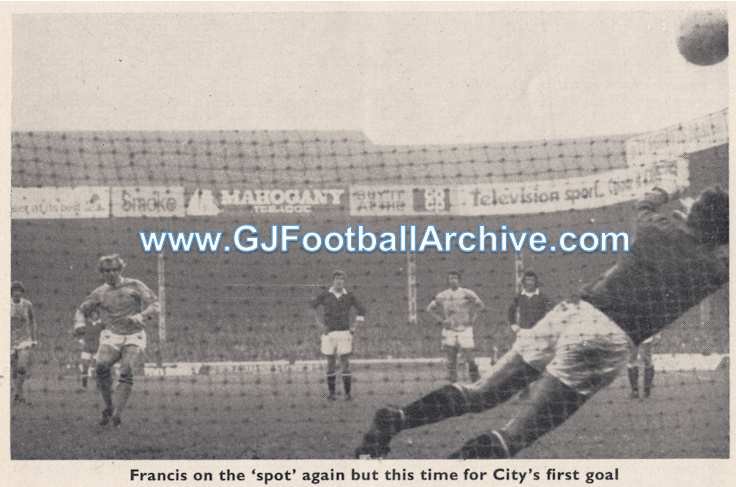
For decades now Francis Lee’s name has been linked with the 1971-72 season and, especially, with him scoring a record number of penalties that season. He netted 13 penalties in a 42 game League season and it’s a record that still stands to this day. This record has often led to the suggestion that Lee ‘won’ more penalties than perhaps he ought to and so for this article I’ve analysed every penalty awarded and taken by Manchester City that season.

This analysis and commentary on Lee’s penalty record is available to subscribers.

Subscribe to get access

Read more of this content when you subscribe today. It costs £20 a year or £3 per month if paying a month at a time. You receive full access to everything on the site throughout your subscription.

The Death Of Jimmy Ross

One of the earliest stars of League Football died on this day (12th June) in 1902. Jimmy Ross, who was a major figure for almost three seasons with Manchester City and had competed in every season of League football since the League was established in 1888, died with an illness described as “an acute skin disease and a raging fever.”

Ross was one of the Preston ‘Invincibles’ in 1888-89 and also scored 7 (sometimes reported as 8) against Hyde in the famous FA Cup record breaking game (read more on that game here: https://gjfootballarchive.com/2021/02/22/hyde-v-preston-a-record-breaking-day/ ).

At the time of his death Ross was a Manchester City player. His last first team appearance was appropriately against Preston North End in the First Round of the F.A. Cup in January 1902.  

City helped his mother, whom he was looking after at the time of his death, financially.  They also arranged the funeral and he was buried at Southern Cemetery (according to newspaper reports of the time he was buried in a grave that contained another City player – Bride – who had died a couple of years earlier). Several City players/personalities carried the coffin, including Billy Meredith.

More can be read on Ross’ life here:

The Great Jimmy Ross

Semi-Final Memories

A few years back I caught up with the goalscorers – Tommy Booth (1969) and Paul Power (1981) – of the last couple of FA Cup semi finals involving Manchester City prior to their 2011 FA Cup triumph v Stoke. Here, for subscribers, is a piece I wrote based on that interview with Booth and Power.

Subscribe to get access

Read more of this content when you subscribe today. It costs £20 a year or £3 per month if paying a month at a time. Whichever method you choose you get full access to everything on this site.

A Complete PDF Of My 1st Book To Download

Subscribers to my site can download a PDF of my entire first book. It was published back in 1989. Here are more details:

The book was published in April 1989 and I talk a little bit about it here:

The 200th Post – Joe Mercer

and here:

A Writing Flashback!