On This Day in 1976: Juventus

On this day (15 September) in 1976 Manchester City defeated Italian giants Juventus 1-0 at Maine Road in the UEFA Cup.  A crowd of 36,955 watched Brian Kidd net the only goal. You can read about the game and watch highlights here:

Subscribe to get access – Monthly

This and all other content is available when you subscribe. It costs £3 per year to access everything posted since 1 October 2022 and everything to be posted during your subscription. Cancel anytime. Or there’s a special annual subscription (see below). Have a search and see what’s available.

Subscribe to get access – Annual

This and all other content is available when you subscribe. You can subscriber for the special annual price of £20 a year (about £1.67 per month) to access everything on the site since it went live in December 2020.

Stan Gibson Obituary (former MCFC groundsman)

Born on this day (10th September) in 1925, Stan Gibson was one of the unsung heroes of Manchester football.  He was City’s groundsman for forty years and created a playing surface worthy of the club’s stature, particularly during the sixties and seventies when the pitch was possibly in its best ever state.  

Stan worked as a stoker during the war for the Navy.  Always a keen sportsman – he was a Naval boxing champion and had football trials with Burnley – but by his 30s was becoming well known as a groundsman.  He arrived at Maine Road from Chorlton Cricket Club in 1959 after a recommendation by City ‘keeper Steve Fleet, and in the years that followed he worked hard to create a perfect pitch.  

By the time of City’s promotion in 1966 Stan had made the surface one the club could be proud of.  Both Joe Mercer and Malcolm Allison were keen to use Stan’s expertise to develop the pitch further, and thereby increase City’s chance of success.  Working with Allison, Stan made the pitch the biggest  – and many would say the best – in the League.  

Both Mercer and Allison recognised his contribution to City’s success.  It’s a little known fact that Stan was trusted with the job of looking after the FA Cup following City’s homecoming in 1969.  He chose to put the prized possession in the safest place he could think of, and the trophy spent its first night in Manchester locked in his toilet!

Stan loved City – he was even on the club’s books for a while in his youth – and felt the pitch was his own.  He could never relax during a match though:  “I watch the pitch rather than the game!  I shouldn’t really, because I get very upset if I see a divot, especially if it is the opposing side who have churned it up.”

Inevitably, the pop concerts in the 80s and 90s brought him a few headaches, but he welcomed other innovations, such as the undersoil heating implemented in 1979.

Stan was always an important influence and others often sought his views.  At one stage Rod Stewart tried to lure him away to tend his own turf, while Ken Bates was desperate for him to join Chelsea.  Stan would have none of it:  “I know I’m biased, but to me there’s nowhere better than Maine Road, and there’s nothing nicer than someone coming up to me on a Saturday and saying how great the pitch looks.  Makes all the toil worthwhile.”

His love for the club and Maine Road was never in doubt, and was perfectly summed up in 1994:  “City is my life.  That pitch out there is my baby.  I can’t keep away from it, and I couldn’t imagine my life without it.”

He leaves his Australian-based son Stuart and his daughter Janice – another popular face around Maine Road.

Stan passed away on Christmas Eve 2001 and this written by me as an obituary for him at the time. It was first published shortly after his death.

While you’re here I’d like to thank you for taking the time and trouble to visit my website. I have been researching and writing about Manchester football for a long time (no wonder I’m going grey!) with my first book published in 1989. I am not employed by anyone and I do not have sponsorship either and so I’ve set up this website to help share my 32 years plus writing and research. The intention is to develop the archive and to provide access to as much of my material as possible over the coming weeks, months & years. Subscribers can already access hundreds of articles/posts including the entire Manchester A Football History book and audio interviews with several people, including former City bosses John Bond and Malcolm Allison.  

It costs £20 a year (it works out £1.67 a month) to get full access for as long as you subscribe. See below. Thanks for the support, Gary.

Subscribe to get access to the full site

£20 per year or £3 per month

Maine Road’s Name

On this day (25 August) in 1923 Manchester City’s Maine Road Stadium opened. In 2003 I wrote “Farewell To Maine Road” and at that time I revealed that the actual street Maine Road had originally been known as Dog Kennel Lane.  The name ‘Maine Road’ did not appear on maps until the 1870s.  At that time I questioned why the new name had been selected and how.  I outlined a few theories – one focused on Mancunian soldiers who, together with members of the prominent Lloyd family, had volunteered for war in America and could possibly have fought in Maine – but I admitted:  “all of this is pure conjecture, but it is known that Lloyd Street was named after the family, and it is clear the renaming of a road during this period was a very deliberate act and there must have been a reason.  It would be entertaining to discover where the original ‘Dog Kennel Lane’ got its name.”

I also claimed to have found the earliest reference to Maine Road in a newspaper – November 1904, the Manchester Guardian

Since that time, after much detailed research I have the answer to both the questions:  How did Maine Road get its name & Where did the name Dog Kennel Lane come from?  I have also tracked down earlier references to Maine Road in newsprint.

So, here’s the truth…

The Maine Road name was indirectly named after the US State of Maine but that this was, in itself, a compromise.  The road was almost to be called ‘Demesne Road’ (pronounced Demain) after a farm positioned slightly south of where the Maine Road Stadium would eventually be built.  The local authority did not want that, so in the end Maine Road was agreed.  It ultimately had more significance as the following newspaper article shows:

“Dog Kennel Lane took its name from the kennel where hounds were kept.  It stood on the right hand side at the bend about a thousand yards from Moss Lane, opposite to the road which tracked off to the left and led to Demesne Farm.  The common name of this lane is so ‘common’ and unattractive that when the Temperance Company bought the Trafford land they asked the local board to change the name to Demesne Road, and the subject was compromised by calling it Maine Road out of compliment to the Temperance principles of the petitioners.”

It’s important to explain this.  The Temperance movement had been growing since the 1850s and, as with so many other areas, Manchester played a lead role.  The idea of the movement was to discourage people from drinking alcohol.  After a series of campaigns of voluntary abstinence failed in the States the Temperance movement changed its approach.   

On 2nd June 1851 the State of Maine passed the first recognised prohibition law, and two years later the United Kingdom Alliance was founded in Manchester, calling itself a legitimate political party and pledging to badger Parliament to outlaw liquor in England.

The ‘Temperance Company’ mentioned in the article was actually part of the movement and had bought some land at the top of Dog Kennel Lane – this area is covered today by the buildings on the western side of Maine Road, close to the junction with Moss Lane East, and stretching to Princess Road.  They wanted to create a better standard of living and within that area they erected buildings in keeping with their approach to life, such as the Temperance Billiard Hall.  However, the ‘Dog Kennel Lane’ name was clearly an issue and so the selection of the name ‘Maine Road’ was made.  Maine, due to the State’s role in the Temperance movement, was a significant name.

So the name Maine Road does not refer to the American War of Independence but it does refer to the US State and the part that Maine played in the Temperance movement.

Initially, only the top section of the road was renamed but gradually as housing was developed southwards the new name replaced Dog Kennel Lane.  

My research has also managed to identify earlier information on the land that ultimately became City’s ground.  The land was owned by the Chadwick family, sometimes they were referred to as the Chaddock family.  In 1760 all of the Maine Road ground site, plus most of the area east of Dog Kennel Lane/Maine Road down to Demesne Farm and across to Heald Place was part of ‘Chadwick’s Tenement’ – described as 49.5 Lancashire acres of farm land.

The family were believed to have owned this land from around 1500 to the early 1800s.  By 1857 the land was owned by someone called Mr Broadie but within the following few years areas were sold off until by 1903 all that was left was a farm house, Moss Grove Farm, on the corner of Moss Lane East and Maine Road.  That was demolished shortly afterwards and by 1910 terraced housing covered the site.

The earliest media reference to Maine Road identified to date is 3rd January 1903 in the Manchester City News, but the road was marked on maps before this time.

David White Double v Liverpool

On this day (21 August) a Wednesday night meeting with Liverpool ended in a 2-1 victory for Manchester City. You can see highlights of the game (and relive the days of night matches on the Kippax/at Maine Rd) including two David White goals here:

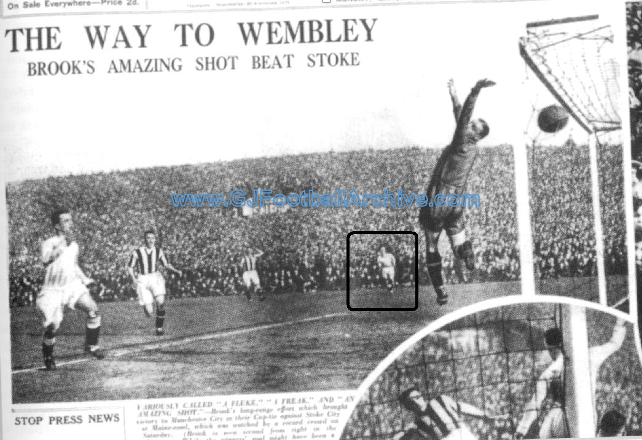
GOLDEN GOALS – 1934 Eric Brook V Stoke City

It has virtually slipped out of living memory but this goal is possibly the greatest ever scored at Maine Road.  It is also the goal that was viewed by the largest paying audience of all time at the old stadium.

The goalscorer Eric Brook remains one of City’s biggest stars and he was idolised by thousands of Mancunians throughout his career.  This goal was obviously popular with Maine Road regulars at the time but it has to be stressed that it was also highly significant in the Blues’ quest to re-establish themselves as a major force.

The idea of this ‘GOLDEN GOALS’ feature is to remember a significant or spectacular Manchester City goal from yesteryear.  My hope is that supporters who were not around back then will learn more about these goals while those who were here will hopefully be reminded of them.  If you would like to nominate a goal for possible use in a future feature then please comment at the end of this piece or email me with details of game, goal scorer and date.

This article, covering Brook’s goal is available for subscribers to the website below. It costs £20 a year (it works out £1.67 per month) and you get full access to all articles posted, including PDFs of the out of print Manchester A Football History and my first ever book about Manchester City. There are also audio interviews & more. Do a few searches on past content to see what’s available.      

Subscribe to get access

Read more of this content when you subscribe today.

GOLDEN GOALS – 1996 Georgiou Kinkladze Goal V Southampton

One of the best goals of Maine Road’s final couple of decades saw the brilliant Georgiou Kinkladze at his best.  Kinkladze was a major star – some would say Manchester City’s biggest during the mid 1990s – and livened up many dull days for City fans.  This goal was obviously popular with Maine Road regulars but, thanks to television and the game’s appearance on Match of the Day, many neutrals recognised the quality of this Golden Goal.

The idea of this ‘GOLDEN GOALS’ feature is to remember a significant or spectacular Manchester City goal from yesteryear.  My hope is that supporters who were not around back then will learn more about these goals while those who were here will hopefully be reminded of them.  If you would like to nominate a goal for possible use in a future feature then please comment at the end of this piece or email me with details of game, goal scorer and date.

This article, covering Kinkladze’s goal is available for subscribers to the website below. It costs £20 a year (it works out £1.67 per month) and you get full access to all articles posted, including PDFs of the out of print Manchester A Football History and my first ever book about Manchester City. There are also audio interviews & more. Do a few searches on past content to see what’s available.     


Subscribe to get access

Read more of this content when you subscribe today.

Home in Barnsley

On this day (31 July) in 2008 Manchester City played a home game at Barnsley. This game made history as it was the first occasion the Blues had played a home European tie outside of Manchester.  Previously City had played home European games at Maine Road and at the City Of Manchester Stadium, but work at Eastlands following a concert by Bon Jovi prevented the Club from staging the game at home.  The decision was taken to stage the match at Barnsley.  Subscribers can read about both legs of the European tie here:

A Kind Of Magic: Cassidy, Queen and Maine Road

On this day (July 16) in 1986 Queen played Maine Road. This was often considered to be the first major concert at Manchester City’s old stadium. However, it wasn’t. The first was actually a concert by David Cassidy in May 1974. This feature takes a look at that concert and the one by Queen which set the tone for legendary music performances at Maine Road.

Subscribe to get access

If you would like to read this and all the in-depth articles on this site (including the entire Manchester A Football History book) then please subscribe. It works out about £1.67 a month if you take out an annual subscription (£20 per year). Each subscriber gets full access to the 250+ articles posted so far and the hundreds scheduled to be posted in the coming year.

69,463 watch MCFC and Burnley in Division Two

On this day (May 10) in 1947 a solitary goal from Alec Herd against Burnley was enough to give Manchester City promotion.  The attendance for this Second Division game was recorded by the media at the time as 67,672 but official records reviewed almost sixty years later showed that City actually recorded the attendance as 69,463.

Typically, the attendance figures City used to give the media for League games through to the 1960s tended to exclude season tickets. So the Blues’ management would give the figure of tickets or pay on the gate admission for the game but exclude season ticket holders. Back in 1946-47 City had around 1,800 season ticket holders and almost every League attendance back then is understated by that amount.

FA Cup games were the actual attendances as these were always sold game by game.

As this practice of excluding all season ticket holders continued for many, many decades at Maine Road attendance figures for League games are usually understated (they were often understated in the 1970s & 1980s as well but for different reasons and back then Peter Swales, Bernard Halford and the others involved in calculating attendances would deny any discrepancy despite many fans, fanzines and others challenging them often).

For comparison purposes it’s worth looking at the attendances of the Division One champions in 1947 to see how the Blues compared. This attendance against Burnley was almost 17,000 higher than Division One champions Liverpool’s highest crowd that season (52,512 v Wolves in December) and the Merseyside Reds nearest home game to City’s Burnley match was watched by 48,800 and that was Liverpool v Manchester United (May 3). Liverpool did average 45,732 that season, whereas City averaged 39,283 but they were a Second Division club.

The City-Burnley crowd was the Second Division’s record at the time and it was higher than every First Division crowd since the 1937-38 season (The Second Division record is now held by Tottenham v Southampton which had 70,302 in 1949-50).

Film of City v Burnley does exist but it’s in a most unlikely place. It was actually filmed as part of a Mancunian Films drama called Cup Tie Honeymoon. The company was run by a Manchester City fan who made this film, which starred Sandy Powell and Pat Phoenix (under her original name of Pilkington). A football game is crucial to the plot and scenes were filmed at Maine Road and interspersed with real action from the City-Burnley game to add credibility.

Myself and Will McTaggart have shown these scenes in our Boys In Blue film shows which have been staged at the Dancehouse and Cornerhouse in Manchester over the last decade. Maybe I’ll explain more about the film and those talks another day.

Subscribe to get access

You can access all of the content on this site, including the in-depth articles, audio recordings/interviews and entire content of my Manchester A Football History book by subscribing. It costs £20 a year (about £1.67 a month) and you have full access throughout your subscription. You can also give it a try by signing up for £3 a month (again full access throughout your membership). Thanks Gary.

Don’t forget you can order Peter Barnes’ biography now (before May 20th) and get your name printed in it (and a copy signed by both Peter and myself). Details here:

Manchester City Chants

Chanting at football games is rarely documented correctly with many myths, rumours and stories developing over the years. This feature is designed to give a potted overview of the development of singing at City.

I explained about some of the chants in this talk recently:

Now, for subscribers is an 1800 word article on the history and development of chants at Manchester City:

Subscribe to get access

Read more of this content and everything on the site when you subscribe today.