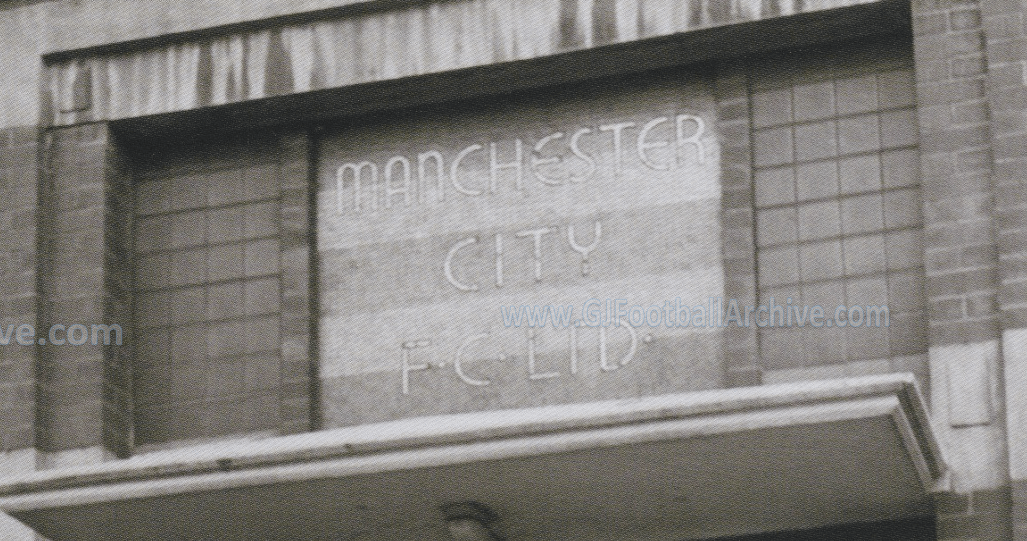
Day 12 of my posts counting down to the centenary of Maine Road’s opening game. Today is a simple photo of something that became lost after decades of proudly stating the club’s name – the central mosaic.
Created in 1923 for the new stadium the central mosaic was one of three created to proudly spell out the club’s name at their new home. I’ve written a lot about these and you can read more in the second chapter of Farewell To Maine Road (I talk about the people who made the mosaics there):
The central mosaic was proudly visible to all from 1923 through to the late 1970s when it was covered up by an advertising hoarding. I was told while researching the book that a refurbishment of the Main Stand saw an air conditioning unit get smashed through it, damaging it forever. You can see the advertising board in this photo:
I do know that during Maine Road’s demolition in 2004 part of the mosaic became visible briefly one day. How I wish we’d have been able to salvage it! If I get chance I’ll post that here, along with other demolition images, later in this series.
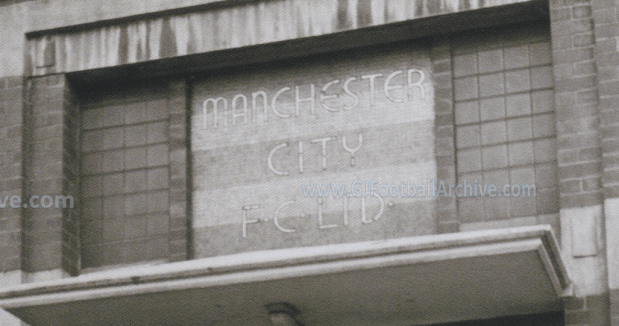
The central Mosaic at Maine Road, seen in 1968
This image of it is from 1968 and for those unfamiliar with Maine Road he specific location of the mosaic was above the main entrance of the Main Stand (the Main Stand is number 1 on this image) facing Maine Road itself.
Maine Road aerial 1971 from Farewell To Maine Road
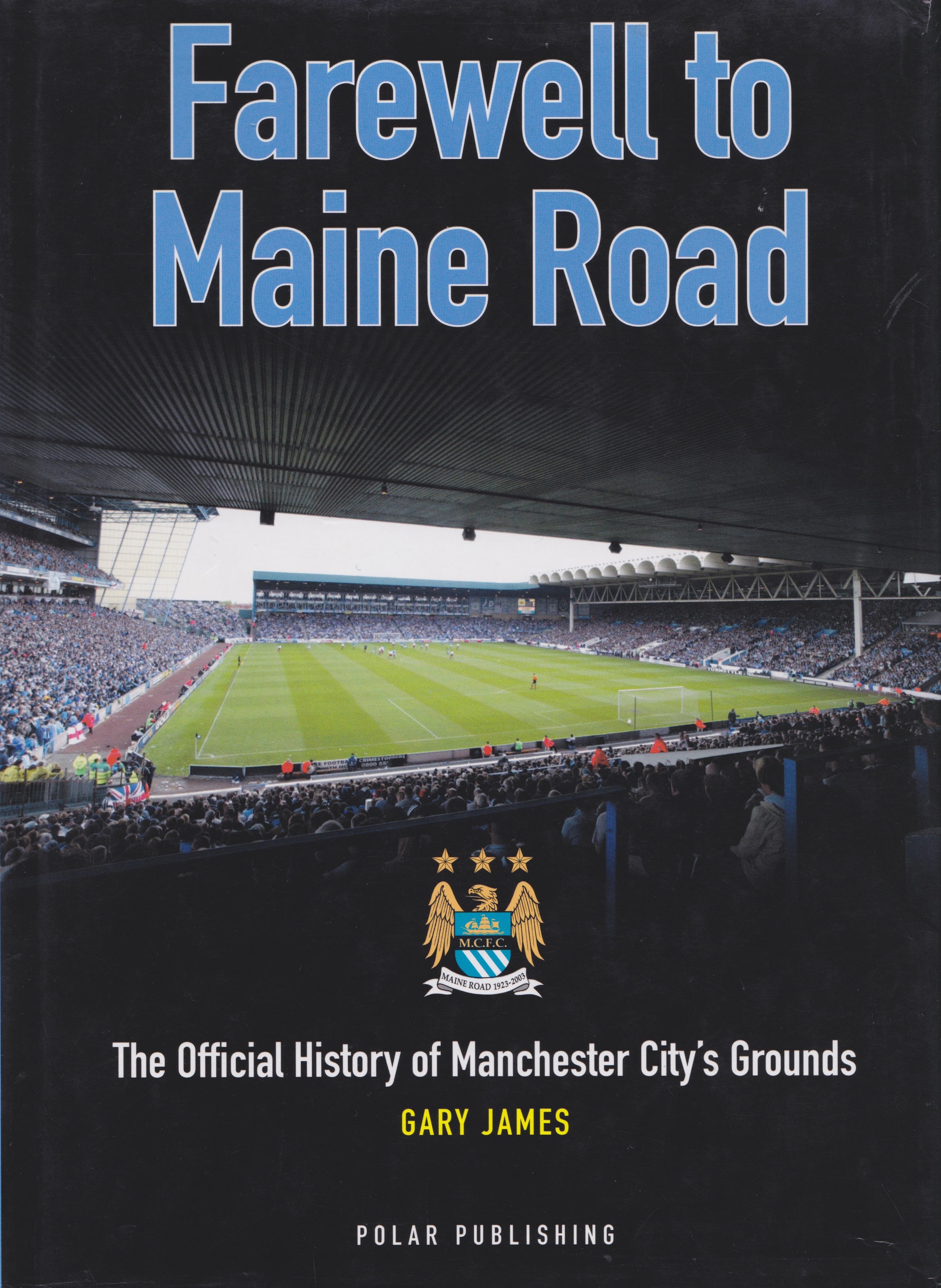
If you’d like to read more on the history of Maine Road, take a look at Farewell To Maine Road, which can be downloaded from this page:
If you enjoy all the free material on my website and would like to support my research and keep this website going (but don’t want to subscribe) then why not make a one-time donation (or buy me a coffee). All support for my research is valued and welcome. It allows me to keep some free material available for all. Thanks.
Day 11 of my posts counting down to the centenary of Maine Road’s opening game. Today follows on from yesterday’s post and shows the demolition of the original Platt Lane Stand.
I know the quality isn’t great but hopefully you can just make out the end of the concrete terracing and see how the 1935 roof was built over a wooden extension to the stand.
Have a look back at yesterday’s post to find out more.
To help those unfamiliar with Maine Road locate the specific location of this post, the Platt Lane Stand is the one where the number 4 & 5 are on this plan. The demolition photo was taken from near the number 6 looking towards the stand.
Maine Road aerial 1971 from Farewell To Maine Road
If you’d like to read more on the history of Maine Road, take a look at Farewell To Maine Road, which can be downloaded from this page:
Continuing from last week, subscribers to my website are able to download a PDF of the original Farewell To Maine Road book (which retailed at £25) in sections posted each week for the next few weeks. Today, we’ve got the third section. Enjoy!
Subscribe to get access – Monthly
If you would like to read the book and download a PDF of it then you can subscribe now at £3 per month or £20 a year. Monthly subscribers access everything posted to the site since 1 October 2022. All subscribers get everything else posted during their subscription too. You could always try a monthly subscription to see what you think (cancel any time).
As well as Farewell To Maine Road annual subscribers get access to everything posted since the site was created in December 2020 (that’s 100s of articles, videos, history talks and PDFs of two other books: Manchester A Football History and my first book From Maine Men To Banana Citizens).
The book has been out of print since 2004 with every copy sold within about six months of publication. Since then I’ve been keen to bring it up to date with stories about the site and the Etihad but that’s not been possible as no publisher has been prepared to invest in the way that Polar Publishing did to ensure it was the right quality.
Copies occasionally appear in second hand book shops or at online retailers but these often sell for ridiculous sums of money. The last time I checked there was one for about £100 here:
When it was published in 2003 apparently, I commented (though I can’t remember saying this, mind you it was 20 years ago): ‘On 320 beautifully illustrated A4 size pages this book tells the story of Maine Road from conception, right through to its final days as a sporting venue. With excellent photographs – including rare illustrations of the stadium during construction never previously published and images from every era – this has been a very interesting book to research, write and compile. I’ve also tried to ensure the views of ordinary fans are included, and some of the most powerful Maine Road moments are captured by the fans who saw them happen.’
In a review, Hugh Ryden wrote in King of the Kippax: ‘The architecture, the moving memories, the reproduction of rare photos and memorabilia and its extensive quotations, make FTMR a must.’
Another King of the Kippax regular Steve Worthington wrote: ‘Following on in the winning formula of his epic “Manchester The Greatest City”, the highly acclaimed author and Manchester City Football Club Historian Gary James has rolled up his sleeves once more and has produced yet another fabulous football book for all to treasure and enjoy. “Farewell to Maine Road” is not only a must for all Manchester City supporters, it is also an essential for all football fans who possess a genuine interest and passion for the history of our great British past time. It catalogues the birth, evolution and ultimate decline of what was once England’s premier and revolutionary provincial football stadium; Maine Road, Moss Side, Manchester M14. Soon to be demolished into oblivion, Maine Road is vividly remembered in all its former glory in this classic portal to the past. Beautifully written with the knowledge and passion you would expect from a lifelong Moss Side Pilgrim, the book provides a definitive literate and graphic illustration of Maine Road’s long and varied history. It contains a rich tapestry of previously unpublished photographs, one of which, a unique atmospheric shot of the famous ‘Ballet on Ice’ (a famous Manchester City V Spurs clash in the late sixties), is arguably worth the cost of the book on it’s own. Having consumed and digested every morsel of information contained within, it is difficult for me to imagine how much painstaking work and dedication it must take to produce and compile a book of such quality. Whilst they continue to produce triumphs such as this, the marriage of Gary James and Polar Publishing is truly one made in a Sky Blue Heaven. This 320-page masterpiece has pushed the boundaries of football publications to a new and higher level and has already prompted tears of nostalgia in my eyes. But don’t take my word for it, sign up a copy and see for yourself, you’ll not be disappointed.’
The publicity blurb said: ‘The only officially approved history of Maine Road is the perfect book for any supporter of City; Maine Road attendee; or general football enthusiast.
‘The book details the history of the stadium focussing on its development, and on the key games and events which have made Maine Road such a famous and important venue. Using first hand accounts, as told by supporters, players, administrators, and the media this book has been written and designed to the same high quality used in the highly acclaimed Manchester: The Greatest City. With special features on all the big City matches, international games, FA Cup semi-finals, League Cup finals, Rugby finals, concerts, religious meetings, and even on United’s use of the stadium during the forties and for European Cup games in the fifties. In addition both City’s former ground Hyde Road and future venue the City of Manchester Stadium have been covered to provide the complete history of City’s three homes.
‘As with earlier works by Gary James & Polar Publishing this book is destined to be regarded as the definitive history of Maine Road & Manchester City’s other grounds.’
My publisher, Julian Baskcomb, commented: ‘Gary James is the appropriate man to write this work after a lifetime’s research on the club and its stadium. As a boy Gary was a regular in the Platt Lane Stand; then at the age of 16 he bought his own season ticket for the Kippax Stand and has been a season ticket holder ever since. He is also a respected journalist with articles for a wide range of publications including The Times and has recently managed the development of Manchester City’s new museum.’
Day 10 of my posts counting down to the centenary of Maine Road’s opening game. Today the original Platt Lane Stand can be seen in this image, taken in 1991. The stand was initially a terraced stand and the original terracing built in 1923. 8 years later the corner (on the left of this image) was roofed, extended a little on wood and the terracing re-profiled for seats. Then, in 1935 the rest of the Platt Lane was roofed and extended on wood but this remained a standing terrace.
The Platt Lane’s development was the first two phases in a planned development which was supposed to see the Main Stand/Scoreboard End corner roofed around 1939, then the neighbouring terracing (later North Stand) roofed to match the Platt Lane by about 1945 and then within about five years the entire Popular Side/Kippax was to be extended and roofed.
Apart from Platt Lane, none of those developments occurred due to the war.
Platt Lane was seated in the 1960s (you can read more on that and all the plans for the stadium in Farewell To Maine Road) and this images shows the steps that were built at the back of the Platt Lane when it was extended. I remember as a young boy climbing up those to get to the benches we sat on occasionally and I was always scared I’d fall through the gaps.
To help those unfamiliar with Maine Road locate the specific location of this post, the Platt Lane Stand is the one where the number 4 & 5 are on this plan.
Maine Road aerial 1971 from Farewell To Maine Road
If you’d like to read more on the history of Maine Road, take a look at Farewell To Maine Road, which can be downloaded from this page:
If you enjoy all the free material on my website and would like to support my research and keep this website going (but don’t want to subscribe) then why not make a one-time donation (or buy me a coffee). All support for my research is valued and welcome. It allows me to keep some free material available for all. Thanks.
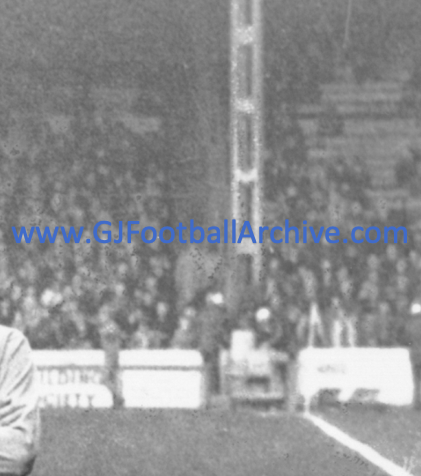
Day 9 of my posts counting down to the centenary of Maine Road’s opening game. Today this grainy image highlights something that was, until the end of the Kippax in 1994, a regular part of the Maine Road match experience. If you look carefully you can see the tea urn being pushed around the ground. It’s currently in front of the Platt Lane Stand and I remember being in that stand as a young boy in the 1970s and desperately wanting something from the vendor. Chipmunk crisps, Waggon Wheels & TipTop orange drinks were three of the items I remember them selling.
Usually, we brought a flask to games (often broken in the excitement of a goal) and occasionally Dad would have enough money to let us go and get some crisps or something. For those who never experienced Maine Road or the tea urns, basically a couple of young matchday staff, usually lads, but sometimes girls, would push a tea urn around in front of the white wall that surrounded the pitch. Presumably they had filled the tea urn at some point early into the game and I guess older fans knew how long it took the tea urn to get from one end to the other. If you were at the wrong end of the Platt Lane Stand your brew may not have been as hot as you’d want.
The Platt Lane tea urn, early 1970s
I never had a hot drink from it, so I don’t know if the urn had hot water in so that they could add a tea bag, Nescafe or bit of Bovril to it or whether it was already made up. If it was maybe there were different drinks in multiple urns that I didn’t spot? Anyone here ever work one or know more about that? If you did please leave your comments, or if you’ve any other memories of Maine Road that you’d like to share.
If you’d like to read more on the history of Maine Road, take a look at Farewell To Maine Road, which can be downloaded from this page:
To help those unfamiliar with Maine Road locate the specific location of this post, the Platt Lane tea urn photographed is heading towards the number 3 on this plan.
Maine Road aerial 1971 from Farewell To Maine Road
If you enjoy all the free material on my website and would like to support my research and keep this website going (but don’t want to subscribe) then why not make a one-time donation (or buy me a coffee). All support for my research is valued and welcome. It allows me to keep some free material available for all. Thanks.
Day 8 of my posts counting down to the centenary of Maine Road’s opening game. Today here’s an image of the Maine Road forecourt in the 1980s. So much to say on this. Notice the Granada TV vehicle and the newspaper adverts hung up for the Sunday Mirror and News of the World. There’s also the advert above the main entrance ‘cage’ – that was covering up the original central mosaic which I wish they’d been able to keep visible but an air conditioning unit was smashed through this at some point. So much for preserving the club’s history back then, hey?
The forecourt looked much the same as this from its opening through to later in the 80s, although there had already been a pebble dash render placed on the lower part of the main stand frontage. Later the decade more render would be place on sections of the front and then in the 1990s the whole stand was clad in metal.
There’s one of the floodlights (second set) showing and this is obviously pre-match as fans are mostly heading to the stands. Also, post match for many games in the 80s the forecourt would have housed a demo!
Those cars are heading towards the directors car park, past the stand, on the left.
This image was from a 1981 Manchester derby.
1981 City v United Maine Road
If you’d like to read more on the history of Maine Road, take a look at Farewell To Maine Road, which can be downloaded from this page:
To help those unfamiliar with Maine Road locate the specific location, the Main Stand is number 1 on this plan and its frontage faced Maine Road, the street running above the stand.
Maine Road aerial 1971 from Farewell To Maine Road
If you enjoy all the free material on my website and would like to support my research and keep this website going (but don’t want to subscribe) then why not make a one-time donation (or buy me a coffee). All support for my research is valued and welcome. It allows me to keep some free material available for all. Thanks.
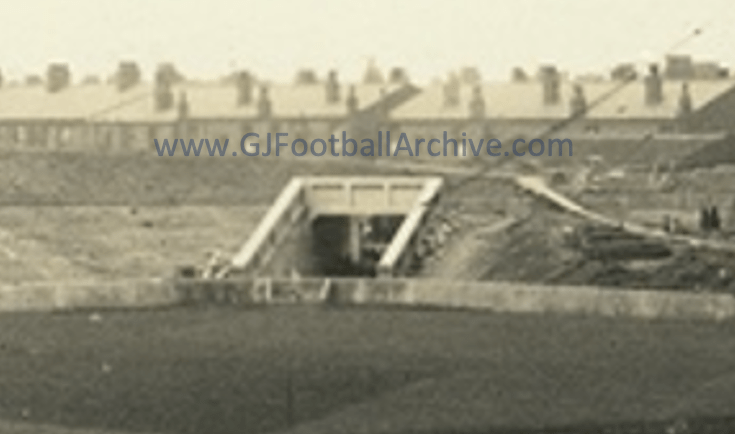
Day 7 of my posts counting down to the centenary of Maine Road’s opening game. Today it’s the story of the Platt Lane tunnel. Maine Road had four large corner tunnels, plus two in the Kippax and three (including the Players’ tunnel) in the Main Stand. The corner tunnels when built were all the same but the one in the Platt Lane/Main Stand corner was altered within 8 years of being built. Many people don’t realise this or know why, so here’s the story…
The tunnels were designed by architect Charles Swain to make access to and departure from the terracing easy after the problems Wembley experienced in its opening game. These huge tunnels became a feature of Maine Road for most of its existence but ground developments led to them all, apart from the Main Stand’s tunnels disappearing by the mid 1990s.
The first one to change was the Platt Lane/Main Stand corner tunnel.
In 1931 the club decided to enlarge Maine Road and they started with that corner. There was a demand for additional seating and so the club rebuilt the corner terracing. They built on top of what was already there by increasing the terracing rake to make it more appropriate for seating. They didn’t demolish the original corner, they built on top of it. This created a problem because the walls of the tunnel were now too low in parts, creating a potential safety issue. So the club raised and remodelled the tunnel walls a little. These are not great images but I hope they give you enough of a feel for how the tunnel was adapted.
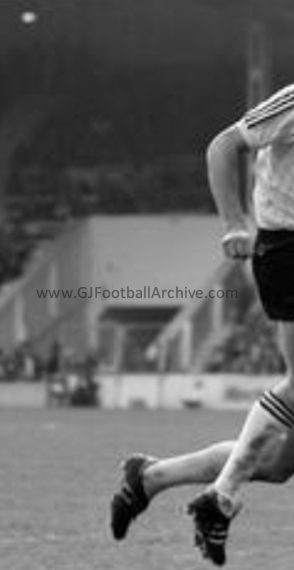
The older image is during construction, with the other image showing the stand in 1981. That corner stand was extended a little on wooden steps, as was the rest of the stand when it was extended in 1935. The difference was that the rake of the terracing elsewhere in the stand was not changed.
Remodelled Platt Lane/Main Stand corner tunnel as seen in 1981
If you’d like to read more on the history of Maine Road, take a look at Farewell To Maine Road, which can be downloaded from this page:
If you enjoy all the free material on my website and would like to support my research and keep this website going (but don’t want to subscribe) then why not make a one-time donation (or buy me a coffee). All support for my research is valued and welcome. It allows me to keep some free material available for all. Thanks.
Day 6 of my posts counting down to the centenary of Maine Road’s opening game asked you to name the year this aerial photo was taken. I gave a few clues which may help date this:
None of the temporary stands have yet been constructed in the corners
The MCFC lettering appears at the bottom section of the North Stand
The Souvenir Shop still appears to be operational and doesn’t look like it’s been turned into offices yet
Both the Platt Lane Stand and the Kippax have been replaced BUT what about the end panelling of the Kippax? Is that complete?
The answer is 1995.
If you’d like to read more on the history of Maine Road, take a look at Farewell To Maine Road, which can be downloaded from this page:
If you enjoy all the free material on my website and would like to support my research and keep this website going (but don’t want to subscribe) then why not make a one-time donation (or buy me a coffee). All support for my research is valued and welcome. It allows me to keep some free material available for all. Thanks.
Day 6 of my posts counting down to the centenary of Maine Road’s opening game. Today it’s an aerial shot of Maine Road. Can you guess the year?
I’m a bit of a ground obsessive (as you may have guessed) and I spend much of my time seeking out images of football grounds (not just City’s) and trying to date them. It drives me crazy when I see something misdated…. Anyway, before I waffle on can you work out which year this was taken?
I’ll give the answer tomorrow but I always look for clues, so I’ll give you a few which may help date this:
None of the temporary stands have yet been constructed in the corners
The MCFC lettering appears at the bottom section of the North Stand
The Souvenir Shop still appears to be operational and doesn’t look like it’s been turned into offices yet
Both the Platt Lane Stand and the Kippax have been replaced BUT what about the end panelling of the Kippax? Is that complete?
I’ll give you the answer tomorrow.
If you’d like to read more on the history of Maine Road, take a look at Farewell To Maine Road, which can be downloaded from this page:
The fifth of my posts counting down to the centenary of Maine Road’s opening game. Today it’s about the Players’ Tunnel at Maine Road…
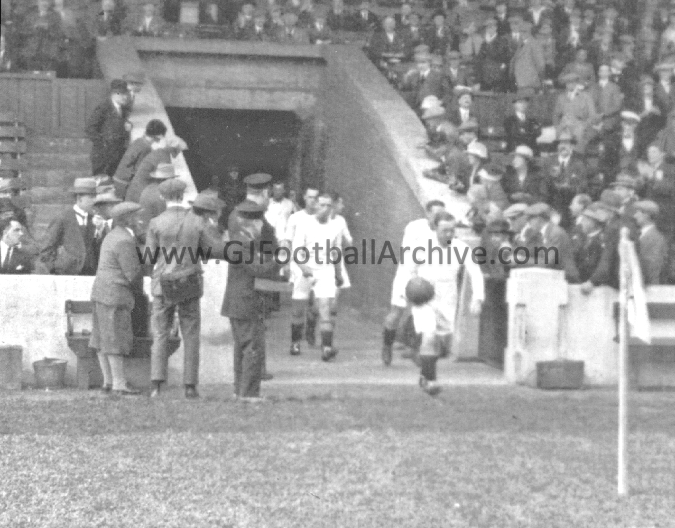
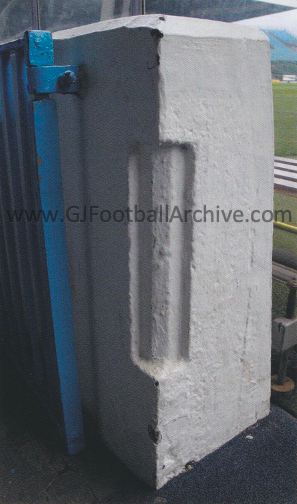
Before I start notice on the black and white image the pitchside stone post. Yesterday I mentioned the carved edge style and how originally there were two impressive stone posts, one either side of the tunnel entrance. I said that by 2003 these had been remodelled extensively to match the rest of the white perimeter wall but that one of them still showed an element of the styling used throughout the stadium at the time of construction.
Maine Road’s Tunnel post. Photo by Ed Garvey
Well on the black and white image you can see that same post (on the right of captain Jimmy McMullan) in its original form.
So, what’s my angle for today? Well, it’s the players’ tunnel itself. In this 1926 image you can see the tunnel as it looked when it was first built. Eagle eyed readers may notice that the tunnel looks a little different to how it did during the 1970s onwards. That wall above the tunnel was actually taken down and the front of the seating above the tunnel was brought forward into the tunnel during the 1960s. You can see that by looking at this image of chairman Albert Alexander and Joe Mercer who are actually sat in front of where the original tunnel wall was. The space they occupy would have been open air, floating above the tunnel only a few years earlier.
Albert Alexander & Joe Mercer in the Directors’ Box extension (Copyright Mirrorpix).
The 1926 photo of the tunnel appeared in my 1997 book Manchester The Greatest City and about a year after it was published I received a letter from Canada. It came from an elderly City supporter who had emigrated to Canada many years earlier. His daughter had returned to England for a visit in 1998 and she popped into a bookshop (I think it was the old Sportspages shop) thinking that if there was a book on Manchester City she would buy it for her dad. She saw my book and bought it.
When she returned to Canada she gave the book to her father and while reading it he was stunned to find himself as a small boy on this photo. He is pictured leaning on the wall close to his mother and father. It was a remarkable coincidence but what made it even more special is that this photo came from film of the game. I was able, with the support of the British Film Institute to get a VHS copy of the game and I sent it to Canada so that he could also see himself and his parents on film, moving around.
For me that story gave me an overwhelming feeling that researching and writing about history can add significantly to the wellbeing, interests or lives of others. Research matters. There was also a great feeling of coincidence – I could easily have chosen a different illustration; the daughter may not have bought my book; her father may have only glanced through the book and so on.
1926 City v Fulham, Maine Road. Jimmy McMullan with the ball.
If you’d like to read more on the history of Maine Road, take a look at Farewell To Maine Road, which can be downloaded from this page:
If you enjoy all the free material on my website and would like to support my research and keep this website going (but don’t want to subscribe) then why not make a one-time donation (or buy me a coffee). All support for my research is valued and welcome. It allows me to keep some free material available for all. Thanks.









 Gary James' Football Archive