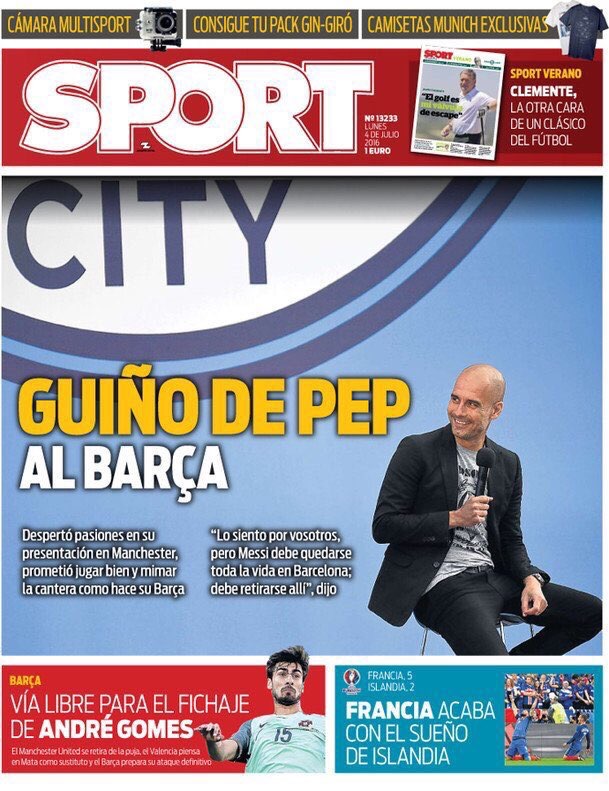
On this day (3 July) in 2016 the new Manchester City badge was officially launched at the Cityzens Weekend. It was also the formal official welcome for new manager Pep Guardiola. There was a surreal moment for me when I was asked to go on stage to be interviewed about the new badge.
I had been consulted by the club on the history of all of City’s badges, emblems and similar for about a year or so, and had performed a series of talks to fans throughout the consultation period.
This was the most detailed badge consultation had ever performed with fans at any club – sadly too many clubs impose a badge without listening to fans. Doing the talks as part of the consultation helped bring out the stories of each emblem and why it was significant – or not! Understanding why, for example, the red rose was introduced in 1972 following the takeover of the club by Joe Smith & Co. or how the 3 emblazoned lines had always been a part of City’s badge (apart from 1972 and the Swales years that followed) helped some determine what elements mattered most to them.
You can find out more about City’s badge history here:
In 2016 I was the warm up act for Pep so it’s a wonder anybody listened. It was a great, positive day for the club and for all of us there. The years since Pep’s arrival have been truly outstanding. We all had hope on this day in 2016 but who’d have thought it would have been as great as it has been?
Today (20 June) in 1992 while English football was gearing up to the first season of the newly established Premier League, Manchester City’s Club Secretary Bernard Halford claimed to have an army containing some of the world’s biggest music stars promoting the club. I’m not entirely convinced this was the truth but Bernard seemed to believe it according to this report.
It makes interesting reading – especially the bit about Mick Jagger, Axl Rose and others asking for a City shirt in their quest to promote Manchester’s Blues.
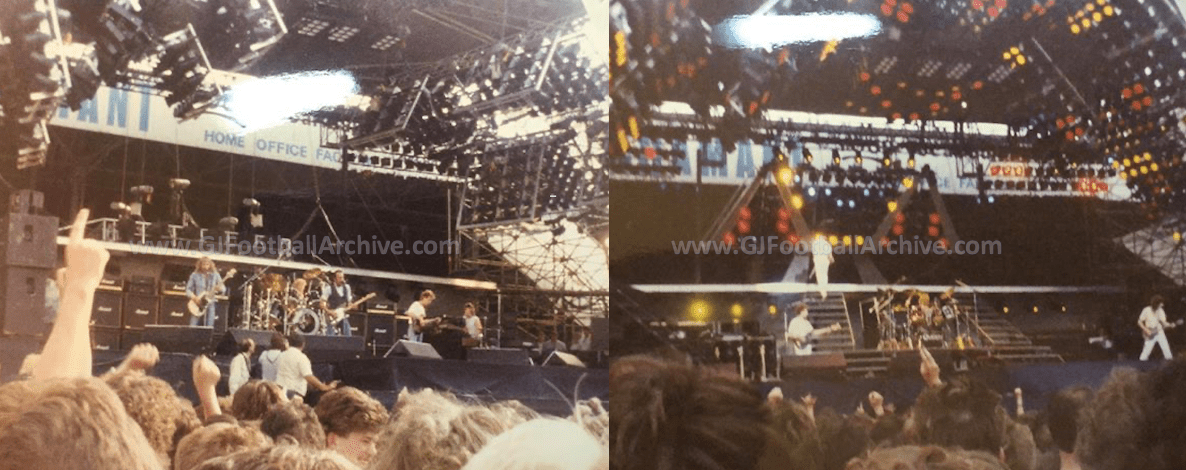
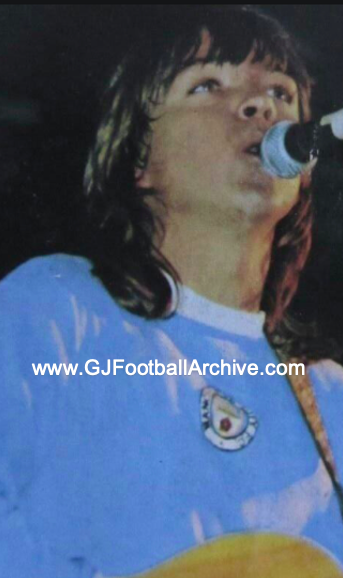
Over the years I interviewed Bernard quite a bit and I do remember him telling me how he’d given Freddie Mercury a City shirt after the legendary Queen concert at Maine Road. This article suggests the same happened with others. I’ve posted previously the David Cassidy image of him in a City shirt at his 1970s Maine Road concert.
I’d love to see a music hall of fame somewhere with an exhibit ‘City shirts worn by rock legends’ – who knows? Maybe they all used to meet up for City chat after Top of the Pops finished?
Status Quo (left) & Queen 1986 concert at Maine Road. Copyright Garry Lippett
Here’s an interesting article from today (18 February) in 1974 which tells the story of FH Drabble & Sons, Tansley, Matlock. Who? Well look at these wonderful shirts from the 1974 League Cup final – They were that colourful because of Drabble! So who was Drabble & Sons? Read on…
This was an important company in the production of football shirts and they dyed shirts for Manchester City, Wolves and many international teams. In essence, if you had an Umbro shirt (or another British manufacturer prior to the late 1970s) then there’s a good chance it was dyed at their works.
I’ve been interested in football kit production for many, many years and spent some great time about twenty years ago with Umbro people going through collections and spotting unique work etc. There are a lot of people interested in kits today and, rightly so, they define great eras and often show football clubs at their best. Think of a great team and no doubt you’ll remember the style of kit worn.
One area that is often overlooked though is the actual process of kit manufacture, especially the dyeing. This is odd seeing as it’s so often the colour, especially for teams wearing unique or rare colours (I see MCFC as one of these – other clubs have copied City’s blue but for MCFC this colour or a shade of it goes back to their days as Ardwick when they wore ‘quartered’ shirts of pale blue and white), that is the brand or identity as far as many of us are concerned.
Ah well, I could go on for hours, but have a read of this. Sadly, Drabble’s dye works was derelicht by the 2000s. Maybe polyester football shirts/overseas production put an end to their operation. Did you work at Drabbles? Any memories of their football related dyeing?
This series of articles and features on Manchester City in the 1970s has been running throughout January with indepth articles some days and smaller ‘on this day’ style posts on others. Every day in January will offer something to enjoy.
Subscribers will get access to everything. If you want to know more on this incredible decade for Manchester City Football Club then why not subscribe and read it all? You could even subscribe for a month and see what you think. The following 1,700 word article is on the 1973-74 season and is available to subscribers below. Enjoy!
Subscribe to get access – Monthly
Read more of this content when you subscribe today. It costs £3 per month (cancel anytime) to access everything posted since 1 October 2022 or there’s a special annual rate below which gives greater access and works out much cheaper.
Read more of this content when you subscribe today. It costs £3 per month (above) or £20 a year (here) to access everything posted since the site was created in December 2020. This special rate works out about £1.67 a week and gives access to everything posted, including PDFs of 3 of my books.
If you enjoy all the free material on my website and would like to support my research and keep this website going (but don’t want to subscribe) then why not make a one-time donation (or buy me a coffee). All support for my research is valued and welcome. It allows me to keep some free material available for all. Thanks.
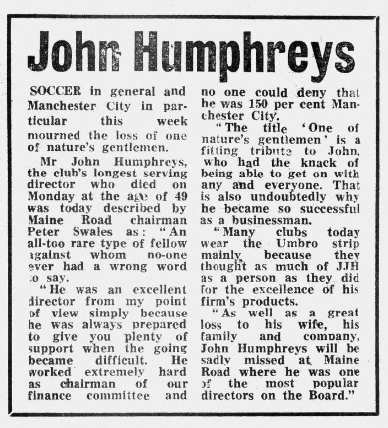
On this day (17 February) in 1979 the Manchester Evening News carried the news that Umbro & Manchester City director John Humphreys had died. His death was a major loss to both organisations. I wrote this about John in my 1997 history of the club Manchester The Greatest City:
This series of articles and features on Manchester City in the 1970s has been running throughout January and now into February with indepth articles some days and smaller ‘on this day’ style posts on others. Every day in January & February offered something to enjoy and I’ll continue this series for a little while yet. Thanks for all the positive comments about it.
Subscribers can access everything. If you want to know more on this incredible decade for Manchester City Football Club then why not subscribe and read it all? You could even subscribe for a month and see what you think. The following 5,700 word article is on the 1978-79 season and is available to subscribers below. Enjoy!
Subscribe to get access – Monthly
Read more of this content when you subscribe today. It costs £3 per month (cancel anytime) to access everything posted since 1 October 2022 or there’s a special annual rate below which gives greater access and works out much cheaper.
Read more of this content when you subscribe today. It costs £3 per month (above) or £20 a year (here) to access everything posted since the site was created in December 2020. This special rate works out about £1.67 a week and gives access to everything posted, including PDFs of 3 of my books.
If you enjoy all the free material on my website and would like to support my research and keep this website going (but don’t want to subscribe) then why not make a one-time donation (or buy me a coffee). All support for my research is valued and welcome. It allows me to keep some free material available for all. Thanks.
Here’s film of Denis Law scoring a header 50 years ago today (19 January 1974) for Manchester City at Birmingham City. Wearing red & black stripes City drew this game 1-1 but it’s worth seeing the goal for that kit and to recognise Law’s final season in League football.
If you enjoy all the free material on my website and would like to support my research and keep this website going (but don’t want to subscribe) then why not make a one-time donation (or buy me a coffee). All support for my research is valued and welcome. It allows me to keep some free material available for all. Thanks.
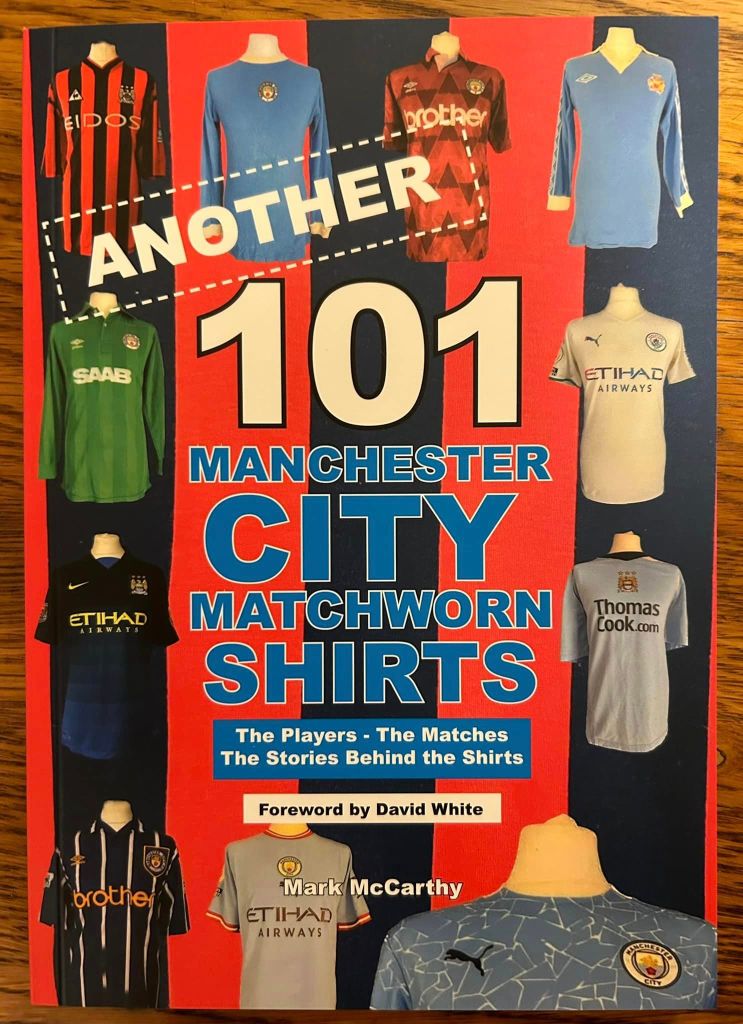
For the second time I’ve asked Mark McCarthy to write a guest blog on his football shirt collection and, specifically, I’ve asked him to tell us about his new book. This book is the second book he has written on his collection. It is packed with lots of great images and stories. Mark tells all below:
It was never my intention to do this follow up book to 101 Manchester City Match Worn Shirts which was released in 2021, but as a passionate City match shirt collector it’s a pleasure to be able to share another part of my collection and some stories regarding the shirts and the seasons’ memories that they may bring.
My collection has grown considerably over the past few years, as has the hobby in general. You only have to scroll through the many social media channels to see the number of accounts now dedicated to collecting not only match worn shirts but football shirts in general. I can’t speak for other collectors, but I can safely say they may well agree with me when I do say the feeling never get’s old of adding a new shirt or unearthing a real holy grail of a shirt into collection. This was the case for me during the first lockdown when after many years of trying to trace the unusual yellow away shirt that was only ever worn once by City at Arsenal on 14 October 1989 (with just one set of shirts produced it has become a real holy grail of City shirts for any collection) I tracked one down. The kit was hastily given away by then City director Freddie Pye, following our 4-0 defeat, with Chairman Peter Swales demanding that the kit was never to been seen again. Well it was actually seen numerous times across Manchester’s Saturday and Sunday leagues when it was used by local team MMS who were managed at the time by Liam Hall.
The kit was used well into the 1990s before the side broke up, a lot of players got to keep the shirts but the majority have long been since sold on. A few have surfaced more recently but were quickly snapped up by a dealer who then sold them for huge profits. After many online requests for the shirt, convinced that there will be one still out there I was put onto a fellow blue called Billy Bell, who had found one just stored in a bag of old City shirts, just waiting to be discovered. A deal was quickly arranged with Billy, who in fairness could have sold the shirt on for much high profits but, as a man of his word, he kept to our deal which I’ll be forever grateful. A courier was quickly arranged to be sent to collect the shirt which I’m thrilled to have in the collection as there certainly aren’t too many, if anymore out there.
Manchester City have played, and still do to this day, a huge part of my life. As many football fans will tell you, our clubs were our first real love, the ones we can forgive no matter what they throw our way. City have certainly tested that unconditional love over the 40 years I have supported the club, although the past 15 years or so have been pretty incredible to say the least.
In February 2023 I was kindly invited by the club to take part in the 2023/24 season kit launch where I spent the day in and around the first team while featuring in the official home fans and players photo shoot along with the likes of Jack Grealish, Erling Haaland, Riyad Mahrez and former City goalkeeper Alex Williams. I also spent time with our current kit manufacturers Puma talking about kit designs and ideas while showing them a collection of match shirts we have worn over the years. The day was topped off when I was introduced to legendary Oasis singer Noal Gallagher who was filming a piece using my shirts, another honour for me and I was delighted to be able to present him with a copy of my first book. For the record Noel’s favourite City shirt is the 86-88 black & red chess board chequered style. A big thank you to Paul Mulholland and City for making a brilliant day of memories to be treasured.
With just over 600 shirts now in the collection I hope the book will spark some memories of days gone by, some you may want to forget and some you will never forget.
You can order a copy direct from Mark which can include a signed dedicated message of choice which will make a perfect birthday or Christmas gift for any blue. EMAIL MARK: mmmac@hotmail.co.uk
It’s day 23 of my posts counting down to the centenary of Maine Road’s opening game and today’s feature is on the building of the North Stand. As Manchester City are about to appear in the 2023 Champions League final I thought I’d post images from a much earlier European game. This image of Neil Young comes from the 1971 ECWC semi-final v Chelsea. Notice Young is wearing City’s away colours. People often assume that City rarely wore away colours at Maine Road, but the truth is somewhat different.
Often when there was a clash of colours in a cup game City would wear their away strip. Games in the 1920s right through to 1970s saw the Blues don maroon, red/black and even scarlet at times at Maine Road.
The main image shows that North Stand being constructed in the background. You can see that the roof is not yet complete but that the terracing is in use for this ECWC semi final. The terracing was new concrete and the stand housed bars underneath. It was a terraced stand until summer 1972 when the decision was taken to make it a seated stand.
City chairman Eric Alexander was the main man responsible for the stand’s development and he was a passionate believer in giving fans the best facilities possible. He also had ambitious plans to redevelop the Kippax, however Peter Swales became the chairman soon after and he put Ian Niven in charge of ground developments. From then on, until 1993, the only major development was the erection of a new Main Stand roof in 1982. In the 1990s the club was forced to build – or condemn – the Platt Lane Stand.
Maine Road was a major ground for most of its existence and, even with little investment during from 1973 onwards, it was still selected as a cup semi-final venue. BUT I often wonder how spectacular the stadium would have been had Eric Alexander been left in charge of stadium developments. Instead of penny-pinching and devaluing the ground maybe it would have eclipsed Old Trafford as it had for the first 40 years of its existence?
People always focus on Swales as the cause of all the problems and it is true that he was the chairman and the man ultimately responsible, but he was not the major shareholder. In fact he often talked of how he only had a small number of shares until 1983 (when he made a major purchase following City’s relegation he often said). He was supported by directors who often held many more shares than he did. They could’ve ousted him, but instead supported him. Each director had responsibilities for different elements of the club – Swales often talked of this and the match programme frequently told us who was responsible and what they did – yet once Swales did stand down and Franny Lee took over some of those who had worked with Swales swapped sides and retained their positions. I know, from my own interviews with Swales, Alexander and others, that Swales felt let down and betrayed. Every issue was suddenly made to be ‘his’ fault. He accepted this, saying that he was the main man, but others needed to hold their hands up for the lack of investment in Maine Road etc.
1971 ECWC v Chelsea. Francis Lee. Photo by Alan Jubb
The above image shows Francis Lee at this same game and to the right you can see more of the North Stand under construction.
For those unfamiliar with Maine Road this photo may help. The North Stand can be seen with a completed roof on this image (number 10). This was later in 1971 and the stand is still a terraced one.
Maine Road aerial 1971 from Farewell To Maine Road
If you’d like to read more on the history of Maine Road, take a look at Farewell To Maine Road, which can be downloaded from this page:
If you enjoy all the free material on my website and would like to support my research and keep this website going (but don’t want to subscribe) then why not make a one-time donation (or buy me a coffee). All support for my research is valued and welcome. It allows me to keep some free material available for all. Thanks.
Concluding the weekly series of ‘True Blue’ figures associated with the early years of Manchester City, here’s an article on William Beastow and James Moores, two men influential during the development of footballing activities in the 1870s-1890s. Most people don’t tend to talk about these guys but they are possibly the two most important church figures directly involved with the development of the football club. You can find out more below:
Subscribe to get access – Annual
Read more of this content when you subscribe today. Annual subscribers can access all the articles, talks, books and interviews posted since December 2020 for an annual subscription of £20 (works out about £1.67 per month). There’s also a monthly subscription (see below).
Monthly subscribers can access all the articles, talks, books and interviews posted since 1 October 2022 for a monthly subscription of £3 (cancel any time).
That was the tenth consecutive weekly ‘True Blues’ feature. Use the tag ‘True Blues’ to find the other profiles in this series. If there’s interest I’ll write some other True Blue profiles later in the year. You can nominate the names that you’d like featured by emailing me at Gary@GJFootballArchive.com or by adding a comment in the comments area below. Thanks.
The full series of True Blue profiles featured:
Lawrence Furniss, John Allison, Joshua Parlby, Walter Chew, William Sumner, Tom Maley, St Mark’s community leaders, Billy Meredith, John Chapman, William Beastow and James Moores.
Here’s a story I’ve told often but I still see it incorrectly reported on occasion. It’s the tale of the 1980s game when Middlesbrough played Manchester City at Maine Road wearing Manchester United’s shirts. It’s the anniversary (17 January) of that game today, so here is the story, a match report and some video clips of that game…
It was January 1981 and Middlesbrough travelled to Maine Road for what was nothing more than a mid table top flight clash. John Bond’s City had faced Liverpool in a controversial League Cup semi final first leg 3 days earlier – don’t get me started on that one! You can read about and listen to John Bond comment on it (from my interview with him back in the 1990s) elsewhere on this site.
The City-Middlesbrough game wasn’t scheduled to be on TV or anything. Remember this was a time when games would only be filmed if they were to be shown as highlights on TV that night or the following day and the news of what games would be on the telly would often be kept secret until shortly before kick off, or sometimes announced at the end of one of the lunchtime football shows on BBC or ITV, depending on which channel had the TV rights for Saturday night games that year. In 1980-81 ITV had the rights to Saturday night football and in Granadaland our programme was called Match Night, presented by Elton Welsby.
That night Granada TV planned on showing the Bolton home game as their match but a waterlogged pitch at Burnden Park meant that game was called off, so a quick decision was made to move the Granada cameras to Maine Road and film the City game instead. I remember arriving at Maine Road with my Dad and being surprised at seeing the Granada TV trucks outside the Main Stand. In those days spotting the TV trucks outside the ground brought a bit of excitement because it also meant you’d have the unusual experience of seeing a game, or at least highlights of it, again. I was 13 at the time, and this was always a big bonus.
Of course, I wasn’t the only person surprised by the TV switch to Maine Road as Middlesbrough were also caught out by it. Back in 1980-81 shirt sponsorship was still a bit of a thorny issue in football and clubs were allowed to wear sponsors names on their shirts but not in games televised. Middlesbrough arrived at Maine Road with shirts wearing their sponsor’s name and this meant the filming of the game was now in jeopardy.
City hadn’t yet struck a deal for shirt sponsorship – that was to come later in the year when Saab became the club’s first sponsor – which meant the club did not need as many shirt variations as Middlesbrough. Whether this had any bearing on what happened next isn’t clear but, instead of wearing City’s second strip, Middlesbrough asked Manchester United if they could borrow their shirts instead. Someone sent for a full set of United home shirts from Old Trafford and Middlesbrough played in United’s unsponsored red instead of their own shirts.
The game was filmed and broadcast that night – Granadaland viewers had the choice of the game or the end of the Parkinson show/start of a Burt Reynolds film.
The game ended in a 3-2 City win with goals from Tommy Hutchison, Bobby McDonald and Kevin Reeves. Middlesbrough’s Hodgson became the first man to score wearing a United first team shirt at Maine Road that season. In fact, Hodgsonnand McAndrew were the ONLY men to score at Maine Road that season in a first team game wearing United’s colours!
Were you at this match? If you were why not leave your memory as a comment or email it to me for possible future use on this website?
You can read a report of the game here:
Here’s some film of the match too:
Subscribe to get access
If you have enjoyed this free post and would like to support my research and writing then please subscribe. Annual subscribers (£20 per year, sign up here) get access to everything posted on the site including PDFs of 2 of my out of print books and archived content like my exclusive audio interviews with John Bond, Malcolm Allison etc. Not only that but you’ll be helping to support this site’s development and my research.
Why not sign up for a month (cancel any time)? Monthly subscribers (£3 per month, cancel anytime and sign up here) get access to everything posted on the site since 1 October 2022. Not only that but you’ll be helping to support this site’s development and my research.
Today I’m focusing on Manchester emblems and, in particular, those used by Manchester City over the years. The club’s current badge has been worn on shirts for over six years after first being revealed at Christmas 2015 and worn from summer 2016, but its roots go back decades with City developing a round badge by the 1930s.
Here for subscribers is a 1500 word piece on the development of badges at City and United. Enjoy!
Subscribe to get access
Read more of this content when you subscribe today. It costs £20 a year (works out about £1.67 a month) and you get access to everything on the site and help future research into Manchester’s football history.









 Gary James' Football Archive