As tonight sees Manchester City face Newcastle United in the League Cup semi-final here’s a reminder of the first ever League Cup semi played by the Blues. That came in 1964 and was a two-legged, often forgotten, tie. The first leg ended in a 2-0 defeat to Stoke in January 1964 and then on 5 February City defeated Stoke 1-0 in the second leg of the League Cup semi-final. The goalscorer was Derek Kevan. This was the first time City had reached the semi final stage but the competition was not particularly welcome at this time in football history. Here’s a report of the game:
Subscribe to get access
Read more of this content when you subscribe today. Annual subscription is £20 (register here, access everything on the site) or £3 per month (register below, cancel anytime, access everything posted since 1 October 2022).
Attendances across football were low in this competition. This Maine Road tie with Stoke was watched by 16,894. The first leg, on 15 January, had seen City suffer a 2-0 loss at Stoke.
Were you at either of these games? Please post your comments if you were. I’m keen to understand how fans felt about the semi final back in 1964.
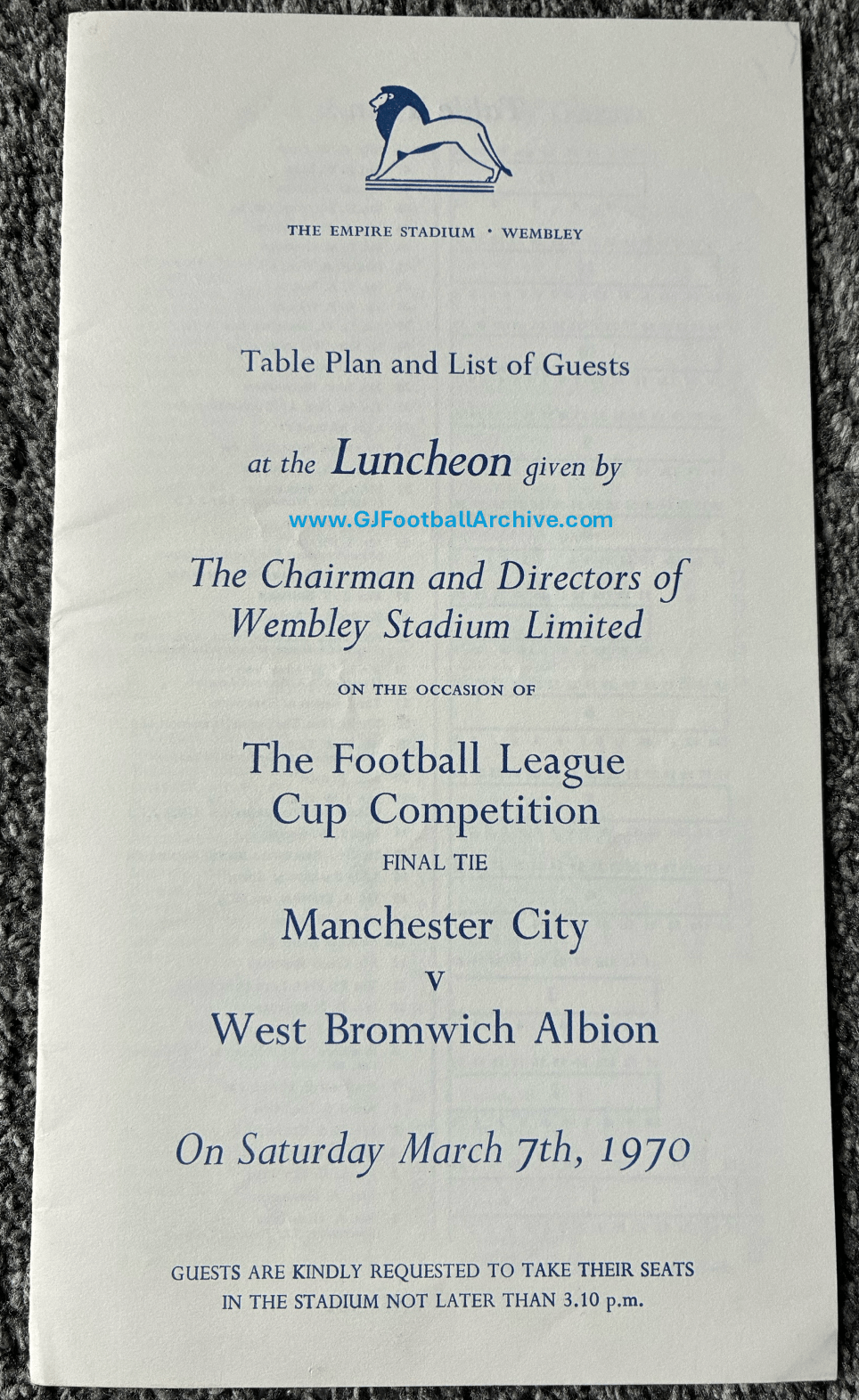
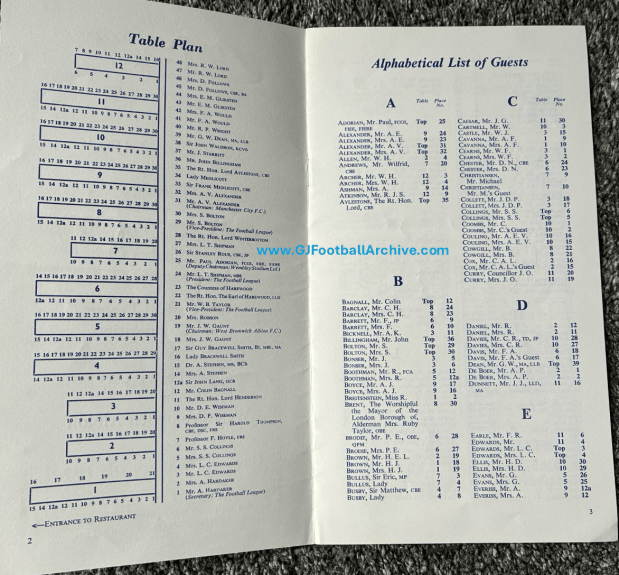
Ever wondered who the official guests were for major games like the League Cup final? Here’s an item from my collection showing the guest lists and tables for the 1970 League Cup final which featured West Bromwich Albion and Manchester City. One of the guests was Manchester United manager and former City player Matt Busby. Here’s the full list:
If you want to know more on the incredible 1960s & 1970s for Manchester City Football Club then why not subscribe and read it all? Have a search through what’s been posted and see what you want to read, watch and remember. The following 5,600 word article on the successes of 1970 is available to subscribers below. Enjoy!
Subscribe to get access – Monthly
Read more of this content when you subscribe today. It costs £3 per month (cancel anytime) to access everything posted since 1 October 2022 or there’s a special annual rate below which gives greater access and works out much cheaper.
Read more of this content when you subscribe today. It costs £3 per month (above) or £20 a year (here) to access everything posted since the site was created in December 2020. This special rate works out about £1.67 a week and gives access to everything posted, including PDFs of 3 of my books.
If you enjoy all the free material on my website and would like to support my research and keep this website going (but don’t want to subscribe) then why not make a one-time donation (or buy me a coffee). All support for my research is valued and welcome. It allows me to keep some free material available for all. Thanks.
Denis Law had such a wonderful footballing career, with so many periods deserving focus. Inevitably – and rightly – many will focus on his exploits with Manchester United and Scotland. Following his death I’d like to add to the tributes out there by highlighting a couple of periods of his career that may be being overlooked. It’s totally understandable, but today I’d like to highlight his Manchester City career. A career that saw him become a City legend. Not many manage to become idolised at both City and United in equal measure (Meredith & Kidd are the other prominent two I can think of) but Law managed it.
He was signed by City in March 1960 from Huddersfield Town for a record figure of £55,000 – £10,000 more than the previous British transfer record. It was a bold move by Les McDowall but was clear proof that City were still a force to be reckoned with, particularly as they had managed to fight off the likes of Arsenal to sign the 20 year old.
Denis Law signs for City from Huddersfield
Law was a lethal finisher, and a genuine crowd pleaser. His first goal for the Blues came during his debut match at Leeds United on 19th March 1960, although City were defeated by the odd goal in seven. His second League game brought another goal as West Ham were defeated 3-1 at Maine Road on 30th March. He ended the season with 7 appearances.
The following season he was top scorer with 19 League goals – 1 more than Joe Hayes – and again made the headlines with an amazing goalscoring feat in an abandoned cup tie. On 28th January City were defeating Luton 6-2 with Law scoring all City’s goals, when the match was abandoned. In the replay, Law again scored but this time City were defeated 3-1 in conditions which Law himself believed were worse than the original game.
In addition to his performances for City, Law was making a name for himself with his country. He made 5 international appearances during his first two seasons at Maine Road, and was an obvious choice for his beloved Scotland.
All the media interest which understandably focused on Law helped to make him known throughout the footballing world and, with City still struggling to find consistency during the early sixties, it was perhaps inevitable that he would move on. In the end he was transferred to Italian side Torino for another record. This time he became Britain’s first £100,000 footballer when the Italians paid City £110,000 for his signature in July 1961.
After a little over a year in Italy, Law returned to Manchester. This time to help United. In his first season there he helped the Reds avoid relegation, but regrettably City suffered as a consequence. While at Old Trafford, Law found the success that had not seemed possible at Maine Road.
In July 1973 after becoming a legend with the Reds – please go and read everything you can about his career at Old Trafford – he was given a free transfer. City manager Johnny Hart quickly made arrangements to sign the player, and on his second City debut he again scored (twice) as Birmingham were defeated 3-1. Of the City side he joined in 1973 only Alan Oakes remained from his final City game in 1961, and the Blues were in an entirely different position.
The late sixties and early seventies had seen City achieve phenomenal success and eclipse Law’s United side, and so rather than join a poor, struggling side, law was now with a team of entertainers capable of tremendous success. He had also joined a team renowned for its unpredictability!
Johnny Hart was replaced by disciplinarian Ron Saunders as manager, and the entire mood of the club changed. Saunders seemed to be at odds with many of the club’s more senior professionals and his handling of the stars was often attacked. For a while there were rumours of player power, especially when City started plummeting down the table. Inevitably, Saunders was sacked and his replacement, Tony Book, managed to change the approach. On the final day of the season, it was as a member of Book’s side that Law scored his final – and most memorable – League goal.
It was scored with his last kick in League football, and he often said it was the worst he had ever felt after scoring a goal. It wasn’t his last competitive goal in football or even for City – people often incorrectly claim it was but he played on into the 1974-75 season, scoring for City in a competitive game at the start of that season.
A page from Manchester A Football History by Gary James
City fans usually remember Denis Law more for that particular goal than for any other moment in his City career. That goal was widely held responsible at the time of ‘sending Manchester United into the Second Division’. In actual fact, the goal was irrelevant as United would have gone down in any case, but it has become a landmark goal and inevitably keeps the name of Law in the minds of Blues fans everywhere. Law’s City career deserves to be remembered for much more.
Less than two months earlier he made his final appearance at Wembley as a member of City’s League Cup final team. That game ended in a 2-1 defeat, but then it did take place during Ron Saunders’ period as manager. Had the atmosphere of the club changed prior to Wembley then it’s possible Law’s illustrious career would have ended with a League Cup winners’ medal.
1974 League Cup final Tommy Booth, Francis Lee, Frank Munro, Denis Law.
Denis Law only managed three seasons with City in total, but in each of those seasons he did enough to make the headlines and become a member of City’s hall of fame. During the mid 1970s The King’s Head pub at Crown Point, Denton became a shrine to football and its sign depicted “The King” Denis Law. Although the nickname was awarded to him at Old Trafford, the pub sign depicted him in a City shirt – the team that first brought him to Manchester. It should never be forgotten that Law is a hero to both Blues and Reds.
On 30 October in 1973 The second round League Cup tie between Manchester City and Walsall went to a second replay. City won the game 4-0 with a hat-trick for Francis Lee, but a pitiful crowd of 13,646 witnessed the match at Old Trafford. City fans didn’t mind playing a 2nd replay, but they did object to it being played at United’s ground.
If you’d like to support my research then why not subscribe? Every subscription directly helps support my research and provides annual subscribers with access to everything posted on this site, including the entire Manchester A Football History and From Maine Men To Banana Citizens books, plus interviews, articles and more. I am not employed by anyone and all my research is self funded or comes from subscriptions to this site.
If you enjoy all the free material on my website and would like to support my research and keep this website going (but don’t want to subscribe) then why not make a one-time donation (or buy me a coffee). All support for my research is valued and welcome. It allows me to keep some free material available for all. Thanks.
New Manchester City manager John Bond’s first cup game was the fourth round tie against Second Division promotion hopefuls Notts County at Maine Road, played on 29 October in 1980 The game had the potential to end in defeat, especially as Bond would be unable to play any of his new signings (remember the struggles pre-Bond’s arrival earlier in the month and the impact he and his new arrivals Now, Hutchison and McDonald had?), nor would the expensive Steve Daley be able to play due to injury.
The match actually ended 5-1 to the Blues with Dave Bennett opening the scoring after 16 minutes. Dennis Tueart was in inspiring form that night scoring the other four City goals, but the result was prof that Bond’s whole approach had lifted the Club. Basically, Bond had taken Allison’s team and given them belief and confidence. Some of the younger players, like Bennett and Caton, may have been given their chance under Allison, but it was under Bond that they started to achieve their potential.
If you’d like to support my research then why not subscribe? Every subscription directly helps support my research and provides annual subscribers with access to everything posted on this site, including the entire Manchester A Football History and From Maine Men To Banana Citizens books, plus interviews, articles and more. I am not employed by anyone and all my research is self funded or comes from subscriptions to this site.
You can subscribe at either £20 per year (above) or at £3 per month here (cancel any time). For those subscribing £3 per month you will be able to access all content from October 2022 onwards for as long as you are a subscriber. Those subscribing £20 a year have access to everything posted since December 2020.
Thirty years ago today (25 October 1994) Manchester City faced QPR in the League Cup in what was an incredible game that kept fans on the edge of their seats. The Blues had already disposed of Barnet 5-2 on aggregate in the second round and clearly expected to put in a good performance at Loftus Road. Sadly, within a minute they conceded a goal just as they had in the earlier League Cup match at Barnet and Brian Horton’s side suffered for a while. By the 37th minute they managed to get their act together a little and Summerbee equalised with a 20 yard volley. A minute later Rangers took the lead again.
Fortunately, in the 46th minute Keith Curle netted a penalty to bring City level once again, followed eight minutes later by a magnificent Beagrie volley which made it 3-2 and brought a series of somersaults from the popular ex-Evertonian. Five minutes later, the same player headed through to Lomas who made it 4-2.
In the 87th minute Rangers pulled a goal back (4-3) to keep City on their toes, but the referee’s whistle signalled the start of a party for the fans while their QPR equivalents began to demonstrate against their chairman. Apparently, some unhappy QPR fans were keen to listen to the advice of a few experienced Mancunian demonstrators!
You can watch highlights of the game here:
The victory gave City a home tie against Kevin Keegan’s Newcastle United.
If you enjoy all the free material on my website and would like to support my research and keep this website going (but don’t want to subscribe) then why not make a one-time donation (or buy me a coffee). All support for my research is valued and welcome. It allows me to keep some free material available for all. Thanks.
On this day (30 September) in 2020 Manchester City defeated Burnley 3-0 in the League Cup at Turf Moor. City’s scorers were Raheem Sterling (2) and Ferran Torres. Here are some highlights of the game:
If you enjoy all the free material on my website and would like to support my research and keep this website going (but don’t want to subscribe) then why not make a one-time donation (or buy me a coffee). All support for my research is valued and welcome. It allows me to keep some free material available for all. Thanks.
The series of articles covering Manchester City in the 1970s has now ended but you can still take a look at the posts that have been made over the last couple of months. The series of articles and features ran throughout January and for much of February with indepth articles some days and smaller ‘on this day’ style posts on others. There were flashbacks to great games, players and more. Every day offered something to enjoy.
Subscribers can still access to everything and there are plenty of free on this day material for all to view.
If you want to know more on this incredible decade for Manchester City Football Club then why not subscribe and read it all? Have a search through what’s been posted and see what you want to read, watch and remember. The following 5,600 word article on the successes of 1970 is available to subscribers below. Enjoy!
Subscribe to get access – Monthly
Read more of this content when you subscribe today. It costs £3 per month (cancel anytime) to access everything posted since 1 October 2022 or there’s a special annual rate below which gives greater access and works out much cheaper.
Read more of this content when you subscribe today. It costs £3 per month (above) or £20 a year (here) to access everything posted since the site was created in December 2020. This special rate works out about £1.67 a week and gives access to everything posted, including PDFs of 3 of my books.
The series of articles covering Manchester City in the 1970s starts today with the story of the opening months of 1970. By the end of April the Blues would have two major trophies on the shelf, including the club’s first European trophy (won before so many of today’s perceived European giants). This series of articles and features will run throughout January with indepth articles some days and smaller ‘on this day’ style posts on others. There will be flashbacks to great games, players and more. Every day in January will offer something to enjoy.
Subscribers will get access to everything, while some on this day material will be free for all to view.
If you want to know more on this incredible decade for Manchester City Football Club then why not subscribe and read it all? The following 5,600 word article on the successes of 1970 is available to subscribers below. Enjoy!
Subscribe to get access – Monthly
Read more of this content when you subscribe today. It costs £3 per month (cancel anytime) to access everything posted since 1 October 2022 or there’s a special annual rate below which gives greater access and works out much cheaper.
Read more of this content when you subscribe today. It costs £3 per month (above) or £20 a year (here) to access everything posted since the site was created in December 2020. This special rate works out about £1.67 a week and gives access to everything posted, including PDFs of 3 of my books.
Broadcast live on this day (25 March) in 1970 was the This is Your Life TV episode with Joe Mercer as the subject. Here are the details plus a special recording which supporters of all the clubs Joe was involved with could be interested in.
This Is Your Life was viewed at the time as significant recognition for a lifetime’s achievement. Only major stars and personalities were featured in those days, and the main idea would be that the subject of the programme would be surprised by the sudden appearance of presenter Eamonn Andrews and his ‘Big Red Book’. The subject would then be whisked away to a studio or other location where a variety of figures from the person’s life would be brought out to tell anecdotes and the like. The main part of the show would be broadcast live.
This is Your Life Joe Mercer 1970
Back in 1970 young Manchester City supporter John Stapleton was working on the series and he suggested they feature Joe Mercer as the topic of one show. John, who has gone on to be a prominent broadcaster with a well-regarded TV career was interviewed by me a few years back and we discussed the programme and John’s part in the idea of featuring Joe: ‘I did it purely for the benefit of me and my dad. Eamon Andrews, the presenter, had of course a great interest in sport and I put the idea to him and the rest of the production team. Together with Norah, Joe’s wife who in recent years I often sat with at games sharing her boiled sweets, we concocted a situation where Joe and Malcolm were in a London hotel before a trip to watch a European game in 1970. Malcolm disappeared – deliberately as part of the show though Joe didn’t know this – and Joe was called to reception urgently. Eamon leaped out to do the big “This Is Your Life” reveal and Joe had no idea whatsoever. It was a great day for us all and Joe was thoroughly deserving of it as well.’
Joe was staying at a Hilton Hotel in London. As John described, He had been due to fly with Malcolm Allison to the continent to watch ECWC semi-final opponents Schalke but he had received a message to say the game was off. It was all a ruse of course. That night television viewers watched as Eamonn Andrews surprised Joe at the hotel reception desk: ‘Joe Mercer, former England playing star, now manager of Cup winning Manchester City, tonight. This Is Your Life!’
Eamon Andrews This is Your Life Joe Mercer 1970
At the start of the show the City team appeared. This had been an extremely busy time for the Blues. Over a 18 day period City had played two League games, the League Cup final, the second leg of the ECWC quarter-final with Coimbra and found time to work with television to honour their manager. This live show occurred on Wednesday 25 March and City were to face Derby in the League on 27th and Manchester United on 28th, plus they had to play the first leg of the ECWC semi-final with Schalke on 1st. It was incredible that a team would be involved in this at such a busy time but that’s the way it was.
This is Your Life Joe Mercer 1970 MCFC squad
As Joe explains in the show Malcolm Allison was nowhere to be seen. He had been staying with Joe at the hotel and the City manager commented: ‘I’m a great sleeper you see, and subconsciously I heard Malcolm getting up and I thought, oh, he’s going to the bathroom. I thought, well, he hasn’t come back, so he must be having a bath, and then I went back to sleep. I woke about ten and Malcolm had gone, but occasionally this happens – Malcolm disappears!’
Andrews explained that Allison had left early to watch the match which was still on. Joe was flabbergasted: ‘He’s left all his clothes! I’ve had to pack his bag as well!’
During the course of the show, Andrews informed Joe that Alf Ramsey had named the squad he was to take to the 1970 World Cup: ‘I know you haven’t had a chance to hear the news, but I’m going to tell it to you now, that two of your boys have been named by Alf for the World Cup – Francis Lee and Colin Bell. And two more in the twelve reserves – Mike Summerbee and Alan Oakes. Congratulations lads, and to the whole of the Manchester City.’
Joe was overjoyed.
Subscribers to this website are now in for a special treat as an audio of the entire episode has been preserved and can now be listened to here:
Subscribe to get access – Monthly
You can listen to this special recording of Joe Mercer, Eamon Andrews, Dixie Dean, Malcolm Allison, Stan Cullis, Stanley Matthews etc. by subscribing. It costs £3 per month (cancel anytime) to access everything posted since 1 Oct 2022 or there’s an annual option (below).
You can listen to this special recording of Joe Mercer, Eamon Andrews, Dixie Dean, Malcolm Allison, Stan Cullis, Stanley Matthews etc. by subscribing. It costs £20 per year (cancel anytime) to access everything posted since the site began in December 2020, that includes history talks, videos, a couple of my books, hundreds of articles etc.
Joe appeared on several other This Is Your Life shows including in November 1988 when Tom Finney was the subject and in 1980 when Emlyn Hughes was. He also appeared on two for Matt Busby, one in 1958 and one in 1971 (which opened at Maine Road).
The Programme details for the Joe Mercer episode are:
Edition No: 274
Subject No: 276
Broadcast live: Wed 25 Mar 1970
Broadcast time: 7.00-7.30pm
Venue: Euston Road Studios
Series: 10
Edition: 18
Director: Margery Baker
Producer: Robert Tyrrell
City supporter and broadcaster John Stapleton worked on the show
The guests were:
Norah – wife
members of Manchester City FC team
Francis Lee
Colin Bell
Mike Summerbee
Alan Oakes
Alan Percival
David – son
David & Joan Mercer, This is Your Life Joe Mercer 1970
Joan – daughter-in-law
Arthur – brother
Stan Cullis
Stan Cullis, This is Your Life Joe Mercer 1970
Billy Dixie Dean
Billy ‘Dixie’ Dean, This is Your Life Joe Mercer 1970
Jim Morris
Charles Palmer
Matt Busby
Frank Soo
Walley Barnes
Maurice Edelston
Bernard Joy
Roy White
George Hardwick
Raich Carter
Neil Franklin
Stanley Matthews
Stanley Matthews, This is Your Life Joe Mercer 1970
Filmed tributes:
Malcolm Allison
Susan – granddaughter
Albert Dyson – father-in-law
If you have enjoyed this article then why not subscribe (see above for details) for other material like this? If you don’t want to subscribe but would like to support the research into Manchester football by Gary James then it’s possible to donate below. All support is used to help perform further research that will be posted here for future generations. Thanks for the support.
If you enjoy all the free material on my website and would like to support my research and keep this website going (but don’t want to subscribe) then why not make a one-time donation (or buy me a coffee). All support for my research is valued and welcome. It allows me to keep some free material available for all. Thanks.



 Gary James' Football Archive