The 1st and Latest Women’s Manchester Derby in the League

Tomorrow is the latest Manchester derby in the Women’s Super League. There’s a long history of competition between teams representing the women of Manchester City and Manchester United. City’s team has been in existence continually since November 1988 when Donna Haynes and Heidi Ward both scored two goals in their first game (v Oldham Athletic at Boundary Park).

I was at the City Ladies (as they were then known) first game and I was also at their first league derby in September 1990 when City defeated United 4-3. It was a fantastic day, watched by around 150 people.

City’s goals came from Rhoda Taylor (8 min), Rachel O’Shaughnessy (43 mins), Jenny Newton (50 mins) and Lesley Peters. City’s manager Neil Mather told me as part of my research for the Manchester City Women book: ‘United were the top side, you know, and beating them was so good for morale. The men’s team were a good side in the early 90s when City Ladies carried on developing, you know. This was the Howard Kendall era, and City had top five finishes. City were one of the top five or six teams in the country at the time, so it was fabulous for women’s football to have Man City, you know.’

Helen Hempenstall played for City that day and she described her memory of the day for my book: I remember when we played United (30/9/90) and Neil (Helen’s boyfriend, now husband) and all his mates came to watch us. There were a lot of people there that day. United had a decent team then. It was always a difficult game against United. They had a right-winger… We never got on. Every time we played each other we were at each other all the way through the game. Me and Carol Woodall were having a go at her. The referee told Lesley Wright “Tell both your full backs to shut their mouths otherwise they’ll both be off!” We just didn’t get along and before every game I thought I’ll get in their first. ‘I’m having her.’ Neil Mather still talks about it.

‘I think Lesley Wright kept the team together. She kept it all tight at the back. I played at the back with her and I learnt a lot from her. Because I was next to her I knew how important she was. If I missed something she always got it. She always encouraged me and kept shouting ‘different class, different class’. You learn from the people around you and I listened to her. Before every game she came to speak to me. She’d put her arm around me and reassure me. She’d tell me not to worry about anything. Most of the time travelling to away games I’d go with Lesley in the car. We used to have a laugh. I remember one day we were travelling to an away game some distance away and we stopped for petrol and all got out. I lit up a fag and everyone else jumped back in the car screaming! I didn’t even think! When we got to the ground they all told Neil Mather and I think he worried that he could’ve lost half his team. At another game I was sat in the middle and as we got out the person before me slammed the door back. It hit my head and I had a big lump for the game.’

The story of that game and of the first 30 years or so of City Women’s existence can be read in my book on the club. It’s called Manchester City Women: An Oral History and is basically the women telling their stories of playing for the club and how they got into football, plus statistics covering the journey from friendlies in 1988-89 through to competition and the modern day successes.

You can buy the book via this link (every copy is signed by me):

International Football History Conference 2023

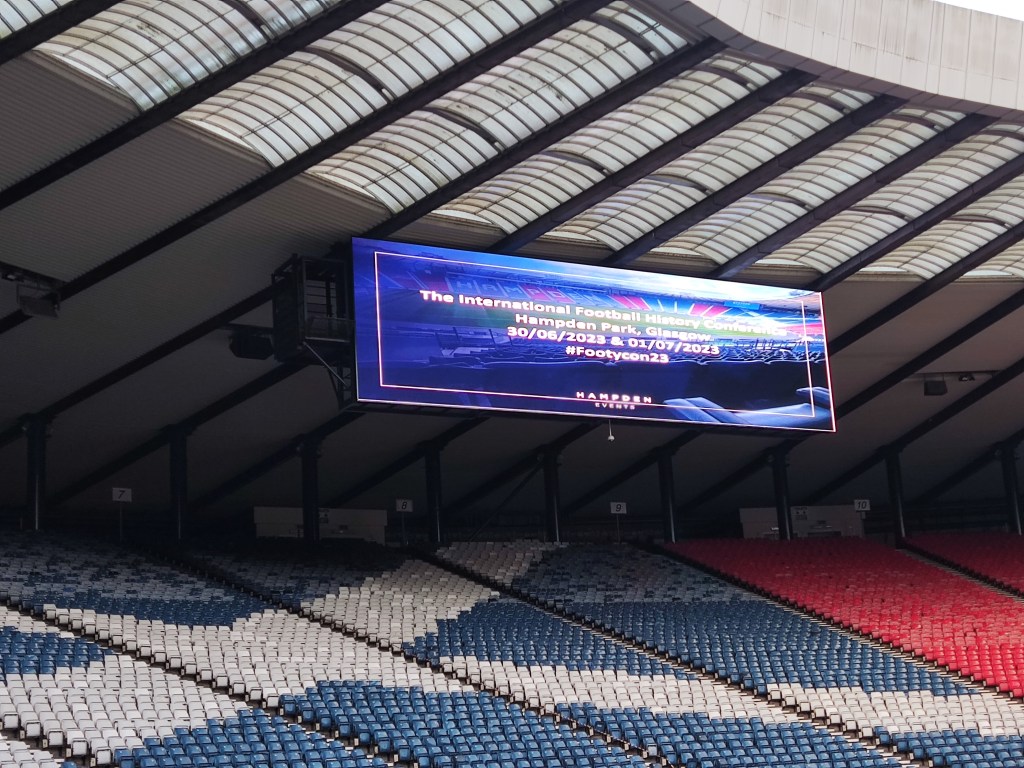
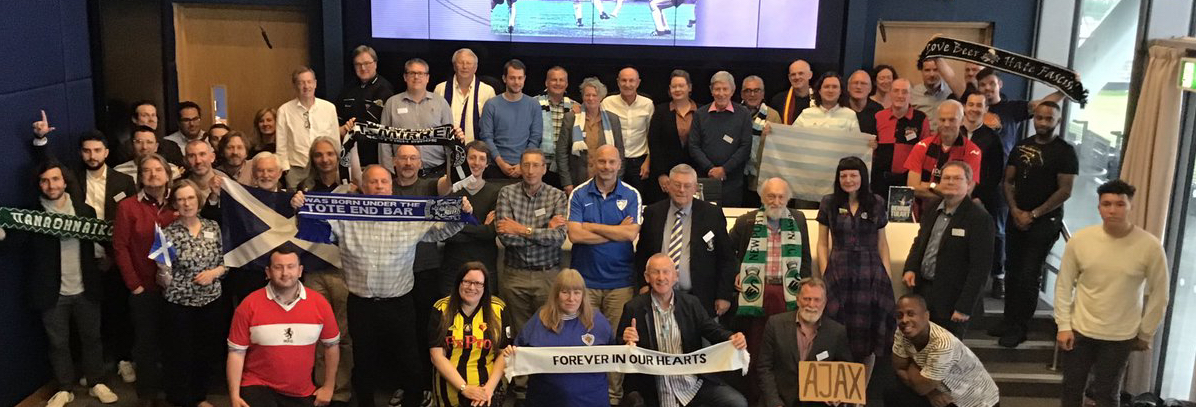
I’m delighted to announce that the 2023 International Football History Conference will be staged at Hampden Park, Glasgow on 30 June and 1 July 2023. The call for papers and details of how to get involved will be announced in January but here are a few details for those interested in getting the date in their diaries….

The aim of this conference is to listen to quality research and to network with others.  We hope delegates take the opportunity to meet with colleagues, friends and other delegates to share your research, hear their ideas and help establish a strong network of football (of all types!) researchers and experts.

The most recent conference was held in Manchester in November 2022 and it owes its success this year to all delegates whether presenting or not, and to the following who have provided great support:

City Football Group & Routledge

We would also like to put on record our thanks to British Society of Sports History for their support during Covid when the BSSH funded a zoom licence which allowed us to have a couple of gatherings online.

Rouledge have provided vouchers for a ‘Best Paper Award’ each year and their support has helped enormously.

Following feedback and the support of Richard McBrearty and the Scottish National Football Museum we will be able to take the conference to Glasgow for the first time in 2023. Provisional details are:

  • Main conference anticipated to be held Friday 30th June through to Saturday 1st July, with main conference proceedings taking place between 8am and 6pm on those days.
  • As with previous years the conference will be open to those presenting on football of any code. This is a fundamental element of the conference, so if you’re looking for somewhere to present your years of research into gaelic football, Aussie rules or other form of the game then look no further.
  • The call for papers will be issued in January. We are particularly keen to have panel debates/discussions next year, as well as traditional presentations. If you’ve got an idea for a debate/discussion you’d like to arrange then please email footycon@outlook.com and we’ll see if it can be accommodated.
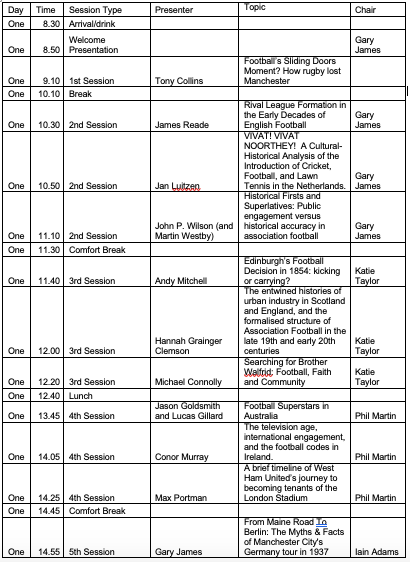
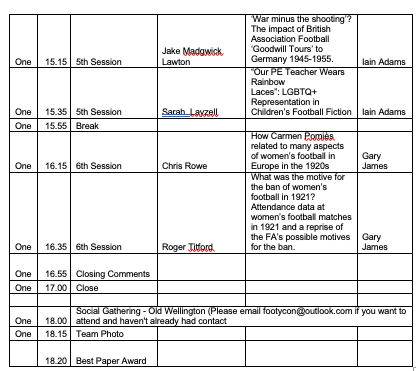
  • To get a feel for the range of topics covered have a look at the schedule for Manchester 2022 at the end of this article (after images of Hampden).

In addition to any debate suggestions, presentations in the following formats will be welcomed:

Short Form (7 minutes) – 20 slides (plus a title slide) with a maximum of 20 seconds per slide.. Ideal for a summary of research; to present early findings; Image related research etc.

Twenty Minutes – Twenty minutes of slides but no audience questions.

Fifteen plus Five – Fifteen minutes of presentation slides plus five minutes of questions (or any combination up to a maximum of twenty minutes).

Follow @footycon for further information.

If anyone would like to contribute to the conference (in terms of organisational support both in the build-up to 2023 and at the conference itself) then please let us know as soon as possible. The more volunteers, the better the conference. Also, financial support is always useful in helping to keep the costs for delegates down. If you are involved with an organisation who can provide some support then please get in touch. Or if you feel you may be able to add value in some way then we are keen to hear from you.

See you in Glasgow, 30th June & 1st July 2023!

Here’s the schedule for the Manchester 2022 conference (you can search on twitter to see images from the conference with #Footycon22 ):

International Football History Conference 18-19 November 2022 at Manchester City’s CFA

In 2017 the first International Football History Conference was staged with delegates from across the globe presenting and listening to talks by a variety of academics, writers, researchers and students. This has become an annual event, only paused bu Covid, and it returns on Friday this week. The conference is open to presentations on football of all codes.

There are presentations on a variety of topics. Here’s this year’s schedule:

You can book your place at the conference via this link: https://www.eventbrite.co.uk/e/international-football-history-conference-18-19-november-2022-at-manchester-tickets-397198690977?lang=en-gb&locale=en_GB&status=30&view=listing

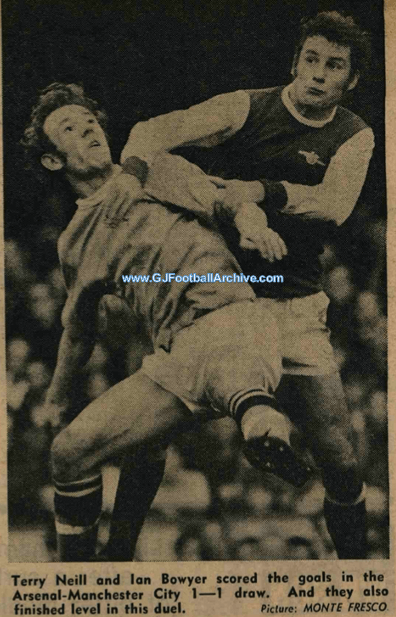
IN SEARCH OF THE BLUES – Ian Bowyer

Back in 2010 one of my interviews with Ian Bowyer was published. Bowyer won European trophies at both Manchester City and Nottingham Forest. The interview ended with Bowyer talking about modern day football (this was 2010 before City rediscovered their trophy winning ways) and he commented: ‘Can I add that I really want to see City re-establish themselves as a successful side? I know what this Club can achieve and I hope success – real success – comes soon.’  Subscribers can now read this 3,000 word article here as it was first published:

Subscribe to get access – Annual

Read more of this content when you subscribe today. £20 per year (access to everything posted since Dec 2020) or £3 per month (see below).

Subscribe to get access – Monthly

Read more of this content when you subscribe today. £20 per year (see above) or £3 per month here. The monthly subscription provides access to everything posted since 1st October and the subscription can be cancelled any time. Why not sign up for a month and see how it goes?

Alternative Sites of Sports History – Free Download October 2022

Recently an academic article of mine offering advice and examples to those researching sports history or working within the industry was published. Normally, it is behind an academic paywall but you can download it for free during October here (it’s free, you may as well have a look):

https://www.tandfonline.com/doi/full/10.1080/17460263.2022.2117731?src=

The article has received publicity in publications/websites of football clubs including Middlesbrough and Manchester City. Here’s what City have said:

https://www.mancity.com/news/club/sport-in-history-academic-journal-manchester-city-63800643

Rare Film of Manchester Women’s Football

Will McTaggart, who hosted a number of football film shows with me in the years before Covid, has alerted me to a new clip that’s been found by the BBC of the Manchester Corinthians women’s team of the 1960s. The Corinthians played from 1949 until the late 1980s (see elsewhere on this site for their story) and this clip is from March 1965. You can watch it here:

I’ve been researching and writing about the Manchester Corinthians and women’s football for many years (in fact my first book published in 1989 included material on the first games of Manchester City’s women’s team and I attended their matches back then). I’m currently working with the Corinthians and others to erect permanent tributes to them at Fog Lane Park which can be seen in this film.

A Complete PDF Of My 1st Book To Download

Back in 1989 my first book was published and subscribers to this site (both annual and monthly) can now download a PDF of that entire book. The original book cost £6.95 when it came out; you can subscribe at £3 per month and get the PDF free here then cancel the subscription if you like). Ignoring yearbooks, this was only the 6th book (and two of those were more like pamphlets published in the 1930s & 40s) ever published specifically on Manchester City Football Club.

Subscribe to get access – Annual

To access the book and everything else on my website please take out an annual subscription here or, alternatively, scroll a little further and take out a monthly subscription. It’s £20 a year (about £1.67 per month) or £3 a month (cancel anytime).

Subscribe to get access – Monthly

To access the book and everything published since 1st October 2022 take out a monthly subscription here. It’s £3 a month (cancel anytime).

The book was published in April 1989 and I talk a little bit about it here:

The 200th Post – Joe Mercer

and here:

A Writing Flashback!

I do not have the original layouts and so I’ve scanned my only surviving copy of the book and put the pages together on a PDF. The pages appear in the order they did in the original but, obviously, as I’ve just placed images of the pages on a word document it’s not as it all appeared. Nevertheless, for those who have never seen it you can now.

There were all sorts of issues with the original publication. My co-author had died and the book was delayed by a year. It was originally due out when I was 20 in 1988. As Keith, my co-author, had died mistakes were made. Keith was also a key figure at the publisher and, without his expertise, the quality of the images and other areas was not as great as it should have been. Even the title was incorrectly published (I’d agreed a different title). Ah well… I got enough of a bug to have started writing my second book within about a month of this coming out.

If you’d like to download the book then you do need to be a subscriber to this site. Subscribers pay £20 a year (works out about £1.67 a month) or £3 a month at a time (cancel anytime). For that annual subscribers now get the entire From Maine Men To Banana Citizens plus my 2010 edition of Manchester A Football History AND all articles/interviews posted so far. These include audio interviews I did with John Bond, Malcolm Allison and George Graham in the 1990s. Monthly subscribers get all content posted since 1st October 2022. All subscribers get access to all new material posted during their subscription too.

Inaccuracies and Myths

Over the last couple of years, usually when there’s a Manchester Derby, a number of myths, inaccuracies and twisting of the facts occurs. It’s usually just fan banter. I don’t normally get involved and try to ensure that whatever I post is factually based and something that is true. However, this week a number of supposed facts about the relationship between City and United have been posted that someone has claimed are ‘facts’ I’ve promoted in my work. So, to allow everyone to see the truth and what I have actually stated I’ve included below the supposed facts as they have been posted by others and then followed that with the truth based on years of research, triangulation etc. First of all the supposed ‘facts’…

This image has been posted outlining ways in which Manchester City are supposed to have helped United. Many of these are inaccurate, complete fabrications or exaggerated and I’d like to state quite clearly the following image does not reflect my views (apart from the bit I’ve added saying: ‘Not to be quoted – Inaccurate’).

This image is not my work and is not to be quoted as it contains inaccuracies.

So, now for the facts…

Starting from the top… 1931 – Nowhere do I say in my writing that City provided United with kit. I have never found any evidence whatsoever to say this is true. I do quote a City fan in my work who talks about how United fans gave themselves the nickname Rags in the 1930s because their kit looked ragged, but that’s a fan story and does not correlate with any evidence of City providing any kit to the Reds. 

In any case United are known to have worn blue before 1931 and at no time, based on years of research by lots of people, did City give United kit. After World War Two City asked fans to help City get kit via fan clothing rations, but that’s not connected with United or 1931. I think (but don’t know, so don’t misquote this) that United may have done the same.

Next the stuff about 1945. I am mystified as to where all that stuff has come from about players going from City to United to help with construction? That’s definitely not something from any book or article I’ve written and no research I’m aware of (certainly not by me) has ever claimed this. I’d love to know what evidence has been found for this. If it’s there then great, but evidence and triangulation are definitely needed when supposed ‘facts’ like these are written. 

Also, Old Trafford was bombed in 1941 not 1945 and United used Maine Rd for about 8 years.

Next the first point about 1958… Again I’d love to know where all that stuff about wages, transport & equipment costs has come from. I’ve never written that. City offered to help United in whatever way they could but to say City covered the costs of all that is a massive exaggeration. 

On the second point about 1958… United did continue to play in the European Cup after Munich so that’s wrong for a start. UEFA did not offer City a place in the competition that City turned down. What happened was that UEFA said if United couldn’t play on then it would be right for City, as a Manchester club, to continue on United’s behalf. The FA said that they would choose a team not UEFA and that it would be Wolves (as they had been second in League). City said they would help United however possible to ensure they played on – that was their aim. Bert Trautmann offered translation services etc. 

The problem is that whenever City’s help for United is exaggerated (or anything like this either way) it makes it easier for others to challenge and then the genuine, real facts get lost. City have helped United a lot over the last 125 years and the facts do not need exaggerating. In my books I talk of City’s cash donations in the early years of the last century which are all properly documented and recorded; of the two clubs working together in an act that was widely perceived by the media as protecting United and killing off the threat from Manchester Central; of the close-relationship between the clubs at times; of the offer to use Maine Road in 1941 (they did offer but that fact gets lost with all that inaccurate stuff); of the offer to use Maine Road again in 1956; of the close relationship and support in 1958… You can read the facts of all this in Manchester A Football History and also in various articles on this site. In fact the whole Manchester A Football History is available to download for annual subscribers here:

Sorry to have gone on about this but facts, evidence and triangulation are important. These are essential to my work and so when someone tells me that a load of inaccurate information is being circulated as fact and that it’s come directly from my work then I have to explain. Banter between rival fans is one thing but please don’t exaggerate or twist stories and claim that I’ve said they are facts when I haven’t.

New Monthly Subscription

Launching today is a new monthly subscription to my website. For £3 a month you will receive a minimum of 4 new articles each month (in practice a lot more – there will be a minimum of 1 post a day in October for example) and access to everything posted from 1 October this year until your subscription ends. Those who subscribe for a year get access to everything posted from December 2020 until the end of their subscription.

Before subscribing why not have a look at the articles posted to see if you fancy subscribing annually to access everything (that works out at £1.67 a month) or monthly to access everything from 1 October onwards at £3 per month. You could sign up for one month and then cancel if you like?

Subscribe to get access

If you’d like to support my research then why not subscribe? Every subscription directly helps support my research and provides annual subscribers with access to everything posted on this site, including the entire Manchester A Football History and From Maine Men To Banana Citizens books, plus interviews, articles and more. I am not employed by anyone and all my research is self funded or comes from subscriptions to this site. Subscribe annually here:

Subscribe to get access

You can subscribe at either £20 per year (above) or at £3 per month here (cancel any time). For those subscribing £3 per month you will be able to access all content from October 2022 onwards for as long as you are a subscriber. Those subscribing £20 a year have access to everything posted since December 2020.

Denis Law and United’s Relegation

Over the years there has been a lot of discussion on Denis Law and his backheeled goal for Manchester City v Manchester United at Old Trafford in April 1974. If you’re a Blue you tend to say it relegated United; if you’re a Red you tend to say ‘absolutely not! It made no difference.’ So, for this feature I decided to focus on the facts, emotion and mood of the era to paint an accurate picture of that day and the significance or not of that goal. Hopefully, Blues & Reds alike will gain a good understanding of it all. I include quotes from some of the interviews I’ve performed in the past. This article will be free to read until 27th September then it’s available to subscribers only. Here goes…

Subscribe to get access

If you have read this and enjoyed it then please subscribe and access more content like this. No one pays for my research and so please support my writing if you can. Subscribers get access to everything on here, including the entire Manchester A Football History book and my first book. It costs £20 a year (works out £1.67 per month).