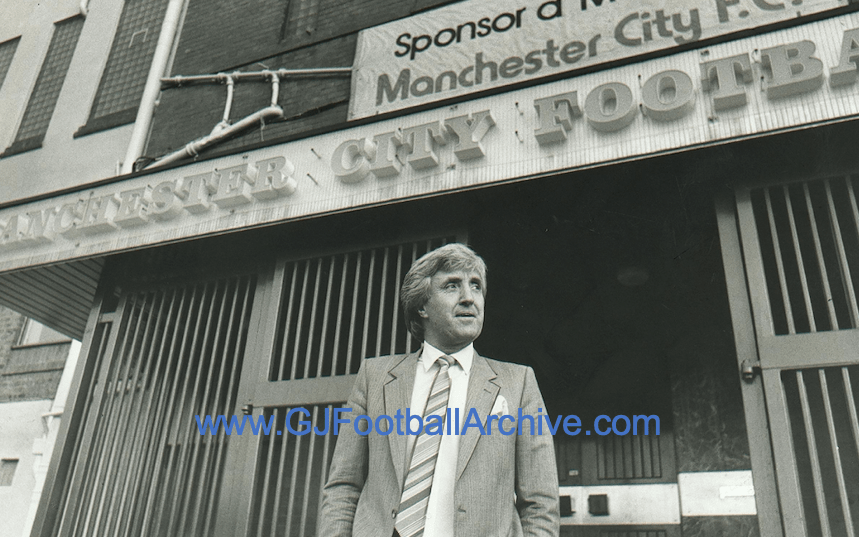
John Bond Interview – Part Four

Back in November 1995 I interviewed the former Manchester City manager John Bond. At the time I was researching my in-depth history of the club called Manchester The Greatest City (later updated as Manchester The City Years). 

I met John at his home and spent a good few hours with him chatting about the Blues and his career. I loved doing this interview and was always grateful for the time he gave me. He was extremely frank, open and honest – which delighted me because he was a great talker. He was also happy for me to share everything he said in the interview recording. I did end up quoting him extensively in the book (and in others I’ve produced) but, until publication on my blog, none of the interview had ever been heard by the wider public. 

This is part four of the interview. It’s about twenty minutes long and this is perhaps the most frank section of the entire recording. At the time we recorded this he was still somewhat upset at the way he’d been treated by City fans at the Bradford promotion game in 1989. I was one of the fans there who had not been happy with what he’d said on TV the night before and I ask him about it a little on here. Whenever I do an interview I’m never looking for soundbites or people to tell me the stories that they think I want to hear. I want the truth and to hear about their feelings. I try to ask them about moments that I remember as a fan but also the things that matter to me. So I wanted to know how he felt about City’s fans.

It upset me hearing how much he had been upset by the treatment he had received and – as you can hear in this clip – he also talks about feeling unwelcome at Maine Road (for various reasons, not simply fans). In 2002-03 I helped City with some of their plans for the end of Maine Road and I made sure that John Bond was on the guest list. I know he was reluctant about attending and had to be persuaded. City had this plan to parade a few legends around the pitch and I felt it would do John Bond some good to hear what the majority of fans actually felt about him. That final day at Maine Road he was given a fantastic ovation.

In a later interview he told me: “I was gobsmacked by their reaction!  When I came out and heard the cheering I was delighted.  I loved that reaction.  Afterwards I rushed home and told my family about the reception and how delighted I was with it. There were times during my management when I received fantastic support from the fans, and at Maine Road’s final game I was delighted with the ovation. I truly enjoyed that feeling when I walked around the pitch.  I’d like to thank the supporters for that reaction.”

So, when you’re listening to this section of the interview it’s important to remember that what happened in 2003 had allowed resolution to occur. He no longer felt so negatively about fans. His views in 1995 though should still be heard.

In this piece he also talks about Peter Swales, the City directors, why he left and so on. Again, his views are frank. I don’t necessarily agree with everything he said but much of what he said about the directors during his time should be heard. It adds context to what many of us always felt. As we recorded this in 1995 it’s also worth pointing out that Bond could see what perhaps those of us who supported City could not see entirely – that was the downward path the Blues were following and why. This interview occurred while City were still a Premier League side but listening to this provides some good indications of why things got worse for City as the decade progressed. 

Of course as this interview was recorded on my old cassette recorder the quality isn’t the best.

So, here exclusive to subscribers is the fourth part of my interview:

Subscribe to get access

If you would like to listen to the fourth part of this frank interview (and the other parts) and read all the in-depth articles on this site (including the entire Manchester A Football History book) then please subscribe. It works out about £1.67 a month if you take out an annual subscription (£20 per year, here) or £3 a month (below) if you’d like to sign up for a month at a time. Annual subscribers access everything since December 2020.

Subscribe to get access

If you would like to listen to the fourth part of this frank interview (and the other parts) and read all the in-depth articles on this site (including the entire Manchester A Football History book) then please subscribe. It works out about £1.67 a month if you take out an annual subscription (£20 per year, above) or £3 a month (here) if you’d like to sign up for a month at a time. Monthly subscribers access everything since 1 October 2022.

If you missed the other three parts then they can be accessed by selecting the John Bond tag below or by searching for his name.

John Bond Interview – Part Three

As before, there’s a lot to interest and perhaps surprise here. This is the third part of my interview with John Bond from November 1995. I loved every minute of our chat but some of the things that were said stunned me at the time.

In this clip John talks about the aftermath of the 1981 FA Cup final with Tottenham; the way he thought City would challenge and the transfer of Trevor Francis. Within this section came the first time ever that I’d been asked to turn off the cassette recorder while the person I was interviewing explained something to me. We agreed that everything on the tape could be quoted – hence the reason I’m happy to play this now – but anything off tape would have to be checked. All these years later I still respect John’s wishes of course.

When you listen to the recording you’ll recognise the point where the tape is switched off and some related comments have been edited out. I have to stress that John’s comments seem a little out of sync because of that and it is worth explaining that his comments were not about anybody alive today. They merely explained something that had happened that he did not like or agree with but these comments were not about a footballer from the time or anyone alive today (2021).

So, here exclusive to subscribers is the third part of my interview (like the other parts it lasts about 17 minutes):

Subscribe to get access

If you would like to listen to the third part of this frank interview (and the other parts) and read all the in-depth articles on this site (including the entire Manchester A Football History book) then please subscribe. It works out about £1.67 a month if you take out an annual subscription (£20 per year, here) or £3 a month if you’d like to sign up for a month at a time (below). Annual subscribers have access to everything posted since December 2020.

Subscribe to get access

If you would like to listen to the third part of this frank interview (and the other parts) and read all the in-depth articles on this site (including the entire Manchester A Football History book) then please subscribe. It works out about £1.67 a month if you take out an annual subscription (£20 per year, above) or £3 a month if you’d like to sign up for a month at a time (here). Monthly subscribers have access to everything posted since 1 October 2022.

John Bond Interview Part Two

There’s a lot to interest and perhaps surprise Manchester City fans here. This is the second part of my interview with John Bond from November 1995. When I interviewed him he was frank in his views and at times outspoken – and I loved every minute of our chat!

In this clip John talks about the controversial 1981 League Cup semi-final with Liverpool; the FA Cup final (first game) against Tottenham; the way City’s directors handled the draw with Spurs (this astounded me at the time of our interview); how certain directors treated him; and how he almost resigned in between the FA Cup final and its replay. 

As this was recorded in November 1995 it is important to remember that our comments about the ‘present day’ Manchester City refer to the club as it was at that time. Similarly, when we talk about the takeover we mean the 1993-94 takeover of the club. Listening again to this piece now I’m quite pleased that my own perception was fairly accurate.

There’s also some great comments about Norwich City which will please supporters of that club.

This is about 17 minutes long (the previous piece was a similar length too). So get yourself a brew, relax in your favourite chair and listen along.

Subscribe to get access

If you would like to listen to the second part of this frank interview and read all the in-depth articles on this site (including the entire Manchester A Football History book) then please subscribe. It works out about £1.67 a month if you take out an annual subscription (£20 per year, here) or £3 a month if you’d like to sign up for a month at a time (below). Annual subscribers access everything posted since December 2020.

Subscribe to get access

If you would like to listen to the second part of this frank interview and read all the in-depth articles on this site (including the entire Manchester A Football History book) then please subscribe. It works out about £1.67 a month if you take out an annual subscription (£20 per year, above) or £3 a month if you’d like to sign up for a month at a time (here). Monthly subscribers access everything posted since 1 October 2022.

Part three tomorrow.

90 Years Ago Today – John Bond

On this day (17 December) in 1932 John Bond was born. Back in November 1995 I interviewed the former Manchester City manager. At the time I was researching my in-depth history of the club called Manchester The Greatest City (later updated as Manchester The City Years).

I met John at his home and spent a good few hours with him chatting about the Blues and his career. I loved doing this interview and was always grateful for the time he gave me. He was quite frank, open and honest – which delighted me because he was a great talker. He was also happy for me to quote everything he said in the interview. I did end up quoting him extensively in the book (and in others I’ve produced) but none of the interview has ever been heard by the wider public.

Now, you can hear the opening 17 minutes of the interview (the rest will follow over the next few days). Here he talks about the steps taken by City to appoint him; the interview (and the directors involved in that notorious filmed interview for the City documentary in 1980-81); the signing of Tommy Hutchison, Bobby McDonald and Gerry Gow. As I said earlier, he is quite frank in his comments and that may surprise a few.

This audio recording of the first 17 minutes of the interview is available to subscribers of my blog whether annual or, for the first time, monthly. If you want to hear it then please subscribe below. If subscribers enjoy this piece then please let me know and I’ll post other audio recordings in the future.

Of course as this interview was recorded on my old cassette recorder the quality isn’t the best but I’m sure you’ll appreciate the exclusive nature of this.

Subscribe to get access

If you would like to listen to this frank interview and read the in-depth articles on this site (including the entire Manchester A Football History book) then please subscribe. It works out about £1.67 a month if you take out an annual subscription (£20 per year; here) or £3 a month if you’d like to sign up for a month at a time (below). Annual subscribers access everything posted since December 2020.

Subscribe to get access

If you would like to listen to this frank interview and read the in-depth articles on this site (including the entire Manchester A Football History book) then please subscribe. An annual subscription (£20 per year; above) or £3 a month if you’d like to sign up for a month at a time (here). Monthly subscribers access everything posted since 1 October 2022.
The second part of the interview will be available tomorrow.

I’ve also posted an obituary I wrote to John here: https://gjfootballarchive.com/2021/02/12/johnny-bond-johnny-bond-johnny-bond/

The 1st and Latest Women’s Manchester Derby in the League

Tomorrow is the latest Manchester derby in the Women’s Super League. There’s a long history of competition between teams representing the women of Manchester City and Manchester United. City’s team has been in existence continually since November 1988 when Donna Haynes and Heidi Ward both scored two goals in their first game (v Oldham Athletic at Boundary Park).

I was at the City Ladies (as they were then known) first game and I was also at their first league derby in September 1990 when City defeated United 4-3. It was a fantastic day, watched by around 150 people.

City’s goals came from Rhoda Taylor (8 min), Rachel O’Shaughnessy (43 mins), Jenny Newton (50 mins) and Lesley Peters. City’s manager Neil Mather told me as part of my research for the Manchester City Women book: ‘United were the top side, you know, and beating them was so good for morale. The men’s team were a good side in the early 90s when City Ladies carried on developing, you know. This was the Howard Kendall era, and City had top five finishes. City were one of the top five or six teams in the country at the time, so it was fabulous for women’s football to have Man City, you know.’

Helen Hempenstall played for City that day and she described her memory of the day for my book: I remember when we played United (30/9/90) and Neil (Helen’s boyfriend, now husband) and all his mates came to watch us. There were a lot of people there that day. United had a decent team then. It was always a difficult game against United. They had a right-winger… We never got on. Every time we played each other we were at each other all the way through the game. Me and Carol Woodall were having a go at her. The referee told Lesley Wright “Tell both your full backs to shut their mouths otherwise they’ll both be off!” We just didn’t get along and before every game I thought I’ll get in their first. ‘I’m having her.’ Neil Mather still talks about it.

‘I think Lesley Wright kept the team together. She kept it all tight at the back. I played at the back with her and I learnt a lot from her. Because I was next to her I knew how important she was. If I missed something she always got it. She always encouraged me and kept shouting ‘different class, different class’. You learn from the people around you and I listened to her. Before every game she came to speak to me. She’d put her arm around me and reassure me. She’d tell me not to worry about anything. Most of the time travelling to away games I’d go with Lesley in the car. We used to have a laugh. I remember one day we were travelling to an away game some distance away and we stopped for petrol and all got out. I lit up a fag and everyone else jumped back in the car screaming! I didn’t even think! When we got to the ground they all told Neil Mather and I think he worried that he could’ve lost half his team. At another game I was sat in the middle and as we got out the person before me slammed the door back. It hit my head and I had a big lump for the game.’

The story of that game and of the first 30 years or so of City Women’s existence can be read in my book on the club. It’s called Manchester City Women: An Oral History and is basically the women telling their stories of playing for the club and how they got into football, plus statistics covering the journey from friendlies in 1988-89 through to competition and the modern day successes.

You can buy the book via this link (every copy is signed by me):

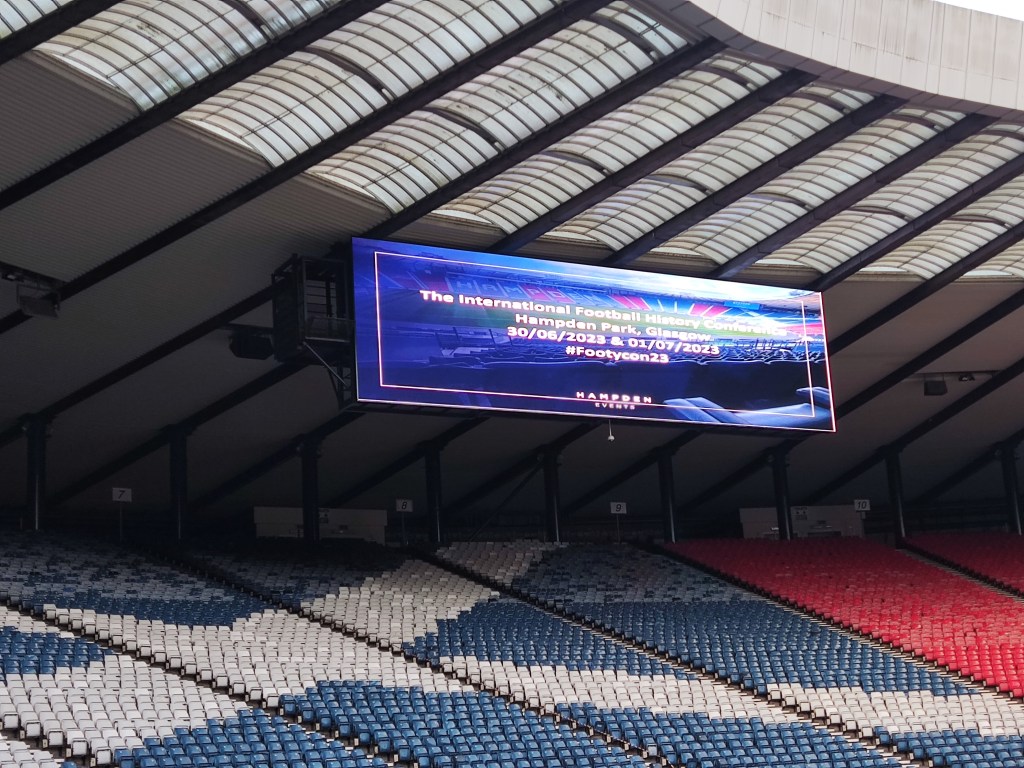
International Football History Conference 2023

I’m delighted to announce that the 2023 International Football History Conference will be staged at Hampden Park, Glasgow on 30 June and 1 July 2023. The call for papers and details of how to get involved will be announced in January but here are a few details for those interested in getting the date in their diaries….

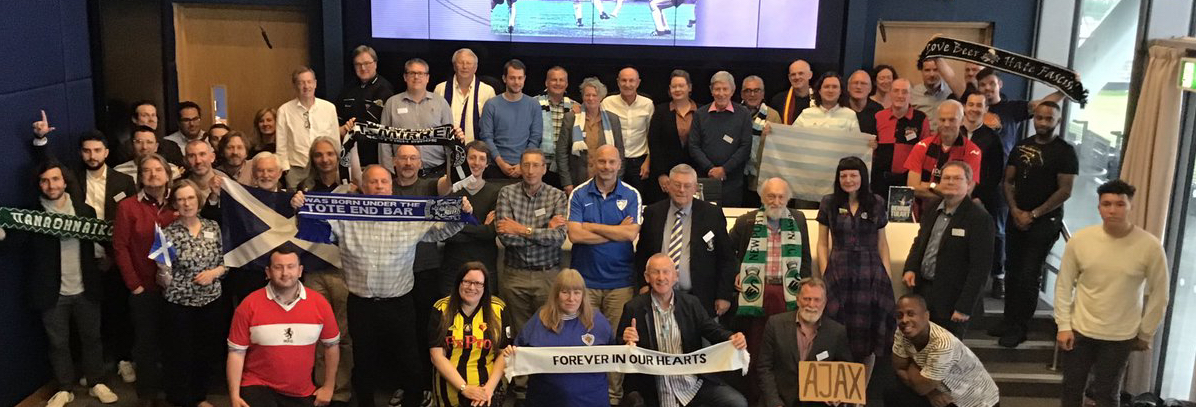
The aim of this conference is to listen to quality research and to network with others.  We hope delegates take the opportunity to meet with colleagues, friends and other delegates to share your research, hear their ideas and help establish a strong network of football (of all types!) researchers and experts.

The most recent conference was held in Manchester in November 2022 and it owes its success this year to all delegates whether presenting or not, and to the following who have provided great support:

City Football Group & Routledge

We would also like to put on record our thanks to British Society of Sports History for their support during Covid when the BSSH funded a zoom licence which allowed us to have a couple of gatherings online.

Rouledge have provided vouchers for a ‘Best Paper Award’ each year and their support has helped enormously.

Following feedback and the support of Richard McBrearty and the Scottish National Football Museum we will be able to take the conference to Glasgow for the first time in 2023. Provisional details are:

  • Main conference anticipated to be held Friday 30th June through to Saturday 1st July, with main conference proceedings taking place between 8am and 6pm on those days.
  • As with previous years the conference will be open to those presenting on football of any code. This is a fundamental element of the conference, so if you’re looking for somewhere to present your years of research into gaelic football, Aussie rules or other form of the game then look no further.
  • The call for papers will be issued in January. We are particularly keen to have panel debates/discussions next year, as well as traditional presentations. If you’ve got an idea for a debate/discussion you’d like to arrange then please email footycon@outlook.com and we’ll see if it can be accommodated.
  • To get a feel for the range of topics covered have a look at the schedule for Manchester 2022 at the end of this article (after images of Hampden).

In addition to any debate suggestions, presentations in the following formats will be welcomed:

Short Form (7 minutes) – 20 slides (plus a title slide) with a maximum of 20 seconds per slide.. Ideal for a summary of research; to present early findings; Image related research etc.

Twenty Minutes – Twenty minutes of slides but no audience questions.

Fifteen plus Five – Fifteen minutes of presentation slides plus five minutes of questions (or any combination up to a maximum of twenty minutes).

Follow @footycon for further information.

If anyone would like to contribute to the conference (in terms of organisational support both in the build-up to 2023 and at the conference itself) then please let us know as soon as possible. The more volunteers, the better the conference. Also, financial support is always useful in helping to keep the costs for delegates down. If you are involved with an organisation who can provide some support then please get in touch. Or if you feel you may be able to add value in some way then we are keen to hear from you.

See you in Glasgow, 30th June & 1st July 2023!

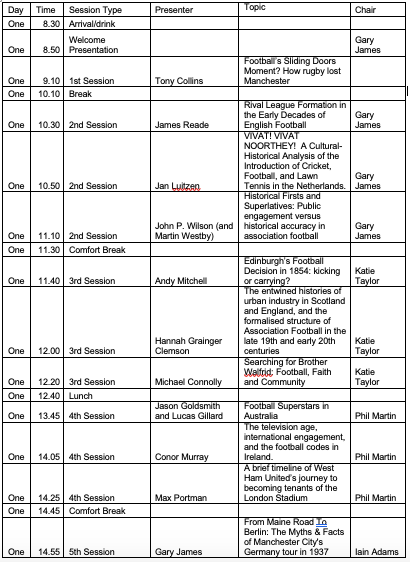
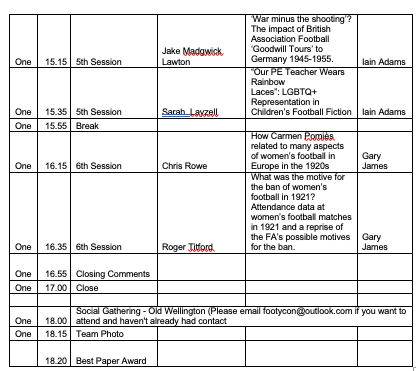
Here’s the schedule for the Manchester 2022 conference (you can search on twitter to see images from the conference with #Footycon22 ):

International Football History Conference 18-19 November 2022 at Manchester City’s CFA

In 2017 the first International Football History Conference was staged with delegates from across the globe presenting and listening to talks by a variety of academics, writers, researchers and students. This has become an annual event, only paused bu Covid, and it returns on Friday this week. The conference is open to presentations on football of all codes.

There are presentations on a variety of topics. Here’s this year’s schedule:

You can book your place at the conference via this link: https://www.eventbrite.co.uk/e/international-football-history-conference-18-19-november-2022-at-manchester-tickets-397198690977?lang=en-gb&locale=en_GB&status=30&view=listing

IN SEARCH OF THE BLUES – Ian Bowyer

Back in 2010 one of my interviews with Ian Bowyer was published. Bowyer won European trophies at both Manchester City and Nottingham Forest. The interview ended with Bowyer talking about modern day football (this was 2010 before City rediscovered their trophy winning ways) and he commented: ‘Can I add that I really want to see City re-establish themselves as a successful side? I know what this Club can achieve and I hope success – real success – comes soon.’  Subscribers can now read this 3,000 word article here as it was first published:

Subscribe to get access – Annual

Read more of this content when you subscribe today. £20 per year (access to everything posted since Dec 2020) or £3 per month (see below).

Subscribe to get access – Monthly

Read more of this content when you subscribe today. £20 per year (see above) or £3 per month here. The monthly subscription provides access to everything posted since 1st October and the subscription can be cancelled any time. Why not sign up for a month and see how it goes?

Alternative Sites of Sports History – Free Download October 2022

Recently an academic article of mine offering advice and examples to those researching sports history or working within the industry was published. Normally, it is behind an academic paywall but you can download it for free during October here (it’s free, you may as well have a look):

https://www.tandfonline.com/doi/full/10.1080/17460263.2022.2117731?src=

The article has received publicity in publications/websites of football clubs including Middlesbrough and Manchester City. Here’s what City have said:

https://www.mancity.com/news/club/sport-in-history-academic-journal-manchester-city-63800643

Rare Film of Manchester Women’s Football

Will McTaggart, who hosted a number of football film shows with me in the years before Covid, has alerted me to a new clip that’s been found by the BBC of the Manchester Corinthians women’s team of the 1960s. The Corinthians played from 1949 until the late 1980s (see elsewhere on this site for their story) and this clip is from March 1965. You can watch it here:

I’ve been researching and writing about the Manchester Corinthians and women’s football for many years (in fact my first book published in 1989 included material on the first games of Manchester City’s women’s team and I attended their matches back then). I’m currently working with the Corinthians and others to erect permanent tributes to them at Fog Lane Park which can be seen in this film.