The research and writing for the authorised history of the Manchester Corinthians is continuing. I’ve spent much of the last few months traveling the country continuing to interview former players and visiting archives. The book will be out next year and we’ll be announcing some further news on it soon, including the opportunity for people to subscribe to the book.
As well as the interviews and archive trips there’s been a concerted effort to compile as comprehensive list as possible on women who played for the club. There’s still some way to go but so far I’ve managed to compile a list of over 260 women who played for the club. Objects and trophies have also been rediscovered. This is the type of detailed research I enjoy. It’s time consuming, difficult and often frustrating but occasionally you find a little gem that adds significantly to our knowledge. There have been a few of those and hopefully more to come.
Obviously, I’m still keen to hear from any former player who can add their voices to the history of the club. Please email Gary@GJFootballArchive.com with your name, rough dates you played and contact details.
The cover of the book will be worked on by the designer over the coming months but following feedback from former players the maroon has been replaced with a darker blue, more reminiscent of the colour most frequently worn by the Corinthians (based on the reports, programmes and other material found so far and the majority of comments from players). This may still change of course (‘The Authorised History’ will probably change colour too). The back will contain later images and wording.
If anyone is wondering about the size and scale of the book, it will be similar in style to the Manchester City Women book I produced a few years back.
Happy 79th birthday to former Arsenal manager George Graham. George was brought to England by Joe Mercer to play for Aston Villa and on 30 March 1993 I travelled to Arsenal’s old stadium, Highbury, to interview George. I wanted to capture his views on his former boss – and Arsenal legend – Joe Mercer.
As I mentioned earlier, Joe was the Aston Villa manager who brought George to England many, many years before George had found fame as a footballer and Joe had taken Manchester City to their first European honour. Joe did win the League Cup as Aston Villa boss, but these were not great days for the former Everton and Arsenal playing legend, but he did always feel responsible for bringing George to England (and loved the success he brought Arsenal).
My interview with George had been arranged for Tuesday 30 March 1993 some time in advance but then Arsenal’s FA Cup semi-final with Tottenham was scheduled for the following Sunday at Wembley (a highly unusual occurrence at the time!). I expected to get a call cancelling the interview but instead George decided to go ahead with it.
On the day I parked up outside Highbury quite early but as I pulled up I saw George leave the stadium and jump into a car. I was early, so wasn’t too worried. Then I remembered the FA Cup semi-final and assumed that George would be busy with plans. I expected to be told when I entered the marble hall at Highbury that the meeting would be off.
When I spoke with the reception staff they told me to take a seat. They said that George had been called away and so could be a few minutes late (which he was). I was relieved because I’d been convinced he would cancel (it’s happened often with other busy managers).
I sat in reception thinking about the chat and then, a few minutes after we were due to meet, George walked in. He spoke with the receptionist and then came towards me, hand out, saying ‘I’m George Graham’ (I remember thinking ‘I know’ but I did love the fact that he introduced himself). He took me up to his impressive office at Highbury – no other offices at any ground I had been to at that time could match the quality and status of that room.
We then did the interview. It’s not my best – I think I was overawed by the situation – but I was appreciative of George’s time. During the interview Stewart Houston, his assistant, popped in to check something with George (I turned off my recorder) and George ushered him away, telling him that he was busy. Again, I loved this – other managers have sometimes disappeared and not come back but for George he’d set this time aside to see me and chat about Joe Mercer and that’s what he was doing.
Arsenal beat Spurs that weekend so, I suppose, George knew what he was doing but I do remember watching that game on TV thinking that if Arsenal lose I’d never be able to tell anyone that George had spent time being pestered about Joe Mercer when he should’ve been preparing for Tottenham!
If you subscribe to this site you can hear the interview below. I have been researching and writing for a long time and my Joe Mercer book was my third (first published in 1993). I am not employed by anyone and I do not have sponsorship either and so I’ve set up this website to help share my 35 years plus writing and research. The intention is to develop the archive and to provide access to as much of my material as possible over the coming weeks, months & years. Annual subscribers can already access over 1250 articles/posts including the entire Manchester A Football History book, my first book on MCFC (published in 1989) and Farewell To Maine Road, plus audio interviews with Malcolm Allison and John Bond.
It costs £20 a year (it works out £1.67 a month) or £3 if you’d like to sign up a month at a time to get full access for as long as you subscribe.
Anyway, here’s the George Graham interview:
Subscribe to Listen – Monthly Subscription
To listen please subscribe. Each Monthly subscriber gets access to everything posted since 1 October 2022 and everything posted during their subscription. It costs £3 per month (cancel anytime). There’s also a special annual subscription available (see below).
To listen please subscribe. Each annual subscriber gets full access to the 1000+ articles posted so far and the hundreds scheduled to be posted in the coming months. This includes PDFs of 3 of my books and interviews with Malcolm Allison and others. Annual subscription is available at the special price of £20 a year (about £1.67 a month).
If you enjoy all the free material on my website and would like to support my research and keep this website going (but don’t want to subscribe) then why not make a one-time donation (or buy me a coffee). All support for my research is valued and welcome. It allows me to keep some free material available for all. Thanks.
Here’s my film of the Bell, Lee & Summerbee light show from before last night’s Manchester City v Leipzig at the Etihad. I normally sit behind the goal but I was in the Colin Bell Stand last night, so it’s a different angle to my normal view of these things.
The light show, like the statue itself, highlights the names of all the players who appeared in City’s 1967-68 season and the FA Cup, League Cup and ECWC triumphs 68-70. I love the fact that City’s statue and tribute remembers them all, even if it inevitably focuses on Colin Bell, Francis Lee and Mike Summerbee.
After the light show the club played the Boys in Blue song and it was great to see that they had used the North West Film Archive’s footage of the recording of the song from March 1972 which featured the players. Sadly, I didn’t manage to record that but you do get the first few seconds at the end of my clip below. Anyway, enjoy the light show:
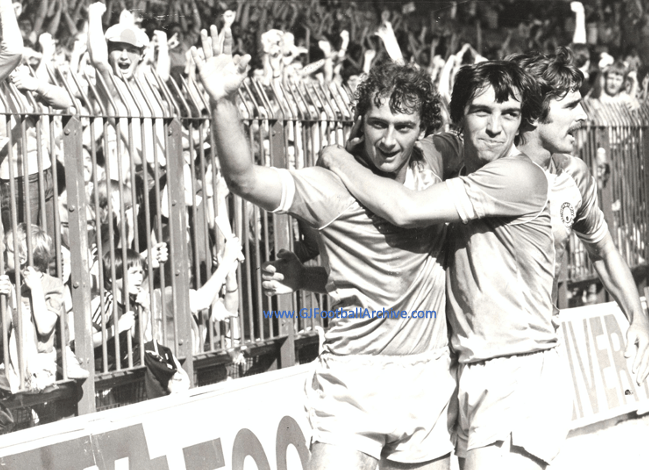
It was great to be at the Etihad today for the unveiling of the statue celebrating the achievements of England internationals Colin Bell, Francis Lee and Mike Summerbee. The statue recognises the achievements of all those involved in winning the major trophies of 1968 to 1970, including City’s first European trophy of course and many of those former players were here for this wonderful day.
Members of the families of Colin Bell, Francis Lee and Mike Summerbee, together with Mike of course, were present to see the statue this morning. After they’d had their personal time with the statue a celebratory brunch occurred. It included a speech from Ferran Soriano and interviews with the sculptor, club archivist Steph Alder, photographer Kevin Cummins, journalist Chris Bailey and myself. We were asked about the significance of the players and that era.
For me one of the most important aspects is that it recognises all the players who appeared in City’s title success of 1968 and in the trophy successes that followed (FA Cup, League Cup and ECWC). That’s significant and fits with comments that all three men have said over the decades that the successes under Joe Mercer and Malcolm Allison were the work of an entire team. Bell, Lee & Summerbee always praised the others.
I love the statue as it shows the men in movement. Often football statues are standing poses or similar, with no suggestion of movement, but this is a wonderful piece of three men moving forward. It’s a great work.
The statue is located in front of the main entrance in a specially paved area which allows fans who want to take a photo to stand with the three men in motion with the Etihad in the background.
There was inevitably some emotion today as Colin and Francis are no longer with us but I do know that Colin was aware that a statue was on its way and Francis did approve the style and saw representations of it. All families seem happy with this work of art.
For those who want to know more on the statues, there will be a film which will be on City’s channel and on YouTube I’m told soon. In the meantime, go and have a look yourself.
Here’s something the club issues a few days ago on the sculptor:
This installation will be located on the west side of the perimeter and will be unveiled on Tuesday morning ahead of a UEFA Champions League meeting with RB Leipzig later that day, where fans will be invited to visit the permanent tribute to an extraordinary era in the Club’s history.
Speaking of his appointment to the project David Williams-Ellis said:
“It is a great honour to create a work of art for Manchester City Football Club celebrating the diverse, talented players, Bell, Lee and Summerbee.
“It’s been an extraordinary last two years, working on this project that celebrates these players from a great era in Manchester City’s football history.
“I hope that the work will give a sense of history and place to the legions of fans and visitors that come to the football ground from around the world and become an enduring part of Manchester’s cultural landscape.”
David Williams-Ellis – Artist Biography
David Williams-Ellis’ sculptures, worked in clay directly from life, are inspired by the romanticism of Rodin and Bourdelle and are noted for their sense of movement and vitality.
David was classically trained in Florence under drawing teacher, Nerina Simi. From there he went on to be an apprentice wood carver and then joined a community of marble carvers beneath the Carrara Mountains in Pietresanta.
David’s reputation was cemented after his time in Italy. Today, his work is in private and public collections across the globe and can be seen in flagship buildings including Scone Palace in Perthshire, Aberdeen’s Maritime Museum, the IFC Building in Shanghai and Oxford House, Swires, Hong Kong.
Amongst his most notable work includes the D-Day Memorial Sculpture, unveiled on 6th June 2019 above Gold Beach in Normandy to commemorate the 22443 service men and women who fell on D-Day and in the Normandy campaign under British command.
Today (27 November) is the 35th anniversary of the first game played by Manchester City Ladies (now Women). This was against Oldham Athletic Ladies at Boundary Park. This photo is the earliest press team photo of the club.
These are pioneering City players and many dedicated considerable time to the club for years. The first ever game ended in a 4-1 City victory with Donna Haynes scoring 2 (including the historic 1st goal). Heidi Ward also scored 2 that day. I was there watching this historic first game and I included some brief details in my first book, published in 1989.
This match report was in an Oldham newspaper & was reproduced in my 2019 Manchester City Women An Oral History book (see https://gjfootballarchive.com/shop/ for details of it).
The club was founded via City In The Community (CITC) with Neil Mather playing the lead role as manager of the club. His drive and the determination of the women involved ensured this club had a life. At the time the wider Manchester City club (in particular CITC) did something that few other clubs were doing. The achievements back then and the years of dedication by the women involved ensured this club lived for years.
When the club was relaunched as Manchester City Women some national newspapers and others in the media suggested this was a new club without a history. That was damaging and hurtful to all those involved back in 1988 and the years that followed. If anything the history of Manchester City Ladies before it became City Women was similar to the majority of women’s clubs. It had gone through the trials and tribulations most face and was kept going by a dedicated band of players and supporters. Unlike Everton and Liverpool (and many others) City did not take over an existing club, they created one back in 1988 when the others had zero interest. So today’s anniversary is important in recognising the wonderful work of these women (and of the men like Neil Mather, Godfrey Williams, Ian Lees and others who were involved over the decades) and of Manchester City itself.
The club gets criticised often for a lack of history but this is all rubbish spouted by rivals. City have delivered in men’s football longer than many rivals and they’ve delivered in women’s football longer than. many rivals too.
Later today I’ll be posting a detailed 2,200 word article on the club’s first game back in 1988.
A new series of articles for subscribers starts covering the 1980s. This will be a seasonal journey through a truly important decade in the history of Manchester City Football Club. There will be a different season each day. Re-live the highs and lows of that decade.
If you’d like to read this series then please subscribe. Details below:
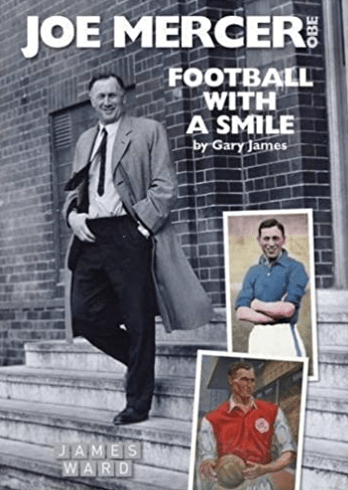
Late in 1993 Jimmy Wagg interviewed me on GMR about my new book on Joe Mercer. Next month it’ll be 30 years (I know!) since that book came out and so I thought I’d post the recording of the interview with Jimmy from that year. The quality is not great (neither are my answers at times!) but you can now hear the recording on my website.
If you want to hear why I did the book and the answers I gave back then have a listen now. Here goes (again apologies for the quality of the recording):
While you’re here why not have a look at all the other articles, interviews, videos and material on this site. Subscribers get access to everything and this includes PDFs of the entire Manchester A Football History book; From Maine Men To Banana Citizens (my first book) and Farewell To Maine Road. There are also audio recordings of my interviews with John Bond, Malcolm Allison, George Graham etc. It costs £3 per month or £20 per year. Details of how to subscribe below:
If you enjoy all the free material on my website and would like to support my research and keep this website going (but don’t want to subscribe) then why not make a one-time donation (or buy me a coffee). All support for my research is valued and welcome. It allows me to keep some free material available for all. Thanks.
The deadline for the last ever King of the Kippax fanzine has passed and I missed it. I meant to get something sent to Dave and Sue Wallace but circumstances meant I couldn’t and I really regret that. So instead I’m posting here a piece I wrote ten years ago in 2013 when there were a series of footballing anniversaries. It’s not quite what I intended but I hope it says enough of how I feel about fanzines and the role of King of the Kippax over the decades.
It’s a season of footballing anniversaries this year (2013). The FA celebrates 150 years, the Football League 125 and King of the Kippax an amazing 25 years. Of these three anniversaries KK is inevitably getting the least focus but in many ways its significance to football, or at least our team, has been greater during its first 25 years than the FA’s first 25.
The FA did little to support football in Manchester for decades and it wasn’t until Manchester’s clubs started to take the FA Cup seriously that the organisation began to matter. But even then the FA did its upmost to prevent our professional clubs from challenging properly. In 1904 when City became Manchester’s first FA Cup winners how did the FA react? They decided we must be doing something illegal and sent auditors to the club to determine if we had ‘bought’ success. Okay, so they found a few irregularities with a transfer from Glossop, but for the following year or so they relentlessly pursued our club (and to be fair did something similar with Newton Heath, who became United, and with Glossop). Ultimately, we received a devastating punishment and the club could have died. I won’t go on about how unjust all of this was – City were no worse than most sides the difference being that the FA was determined to catch us out! – but if you do want to read an account of it dig out my latest book “Manchester The City Years”.
Despite all of this the FA Cup actually gave City our first success and we should ensure we celebrate 23 April 1904 (the date of the final) every year – make St George’s Day City’s day!
The Football League was more supportive of City during those early years, but prior to 1892 the League had no involvement from either Manchester side despite the League holding its first meeting in Manchester. Our celebrations of the League should really come in 4 years’ time when it’ll be 125 years since City (as Ardwick) joined the League. Although it’s worth pointing out that Ardwick and Manchester City were two separate organisations – and stressed as such at the time – and even existed alongside each other for a short while (personally though, I see MCFC as a continuation of Ardwick in spirit if not in legal terms). From 1892 to 2002 (when City last competed in the Football League) the Football League was central to City’s life. The competition became City’s lifeblood as far as competition was concerned.
What about KK? Well, unlike the other two KK was significant to City and City fans from the start. It was born in an era when fans had much to say but little opportunity to be heard. Alongside the other fanzines born in the late 1980s KK gave us a voice and a shared understanding of what the issues at City and in football were. Before the fanzines our only real outlet was the Piccadilly Radio phone-in on Saturdays which came in to its own during the time James H Reeve was at the helm. We had no forums, blogs, tweets etc. We didn’t have phone-in shows on national radio or fan columns in newspapers. We didn’t have interaction with the club, other than via supporters clubs meetings which some fans saw as being too weak to challenge the club on key issues (I won’t get into all of that here, but it’s worth noting that some fans did feel the Supporters Club was too close to Peter Swales and, as he was often the cause of fan concerns, that caused some issues).
We did also have the Pink postbag in the Saturday sports paper, sadly no longer with us. Unfortunately, journalists on the paper in the late 80s would contact the club to get their views before publishing a controversial or critical letter (this happened with one from me in 1987 which presented evidence about an issue that mattered to fans but was ultimately swept under the carpet). Censorship and club propaganda was an issue at a time when the game was dying and fans were being treated appallingly.
King of the Kippax helped to give us a voice and helped highlight the issues. Staff at City would be sent out to buy the fanzine in its early days, while others would do all they could to limit the fanzine’s opportunity to question what was going on – proving the significance of the fanzine. I don’t want to get too giddy about what KK and the other fanzines achieved but it is important that we all understand what has been achieved. It’s a bit like the electoral system – people fought hard to get the vote in the face of adversity but today we take it all for granted. We think it’s always been like this. Now with social media it would be easy to forget what KK and the other fanzines have achieved. Many fanzines have stopped being produced, which makes it all the more important to celebrate KK’s 25th anniversary and to congratulate Dave, Sue and all the contributors over the years for what they’ve achieved. I still read KK from cover to cover and find all the regular contributors interesting. I don’t always agree with everything I read but, I guess, that’s always been the point. KK has promoted debate and encouraged fans to think about issues, and that’s how it should be.
I hope King Of The Kippax continues to provide a powerful outlet for fans for years to come. It’s important that we remember that before the fanzines we didn’t have a voice. Thanks Dave & Sue, and the others, for all you’ve done and continue to do for us.
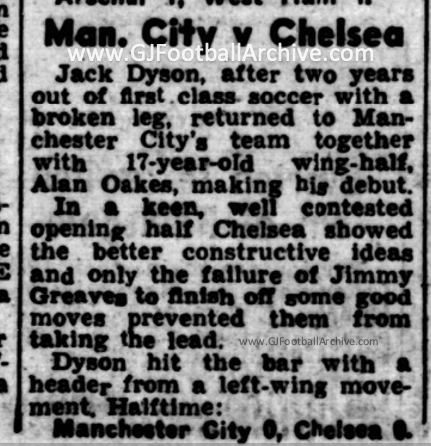
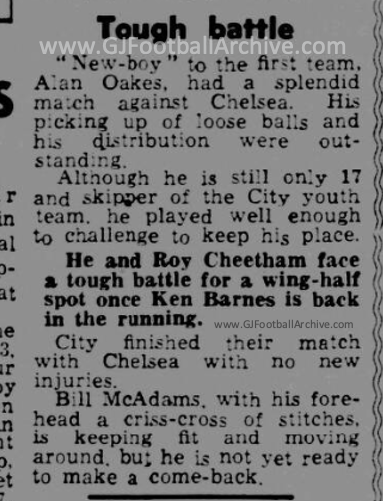
Today (14 November) is the anniversary of the first appearance for Manchester City’s first team of Alan Oakes. Oakes is City’s record appearance holder and that all important first competitive appearance came in a 1-1 draw with Chelsea back in 1959.
The City scorer was Jack Dyson who had been out of action for two years with a broken leg and related complications. These two brief match reports suggest that Oakes had a good game.
Were you at this match? If so why not leave your memories below as comments. Thanks.
A new series of articles for subscribers starts covering the 1980s. This will be a seasonal journey through a truly important decade in the history of Manchester City Football Club. There will be a different season each day. Re-live the highs and lows of that decade.
If you’d like to read this series then please subscribe. Details below:



 Gary James' Football Archive