Women’s Football Project

A week or so ago I announced that I’m working on a new Heritage Lottery Funded project seeking to capture the stories of women footballers who came from the Trafford borough or who women who played football at sites within Trafford. There are some excellent people in Trafford involved with the project and I’m delighted to be working with them. The project is part of a wider project connected with the Women’s Euros to be staged this summer (See below for details). This week the first interviews with former footballers connected with Trafford occurred and the stories they have told will help the project enormously. We need more though and, not only that, but fans can contribute too.

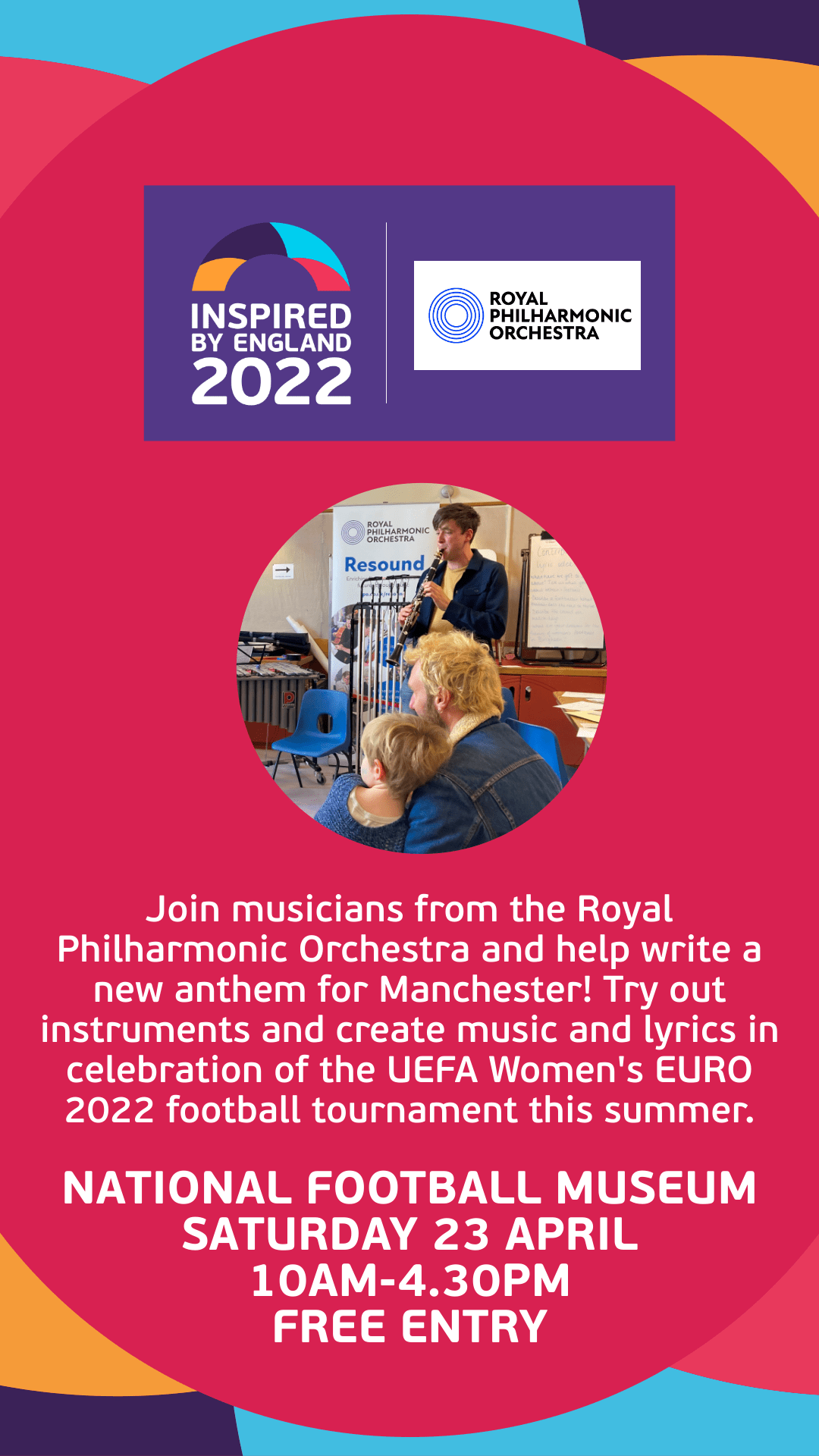
The above image provides details of an event at the National Football Museum which seeks to create a Women’s Euros footballing anthem for the Manchester region and the Royal Philarmonic Orchestra are keen to have input from fans, players and anyone with a strong interest in women’s football within the region. I know part of the event clashes with a MCFC men’s game but I’ve been assured that attendees can pop in for a time and won’t need to be there for the entire session. I’m not involved with the organisation or the main aspects of the day but I do intend popping in during the late morning if I can.

Alongside this, the call out to woman who have played football still stands and I’m keen to hear from Trafford women or women who played games in Trafford. Maybe you can help the project? We’re keen to capture your stories and memories. The details are:

In preparation for the Women’s Euros which will open at Old Trafford at the start of July Trafford Local Studies are keen to interview women who have played football. We are particularly keen on hearing the stories of women footballers from the borough or from women who played for teams within Trafford. 

For those uncertain the Trafford borough covers a number of towns and areas including Altrincham, Bowden, Flixton, Irlam, Old Trafford, Sale, Stretford, Timperley, Trafford Park and Urmston. If you are a woman from the area and played football then please get in touch. Also, if you played either for or against a team from the Trafford area then we also want to hear your memories of that game.

The Trafford area has incredibly strong links to the history of women’s football. In 1921 a game between Dick, Kerr Ladies and Bath Ladies at Old Trafford was watched by over 30,000 and over the following century significant games were staged at White City, Stretford, Timperley and other venues in our borough. In fact on this day (7 April) in 1968 the renowned Manchester Corinthians played Kippax Ladies (from Yorkshire not Maine Road!) at the White City Stadium (see image above).

Over the last fifty years or so many prominent local teams have developed and played in the area such as Sale Hotel, Trafford, Redstar, Urmston and many others, while women from Trafford have played for prominent teams outside of the borough. 

We are keen to hear the memories of women who have contributed to this rich history of women’s football in the area. If you are from Trafford or played for a team based in our borough then please get in touch. Your memories will help to develop our archive and ensure future generations are aware of the experiences of women footballers. 

In addition, we are keen to locate objects, match programmes and memorabilia associated with women’s football, so if you have an item that you feel may help please get in touch. 

If you would like to help then please email me via gary@GJFootballArchive.com

This project is part of a National Lottery Heritage funded progamme which seeks to bring this history into the light through a number of physical and virtual exhibitions, and to create a documentary record of the game at this moment, through oral history interviews with local players and fans and a contemporary collecting programme. 

Here’s some background from earlier this year:

https://www.trafford.gov.uk/residents/news/articles/2022/20220114-History-of-women%27s-football-to-be-revealed-and-celebrated-by-UEFA-Women%27s-EURO-2022-Heritage-Programme.aspx

Musampa’s Strike V Liverpool

On this day (April 9) in 2005 a 90th minute volley from Kiki Musampa – his first for the Blues – at the northern end of the stadium gave Manchester City a 1-0 home victory over eventual European Champions Liverpool.  This was Stuart Pearce’s first league victory as City manager.

The Musampa goal was described at the time as a ‘spectacular volley’ – You can judge for yourself here:

Former City and England captain Pearce guided the Blues through the final nine games of 2004-05 after the departure of Kevin Keegan.  Apart from a 2-1 defeat in his first game, the Blues were unbeaten until the end of the season.  This run included the victory over Liverpool and wins over Birmingham (3-0), Portsmouth (2-0) and Aston Villa (2-1).       

As a result Pearce was named the Barclays Premiership Manager of the Month for April. 

Manchester v Liverpool

This weekend marks the latest in the series of games between one of the Manchester clubs and a Liverpool team. Today (9 April 2022) relegation worried Everton face United and tomorrow League Champions and leaders City take on second placed Liverpool at the Etihad. Much will be made of the Manchester-Liverpool rivalry and it is true that the two cities have been rivals for over 150 years (it certainly predates the building of the Ship Canal!) BUT the football clubs have not always been rivals. In fact Utd and Liverpool have been close over the decades at times while the on-the-pitch rivalry between City and Liverpool was extremely strong in the late 60s and 70s.

The strength of the two conurbations’ footballing rivalries came during the late 1960s but intensified in the late 70s. Prior to this one-off seasons may have seen grudge matches or significant games between clubs from the cities but nothing more than that. In fact for many, many years Manchester United and Liverpool, for example, were extremely close. They once put forward a suggestion to the Football League that all home teams should wear red and away teams white – the rest of football soon got wise to the plan!

There was also the time when United and Liverpool ‘fixed’ a game of football. It’s a long story (amazingly United’s solicitor was part of the ‘neutral’ investigating committee!) and can be read here:

Match Fixing – Manchester United v Liverpool: A Long Read

The rivalry between the footballing clubs developed in the 60s and there were many significant games between all the clubs in the two cities with several prominent matches (there were significant grudge matches between Everton and City for example in the 60s and at one point Liverpool’s Bill Shankly told the media that City were Liverpool’s biggest rival!).

Back in 1995 I interviewed former Manchester City boss John Bond at his home. The interview lasted about two hours and here’s a brief snippet from that interview where Bond talks about beating Liverpool on Boxing Day 1981.

The Blues won 3-1 (Bond, Hartford & Reeves) then two days later (Bond says it’s the next day in this clip but it was 28th December) City defeated Wolves 2-1 at Maine Rd. John discusses a brilliant goal from Trevor Francis. City went top of the League after the Wolves victory.

Stick with the clip because it ends with Bond’s views on how Liverpool used to react to wins and defeats. I’d best not comment – have a listen:

I’ve covered one particularly bitter moment in the City-Liverpool rivalry from the 80s that concerns John Bond here:

40 Years Ago Today (Yes, 40!) – ‘Illegal Jumping’, Alf Grey and Manchester City (Sorry!)

I hope this weekend’s games between go well and it’d be great if one of Manchester’s Blues could score four goals as Fred Howard did on his debut against Liverpool – see:

https://gjfootballarchive.com/2021/01/18/imagine-scoring-four-goals-for-mcfc-against-liverpool-on-your-debut/

and Frank Roberts did:

https://gjfootballarchive.com/2021/01/17/the-flu-limits-mcfcs-selections-but-they-beat-liverpool-5-0-roberts-4-goals/

Women Footballers

I’m delighted to say that I’m working on a new project capturing the stories of women who played football. The project is part of a wider project connected with the Women’s Euros to be staged this summer (See below for details). If you are a woman who has played football then maybe you can help the project. We’re keen to capture your stories and memories. The details are:

In preparation for the Women’s Euros which will open at Old Trafford at the start of July Trafford Local Studies are keen to interview women who have played football. We are particularly keen on hearing the stories of women footballers from the borough or from women who played for teams within Trafford. 

For those uncertain the Trafford borough covers a number of towns and areas including Altrincham, Bowden, Flixton, Irlam, Old Trafford, Sale, Stretford, Timperley, Trafford Park and Urmston. If you are a woman from the area and played football then please get in touch. Also, if you played either for or against a team from the Trafford area then we also want to hear your memories of that game.

The Trafford area has incredibly strong links to the history of women’s football. In 1921 a game between Dick, Kerr Ladies and Bath Ladies at Old Trafford was watched by over 30,000 and over the following century significant games were staged at White City, Stretford, Timperley and other venues in our borough. In fact on this day (7 April) in 1968 the renowned Manchester Corinthians played Kippax Ladies (from Yorkshire not Maine Road!) at the White City Stadium (see image above).

Over the last fifty years or so many prominent local teams have developed and played in the area such as Sale Hotel, Trafford, Redstar, Urmston and many others, while women from Trafford have played for prominent teams outside of the borough. 

We are keen to hear the memories of women who have contributed to this rich history of women’s football in the area. If you are from Trafford or played for a team based in our borough then please get in touch. Your memories will help to develop our archive and ensure future generations are aware of the experiences of women footballers. 

In addition, we are keen to locate objects, match programmes and memorabilia associated with women’s football, so if you have an item that you feel may help please get in touch. 

If you would like to help then please email me via gary@GJFootballArchive.com

This project is part of a National Lottery heritage programme which seeks to bring this history into the light through a number of physical and virtual exhibitions, and to create a documentary record of the game at this moment, through oral history interviews with local players and fans and a contemporary collecting programme. 

Here’s some background from earlier this year:
https://www.trafford.gov.uk/residents/news/articles/2022/20220114-History-of-women%27s-football-to-be-revealed-and-celebrated-by-UEFA-Women%27s-EURO-2022-Heritage-Programme.aspx

Today in 1976

On this day (20 March) in 1976 a penalty from Dennis Tueart and a goal each from Mike Doyle and Ged Keegan gave City victory by the odd goal in five against Wolves at Maine Road.  City ended the season eighth while Wolves were relegated alongside Burnley (their last appearance in the top flight until 2009-10) and Sheffield United.

Women’s Football and the 1921 FA Ban

Recently, I was one of the co-authors of an academic article looking at how the FA’s ban on women’s football occurred and how it affected the development of the sport. It also compared that ban with what occurred in Wales, Scotland, Ireland and Northern Ireland. Some assume a ‘one size fits all’ approach but that was definitely not the case and it is important that national and regional histories of women’s football are performed to fully understand what was happening. As with men’s football, each region is different and this article was an attempt to help develop a wider understanding. You can read the article here (It’s free to download so you may as well have a look):

https://www.tandfonline.com/doi/full/10.1080/17460263.2021.2025415

In that article there’s talk of a male coach who was punished by the FA for being involved in women’s football – this wasn’t in the 1920s. It was post WW2 and demonstrates that the FA Ban wasn’t simply about stopping women from playing on FA approved ground. It was more involved than that. To my knowledge, apart from an earlier biographical article I wrote, that had never been identified in academic writing or work on women’s football.

Too often people assume that what was true in, say, Birmingham was also true in Leicester. Or that research into something occurring in Burnley would explain what happened in Manchester, but it doesn’t. I’ve outlined in research into the origins of men’s football that the wider Manchester conurbation followed a different path than towns in Lancashire that were only a few miles further north than Manchester. Even within Greater Manchester what happens in Bolton or Wigan for either men’s or women’s football could be considerably different than what happened in Hyde, Altrincham or Gorton.

Here’s hoping women’s football gets the breadth of regional studies that it needs to ensure we have a good understanding of what happened town by town, region by region. My December talk at Hebden Bridge added evidence connected with that part of West Yorkshire (nowhere near enough of course!) and my project on female participation and involvement in Manchester is aiming to document how women’s football developed there, together with wider involvement and interest in football by women.

Quite a few articles appear on my website here about women’s football. Most are free to download. Use the tags, tabs, search and categories to find more. Thanks.

The First Manchester Derby at the Etihad

The first Manchester derby at Manchester City’s new stadium (then called the City of Manchester Stadium, now the Etihad) occurred on this date (14th March) in 2004.  For pride’s sake it was important Kevin Keegan’s side did not lose that fixture, but with United some 13 places above the Blues pre-match Ferguson’s side were clear favourites.  It was time for City to upset the form book.

On a wonderful day, perhaps the best the stadium had enjoyed in its inaugural year, a terrific atmosphere helped Keegan’s side achieve a memorable victory.  Fowler opened the scoring in the third minute and Macken made it 2-0 after 32 minutes.  Scholes made it 2-1 three minutes later.  

In the second half goals from Mancunian Trevor Sinclair (73) and Shaun Wright-Phillips made it 4-1 to the Blues.  You can hear my interview with Trevor Sinclair about this game here:

Trevor Sinclair Interview

Matt Dickinson (The Times):  “Humiliated by Manchester City last season, Sir Alex Ferguson and his men used the pain to fuel their drive to the title.  Humiliated again yesterday, they are condemned to live with the despair for months – perhaps even years.”  

Keegan felt the win was thoroughly deserved:  “We had played better against Chelsea and lost.  But against United we got that important early goal which gave us something to hang on to.  We had personnel problems because we had players doing jobs that don’t come naturally to them and also had to make two enforced changes at the interval.”

Chris Bailey explained the significance of the match in the Manchester Evening News:  “Maine Road saw some pulsating derbies in its time but few could have matched this first-ever neighbourly spat at Eastlands.  And how satisfying that Kevin Keegan’s side should choose this day of all days to win their first home game since October 18 and banish all thoughts of the drop.”

In 2012 Dennis Tueart, who was a director at the time of the stadium move, told me his memories of that derby match, believing it was an important moment in the stadium’s inaugural season:  “When we moved to the stadium Kevin Keegan worried about whether the atmosphere would be the same and I told him that fans would take a bit of time getting used to it because they were no longer sat with the people they’d been with for years.  The dynamics were different.  He felt we should try and get fans in the ground earlier, but I said that performance on the pitch would be the most significant factor.  

“When we beat United 4-1 in the first derby at the stadium the atmosphere was incredible.  Kevin came to me afterwards and said ‘I see what you mean’.  That then set the tone of the place.  The place was rocking – people were singing as they walked down the spirals at the end of the match and the atmosphere was absolutely superb.”

If you would like to read about other Manchester derbies then check out this:

https://gjfootballarchive.com/category/manchester-derbies/

Subscribe to get access to the entire site

This was a brief taste of the material on http://www.GJFootballArchive.com If you would like to read all the in-depth articles (including the entire Manchester A Football History book and the audio interview with John Bond) then please subscribe. It works out about £1.67 a month if you take out an annual subscription (£20 per year) or £3 a month if you’d like to sign up for a month at a time. Each subscriber gets full access to the 500+ articles posted so far and the hundreds scheduled to be posted in the coming months.

Norah Mercer: 11th March 1920 – 12th March 2013

On this day (11th March) in 1920 Norah Mercer was born and on 12th March 2013 she passed away. Here is an obituary I wrote for her in 2013:

A short while ago (this was written on 13 March 2013) I heard the news that Norah Mercer, the widow of former England captain and manager Joe Mercer, had died this morning.  She was 93 yesterday.  

I first met Norah in 1988 when I was researching for a book on the Manchester derby.  Joe had agreed to write an introduction to the book and I was invited to the Mercer home to talk with Joe.  Unfortunately, on the day the car my father and I were supposed to be travelling in had a few problems and we ended up using a white transit van to get to their home.

As we arrived at the end of their street we started to worry.  We were about to park a transit van outside the house of the greatest Manchester City manager of all time.  Not only that but we were about 45 minutes early.  We couldn’t pull up outside Joe Mercer’s house 45 minutes early and in a transit van!  We decided to park near the junction of the neighbouring road – where we could see the Mercer house – and wait in the van.

At the appropriate time we climbed out of the van, walked up the Mercer road and knocked on their door.  Joe came out with a big beaming smile and simply said “come in”, then Norah appeared from the kitchen wagging her finger at us and saying “you’ve been hiding in that van for 45 minutes!  No need for that you should have pulled up outside.”  From that moment on Norah made us feel welcome and in the 25 years since has been a wonderful friend.

Throughout her life Norah supported Joe wonderfully.  Today people often talk of footballers’ wives – often for the wrong reasons! – but back when Norah and Joe first became a couple it was unknown for a wife to become known by supporters.  However, Norah’s support for her husband was such they she played a marvellous part in every period of his career from the moment her father helped Joe get to Goodison Park in the early days of his career; through the highs and lows of an amazing playing career with Everton, Arsenal and England; on to managerial ups and downs at Sheffield United, Aston Villa, Manchester City, Coventry City and that great spell as England boss; and on to retirement, illness and so on.  Joe passed away on his 76th birthday in 1990 but Norah continued to show interest in football becoming a regular at Manchester City and a frequent visitor to Joe’s other clubs.

When Joe passed away in 1990 I asked Norah if I could write a biography of her husband.  Her response was typical: “Only if it’s not too much trouble for you.”  Too much trouble?  After what Joe had given football, and in particular my team Manchester City, I felt we all owed him something, but typical of Norah she wanted to make sure I wasn’t taking on too much, or doing it for the wrong reasons.

With Norah’s support – and also great assistance from her son David – I wrote the biography over the following three years but, most significantly, I also spent many days at Norah’s listening to her views on football and life, questioning her on odd snippets of information, marvelling at her photo collection, and generally enjoying every minute.  Typically my visits would include Norah insisting I had something to eat – I really didn’t want to intrude too much but soon realised that Norah was always such a welcoming figure.  She was also keen to meet my own family and my girlfriend (my wife since 1992) was as welcome as I was and became someone else looked after by Norah.  

On one occasion when I was researching Joe’s Aston Villa material Norah insisted I have a beer.  When she brought the drink in she nodded to my girlfriend and then gave me the tankard – Joe’s League Cup winning tankard from his days at Villa!  I was petrified that I was going to damage it.

Norah was born in Liverpool in 1920 and was the daughter of a popular grocer, Albert Dyson, on The Wirral.  Albert was a passionate Evertonian and had various contacts at the club.  As Albert’s business was based in Ellesmere Port inevitably he came into contact with a young Everton player called Joe Mercer.  Joe and another player were invited to the Dyson home for tea one day. The other player couldn’t come but Norah did meet Joe for the first time:  “Old cheeky face Mercer came!  At the time I was 11 and Joe was 17 and he treated me like a sister.”  Around six years later a relationship began to develop between the two of them and Norah became an intergral part of Joe’s life.

In March 1941 Joe and Norah became engaged and on 3rd September that year they married with Everton’s TG Jones the best man.  Norah explained to me fifty years later that the honeymoon was cut short by a day so that Joe could play for Everton:  “We left early Saturday and he played Saturday afternoon.  So that’s how our marriage started… with football!  And that’s how it went on.”

Norah was knowledgeable about football herself.  In fact some of Joe’s teammates teased him that Norah knew more about the game than he did!  She played her part in all the big moments of his career:  “Playing for Everton meant a great deal to us all because we were all Evertonians, but I suppose the greatest moment in his pre-war career came when he was selected to play for England.  He was at our house when it came through on the radio – no one ‘phoned you then to tell you you’d been selected.  

“He was delighted.  We all were.  It was such a honour to play for England.  It made us all so proud.  When he played at Hampden in one of his first internationals Joe’s mum came with me and my father to watch him.  That meant everything and Joe was named the Man of the Match (England won 2-1).” 

The couple were, of course, separated for significant periods during the war years.  It was a difficult time for all, but once the war was over it also looked as if Joe’s footballing career had come to an end.  Joe became a grocer like his father-in-law, but he often admitted it was a poor substitute for playing football.  Then a chance came to join Arsenal and arrangements were made for Joe to train on the Wirral and travel to Highbury for games.  Whenever possible Norah would travel, together with their young son David, to London for games.  She was, of course, present at all the landmark moments of Joe’s career with the Gunners:  “I went as often as possible, and of course we had David by then.  If I didn’t go to games I’d be waiting for him up here after the game.  He used to catch the 5.30pm from Euston and arrive back to The Wirral around 10.30.  We lived near the line then and I used to look out for the train.  Of course, Joe often fell asleep and would end up at the end of the line!  Once he said to a guard ‘why didn’t you wake me?’ and the guard said ‘because of what you did to my team today!’  Arsenal must have beaten his team.” 

Once Joe’s playing career ended he moved into management with Sheffield United, Aston Villa and then Manchester City.  As football management required a much closer presence the family moved whenever Joe’s career took a different course.  Norah, for her part, tried to ensure everything ran smoothly for Joe and David.  She also played her part as a welcoming aspect at each of the clubs.  In 2003 she told me: “I used to come to all the games of course, and both before and after the match would be with the wives of the directors, visiting officials, and even the referee’s wife in the Ladies Room.  We were all told who the referee’s wife was and we tried to make her feel welcome, although for some ladies it all depended on how well her husband had refereed the match!”

Norah supported Joe fully throughout his managerial career, especially during some difficult periods at Aston Villa and the final days at Manchester City. Norah, talking to me in 2003:  “He didn’t want to leave City but felt he had no choice.  He obviously wanted Malcolm to succeed and he did not blame him, but the new directors could have sorted it out properly.  Once the takeover had happened and the new directors came on board (1970-72) the club had changed.  It wasn’t really until Franny returned to the club (1993/4 season) that efforts were made to invite me and others back.  Of course Joe had passed away by then, but I was delighted to be asked to games.  That invite has carried on ever since and it is great to feel part of the club again.” 

Joe passed away in 1990 after suffering with Alzheimer’s.  Norah did all she could during that period to ensure Joe was comfortable and she insisted on looking after him, even during some very difficult days.

Norah continued to attend games at City from 1994 through to the present day.  She also came to the ground for other activities and functions over the years, including the unveiling of the Mercer mosaics in 2005.  That day she was accompanied by her son David, but sadly, a little over two years later he passed away after a struggle with cancer. Life must have been difficult once more for Norah.  

Away from football Norah tried to play a part in her local community.  For many, many years she worked in charity shops on The Wirral.  In fact, when I went to see her once when she was in her late 70s she told me that earlier that week a man had stolen a handbag from someone inside the shop and that Norah had chased after him.  Only losing him when he jumped on a waiting train at the railway station:  “if that train hadn’t been there I’d have caught him!”

On another occasion when she was approaching ninety she told me of her upset at being “made redundant!”  The charity had decided to stop using volunteers and had employed younger permanent staff instead.  I’m pretty certain that few permanent staff would have had the same level of dedication and determination that Norah had.

I once asked her about her family’s interest in football:  “It’s changed so much since Joe and I first met.  Throughout his career I supported him all the way.  To Joe football was the most important thing.  The people… the money… the grounds even change, but Joe used to say that the game itself doesn’t need to change.  Football is a great game and that’s what mattered to Joe.  I often joke that football was everything to Joe.    When he met me it was football then me.  When our son David was born it was football, David, then me.  When our granddaughter Susan was born it was football, Susan, David, then me!  Football was always number one and we all knew that.  Football was Joe’s life.

By 2009-10 I had become a little frustrated that the Mercer name was not often remembered outside of the clubs Joe had been involved with and so I decided to update and revise my biography of Joe, but first I asked Norah’s permission.  Just like twenty years earlier she said “Are you sure?  Will anybody be interested?  Don’t do it unless you feel it’s worthwhile.”  “Joe Mercer: Football With A Smile” came out in April 2010 and I made sure that the book explained Norah’s continued presence and interest in football – to me it’s a shared story.  It was the least she deserved.

In September 2009 I included an interview with Norah in the Manchester City match programme.  In that piece I asked her about present day City and ended the piece with a simple question: Looking to the future, who would you like to win the League?

Her response:  “After City you mean?  Well, the top four would have to be City, Everton, Arsenal and Liverpool, but apart from City as champions I’d best not say which order.”  In 2012 she got her wish and, most significantly, she was there when City defeated QPR to lift the title for the first time since Joe’s side had in 1968.

My thoughts are with her granddaughter Susan and the rest of her family.

Gary James

12th March 2013

Glyn Pardoe

On this day (March 7) Manchester City defeated West Bromwich Albion 2-1 in the League Cup final. City’s goalscorer were both grandfathers of modern day player Tommy Doyle. They were Glyn Pardoe and Mike Doyle. Sadly both men have since passed away. I interviewed Glyn Pardoe (photo is of Glyn with Janice Monk and Steve Mackenzie at one of my book launches) a number of times over the years, including one of my first ever interviews back in the early 1990s (it was for my biography of Joe Mercer and Glyn was a wonderful, welcoming man). Back in January 2004 I interview Glyn for my then regular Manchester City match programme series In Search of the Blues. Here is that interview as it was written up for the programme:

Glyn Pardoe holds the record for the youngest player to make his debut with the Blues.  At the age of 15 years and 314 days he played in City’s 11th April 1962 meeting with Birmingham City.  He went on to play throughout City’s glorious late sixties period and made a total of 374 (plus 2 as substitute) appearances.

Gary James, author of Farewell To Maine Road, caught up with Glyn to discuss his playing career and his present day activities.

Let’s start with your role today, I’m sure many of our readers will have heard you on local radio this season.  Can you explain your role?

I work with Ian Cheeseman, Jimmy Wagg and the others at GMR to provide my views on what’s happening on the pitch.  Part of that is actually sat next to Ian summarising, and part of it is after the match when I am one of the guys talking to callers and generally talking about City.  It’s a great role and I love chatting to fans.  Ian and Jimmy are nice lads as well, and the great thing for me is that I enjoy it.  I love listening to supporters giving their views and I like to stress that the game is still all about opinions.  It doesn’t matter what else changes, football is a great game to talk about.

How did it all come about?

You have to go back to the eighties when I was still working for the Club.  Back then Ian Cheeseman was doing the Club videos of each game, while I was working with the Reserves and the Youth teams.  I was asked to give my opinions of each first team game for the Club videos, and so I’d work with the Reserves in the morning, then head off up to the old commentary gantry at Maine Road for the first team.  

Eventually that stopped of course, but then a few months ago I got a call from Ian.  Totally out of the blue really… I didn’t ever consider I could do the same thing on radio.  Ian asked if I could help for one game, so I did, then afterwards they kept asking me back.  

Did you find it difficult?

At first it was hard, although I don’t think any of that came across.  Unlike the old days of working on the video, I was not too familiar with every one of the first team squad, so it took some time to work out the characteristics of each player.  I also have a day job of course – it’s security reception work – so that had to be taken in to consideration.  Nevertheless, it has been a great experience and I do enjoy doing it.

Going back to your early career, making your debut at such an early age must have been a shock?

Well you’d think so, and I’m sure it was, but I did actually get to find out a few days before, so that helped.  If I’d have found out on the morning I don’t know how I’d have coped.  I don’t think I ever thought about my age.  I’m sure others did, but to me it was just a great opportunity.

Your debut came against Birmingham in 1962.  Do you remember much about the game?

Not really, except we lost 4-1 at home and I was up against a tough centre-half called Trevor Smith.  I wore the number nine shirt for that game – I later played in almost every position!  I don’t think I did a great deal, but I know I kept my place for the next 3 games.

These were not particularly good days as far as fans were concerned, but how did it feel to be a player during those first few years of your career?

The great side of the 1950s had disintegrated really.  We still had a few of the players in the side like Trautmann and Hayes, but the rest of the side was mainly youngsters finding their feet.  It was difficult because there was a general air of despondency.  We’d go to places like Blackburn and expect to win.  We’d take the lead, but end up losing 4-1 (1st May 1963) and I think that said it all.  We didn’t know how to win matches.  At the time I knew nothing else really, but when you do start to find success you suddenly realise how bleak the atmosphere inside the Club had been just a couple of seasons earlier.

Because you made your debut at such an early age did you think ‘this is it, I’ve made it’?

Not a chance!  They’d never have allowed me to think like that anyway.  I remember playing on the Saturday, and then walking up to the ground on the Monday and having to knock to be allowed in.  As far as everybody was concerned I was a Reserve – or even a youth player I suppose – not a first teamer.  You never actually ‘made it’ until you were a first team regular and even then you could never be complacent.  Even when we were winning all the trophies there was a very real fear that your contract would not be renewed.  I remember worrying each summer, thinking that I’d be forced to move on.  

In those days the Club had total control and as a player you were simply glad to be there.  We’ve gone to the other extreme now, but for me I don’t think I ever felt I’d made it.  Even when we were the most successful side in the Country.

How do you feel the mid-sixties transformation of the Club’s fortunes came about?

Joe Mercer and Malcolm Allison came in.  That’s it really.  I remember when the Club was at its lowest and we had no hope, ambition, or direction and as a player you really worried about where we were heading and who the new guy might be.  I was still only about 18 and had no idea how it would all pan out of course.  Then Joe arrived, followed by Malcolm, and everything started to improve.  Training improved considerably and so you started to realise how football could be improved and enjoyed.

What were your first impressions of Mercer & Allison?

Joe was a very respectable figure.  We knew what he’d achieved as a player and he had a great approach.  He was quiet but very supportive.  A real calming influence.  Lovely.  

My first impression of Malcolm – remember I was still only a lad – was that he was very loud.  He liked to shout a lot!  Naturally, I got used to that, but at first it was a bit of a shock.  Malcolm was a terrific coach and we all learnt so much from him.  He was fantastic once you got to know him, and together they both turned us into a great side.

In the 1965-6 promotion season I only missed the opening game, so it was their arrival which made me a regular first teamer.  I’d had good runs before that of course, but once they arrived I hardly missed a match, and enjoyed the successes.

The 1970 League Cup Final saw you score the winning goal 12 minutes into extra-time – presumably a great moment?

Fantastic!  It’s always a great feeling when you score, but when you score in a cup final it’s tremendous.  A truly great memory.

Not too long after that you suffered with a serious leg injury sustained in the Manchester derby.  Did you realise how bad it was at the time?

I knew very little at the time.  It was the December 1970 game at Old Trafford and there was a collision between me and George Best.  Apparently I broke my leg and an artery was trapped, but I have no memory of what followed.  I’ve been told that I was within twenty minutes of losing my leg.  They had decided that removing my leg would save my life, but fortunately the operation they eventually did meant that my leg was saved as well.  I was in a daze for at least four or five hours and really have no idea of the worry my family and friends went through.  

You were only 24 when the injury occurred, and it was a long struggle back to fitness after that wasn’t it?

I missed the rest of that season, all the next, and didn’t play again in the first team until November 1972.  Even then my appearances were limited.  I managed 32 League appearances during 1973-4 and played in the League Cup Final with Wolves, but my career was really over.  

Even now I still haven’t got full movement back, but I do feel fortunate that I am still alive and I still have my leg.

Personally, considering your age at the time I feel the blow you suffered was equal if not greater than the tragedy suffered by Paul Lake and by Colin Bell.  Presumably you regard it as your worst moment?

I don’t like thinking about worst moments.  Football was all about enjoyment to me.  I feel very lucky to have been in such a successful side, and to play during a great period.  Not many people are given the opportunity in the first place, so it all has to be great.

Which players were you closest with during your career?

Alan Oakes is my cousin of course, so I’d been playing with him since I was very young.  The two of us, plus Mike Doyle and Colin Bell were known as the Big Four because we were always together.  We played golf a lot and so were always seen together, but the whole of the playing staff was close in those days.  We had a great team spirit.

After your playing days finished you continued to work with the Club.  Did you enjoy that period?

I worked with the youth sides, and winning the Youth Cup against United in 1986 was a great moment.  The lads had so much enthusiasm – Paul Moulden, Paul Lake, Steve Redmond, Andy Hinchcliffe, Ian Brightwell and the others.  That gave me great satisfaction but people forget that we came close to winning it again three years later.  Watford beat us in the final, but that side contained players like Neil Lennon, Ged Taggart and Ashley Ward.  To think that so many of the players from those two sides went on to play international football or make a name for themselves at other clubs makes you appreciate the quality we had at the time.  Those kids had ability, and it brought me and the others a lot of satisfaction.

Finally, how did the fans treat you during your time at the Club?

Always great.  They were very supportive – even when we were struggling at the start of my career.  They gave me fantastic treatment throughout my career, and I still enjoy meeting and talking with them today. 

Here’s film of that 1970 final:

A reminder that you can still watch my 1 hour plus talk on Manchester City crowds, support, chants and Maine Road here. It’s free to watch:

I’m keen to hear thoughts on the idea of doing other talks like this for subscribers to my site. If you’re interested then please get in touch and let me know what you’d like me to talk on. I have quite a few ideas I’m keen to do and am also open to suggestions. Thanks.

If you enjoy the talk then please subscribe to my site. I am a self employed historian and spend all my working week writing, researching and publishing my work. I am not an employee of any organisation (I know some think I’m employed by a football club but I’m not an employee of any club). I am independent of any organisation and care passionately about the quality and accuracy of my work. 

A limited amount of content will always be free for anyone to read but those subscribing will have access to everything on this site for as long as they subscribe. For subscribers I guarantee to post a minimum of 4 articles alongside adding material from my archives each month (in practice it’s been much more than this!). To subscribe costs £3 a month or £20 a year (a reminder that the 2010 edition of Manchester A Football History cost £24.95 when published and is now out of print but available to subscribers as a downloadable pdf as part of their subscription.).

If you’re uncertain whether to subscribe or not then why not subscribe for a month at £3 and see if you’re getting value for money. The £20 annual subscription works out about £1.67 a month for a guaranteed 4 new articles per month and access to everything else posted in the archive.

You can subscribe here:

Subscribe to get access

Read everything on this website when you subscribe today.

Manchester Derby Day

It’s Derby Day! I know we don’t need anything to get us pumped up for this game but if you want to know a bit about the history of this fixture of would like to relive past games, here are links to articles/posts/videos on my site about past games…

https://gjfootballarchive.com/category/manchester-derbies/

There’s also the entire Manchester A Football History free to download for subscribers. Start here: