Francis Lee

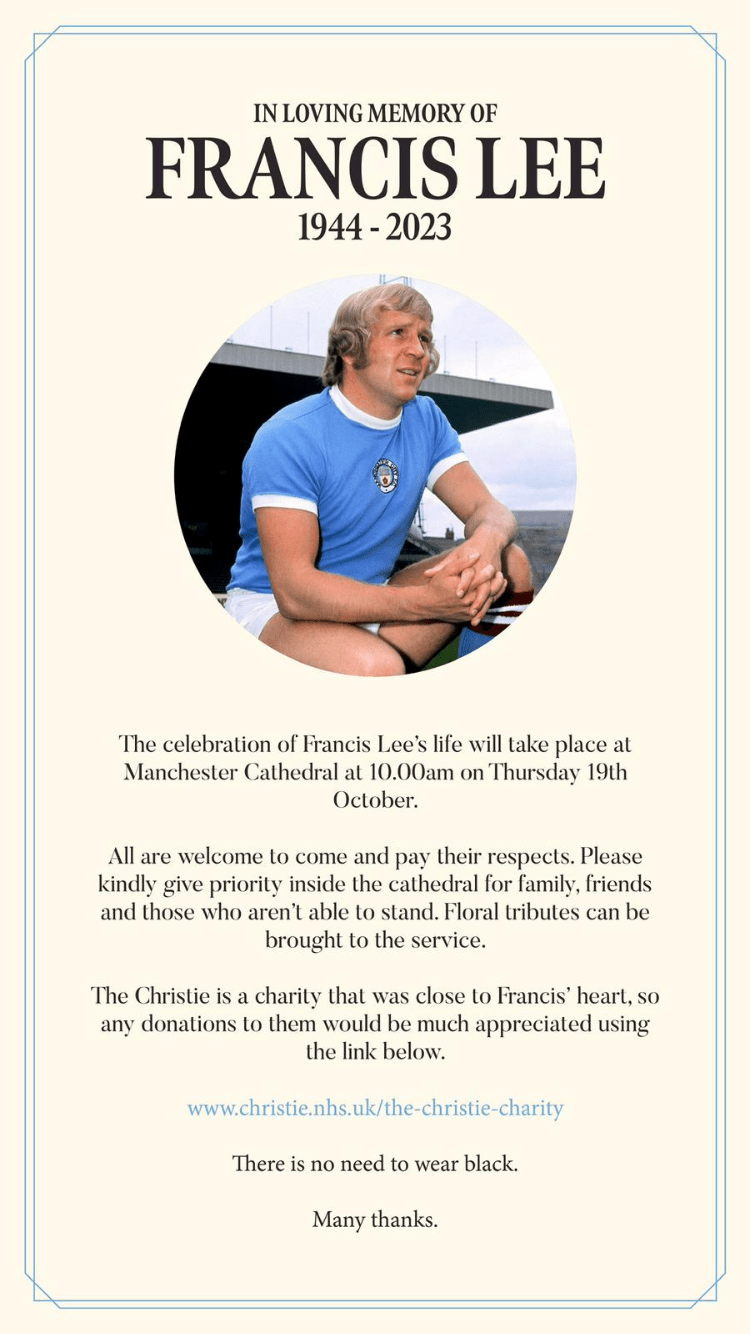
It’s going to be an emotional day today as it is the funeral of Francis Lee. I’ll be at the cathedral to pay my respects but I also wanted to mark today by including here an interview I did with him back in 2010. This is one of many interviews I did with Francis over the decades and I want to include this one today as it was written up as a Q&A style piece with Francis’ own words documented. I hope it captures the spirit of the legendary Bolton, City, Derby and England player.

IN SEARCH OF THE BLUES – Francis Lee

For today’s feature author Gary James met up with former Bolton, City and England star Francis Lee.  In a glittering career Francis won two League Championships, the ECWC, League Cup and the FA Cup.

Francis, let’s begin with your early career at Bolton.  Can you explain how that started?

I was a member of the groundstaff and I set myself a target that I had to get into the first team by the time I was 17 or 18 and if I didn’t I was going to go back to college and train as a draughtsman.  That was my plan, but I managed to get into the first team at 16 and I made my debut against City (5/11/60).  We won 3-1 and I scored a header at 3.15 against Bert Trautmann – I think Bert must have thought he was getting over the hill for me to score a header past him!  It was a great day and there were some very good players on both sides – Nat Lofthouse of course.  Ken Barnes and Denis Law were playing for City.

I kept my place for about six games and then the following season I had 5 games, then in 1962-63 I was top scorer with 12 goals from 23 League games.

You were playing out on the wing those days and topped the goalscoring charts each season at Bolton from 1962 until you left.  Was that your preferred position?

I think my best position was as support striker to a big fella.  I only played in that role twice really – at Bolton with Wyn Davies when I scored 23 League goals one season and then at City with Wyn again when I scored 33 League goals in 1971-72.  A lot of my career was spent at centre-forward at City and at Derby which is a bit of a difficult position to play if you’re only 5ft 7.  When I played for England I was support to Geoff Hurst and that suited me.  When I played at centre-forward I had my back to the ball but when I was support striker – the free player – that suited me fine.  I could pick up the ball going forward and that was great.

At Bolton you scored 106 goals in 210 appearances.  A great record, but when you left the club the stories were that you were in dispute.  Is that true?

Well, what happened is that Bolton had got relegated in 1964 and, despite a near-miss in 1965 when we finished third, it didn’t feel as if we were going forward.  My ambition was still to see how far I could develop in the game and in the back of my mind I had the ambition to play for England, but I wasn’t even selected for the under 23s.  The story was going around that I was difficult to handle – which is funny because Joe Mercer said that I was the easiest player to handle at one point.

At one point I remember asking the manager why I wasn’t earning as much as Wyn Davies who had been brought in to score goals.  I was top goalscorer but Wyn was paid more and the manager said:  “you’re too young!” but Wyn was only about a year older than me.

Were you difficult to handle at Bolton?

I was opinionated and ambitious, but not difficult.  I think that message was going around because I was on a weekly contract at that time and the club knew that it would be difficult for them to stop me moving on if another club came in.  So any player with a reputation for being difficult would not be on anyone else’s shopping list, would they?  Bolton offered me a new contract worth something like £150 a week but before that I was on £35.  That actually upset me more and I said: “if you now think I’m worth £150 a week what about all those years you’ve been underpaying me?”  It wasn’t the money that was an issue it was the way they handled it.  What they were doing was trying to get me on that contract and then my value would increase if someone came in to buy me.   Once they saw how dissatisfied I was with the way they were handling it, they said that it’d be best if we made a clean break, and so I said I’d pack the game in.  I had my business by then and so I said:  “give me my employment cards and I’ll pack it in.”  They thought I was bluffing. 

It’d been a decent season so far – I’d scored 9 goals in 11 games including when we beat the great Liverpool side in the League Cup – but then it all stopped in September 1967.  They gave me my cards and that was it.

Were you absolutely certain you’d pack it all in at that point?

I kept myself fit but I was working on my business.  I was driving my lorry around, collecting the waste paper and so on.  The business was growing and I felt that if I wasn’t wanted then I’d concentrate on that.  It was always my fallback.  It was only a small business really.

I know how stories can get exaggerated over the years, but is it true that in between games you were going around collecting the waste paper?

I used to drive my lorry during the week and even on the Thursday or Friday before a game I’d be collecting waste paper.  I used to put on a flat cap and muffler so that nobody would recognise me!  In summer I worked long hours and I was earning more in the summer months than I was playing football in Division One.  I also played cricket.  At one point it looked like I was going to be a footballer and cricketer but the season overlap meant I had to concentrate on football.

In the end I was driving articulated lorries and it was getting to be a very good business.  My last job was the day before I signed for City!  I roped and sheeted about 15 ton of paper and cardboard from a spinning mill in Bolton.  Took it to the Sun Paper Mill in Blackburn and when I got back about 5pm I got a call from Joe Mercer.  He didn’t give his name at first but I recognised him and he said:  “Where’ve you been?” I told him I’d been playing golf – I couldn’t play the game at all then but I couldn’t tell him what I had been doing!  I asked him:  “who is that?”  He said:  “Tom Jones.”  I said: “It doesn’t sound like Tom Jones, sounds more like a man called Mercer!”

Did you immediately want to sign for City?

Other teams had shown interest in signing me.  Liverpool offered £100,000 I understand but then when I wasn’t playing it affected my price.  In later years Shanks often used to grab me and say in that strong Scottish accent:  “Son, I should’ve signed ya the night I saw ya!”

City was just right of course.  It meant the business could carry on.  I don’t know if Bolton had told Joe about my contract or the £150 offer but the first thing he said to me before we talked it through was:  “I’ll be honest with you son.  We’ve no money.  We’re skint!”  I said:  “It doesn’t matter.  I’ll just be delighted to start playing again.” 

I signed for City for £60 a week – remember I’d turned down £150 at Bolton – and in the end it was well worth it.  The way the team developed and, of course, when I realised my ambition and played for England.

City paid £60,000 – actually they paid £40,000 down and £20,000 on the drip!  I was told I should get about 5% of the fee but then the League wouldn’t allow it because I’d left under strained circumstances or something.

I left a lot of friends of mine at Bolton – Freddie Hill, a great friend, Tommy Banks, Roy Hartle, Gordon Taylor – and we had some great times.  Those of us who had come through the ranks were poorly paid for the job we were doing at the time, but we enjoyed ourselves.  I never had any argument with the players, fans or people at Bolton, it was just those that ran it.  I loved my time at Bolton.

When you joined City the Blues were ninth in Division One after losing 5 of the 11 games played.  But the side was transformed from the moment you came.  Unbeaten in your first 11 League games.  Were you the difference?

The team just clicked and I was only part of a good group of players.  We had that great run up to Christmas, then a bit of a blip, but in the New Year we just rattled on.  It was a terrific period.  Mike Summerbee was playing at centre-forward and our culture at the time was to play with five forwards.  It was very unusual for the time.  The only system we played was that we all played we had ten players who went up together, and ten who defended together.  When we won the League at Newcastle at the end of the season it was wonderful and particularly special because none of us had ever won anything significant.  This was our first major success and that’s why the following season the ordeal of playing a European Cup tie was so tough.

Was it just inexperience that caused City to lose the Fenerbahce European Cup tie 2-1 on aggregate?

None of us had played in Europe before.  Mike Summerbee had only made his England debut against Scotland in February 1968.  Colin Bell had played in two England friendlies, but apart from that none of us had any concept of what it could be like in Turkey.  Had we played the first leg in Istanbul and the second at Maine Road I think we’d have gone through, but the goalless 1st leg at Maine Road killed us really.  We worked hard in Istanbul and it was a creditable result over there but we were out and it was because we were inexperienced.  It was a culture shock.

Despite the Fenerbahce setback did it feel as if City could find further success?

No confidence was at a real low after that game.  We’d had a bad run and only had a small squad so we struggled.  But that was the way it was.  Most clubs had small squads but what Shankly used to do at Liverpool was sign a couple of players each season just to ensure that those who were first choice felt the pressure and remained hungry for the game.  Back then the motivation for all of us was to be in the team and to keep your place.  The money was significantly different if you lost your place – City used to have this thing where we’d get a bonus depending on the size of the attendance as well as goals, wins and so on.  That motivated you to ensure you did all you could to entertain as well as win – you wanted the crowds to grow. 

Effectively you could double your wage by simply being in the team.  That’s a big incentive. 

You mentioned about squad size, I think younger readers may be surprised to read that City tried to keep the same eleven players game after game, competition after competition.  Would you have enjoyed a squad rotation policy when you played?

The aim of a footballer is to play.  Why would anyone want to be rested?  If a manager had said to me ten minutes before full time that he wanted to bring me off even though I was playing well, I’d have told him “no way!  I’m enjoying myself.  This is what you bought me for, now let me do it!”  It wouldn’t matter what the manager says I’d want to stay on.  That’s what the game is about – enjoyment!  Every player wanted to play.  None of us wanted to be on the bench. 

People talk about the number of games played today but in 1969-70, ignoring domestic friendlies and the Charity Shield, you played 71 competitive games for England and City.  Would squad rotation have helped?

No. Playing is always better than being on the training pitch and I used to love playing, so I tried not to miss a game.  It didn’t matter whether it was an England friendly, Anglo-Italian cup or whatever, I wanted to play and represent my club and my country.  I think it’s best for all players.  Look at Tevez.  He’s improved his fitness and form by playing, and I think a lot of players are like that.  He needs to play, and that’s what I always wanted. 

Some of the other players from the 1969-70 season have talked about Franny’s Grand Slam.  Your aim to win four trophies in one season inspired them.  What do you remember of that?

Well, we wanted to win every game so it seemed natural to me that we should go for all four.  We won the League Cup and Cup Winners’ Cup, so that wasn’t bad.  In the FA Cup we were odds on to win at Old Trafford because we’d beaten them so many times.  We ended up suffering a rare defeat at United, but it was one of those we should really have won based on form and everything.  We were doing okay in the League then we had a few injuries – Mike, Colin Bell and Neil Young were injured at key times – otherwise I think we would have won three trophies.  But the thing about the ‘Grand Slam’ was that it was the ambition of the place.  I remember we were going to London on the train and could see Wembley, and I shouted to the lads to take a look because two of our ‘Grand Slam’ games would be played there!

Moving forward a couple of years, the success started to disappear.  There had been the takeover that ultimately led to Peter Swales being Chairman, and of course we missed the title by a point in 1972.  What had changed?

Rodney Marsh has told you himself that his signing made a difference.  Malcolm played Rodney and disrupted a team that I’m convinced would have won the League that year.  Derby won it when they were in Majorca or somewhere!  I don’t blame Rodney… that season our luck changed and everything went against us.  There was one game near the end where we should have had a couple of penalties for hand ball but because this was the season when we got that record number of penalties they weren’t given. 

Thinking about the penalties, a lot has been made about you ‘diving’ but the factual evidence is that the majority of penalties were given for things like handball or fouls on other players.  Nevertheless, the myths survive.  So, big question, did you ever dive?

I couldn’t say that I always stayed on my feet unless I was absolutely knocked down.  In those days you used to get some horrendous treatment by the defenders, but I will tell you that the season before those penalties we only had a couple, and before that I think it was one.  The reason we got so many in 1971-72 is that they had changed the law, plus we were going for the title so we were putting sides under a lot of pressure and they reacted.  I was fouled only 5 times out of the 13 league penalties we got.

When I was attacking I used to play the odds.  If a defender was coming towards me I’d carry on, or I’d run towards the defender because there were only three things that could happen – he pulls me down, he gets the ball of me – well done, or I get a cracking shot at goal.  So the odds were in my favour.  You have to play them.

I think the reason people go on about penalties with me is because I was the one taking them.  It didn’t seem to matter what they were given for, the headlines were that I had scored from a penalty.  The season after I think we only got one penalty and by the time I moved to Derby they already had a penalty taker so that was it.  I would say that for every dubious penalty that was awarded there were another twenty that we should have had.

Was the move to Derby something you really wanted?

No.  By that time my business was substantial so going to Derby was going to cause problems.  Derby offered City more than anyone else and so I went there.  We won the title in my first season – I’d only signed a contract for a year – and they were a very good side, so I stayed with them for another season.  The pitch was awful – even Maine Road’s pitch was better – but we could have won the European Cup that second season.  We won the first leg of a tie with Real Madrid 4-1 but I missed the return because I’d been sent off in the Hunter incident against Leeds.  We lost 5-1.

They actually changed the rule after that saying it was unfair to automatically ban a player from a European game after a domestic match when the player had yet to be proved to be guilty or not guilty.  There wasn’t much chance of me being ‘not guilty’ – the footage was there for everyone to see!

There was that memorable game when you came back to Maine Road and scored for Derby at the Platt Lane end of the ground.  I was in the stand that day and I remember a surreal moment when City fans cheered your goal.  Did that happen or is it just my memory?

Yes, it did happen.  Then I think they thought:  “What have we done, he’s playing for them!”

I enjoyed my football and I loved scoring so when I scored and the film shows me smiling it was because I’d scored what I thought was a good goal.  I picked it up with my back to the line, went through two people and on to score the goal.  I loved the goal and it is true that everyone applauded.  It had nothing to do with City or revenge or anything like that.  I think I enjoyed about 95% of every game I ever played.  It was fun.  A great way to earn a living, so on that day I was happy.

People often suggest that City sold you too soon and that had you stayed a couple of seasons longer we might have won the title ourselves.  Do you hold this view?

I think if I’d have stayed and Mike Summerbee – remember he was sold a year after me – then I do think we’d have mounted a serious challenge for the title.  Mike had more to offer.

After two seasons at Derby you retired, but you were still relatively young.  Why?

I had about 110 people working for me and my business was taking over.  I was travelling all over the country for my business and was trying to fit the football training in as well.  I needed to concentrate on the business.  Had I been playing in Manchester or Bolton then I may have carried on.  I was only 32.  Derby wanted me to stay on, and I made a promise to Dave Mackay that if I was to return to football then I’d do it for him.  Tommy Docherty tried to persuade me to join United but I’d made that promise and wouldn’t do it.

You developed your business interests and horse racing over the following twenty years, but then suddenly you were back, mounting takeover of City.  Why?

I wasn’t really looking to get back into the game at all during those years.  I had a good and successful career outside of the game and was happy.  But the takeover was one of those things that happened.  I should have known that it wouldn’t work.  The biggest problem we faced at the start was having to build the new Kippax Stand.  We ended up spending about £16m in the end – even removing the waste from underneath the old terracing should have cost only £80,000 but ended up costing about £1.8m.  I thought then that I’d always been lucky in life and then suddenly my luck had changed.  Everything we tried to do became an issue and the Kippax was a bit of a millstone.

It’s extraordinary when you think that at that time Jack Walker had put some money into Blackburn and Everton had had some money put into it, and we put money into City, but prior to that no one ever put money into a football club.  They bought shares but never invested, we did invest.  But the financial state of the club was appalling.

It strikes me that off the pitch things did improve significantly, but on the pitch we struggled.  What’s your view?

People like John Dunkerley worked very hard during that spell and the training facilities were improved and so on.  Then, just when we finished the Kippax Manchester Council started to talk to me about becoming tenants of the new stadium – now that turned out to be the best thing that happened to City during the decade that followed.  We spent a lot of time working with them and talking with various people to make it happen.  Full marks must go to the Council for having the foresight and it became very important for City to become anchor tenants.  I think I had a lot of bad luck as Chairman and things certainly didn’t work on the pitch, but I do think that was one thing that the club got right.

Why did it fail on the field?

I don’t know.  Maybe the footballers didn’t enjoy playing as much as they ought to have done.  We also had a few problems with managers but I’d better not get into that.

Finally, many people claim the 1970 League Cup Final was your greatest City game, do you feel that?

I don’t view it like that.  I don’t think of individual games in that way.  My job was to score goals and win games, and so I look at my career and see what goals I’ve scored.  You have to look at the club during your time there and see what that club won and what you contributed to the overall success of the club, not necessarily individual games. 

My role was to make things happen, and if I was making things happen, especially if it was causing some aggravation for the opposition, then I was happy.  When you hear the opposition players shouting things like: “don’t let him turn!” that’s a real pat on the back.  You know you’re getting to them.

In terms of individual games or goals… I don’t see it in those terms.  In the championship season I think one of the goals I scored at West Ham (18/11/67) was the best goal I’ve ever scored.  I was playing against Bobby Moore and I think I had a fantastic game but, because they are trophy winning games in their own right, cup finals tend to be remembered mostly by others.

I always think that a top class player should go on to the pitch and have enough confidence in his own ability to know that it is very rare for him to have a bad game.  It’s not arrogance or anything, but it is the mark of a top class player.  If you go onto the pitch feeling that then more often than not you will have a good game.  The next step is to take it up the levels until you walk on to the pitch believing you’ll have a great game and score a couple of goals.  At City most of us developed that confidence and on some days, when the entire team was at that level, we had some tremendous games.  That Newcastle title decider was like that.

Maine Road 100 – Day 80

For post 80 of my Maine Rd 100 countdown how about a story of a 8-0? This post is about “Stanley’s Match” when England beat Scotland 8-0 at Maine Road and the image shown is a section of the crowd that day.

“When I heard the team I said two prayers.  One of thanks to the Scots for leaving me out, and one on behalf of Adam Little who had taken my place.  I knew then we’d do well to get away with less than five goals against.”  So said Bill Shankly referring to the selection of the England team to face Scotland at Maine Road in October 1943. You can read the story of this incredible game here:

Subscribe to get access – Annual

Read more of this content when you subscribe today.

Subscribe to get access – Monthly

Read more of this content when you subscribe today. You can subscribe at either £20 per year (above) or at £3 per month here (cancel any time). For those subscribing £3 per month you will be able to access all content from October 2022 onwards for as long as you are a subscriber. Those subscribing £20 a year have access to everything posted since December 2020.

This is Your Life Joe Mercer

Broadcast live on this day (25 March) in 1970 was the This is Your Life TV episode with Joe Mercer as the subject. Here are the details plus a special recording which supporters of all the clubs Joe was involved with could be interested in.

This Is Your Life was viewed at the time as significant recognition for a lifetime’s achievement. Only major stars and personalities were featured in those days, and the main idea would be that the subject of the programme would be surprised by the sudden appearance of presenter Eamonn Andrews and his ‘Big Red Book’. The subject would then be whisked away to a studio or other location where a variety of figures from the person’s life would be brought out to tell anecdotes and the like. The main part of the show would be broadcast live.

This is Your Life Joe Mercer 1970

Back in 1970 young Manchester City supporter John Stapleton was working on the series and he suggested they feature Joe Mercer as the topic of one show. John, who has gone on to be a prominent broadcaster with a well-regarded TV career was interviewed by me a few years back and we discussed the programme and John’s part in the idea of featuring Joe: ‘I did it purely for the benefit of me and my dad.  Eamon Andrews, the presenter, had of course a great interest in sport and I put the idea to him and the rest of the production team.  Together with Norah, Joe’s wife who in recent years I often sat with at games sharing her boiled sweets, we concocted a situation where Joe and Malcolm were in a London hotel before a trip to watch a European game in 1970. Malcolm disappeared – deliberately as part of the show though Joe didn’t know this – and Joe was called to reception urgently.  Eamon leaped out to do the big “This Is Your Life” reveal and Joe had no idea whatsoever. It was a great day for us all and Joe was thoroughly deserving of it as well.’

Joe was staying at a Hilton Hotel in London. As John described, He had been due to fly with Malcolm Allison to the continent to watch ECWC semi-final opponents Schalke but he had received a message to say the game was off. It was all a ruse of course. That night television viewers watched as Eamonn Andrews surprised Joe at the hotel reception desk: ‘Joe Mercer, former England playing star, now manager of Cup winning Manchester City, tonight. This Is Your Life!’

Eamon Andrews This is Your Life Joe Mercer 1970

At the start of the show the City team appeared. This had been an extremely busy time for the Blues. Over a 18 day period City had played two League games, the League Cup final, the second leg of the ECWC quarter-final with Coimbra and found time to work with television to honour their manager. This live show occurred on Wednesday 25 March and City were to face Derby in the League on 27th and Manchester United on 28th, plus they had to play the first leg of the ECWC semi-final with Schalke on 1st. It was incredible that a team would be involved in this at such a busy time but that’s the way it was.

This is Your Life Joe Mercer 1970 MCFC squad

As Joe explains in the show Malcolm Allison was nowhere to be seen. He had been staying with Joe at the hotel and the City manager commented: ‘I’m a great sleeper you see, and subconsciously I heard Malcolm getting up and I thought, oh, he’s going to the bathroom. I thought, well, he hasn’t come back, so he must be having a bath, and then I went back to sleep. I woke about ten and Malcolm had gone, but occasionally this happens – Malcolm disappears!’

Andrews explained that Allison had left early to watch the match which was still on. Joe was flabbergasted: ‘He’s left all his clothes! I’ve had to pack his bag as well!’

During the course of the show, Andrews informed Joe that Alf Ramsey had named the squad he was to take to the 1970 World Cup: ‘I know you haven’t had a chance to hear the news, but I’m going to tell it to you now, that two of your boys have been named by Alf for the World Cup – Francis Lee and Colin Bell. And two more in the twelve reserves – Mike Summerbee and Alan Oakes. Congratulations lads, and to the whole of the Manchester City.’

Joe was overjoyed.

Subscribers to this website are now in for a special treat as an audio of the entire episode has been preserved and can now be listened to here:

Subscribe to get access – Monthly

You can listen to this special recording of Joe Mercer, Eamon Andrews, Dixie Dean, Malcolm Allison, Stan Cullis, Stanley Matthews etc. by subscribing. It costs £3 per month (cancel anytime) to access everything posted since 1 Oct 2022 or there’s an annual option (below).

Subscribe to get access – Annual

You can listen to this special recording of Joe Mercer, Eamon Andrews, Dixie Dean, Malcolm Allison, Stan Cullis, Stanley Matthews etc. by subscribing. It costs £20 per year (cancel anytime) to access everything posted since the site began in December 2020, that includes history talks, videos, a couple of my books, hundreds of articles etc.

Joe appeared on several other This Is Your Life shows including in November 1988 when Tom Finney was the subject and in 1980 when Emlyn Hughes was. He also appeared on two for Matt Busby, one in 1958 and one in 1971 (which opened at Maine Road).

The Programme details for the Joe Mercer episode are:

  • Edition No: 274
  • Subject No: 276
  • Broadcast live: Wed 25 Mar 1970
  • Broadcast time: 7.00-7.30pm
  • Venue: Euston Road Studios
  • Series: 10
  • Edition: 18
  • Director: Margery Baker
  • Producer: Robert Tyrrell
  • City supporter and broadcaster John Stapleton worked on the show

The guests were:

  • Norah – wife
  • members of Manchester City FC team 
  • Francis Lee
  • Colin Bell
  • Mike Summerbee
  • Alan Oakes
  • Alan Percival
  • David – son
David & Joan Mercer, This is Your Life Joe Mercer 1970
  • Joan – daughter-in-law
  • Arthur – brother
  • Stan Cullis
Stan Cullis, This is Your Life Joe Mercer 1970
  • Billy Dixie Dean
Billy ‘Dixie’ Dean, This is Your Life Joe Mercer 1970
  • Jim Morris
  • Charles Palmer
  • Matt Busby
  • Frank Soo
  • Walley Barnes
  • Maurice Edelston
  • Bernard Joy
  • Roy White
  • George Hardwick
  • Raich Carter
  • Neil Franklin
  • Stanley Matthews
Stanley Matthews, This is Your Life Joe Mercer 1970

Filmed tributes:

  • Malcolm Allison
  • Susan – granddaughter
  • Albert Dyson – father-in-law

If you have enjoyed this article then why not subscribe (see above for details) for other material like this? If you don’t want to subscribe but would like to support the research into Manchester football by Gary James then it’s possible to donate below. All support is used to help perform further research that will be posted here for future generations. Thanks for the support.

If you enjoy all the free material on my website and would like to support my research and keep this website going (but don’t want to subscribe) then why not make a one-time donation (or buy me a coffee). All support for my research is valued and welcome. It allows me to keep some free material available for all. Thanks.

Choose an amount

£2.50
£5.00
£7.50

Or enter a custom amount

£

Your contribution is appreciated.

Donate

Colin The King

I know I’ve written plenty about Colin Bell over the years but, to be frank, you can never read or write enough about Bell. So for today’s subscriber article here’s a 1,900 word piece (plus videos of the Ballet On Ice game and his first return game v Derby in April 1976 – yes that’s right!) on the legendary Manchester City and Bury footballer. Enjoy!

Subscribe to get access

Read more of this content when you subscribe today. It costs £20 for an annual subscription (here; access everything from December 2020) or £3 per month (below; access everything since 1 October 2022).

Subscribe to get access

Read more of this content when you subscribe today. It costs £20 for an annual subscription (above; access everything from December 2020) or £3 per month (here; access everything since 1 October 2022).

IN SEARCH OF THE BLUES – Colin Bell MBE (interviewed in January 2005)

Boxing Day is a day that will forever be a reminder of the great Colin Bell and his return to the Manchester City first team after the devastating injury that came in the November 1975 Manchester Derby. Colin did return briefly at the end of the 1975-76 season but that was a comeback too early. To remember Colin and everything he achieved at Bury and City here’s an interview I did with him in January 2005. This was published in the City match programme back then and you can read Colin’s views on his career here as published at the time. Enjoy!

Colin Bell MBE joined the Blues from Bury in March 1966 and went on to become a major trophy winner with the Blues and a star with England.  Gary James met up with him at the end of January 2005

Let’s start with your early life, was football everything to you from an early age?

From the moment I was born I wanted to play.  Actually, everybody did in those days.  Football was all you ever wanted and I always had a ball with me, so I could play anywhere.  No one ever pushed me; it was something I just wanted to do.  My mother had played ladies football before I was born and so did others in the family, so there must have been a natural instinct for the game.  I used to go and watch Sunderland when I could, although it would take about 90 minutes and three buses to get to Roker Park.  As a boy my hero was Len Shackleton and then Charlie Hurley. 

At the age of 17 (1963) you joined Bury.  There were other potentially larger teams interested, so what made you choose Bury?

The move had to be right and I was quite a shy boy in many ways, so I needed to go somewhere where I felt at home.  Bury were a homely club and made me feel so welcome.  I’d had interest from a few clubs – Newcastle offered me a trial but I heard nothing afterwards!  Arsenal were another.  I damaged my back shortly before I went down to London from my home in the north-east and that made me a little uncomfortable.  Their manager Billy Wright watched the games we played and selected the ones to stay, and then said to those not selected “I hope you join other clubs that are not as good as Arsenal!”

Both Bury and Huddersfield wanted me to sign, so I was totally open with them and agreed I wouldn’t make my mind up until I returned back home and looked at it objectively.  The Huddersfield experience went well, but Bury was so much more homely.  While I was there I knew I’d sign for Bury, but I wouldn’t tell them.  They kept pushing me, and I wanted to say yes, but I felt it was more important to stick to the plan.  So when I went home I told both clubs of my decision.

Presumably, you never looked back and felt Bury was the right choice?

Definitely.  My instincts were right, however I did still feel homesick.  It really hit me for about six weeks or so and I know that if my family had suggested I go home I would have done.  I’d have packed it all in because I hated that homesick feeling.  I’d have got that wherever I went, and I’m glad I chose Bury because in the end I couldn’t have had a better start to my career.  It was a great period once I’d settled and I felt I was so lucky to be paid for playing.  

How ambitious were you then?  Did you set targets and aims?

I took each day as it came.  That’s true of all my career.  I never thought about moving from Bury.  It never crossed my mind, and I certainly didn’t think about playing for England.  I didn’t even know City were watching me until the official approach came.  In fact it got to transfer deadline day and suddenly I had both City and Blackpool interested in me and I had to make another choice.  This time it was stay at Bury, move to Second Division City, or move to First Division Blackpool.

So what made you pick City, was the Mercer-Allison involvement the deciding factor?

At the time I didn’t know enough about Mercer or Allison to base a decision on, so my decision was based more on league position.  City were heading for promotion, while Blackpool were beginning to struggle (they were eventually relegated in 1967), so I thought it would be best to join a club looking forward rather than one heading for struggle. 

Was City as homely as Bury?

That’s something that was truly special about City at the time because even though it was a much bigger club, it still had that homely feel.  We were all part of the same family.  First team players would pop into the laundry room and have a cup of tea with the ladies in there.  Sometimes we’d just love being at the ground.  I do think football’s lost a lot by having training grounds some distance from the home grounds.  We felt part of the Maine Road furniture.  It was my second home and most mornings we’d get in early to get into the gym for head tennis.  If ever you arrived at the ground and found you’d arrived too late to make up a head tennis team you’d skulk around and plan to get in even earlier the next day.

You mentioned that you were homesick at Bury, how long did it take you to settle at City?

I arrived in March 1966 and it took me the rest of that promotion season to settle.  Promotion helped because I was part of the celebrations from the start.  The goal I scored at Rotherham guaranteed promotion and afterwards I tasted champagne for the first time.  I couldn’t believe how quickly I was part of a winning side.  Something major I realised at this time was that at Bury we’d go to away matches with the aim of getting a draw – at best – but with City we went expecting to turn over every side.  After a couple of games I felt this same level of expectation and I think that’s why we became so successful.  Malcolm stressed our strengths and used to say that he didn’t care how many we concede so long as we win.  If ever we won 4-3 he’d never mention the three goals, he’d only mention the four.  That was a great way to play and it continued throughout those successful years.

Both Mercer & Allison and most of the other players have often commented on your high level of fitness and your stamina, was this something you were conscious of at the time?

I think in games I was just as tired as the rest but I think I had a quick recovery rate and I never ever wanted to give less than the best.  I was always determined.  At training I never really thought about my own fitness, but I do remember that when Malcolm had us all running hard I’d give a commentary as we were running.  I’d be going “Bell overtaking Booky on the inside” and so on and I think that may have been a bit off putting for some of the others.  

In 1967-68 City won the Championship by two points over Manchester United with a victory over Newcastle, do you remember much of that day?

It was a great end to end game.  I’d never previously won at Newcastle and I know that beforehand I felt quite uncomfortable.  The great thing about football during this period was that every team in the League was capable of beating you on their ground, so it didn’t matter whether you were playing the top or the bottom.  Also, no side ever gave up, so we knew that Newcastle, who were about tenth, wouldn’t sit back if we took the lead they’d be going for it… and they did!  We beat them 4-3 but it could have been 5-4 or 6-5 – we knew we’d score one more than them, but both sides kept attacking, kept playing.  At no time did they give up. 

Presumably the Old Trafford derby match (March 1968) remains another great memory for you?

We beat United 3-1 and that really set us up, but we’d lost a goal right at the start.  I equalised, George Heslop headed a goal, and then late on I was brought down by Francis Burns.  As I was being stretchered off Francis Lee scored the penalty.  I went to hospital, had my leg put in plaster and then joined the rest of the players at the Fletcher’s Arms in Denton for a celebratory drink! 

Before the match Malcolm had stressed the importance of the game.  He told us they were beatable and once he’d convinced us of that nothing was going to stop us.  I think that helped the other teams as well, because once we started to beat them at Old Trafford – and remember I played 9 League derbies at Old Trafford and only lost the first – they realised they could do the same.

Winning so many trophies – League, FA Cup, ECWC, League Cup – during such a short spell was incredible, but which success brought you most satisfaction?

Each trophy was important but I judge success by consistency and when we won the League in 1968 we proved over 42 games that we were the most consistent side.  I have to say I’m also very proud of winning the Central League in 1977-78 because I was fighting to regain fitness and also because the side was a very good one.  It was great to play with some very enthusiastic young players.

Of course, each success means a great deal.  Winning the ECWC was great, but the 1968 League success was all about consistency. Our journey back from Newcastle after the last game was very memorable.  Coming down the A1 was superb.  There was a convoy of blue and white all the way back.

Moving on to international football, how did it feel when you first discovered you were in the England squad?

When the letter came through the door I couldn’t believe it.  Again, as with my early days, I never thought about anything beyond the next City game.  I didn’t think about England, but when the letter arrived it was a major, major honour.  In fact every time the letter came – even after 40 odd appearances – I still had the same excitement and same buzz I’d always had.  It was the highest honour you could receive.

When I joined the squad I remember sitting in the dressing room and seeing all those players who had won the World Cup only a year earlier.  These men had achieved so much and to be sat in the same room and to see my name on the squad list next to theirs was a real highlight.  Of course when there were other City players in the squad that helped as well, but it’s also worth remembering that every top division side had players who were either in the international squad or on the fringes, so you knew that you’d achieved something major if you got into Alf Ramsey’s team.

You made your international debut in May 1968 against Sweden, and went to the 1970 World Cup finals.  How did you feel about the way your career had developed?

Immensely proud, and looking back it’s incredible how it all developed.  Having said that I do feel a little aggrieved that when some people talk of the 1970 quarterfinal against West Germany they talk of the substitution of Bobby Charlton as some sort of turning point.  I came on for him and I know that he was absolutely drained.  Like me he would try and deliver more, but his age and the heat worked against him.  I personally think I should have come on earlier and maybe we’d have kept the score at 2-1, or even increased it.  Once I came on we still had a lot of play but they’d got to 2-2 and then unfortunately they scored the winner in extra time.  Apparently Brazil were delighted because they were convinced we were the best side in the tournament – they’d beaten us in the group stage but knew they’d been in a real game.

You made 48 England appearances and replaced Bobby Moore as captain for one game in 1972, was this something you had always wanted?

I always believed that there should be eleven captains in a side.  By that I mean every player needed to be interested and offer advice. There’s no point hiding, waiting for someone else to make the decisions.  Every player needed support at times and everybody needs to give advice in my opinion.  Tony Book was City’s great captain and a wonderful leader, but if you watch any of those games you’ll see we all act as a captain should.  Actually they used to go on about how loud I was on the pitch and how quiet I was off it.  

The England captaincy came against Northern Ireland and it must have been a one-off because Moore remained captain for the next year or so.  I’m not certain why I got the nod, but it was a privilege and I do remember Sir Alf Ramsey asking me to take on the role.

Moving on to your injury in the 1975 Manchester derby, we now know how serious it was, but how did you feel at the time?

I knew it was very bad, and I know that the physio Freddie Griffiths worked hard to try and get things working for me.  He and his assistant Roy Bailey really went out of their way to help, but it was a long and difficult recovery.  The TV programme Nationwide did a feature on me and I received lots of letters and cards, which helped – the fans were terrific – but it was the blackest moment of my life.  I had violent pains in my leg if I sat a certain way, and thanks to my wife and family they managed to keep me sane.  When I started walking properly I was so glad.  At one point I didn’t think I would walk again, let alone play sport.  

I tried a comeback towards the end of 1975-6 but after the fourth game (V Arsenal) I broke down.  It was too soon, and for the following 20 months the battle to return dominated everything I did.  

Boxing Day 1977 V Newcastle was your memorable return.  I know how I and most Blues felt that day, but how did you feel?

There’s always been something about Newcastle.  That day I came on as substitute and I could not believe the atmosphere.  The whole ground – including the Newcastle fans – stood and applauded and chanted my name.  I was at the Halifax Supporters Club a month ago and I mentioned the game and almost every person in the room talked of the day and how emotional they got.  There were at least two dozen people in the room who said they were crying when I came on.  Grown men admitted it and I was deeply touched.  On the day you could feel that emotion.  I don’t believe I did anything of note in the game.  I was a passenger, but everyone tells me it was great seeing me there and for me it was and will always be my number one game, and my number one memory of playing football.

Finally, I guess that Newcastle game demonstrated how fans truly felt about you?

The fans have been marvellous throughout my life.  The last four years they’ve helped to get me honoured as one of the Football League’s 100 legends; the stand has been named after me; and now the MBE.  It’s been an amazing four years.  I don’t believe there’s any other player anywhere in football who has the same bond with the fans, and I don’t believe any club has fans as loyal as ours.  City fans like players who give 100% and so long as you do that, you will always get incredible support.  I loved my time as a player, and I am delighted my bond with the fans is as strong – possibly stronger – today than its ever been.

Subscribe to access great content and support Gary’s research

If you’ve enjoyed this piece then why not subscribe and read the rest of the great material on here. At the same time you’ll be supporting my research and writing (I’m not employed by anyone and my research/writing is self-funded). It costs £3 per month (here; access everything posted since 1 October 2022) or £20 per year (below; access everything posted since December 2020). You’ll also get to read all content posted during your subscription. Thanks.

Subscribe to access great content and support Gary’s research

If you’ve enjoyed this piece then why not subscribe and read the rest of the great material on here. At the same time you’ll be supporting my research and writing (I’m not employed by anyone and my research/writing is self-funded). It costs £3 per month (above) or £20 per year (here; access everything posted since December 2020). You’ll also get to read all content posted during your subscription. Thanks.

Frank Swift

On this day in 1913: Frank Swift was born. Here for subscribers is a detailed article I wrote on Swift a few years back: Swift, Frank Victor (1913-1958), footballer and journalist was born in Blackpool, Lancashire on 26 December 1913, the second son of five children.  From his earliest memories, he was always obsessed with the game of football, playing at every opportunity with his brothers, one of whom, Fred, became first team goalkeeper for a variety of clubs, most notably Blackpool, Oldham Athletic and Bolton Wanderers.

Subscribe to get access

Read more of this content when you subscribe today. It’s £20 for an annual subscription or £3 per month (cancel anytime, see below).

Subscribe to get access

Read more of this content when you subscribe today. It’s £3 per month (cancel anytime) or £20 for an annual subscription (above).

City’s First England International who managed Milan and Roma!

We’re in the knock out stages of the World Cup and Manchester City players are contributing significantly to England’s progression at the moment. They are household names and are delivering on the biggest stage, but what about the first City player to appear for England? Who was it and when? Well, here’s the answer.

The first Manchester City player to appear for England was Herbert Burgess, who was reportedly born in Openshaw on 25 February 1883. Burgess was a left back but, according to articles at the time, was only 5ft 4.75 inches tall (weighing 11st 7lbs).

He made his first England appearance against Wales, and City teammate Billy Meredith, in February 1904 and did well in a game that ended 2-2 at Wrexham.

Prior to City Burgess had joined Football League side Glossop in March 1900 and, after three good years there, he moved to City on 30 July 1903. The fee City paid was £250. This was a period when Manchester’s Blues seemed to be cherry-picking the best Glossop had to offer and one report even suggested the nearby club was becoming a nursery club for City.

Burgess made three international appearances in 1904 with the Welsh game followed by a 3-1 victory over Ireland at Solitude, Belfast in March and a 1-0 win over Scotland at Parkhead, Glasgow on 9 April 1904. Only two weeks later Burgess helped City to FA Cup success (they became the first Manchester team to win a major trophy) and the Blues were also League runners up. These were great days for Burgess.

He made one further appearance for England – a 2-1 defeat at Hampden Park on 7 April 1906, played in front of 102,741 – and was furious that one of the Scotland goals was allowed to stand.

This period was a tough one for Burgess as the illegal payments scandal at City completely rocked his world. He was one of 17 players suspended by the FA (I can talk about this for days – it was so unfair and northern newspapers believed it was some sort of conspiracy by the southern based FA!).

Burgess was forced to leave City and, along with other star men, including Billy Meredith, he joined the then underdogs Manchester United and helped them achieve their first major success. He then moved to Denmark and played for Kristiania before joining Hungarian club MTK Budapest.

When his playing days came to an end he became Budapest’s manager and then managed Padova (1922-1926). He left Padova to become Milan’s manager in 1926 and after two years there he returned to Padova.

From 1930 to 1932 Burgess managed another Italian club, Roma. This photo is of Burgess (with cap on) as manager of AS Roma.

Burgess immediately etched his own name into the history of Roma, winning the first ever Rome derby in only his second game in charge. Roma won 1-0 win at Lazio’s Stadio della Rondinella. Burgess also guided Roma to success in the second derby, winning 3-1, the following May, this time at their all-wooden ground Campo Testaccio.

Burgess never lost a Rome derby during his time there as they drew their subsequent two derbies under him. His Roma team also pushed eventual champions Juventus all the way in the 1930-31 campaign, finishing just four points behind Juventus as runners-up.

Sadly, it’s been reported that Italy’s development under the dictatorship of Mussolino meant that English coaches were under pressure to leave and Burgess returned to Manchester, taking a job as a labourer on a housing estate on the outskirts of Manchester. He also became trainer to Ashton National.

He died in 1954.

In total at City he made 94 first team appearances and scored two goals. Had the illegal payments scandal not occurred he may well have been an England regular for several years. As it is his career is pretty impressive for a lad born in Openshaw in the 1880s – FA Cup & League winner; England international; manager of prominent clubs in Hungary and Italy.

People tend to think that it’s only in the modern era that Manchester City have achieved anything or that footballers have gone abroad to coach major clubs like Milan, Budapest and Roma, but the truth is that men like Burgess achieved so much over a century ago. We must take steps to remember them. Oh, and while I’m here it’s worth pointing out that City did have international players for years before Burgess but they didn’t play for England.

The earliest played to make an international appearance while on City’s books made an appearance for Wales in 1890 when the club was still Ardwick. Maybe I’ll write about him one day too?

Subscribe to get access

If you have enjoyed this piece and would like to support my writing while also accessing further great content, then why not subscribe? Those who subscribe on an annual basis get access to everything posted on this site since December 2020 (including PDFs of 2 out of print books, and audio interviews with John Bond, Malcolm Allison etc.). Those subscribing on a monthly basis get access to everything posted since 1 October 2022. It’s £20 a year (subscribe here) or £3 per month (subscribe below). Why not try it for a month?

Subscribe to get access

If you have enjoyed this piece and would like to support my writing while also accessing further great content, then why not subscribe? Those who subscribe on an annual basis get access to everything posted on this site since December 2020. Those subscribing on a monthly basis get access to everything posted since 1 October 2022. It’s £20 a year (subscribe above) or £3 per month (subscribe here). Why not try it for a month?

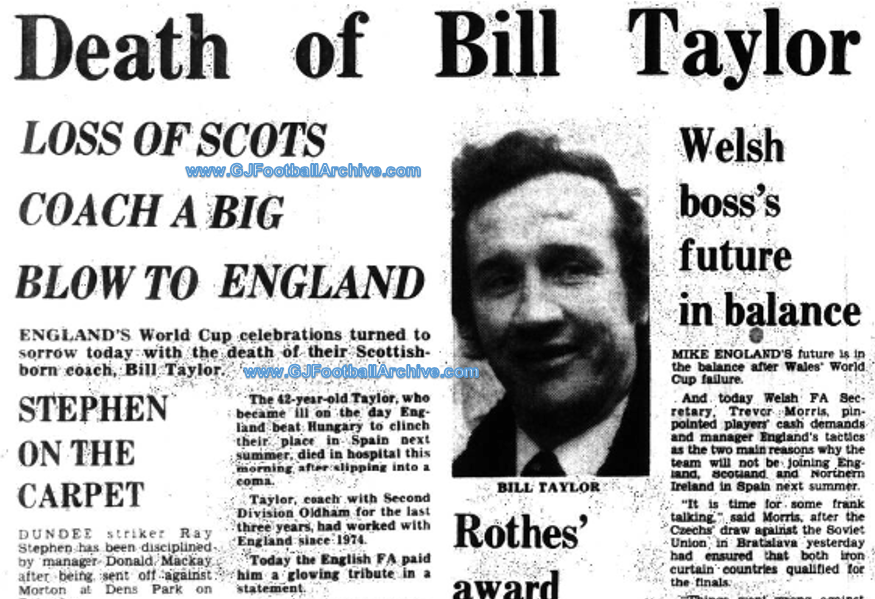
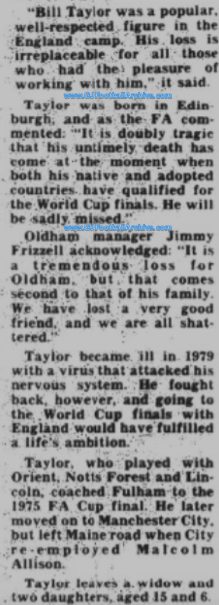
Bill Taylor

On this day (30 November) in 1981 former Manchester City, Oldham & England coach Bill Taylor died at the age of 42. Taylor was a tremendous coach who joined City from Fulham in 1976 and also coached England. At the time goalkeeper Joe Corrigan commented:  “His coaching methods were an inspiration to so many players and he helped tremendously to improve many of them.  He was always a bright and breezy character and he had a terrific sense of humour.  I can never repay the debt I owe him for the help he gave me both with City and England.” 

A Shock Transfer From Spurs

Today (5 November) marks the anniversary of a shock transfer of an England international from Tottenham to Manchester City only a few days before an England game. The player even travelled on the Tottenham coach to Manchester as the two teams were about to play each other. You can read the story and match reports here:

Subscribe to get access

Read more of this content when you subscribe today. If you’d like to support my research then why not subscribe? Every subscription directly helps support my research and provides annual subscribers with access to everything posted on this site, including the entire Manchester A Football History and From Maine Men To Banana Citizens books, plus interviews, articles and more. I am not employed by anyone and all my research is self funded or comes from subscriptions to this site. £20 per year or £3 per month.

Subscribe to get access

Read more of this content when you subscribe today. You can subscribe at either £20 per year (above) or at £3 per month here (cancel any time). For those subscribing £3 per month you will be able to access all content from October 2022 onwards for as long as you are a subscriber. Those subscribing £20 a year have access to everything posted since December 2020.

“Stanley’s Match” – England 8 Scotland 0 16th October 1943

“When I heard the team I said two prayers.  One of thanks to the Scots for leaving me out, and one on behalf of Adam Little who had taken my place.  I knew then we’d do well to get away with less than five goals against.”  So said Bill Shankly referring to the selection of the England team to face Scotland at Maine Road in October 1943. You can read the story of this incredible game here:

Subscribe to get access

Read more of this content when you subscribe today.

Subscribe to get access

Read more of this content when you subscribe today. You can subscribe at either £20 per year (above) or at £3 per month here (cancel any time). For those subscribing £3 per month you will be able to access all content from October 2022 onwards for as long as you are a subscriber. Those subscribing £20 a year have access to everything posted since December 2020.