Eighty years ago today (26 February 1946) Colin Bell was born. The above photo comes from Peter Barnes’ collection and was taken at Champneys where City were staying prior to the League Cup final in 1976. It was, of course, Colin’s 30th birthday. My thoughts and best wishes are with Colin’s family today.
Sadly Colin, recognised by most Manchester City fans as the greatest ever player for the club, passed away in January 2021.
I’ve interviewed Colin and written a lot about him over the years. A few posts are available (free to read) here for anyone who wants to learn more about Colin or remember some of his incredible achievements:
On This Day in 1977: Colin Bell’s Emotional Return
City 4 Newcastle United 0
Division One
26th December 1977
City Team: Corrigan, Clements, Donachie, Booth, Watson, Power (Bell), Barnes, Owen, Kidd, Hartford, Tueart
Attendance: 45,811
This match has entered Manchester folklore as one of those games you just had to experience to fully appreciate. All of those present that night from players, to fans, club officials to newspaper reporters, talk of this afternoon as one of football’s most emotional nights.
The story of Colin Bell and his injury had become one of football’s most discussed issues. The teatime BBC television news show Nationwide had profiled Colin’s tragic story and as a result the player received thousands of good luck messages from neutrals and ordinary non-footballing members of the public. They had been touched by his long, hard training schedules; his lonely runs through the streets of Moss Side and Rusholme; and by his absolute determination to return to full fitness. To them Colin’s story was incredible, to City and England supporters it was a deeply disappointing and tragic story.
Colin’s gruelling training regime ensured he forced his way into manager Tony Book’s thinking by December 1977, and on Boxing Day he was named as substitute for the visit of Newcastle. Anticipation was high as supporters believed this would be the day they would see their hero return to action.
Chairman Peter Swales rated Colin highly and shortly before his death in 1996 the former Chairman explained: “The supporters loved him. You can never kid supporters. They know great players. It’s no good a manager saying, ‘this is the best player we’ve ever had’. The supporters will know after a few weeks whether he really is the best. Bell was the best. No question.”
On the night itself Tony Book had planned to send Colin on as substitute for the final twenty minutes, but an injury to Paul Power meant the manager had to take decisive action. The supporters didn’t realise, but as the players were making their way into the dressing room for the interval, it was decided that Colin would play the second half. During the interval fans started to speculate as to when they would see their hero, with the majority believing he would come on for the final flourish, but then as the players came back out on to the pitch it was clear that Paul Power was missing and that Colin was coming on.
The stadium erupted and the fans on the Kippax terracing began to chant his name. It was a truly marvellous sight and the tremendous feeling of anticipation and excitement had never been felt midway through a match for any player before. It was the most amazing individual moment witnessed at the old ground. Dennis Tueart, a player on that day, remembers: “He came on at half time, and it was like World War Three. I’ve never known a noise like it in all my life! The crowd gave him a standing ovation and he hadn’t even touched the ball. I’ve never seen a guy work as hard to get back. The hours and hours he put in. The pain he went through… it was a phenomenal amount of work and he definitely deserved that ovation.”
For the player himself the day remained one of the most significant memories of his life when I interviewed him in 2005. “As I came down the tunnel I could hear a whisper go right round the ground. I knew that reception was for me alone. I was never an emotional player but that afternoon I got a big lump in my throat. I’ve been lucky to win cups and medals and play internationals, but of all my great football memories, that is the one that sticks in my mind.”
“The City crowd and I had this mutual respect really, and that standing ovation from over 40,000 people brought a lump to my throat for the only time in my career.”
The substitution totally transformed the atmosphere and the result. The game had been goalless, but the Blues tore into Newcastle as if they were playing in the most important game of all time. Dennis Tueart played superbly and scored a hat-trick, with Brian Kidd also scoring, to make it a convincing 4-0 win for the Blues. At one point Colin had a header which just sneaked over the bar, but the fairytale goal on his return did not arrive.
When I interviewed him years later a modest Colin felt he didn’t contribute a great deal: “I don’t think I touched the ball. It was ten men versus eleven, but the atmosphere got to our team and we ran away with it.”
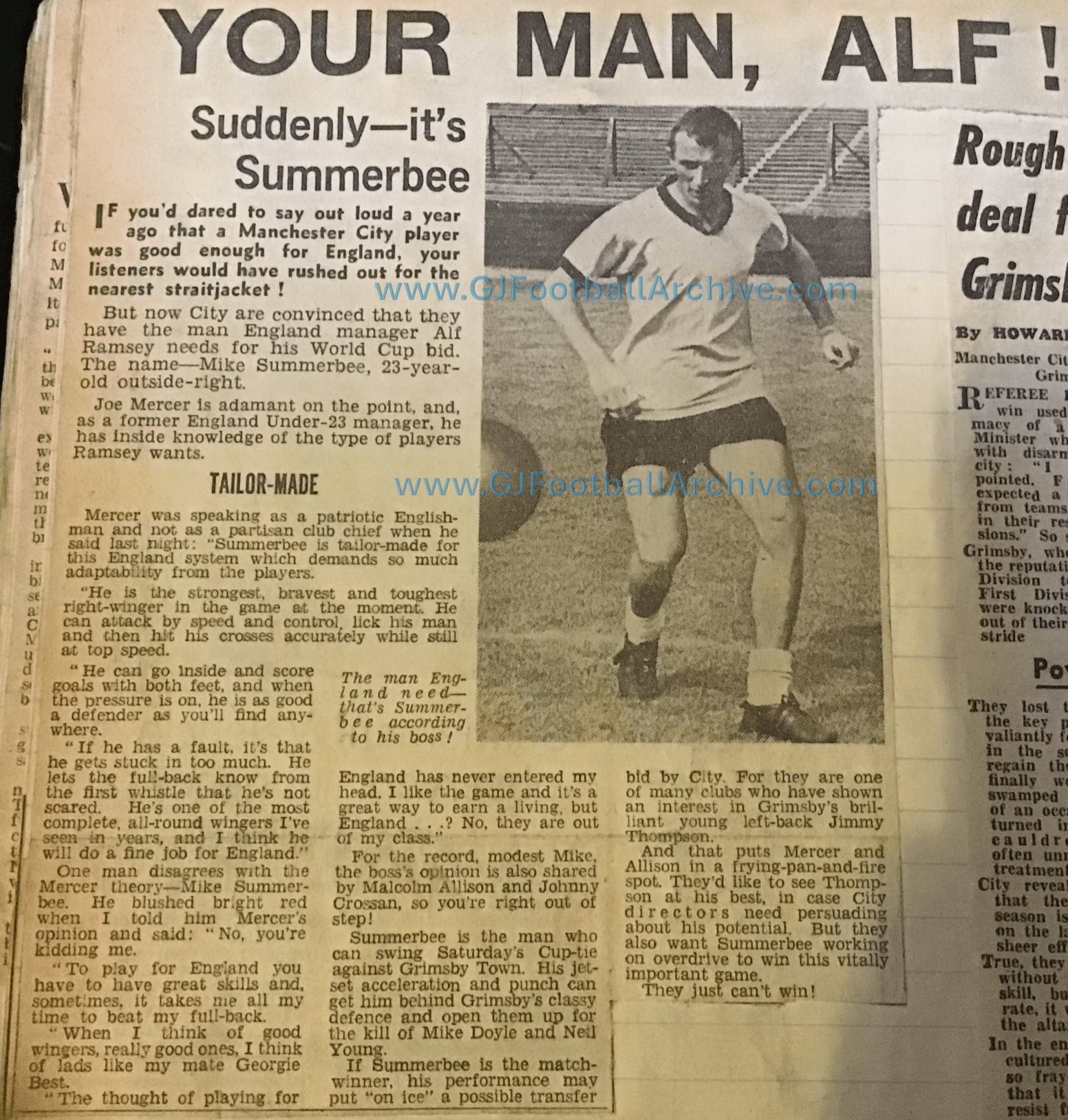
This week in 1966 Manchester City manager (and future England boss) Joe Mercer told journalists that he believed that Mike Summerbee was ready to play for England. Mercer felt Summerbee could play in the following summer’s World Cup and urged Alf Ramsey to pick the City star. You can see one of the many articles published about this here. As for Mike Summerbee… Summerbee was flattered and slightly embarrassed about Mercer’s claims but many neutrals believed the City star deserved the opportunity.
You can find out more on Manchester City during the 1965-66 season by reading the following 4100 word article. As with most of the other features in this series it includes words from interviews I have performed with those who were there. This is a subscriber article (see below).
Subscribe to get access
Read more of this content when you subscribe today. It costs £3 per month (cancel anytime) or sign up for a year at the discounted price of £20 per year (works out £1.67 per month). Subscribers access the 1000+ articles posted so far and the others scheduled during the life of your subscription.
If you enjoy all the free material on my website and would like to support my research and keep this website going (but don’t want to subscribe) then why not make a one-time donation (or buy me a coffee). All support for my research is valued and welcome. It allows me to keep some free material available for all. Thanks.
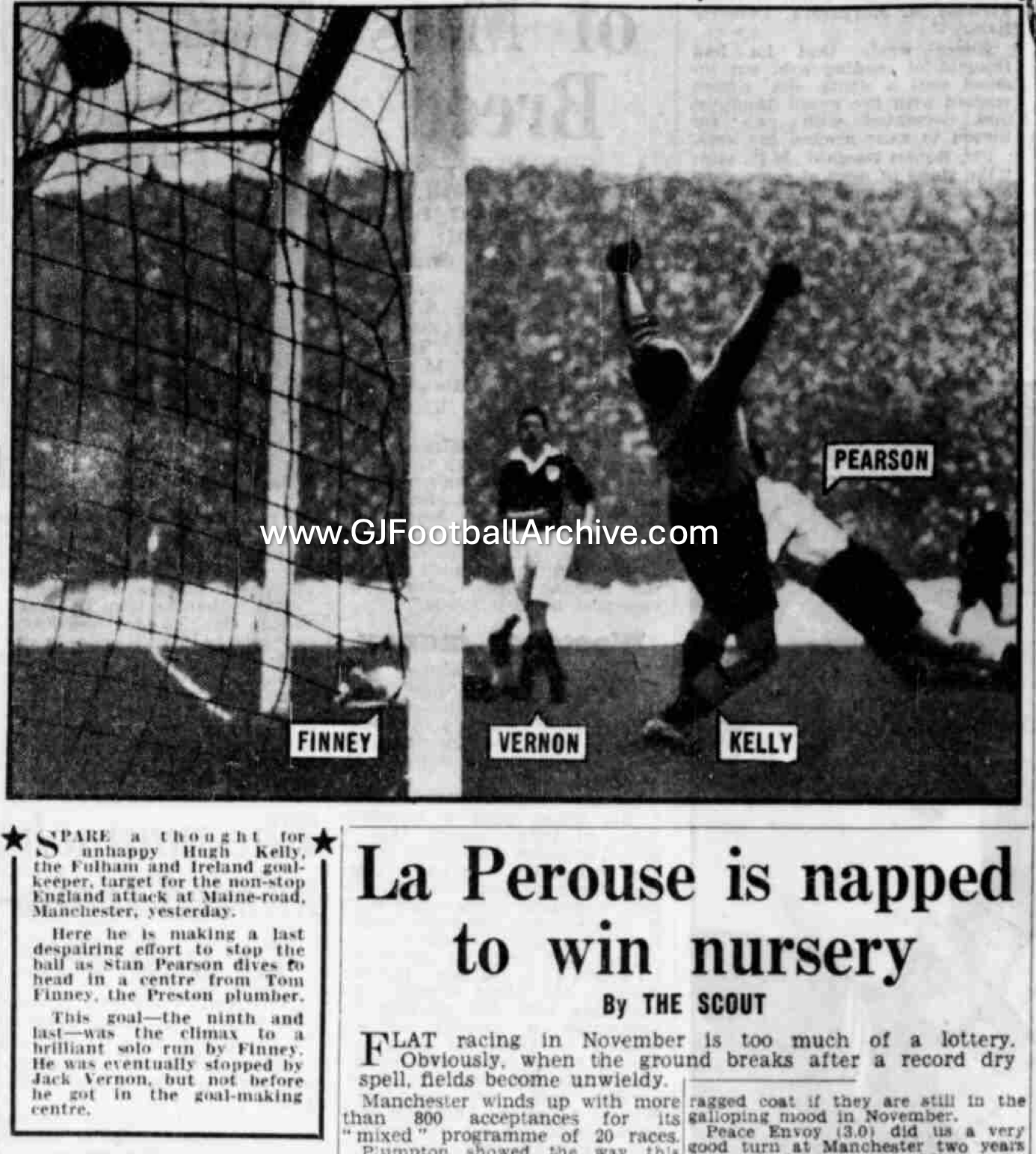
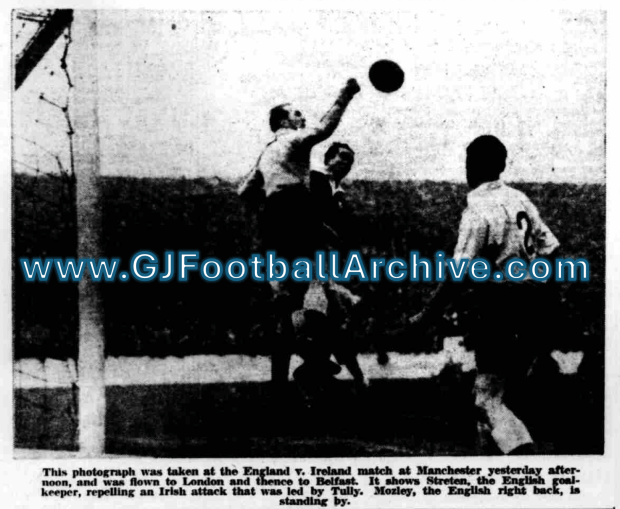
Here’s a report, image and film from the first World Cup qualifying match played in England (from this date, 16 November, in 1949). It saw England thrash Ireland 9-2 at Maine Road. This was a historic game for obvious reasons and the match programme explained how the World Cup operated as this was the first time England had participated in the tournament.
Last Saturday (25 October 2025) I was fortunate to be invited to the England v Brazil women’s international as a guest of the FA. My seat was in the Royal Box at the Etihad (City of Manchester Stadium as it was named on the night due to sponsorship reasons). On social media someone commented that the Royal Box was a bit of a stretch in terms of its name but the truth is that the Directors Box (as it’s more commonly known) has housed members of the British royal family, including the late Queen Elizabeth II. In fact it was originally named the Royal Box for the Commonwealth Games in 2002. Back then I remember suggesting it should retain the name and now, maybe, the original name should return?
Other royals, including the former King of Spain, have sat there for Manchester City games and other events, so the name would be quite apt. Funnily enough, the Etihad’s ‘Royal Box’ isn’t the first part of a City ground to be given that name. It’s not even the second but the third! Both Maine Road and before that Hyde Road, had visits from senior members of the British Royal Family and on each occasion the Directors Box was spruced up and renamed the Royal Box for the game. Here’s the current King’s great grandad at Hyde Road’s Royal Box in 1920:
The King with the Mayor in Hyde Road’s ‘Royal Box’. Notice Lawrence Furniss stood, behind the King. Furniss was a major figure from the 1880s to the 1940s at City.
So, City, how about renaming the Directors Box the Royal Box again?
The following subscriber article talks about all of that, but in essence the current King’s dad, grandad and great grandad have all attended City matches at one of City’s home grounds. You can read about those visits here:
Subscribe to get access – Monthly
Read this 1,600 word article when you subscribe today. It costs £3 per month (cancel any time) or £20 a year. As well as this article you get to access books, videos, history talks, interviews and other articles.
Annual subscribers access everything since the site went live in December 2020. Monthly subscribers get everything since 1 October 2022. All subscribers access new posts throughout their subscription.
“When I heard the team I said two prayers. One of thanks to the Scots for leaving me out, and one on behalf of Adam Little who had taken my place. I knew then we’d do well to get away with less than five goals against.” So said Bill Shankly referring to the selection of the England team to face Scotland at Maine Road in October 1943. You can read the story of this incredible game here:
Subscribe to get access
Read more of this content when you subscribe today.
Read more of this content when you subscribe today. You can subscribe at either £20 per year (above) or at £3 per month here (cancel any time). For those subscribing £3 per month you will be able to access all content from October 2022 onwards for as long as you are a subscriber. Those subscribing £20 a year have access to everything posted since December 2020.
Forty years ago today (29 September 1985) it was reported that Manchester United’s winger Peter Barnes was being considered for a place in Bobby Robson’s England. The former City player had dropped out of the England squad a few years earlier but, as this report shows, his form for United brought him back in contention for an England place.
Sadly, injury ended the prospect for the talented winger.
You can read Peter’s story in the authorised biography I have written on him. It covers every aspect of his career. Details here:
Continuing the series on Manchester City in the 1920s today’s free article is about the City England international (in fact City’s first England international!) who became the manager of Milan in 1926. Here goes…
The first Manchester City player to appear for England was Herbert Burgess, who was reportedly born in Openshaw on 25 February 1883. Burgess was a left back but, according to articles at the time, was only 5ft 4.75 inches tall (weighing 11st 7lbs).
He made his first England appearance against Wales, and City teammate Billy Meredith, in February 1904 and did well in a game that ended 2-2 at Wrexham.
Prior to City Burgess had joined Football League side Glossop in March 1900 and, after three good years there, he moved to City on 30 July 1903. The fee City paid was £250. This was a period when Manchester’s Blues seemed to be cherry-picking the best Glossop had to offer and one report even suggested the nearby club was becoming a nursery club for City.
Burgess made three international appearances in 1904 with the Welsh game followed by a 3-1 victory over Ireland at Solitude, Belfast in March and a 1-0 win over Scotland at Parkhead, Glasgow on 9 April 1904. Only two weeks later Burgess helped City to FA Cup success (they became the first Manchester team to win a major trophy) and the Blues were also League runners up. These were great days for Burgess.
He made one further appearance for England – a 2-1 defeat at Hampden Park on 7 April 1906, played in front of 102,741 – and was furious that one of the Scotland goals was allowed to stand.
This period was a tough one for Burgess as the illegal payments scandal at City completely rocked his world. He was one of 17 players suspended by the FA (I can talk about this for days – it was so unfair and northern newspapers believed it was some sort of conspiracy by the southern based FA!).
Burgess was forced to leave City and, along with other star men, including Billy Meredith, he joined the then underdogs Manchester United and helped them achieve their first major success. He then moved to Denmark and played for Kristiania before joining Hungarian club MTK Budapest.
When his playing days came to an end he became Budapest’s manager and then managed Padova (1922-1926). He left Padova to become Milan’s manager in 1926 and after two years there he returned to Padova.
From 1930 to 1932 Burgess managed another Italian club, Roma. This photo is of Burgess (with cap on) as manager of AS Roma.
Burgess immediately etched his own name into the history of Roma, winning the first ever Rome derby in only his second game in charge. Roma won 1-0 win at Lazio’s Stadio della Rondinella. Burgess also guided Roma to success in the second derby, winning 3-1, the following May, this time at their all-wooden ground Campo Testaccio.
Burgess never lost a Rome derby during his time there as they drew their subsequent two derbies under him. His Roma team also pushed eventual champions Juventus all the way in the 1930-31 campaign, finishing just four points behind Juventus as runners-up.
Sadly, it’s been reported that Italy’s development under the dictatorship of Mussolino meant that English coaches were under pressure to leave and Burgess returned to Manchester, taking a job as a labourer on a housing estate on the outskirts of Manchester. He also became trainer to Ashton National.
He died in 1954.
In total at City he made 94 first team appearances and scored two goals. Had the illegal payments scandal not occurred he may well have been an England regular for several years. As it is his career is pretty impressive for a lad born in Openshaw in the 1880s – FA Cup & League winner; England international; manager of prominent clubs in Hungary and Italy.
People tend to think that it’s only in the modern era that Manchester City have achieved anything or that footballers have gone abroad to coach major clubs like Milan, Budapest and Roma, but the truth is that men like Burgess achieved so much over a century ago. We must take steps to remember them. Oh, and while I’m here it’s worth pointing out that City did have international players for years before Burgess but they didn’t play for England.
The earliest played to make an international appearance while on City’s books made an appearance for Wales in 1890 when the club was still Ardwick. Maybe I’ll write about him one day too?
Subscribe to get access
If you have enjoyed this piece and would like to support my writing while also accessing further great content, then why not subscribe? Those who subscribe on an annual basis get access to everything posted on this site since December 2020 (including PDFs of 2 out of print books, and audio interviews with John Bond, Malcolm Allison etc.). Those subscribing on a monthly basis get access to everything posted since 1 October 2022. It’s £20 a year (subscribe here) or £3 per month (subscribe below). Why not try it for a month?
If you have enjoyed this piece and would like to support my writing while also accessing further great content, then why not subscribe? Those who subscribe on an annual basis get access to everything posted on this site since December 2020. Those subscribing on a monthly basis get access to everything posted since 1 October 2022. It’s £20 a year (subscribe above) or £3 per month (subscribe here). Why not try it for a month?
It’s wonderful that England have won, once again, the Women’s Euros. It’s so important for moments like this to be celebrated and recognised for the significant achievement they are. During recent weeks much has been said about the first England women’s international against Scotland back in 1972. That’s great – the history of women’s football in this country goes back a long way – however I am a little disappointed that the role of one significant figure in the development of international football has not really been mentioned. That’s he role of Gladys Aikin, the first chair of the England Women International Committee.
Gladys was the manager of the Manchester Corinthians and she was one of the founding people behind the establishment of the Women’s FA. She was also someone who challenged the FA a ban and in the early 70s she worked with others to establish an England international team. She became the first chair (though she always described herself as Chairman using the convention of the time) of the England Women International Committee and was ultimately responsible for that first England squad (see letter).
I’ll be mentioning Gladys during the Free Corinthians event I’m staging at Hebden Bridge on Saturday 2 August (4pm-6pm) so why not come along and hear more on her and the Corinthians? Follow the link for tickets and details:
My latest article on women’s football has been published. This one looks back to 1957 when a Manchester club (chosen by Bert Trautmann to play) represented England in a European Cup in Germany. The article has been posted by Manchester City. You can access it via this link:
I was interviewed on this day (17 February) in 2021 about the great Joe Mercer for the ‘esk podcast’ – an Everton podcast. I talk about meeting Joe; about writing his biography; about Joe’s time at Everton, Arsenal, Manchester City and so on. I also tell the story of Norah Mercer insisting that Bobby Charlton phones me to apologize (it was somewhat of a shock at the time)! We also discussed Everton and City in preparation for their game that night (17th February 2021). No matter who you support it’s well worth listening to.
If you enjoy all the free material on my website and would like to support my research and keep this website going (but don’t want to subscribe) then why not make a one-time donation (or buy me a coffee). All support for my research is valued and welcome. It allows me to keep some free material available for all. Thanks.





 Gary James' Football Archive