This site was launched on January 1 this year and already I’ve reached the 300th post. I’d like to take this opportunity of thanking all those who have commented on the site and, especially, those who have subscribed. 22,326 people have visited the site since it’s launch. I’m bowled over by the response. It really is appreciated.
For those that haven’t subscribed here’s some background to the site and comments on the material that you can find here.
I set the site up as an archive of new writing and of my past works with the intention being that over time as much of my past writing can be posted here for the enjoyment of subscribers. Subscribers can access all content on here, including the entire 2010 edition of my Manchester A Football History book (PDFs of every chapter from this out of print history of men’s football within the Manchester region) and exclusive audio interviews with John Bond, Malcolm Allison and George Graham. Much more to come of course.
There’s also the oldest surviving film of Manchester City Ladies (now Women), captured in January 1989 and numerous other articles (including some of my academic work) and stories.
Many of the articles are in-depth pieces of several thousand words.
If you would like to see the type of feature that’s been posted and do not currently subscribe use the ‘Free’ tab above to see a selection of posts, including an audio interview with Trevor Sinclair and profiles of Colin Bell, Sergio Agüero plus others.
For those of you that do subscribe I’d like to say ‘thanks’. It really is appreciated and I hope you’re happy with everything on the site. If you would like to suggest content (don’t worry I’ve got plenty scheduled over the coming months, but I’m always open to ideas from subscribers) then please contact me.
I’ve been asked a few times why I’ve set this site up and why much content is only available to subscribers. Well, at present I do not have a regular outlet for my writing, research and interviews and so I’ve set up this website to help share my 32 years plus writing and research. The intention is to develop the archive and to provide access to as much of my material as possible over the coming weeks, months & years.
I am not employed by anyone and no one pays me to do research or interviews. Similarly, I do not have sponsorship or advertising either and so the choice was either find advertisers (which potentially may then have a detrimental effect on one of the other great Manchester writers/bloggers/vloggers who do have advertising – there’s only so many advertisers to go around) or have a subscription model. I chose the subscription model as this seems fairest. If people want to subscribe then that’s appreciated and I’m grateful; if not then that’s absolutely fine. That’s personal choice which I always support.
It costs £20 a year (it works out £1.67 a month) or £3 if you’d like to sign up a month at a time to get full access for as long as you subscribe (you can always try it for a month if you’ve doubts). It’s worth bearing in mind that the 2010 Manchester A Football History cost £24.95 and all subscribers will be able to access all of that for as long as they are a subscriber (plus all the other stuff of course). You can subscribe below.
On this day (March 31) in 1971 holders Manchester City were forced to play a European Cup Winners’ Cup game at a neutral ground. These were the days before penalty shoot outs decided ties. For subscribers to my site, here’s the story of that game:
Subscribe to get access
Subscribing to this site will provide access to this article and the other 290+ articles plus hundreds more scheduled over the coming months. It costs £20 per year (works out about £1.67 per month). Thanks
On this day (30th March) in 1993 I travelled to Arsenal’s old stadium, Highbury, to interview the Arsenal manager George Graham, not about the Gunners’ form that season but about his former boss – and Arsenal legend – Joe Mercer.
Joe was the Aston Villa manager who brought George to England many, many years before George had found fame as a footballer and Joe had taken Manchester City to their first European honour. Joe did win the League Cup as Aston Villa boss, but these were not great days for the former Everton and Arsenal playing legend, but he did always feel responsible for bringing George to England (and loved the success he brought Arsenal).
My interview with George had been arranged for Tuesday 30th March 1993 some time in advance but then Arsenal’s FA Cup semi-final with Tottenham was scheduled for the following Sunday at Wembley (a highly unusual occurrence at the time!). I expected to get a call cancelling the interview but instead George decided to go ahead with it.
On the day I parked up outside Highbury quite early but as I pulled up I saw George leave the stadium and jump into a car. I was early, so wasn’t too worried. Then I remembered the FA Cup semi-final and assumed that George would be busy with plans. I expected to be told when I entered the marble hall at Highbury that the meeting would be off.
When I spoke with the reception staff they told me to take a seat. They said that George had been called away and so could be a few minutes late (which he was). I was relieved because I’d been convinced he would cancel (it’s happened often with other busy managers).
I sat in reception thinking about the chat and then, a few minutes after we were due to meet, George walked in. He spoke with the receptionist and then came towards me, hand out, saying ‘I’m George Graham’ (I remember thinking ‘I know’ but I did love the fact that he introduced himself). He took me up to his impressive office at Highbury – no other offices at any ground I had been to at that time could match the quality and status of that room.
We then did the interview. It’s not my best – I think I was overawed by the situation – but I was appreciative of George’s time. During the interview Stewart Houston, his assistant, popped in to check something with George (I turned off my recorder) and George ushered him away, telling him that he was busy. Again, I loved this – other managers have sometimes disappeared and not come back but for George he’d set this time aside to see me and chat about Joe Mercer and that’s what he was doing.
Arsenal beat Spurs that weekend so, I suppose, George knew what he was doing but I do remember watching that game on TV thinking that if Arsenal lose I’d never be able to tell anyone that George had spent time being pestered about Joe Mercer when he should’ve been preparing for Tottenham!
If you subscribe to this site you can hear the interview below. I have been researching and writing for a long time and my Joe Mercer book was my third (first published in 1993). I am not employed by anyone and I do not have sponsorship either and so I’ve set up this website to help share my 32 years plus writing and research. The intention is to develop the archive and to provide access to as much of my material as possible over the coming weeks, months & years. Subscribers can already access over 280 articles/posts including the entire Manchester A Football History book and audio interviews with Malcolm Allison and John Bond.
It costs £20 a year (it works out £1.67 a month) or £3 if you’d like to sign up a month at a time to get full access for as long as you subscribe.
Anyway, here’s the George Graham interview:
Subscribe to Listen
To listen please subscribe. Each subscriber gets full access to the 290+ articles posted so far and the hundreds scheduled to be posted in the coming weeks.
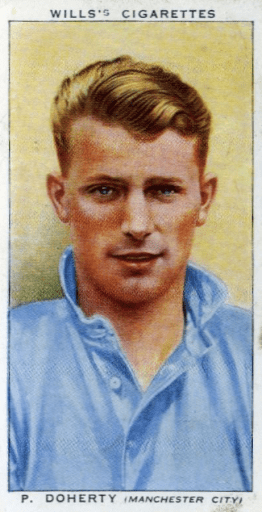
In 2019 I wrote this profile of Peter Doherty – a man who well into the 1970s was described as the greatest Manchester City player of all time. Of course, views change and other heroes have come and sadly gone since then, but it is clear that Doherty was the leading player of his generation.
Subscribers to my site can read the article below:
Subscribe to get access
If you would like to read this and all the in-depth articles on this site (including the entire Manchester A Football History book and my audio interview with John Bond) then please subscribe. It works out about £1.67 a month if you take out an annual subscription (£20 per year) or £3 a month if you’d like to sign up for a month at a time. Each subscriber gets full access to the 250+ articles posted so far and the hundreds scheduled to be posted in the coming weeks.
Score United 1 City 3, Attendance 63,004 Old Trafford
Rather than settling a relegation issue, this match was perceived more as a title decider. Prior to the match United were 2 points clear of the Blues at the top of the table, and were favourites for the League title, but the City of Mercer & Allison wanted to challenge United’s stranglehold on local football. If the Blues were to make a name for themselves they had to beat the Reds. It was as simple as that. Here for subscribers is the story of that game…
Subscribe to get access
Read more of this content when you subscribe today.
If you would like to read this and all the in-depth articles on this site (including the entire Manchester A Football History book and the audio interview with John Bond) then please subscribe. It works out about £1.67 a month if you take out an annual subscription (£20 per year) or £3 a month if you’d like to sign up for a month at a time. Each subscriber gets full access to the 280+ articles posted so far and the hundreds scheduled to be posted in the coming weeks.
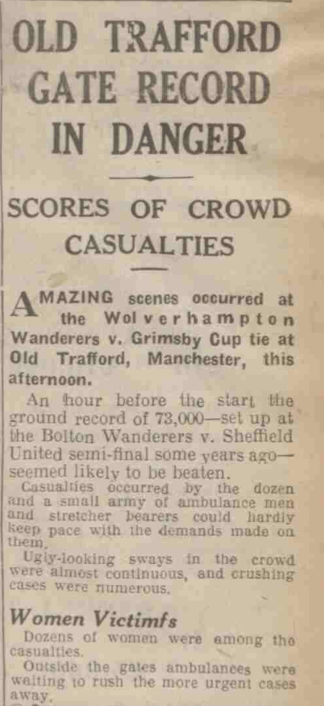
On this day (March 25) in 1939 Old Trafford attracted its highest ever attendance when 76,962 packed Manchester United’s ground to see Wolves defeat Grimsby 5-0 in the FA Cup semi-final.
At the time this was the third highest attendance ever attracted in Manchester (behind 84,569 MCFC v Stoke, 1934 & 79,491 MCFC v Arsenal, 1935; fourth highest was 76,166 MCFC v Cardiff, 1924) and today it is the eighth highest.
You can view film of the semi-final here. Well worth watching to see Old Trafford at that time. The Old Trafford scenes begin after about 48 seconds:
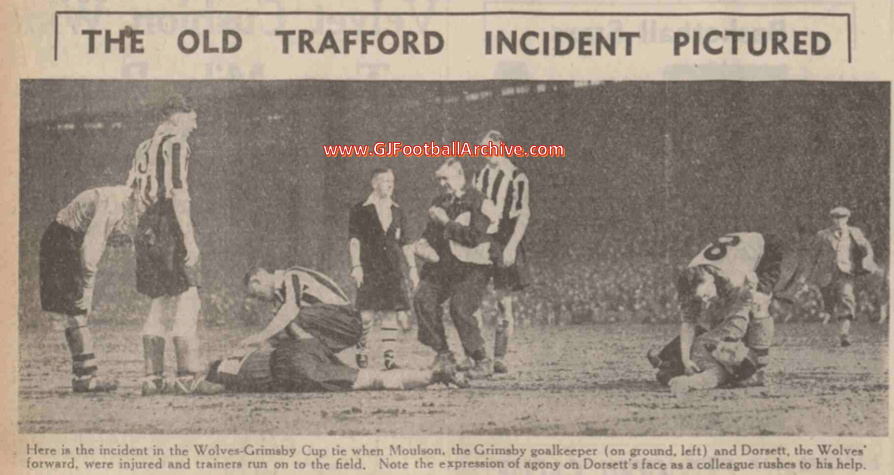
There were lots of crowd safety issues at this game – these were the days when fans were packed in without the authorities really considering the potential for disaster or injury (which happened frequently).
Incidentally, Dorsett (seen below after a collision) was related to two of Manchester City’s early heroes Joe and George Dorsett.
You can read about the 84,569 record attendance set in 1934 for Manchester here:
I’d like to thank you for taking the time and trouble to visit my website. I set up this website in December 2020 to help share my 32 years plus writing and research. The intention is to develop the archive and to provide access to as much of my material as possible over the coming weeks, months & years. Annual subscribers can access everything on here including the entire Manchester A Football History book and audio interviews with former City bosses Malcolm Allison and John Bond.
It costs £20 a year (it works out £1.67 a month) or £3 if you’d like to sign up a month at a time to get full access for as long as you subscribe (see below). Thanks for the support, Gary.
It costs £3 if you’d like to sign up a month at a time to get full access to everything posted since 1 October 2022 and for as long as you subscribe (see below). Thanks for the support, Gary.
On this day (25th March) in 1998 Manchester City cult hero Ian Bishop returned to the club. Here subscribers can read an interview I did with the former Bournemouth, West Ham and City player in 2015.
Subscribe to get access
To read this and all the other content on this site please subscribe. It works out about £1.67 a month if you take out an annual subscription (£20 per year) or £3 a month if you’d like to sign up for a month at a time. Each subscriber gets full access to the 280+ articles posted so far and the hundreds scheduled to be posted in the coming weeks.
The news that Manchester City will be installing rail seats at the Etihad this summer (2021) means that for the first time since 1994 the stadium will possess a section that is designed to allow people to stand. Whether officially they’ll be allowed to depends on the legislation in place at the time but, whichever way you look at it, this is good news for those who like to stand at football matches.
It is now almost 27 years since we said goodbye to terracing in Manchester and for those of us old enough to remember those days at Maine Road there was one standing area which, above all else, represented the passion fans had for their club – The Kippax.
Unlike most other grounds City’s main terracing ran the full length of the pitch and wasn’t tucked away behind a goal. Because of its positioning the Kippax breathed life into every area of the stadium and was huge. Originally, it held in excess of 35,000, but even in its final days it still gave the impression of power and passion.
The Kippax was originally known as the Popular Side, matching a similarly dominant feature of the Blues’ Hyde Road ground, when it opened in 1923. That first season it held an estimated 35,000 in a crowd of 76,166 – then a national record attendance for a club ground. In 1934 when 84,569 packed into the stadium City’s vast stand may well have held almost 40,000. Incidentally, that 84,569 became the new national record attendance for a club ground (a record that still stands as Wembley is a national stadium, not officially a club ground). You can read about that crowd and game here:
Incidentally, I know City fans get a lot of abuse these days from fans of certain other clubs about filling stadia etc. Well, if you need any ammunition that 84,569 record crowd is over 22,000 higher than Liverpool’s record crowd (61,905 – a figure which wouldn’t get anywhere near City’s top ten crowds!).
Throughout the period up to the mid-50s the Popular Side developed its reputation but it was when it was roofed in 1957 that it became the true heart of the club. Back then it was extended slightly, although legislative changes had reduced terracing capacities by this time. The club announced it would be known as The Kippax Street Stand and that is what it officially remained until 1994 although most of us knew it simply as The Kippax. Its capacity by this time was about 32,000, reducing to 26,155 by the end of the 1970s.
The Kippax accommodated fans of every age and gender and, although it was a formidable place for opposition supporters, it was a welcoming stand for Manchester’s Blues. Young children would sit on the walls and railings, while older fans would find their own preferred viewing spot. Here’s a few snippets about the old stand:
Originally four vast tunnels (one in each corner and two built into the stand) and two significant stairways allowed fans to move onto the Popular Side.
A flag pole, positioned at the back of the terracing up to 1957, allowed a blue and white flag emblazoned with the words City FC to proudly fly. The flag was then re-positioned until it disappeared for good in the 1960s.
Chanters Corner, also known as The Sways, was the area where the more vocal members of City’s support gathered. Packed above a tunnel and next to the segregation fence, fans here often generated the main chants.
The 1960s saw The Kippax’s reputation grow. Fans sang their way through success after success as Joe Mercer’s Aces won the European Cup Winners’ Cup and every domestic trophy possible. The Kippax would begin every game with the chant “Bring on the Champions!” and then follow up with a song for every player as they warmed up.
The final capacity of The Kippax was 18,300 – making this the largest terraced area at a League ground on its final day (The Kop held its final game on the same day but had a smaller capacity).
The Kippax was used for the last time on 30 April 1994 for the visit of Chelsea.
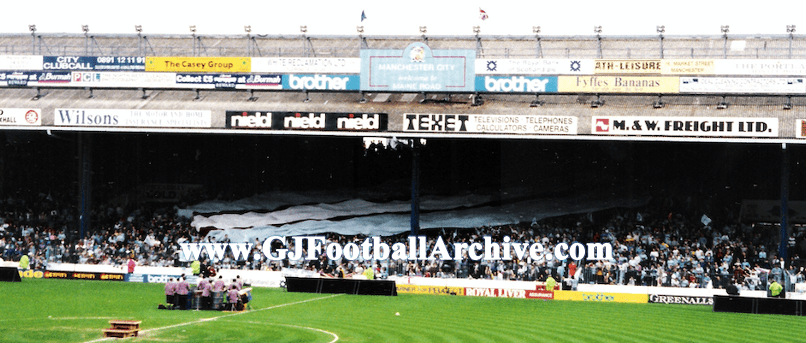
The Blue Print flag was a popular presence on many match days from the late 1980s until 1994, making its last appearance at The Kippax’s final game. The flag had been reduced in size by then. But it still covered much of the terracing. Blue Print was a City fanzine and they had paid for the flag.
Segregation was unnecessary for most of the stand’s existence, but by the end of the 1960s a rope would often be used to separate City and United fans on derby day. This was replaced by permanent barriers in the mid-70s which were increased over the years to keep home and away fans apart. Away fans were positioned at the Platt Lane end of the stand by this time.
It says much about the passion of the place that in the late 1970s the BBC came to film The Kippax chanting and in full flow.
In 1985 when City defeated Charlton 5-1 in a promotion decider on the final day of the season the Kippax was so packed that supporters remain convinced that its official capacity of 26,155 was significantly exceeded. Those of us on the terraces that day will never forget the shock we all experienced when the official crowd of 47,285 was announced – some 5,000 short of capacity!
The Kippax is no more, but those of us who experienced the stand will never forget its power, passion and presence. Its spirit lives on with thousands of Blues who stood there now bringing their own children and grandchildren to the Etihad who, if legislation allows, will soon be able to stand in a section specifically created for that purpose.
If you’re interested you can read how Maine Road got its name here:
While you’re here I’d like to thank you for taking the time and trouble to visit my website. I am not employed by anyone and no one pays me to do research or interviews. I do not have sponsorship or advertising either. I’ve set up this website to help share my 32 years plus writing and research. The intention is to develop the archive and to provide access to as much of my material as possible over the coming weeks, months & years. Subscribers can already access over 280 articles/posts including the entire Manchester A Football History book and audio interviews with former City bosses Malcolm Allison and John Bond.
It costs £20 a year (it works out £1.67 a month) or £3 if you’d like to sign up a month at a time to get full access for as long as you subscribe (see below). Thanks for the support, Gary.
Subscribe to get access
This has been a sample of the material on http://www.GJFootballArchive.com If you would like to read all the in-depth articles and listen to the audio interviews then please subscribe. It works out about £1.67 a month if you take out an annual subscription (£20 per year). Each subscriber gets full access to the 280+ articles posted so far and the hundreds scheduled to be posted in the coming weeks.
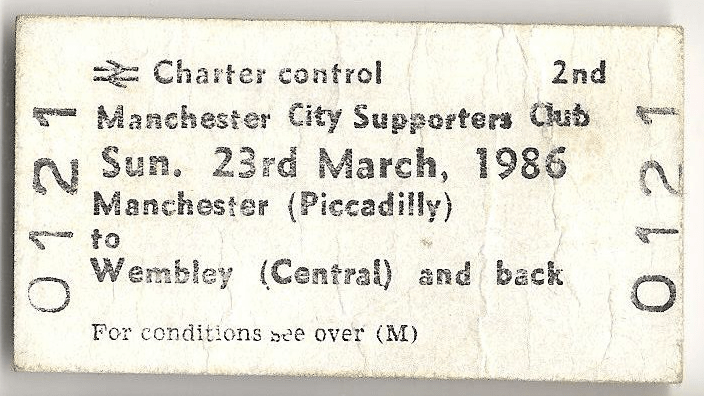
Today (23rd March) marks the anniversary of the first Wembley meeting between Manchester City and Chelsea. That was the 1986 Full Members’ Cup final. Here for subscribers to this site is an article on the competition and some film of the final:
Subscribe to get access – Annual
If you would like to read this and all the in-depth articles on this site (including the entire Manchester A Football History book and the audio interview with John Bond) then please subscribe. It works out about £1.67 a month if you take out an annual subscription (£20 per year) or £3 a month if you’d like to sign up for a month at a time (see below). Annual subscribers gets full access to everything posted to the site since December 2020 and the hundreds scheduled to be posted in the coming weeks.
Those subscribing at £3 a month get this article and full access to everything posted to the site since 1st October 2022 and everything posted during your subscription. Why not sign up for a month and give it a try?





 Gary James' Football Archive