Trevor Sinclair Interview

The first Manchester derby at Manchester City’s new stadium occurred on this date (14th March) in 2004. To mark this anniversary I’ve interviewed former City winger Trevor Sinclair. Trevor scored in that game, which the Blues won 4-1. Here he talks about being a City fan; signing for City; scoring the first competitive goal at the City Of Manchester Stadium (now Etihad); and the 4-1 derby. He also talks about the 3-1 victory over Manchester United in 2006 (again he scored); present day City and other memories. 

Here’s the audio from our chat (it lasts about 26 minutes so get yourself a brew and settle down to listen):

While you’re here I’d like to thank you for taking the time and trouble to visit my website. I have been researching and writing about Manchester football for a long time (no wonder I’m going grey!) with my first book published in 1989. I am not employed by anyone and no one pays me to do research or interviews like the one posted here. I do not have sponsorship either. I’ve set up this website to help share my 32 years plus writing and research.

From Wednesday, for subscribers I’ll be posting the entire hour long plus interview I did with Malcolm Allison about his first period at Manchester City. Here’s a brief clip from the interview (he’s talking about his relationship with Joe Mercer):

The intention is to develop the archive and to provide access to as much of my material as possible over the coming weeks, months & years. Subscribers can already access over 280 articles/posts including the entire Manchester A Football History book and an audio interview with former City boss John Bond I performed in 1995. My interview with Allison will also be available from Wednesday.

If you’d like to support my research and writing while benefitting from accessing all the content on here then it costs £20 a year (it works out £1.67 a month) or £3 if you’d like to sign up a month at a time (you get full access for as long as you subscribe).

If you enjoyed the interview posted here then please subscribe (see below) to access all the content and, over time, I’ll add other interviews too. Thanks for the support and interest in my work, Gary.

Subscribe here for £20 per year or £3 per month

Each subscriber gets full access to the 280+ articles posted so far and the hundreds scheduled to be posted in the coming months.

If you would like to read about other Manchester derbies then check out this:

https://gjfootballarchive.com/category/manchester-derbies/

Decisive Derbies MCFC v MUFC 13 March 1974

Score 0-0, Attendance 51,331 Maine Road

The Old Trafford derby of 1974 is usually quoted as a decisive derby, however the Maine Road match was viewed at the time as being vital to United’s survival.  In fact in the programme Red manager Tommy Docherty claimed:  “Tonight’s game is one which decides our fate.  City’s League Cup defeat is a big anti-climax for them and could help our fight for First Division survival.” Here for subscribers to this site is the story of that game – a highly controversial one that was almost abandoned due to player indiscipline!

Subscribe to read this and all other content

If you would like to read this and all the in-depth articles on this site (including the entire Manchester A Football History book and the audio interview with John Bond) then please subscribe. It works out about £1.67 a month if you take out an annual subscription (£20 per year) or £3 a month if you’d like to sign up for a month at a time. Each subscriber gets full access to the 270+ articles posted so far and the hundreds scheduled to be posted in the coming weeks.

Coming Soon: My 1991 Malcolm Allison Interview

Thirty years ago, while researching for my biography of Joe Mercer, I interviewed Malcolm Allison in his flat at Yarm. Starting on Wednesday 17th March I will be serialising the interview over five days for subscribers to this site.

In the interview Malcolm talks about meeting Joe Mercer for the first time; joining Manchester City; the relationship with Joe; the signing the players; the major successes; the set-up of Manchester City at the time and much more.

Here’s a brief section of audio from our chat:

Obviously, this was recorded on an old cassette recorder so, at times, the quality is not the best, but I’m sure you’ll agree that this exclusive interview is worth listening to. To hear the entire interview please subscribe and from Wednesday the interview will be posted a section at a time over five days (it’s over 1 hour in total).

While you’re here I’d like to thank you for taking the time and trouble to visit my website. I have been researching and writing about Manchester football for a long time (no wonder I’m going grey!) with my first book published in 1989. I am not employed by anyone and I do not have sponsorship either and so I’ve set up this website to help share my 32 years plus writing and research. The intention is to develop the archive and to provide access to as much of my material as possible over the coming weeks, months & years. Subscribers can already access over 280 articles/posts including the entire Manchester A Football History book and an audio interview with former City boss John Bond I performed in 1995. 

It costs £20 a year (it works out £1.67 a month) or £3 if you’d like to sign up a month at a time to get full access for as long as you subscribe (see below). Thanks for the support, Gary.

Subscribe to get access to the entire site

£20 per year or £3 per month

European Tours

These days pre-season tours are an expected part of a football club’s activities but that’s not always been the case. Pre-1939 it was highly unusual for English teams to travel for friendlies before a season, but some clubs did enjoy post-season tours. The idea was that a trip to mainland Europe was a reward for first team players after an arduous season. Here for subscribers to my site is a brief overview of some of Manchester City’s European tour firsts.

Subscribe to get access

If you would like to read this and all the in-depth articles on this site (including the entire Manchester A Football History book and the audio interview with John Bond) then please subscribe. It works out about £1.67 a month if you take out an annual subscription (£20 per year) or £3 a month if you’d like to sign up for a month at a time. Each subscriber gets full access to the 250+ articles posted so far and the hundreds scheduled to be posted in the coming weeks.

80 Years Ago Today The Bombing of Old Trafford

On  this day (11th March) in 1941 Old Trafford was hit by bombs dropped by the German Luftwaffe.  The highly industrialised Trafford Park had been the target and by daybreak the news of damage to Old Trafford was circulating around Manchester, although the Manchester Guardian and other newspapers did not mention the ground by name.  Due to the wartime situation the newspaper did not want to give away too much information and reported:  “Slight damage was done to dwelling-houses in one or two working class districts and slight outbreaks of fire were reported from a football ground and a training institute.”

The ‘slight damage’ saw a bomb hit United’s Main Stand.  The stand was almost completely wrecked, while the pitch was scorched by the blast.  Manchester City contacted United and offered the use of Maine Road immediately and the first home United match to be staged at City’s ground was the 5th April meeting with Blackpool in the North Regional League.  The Seasiders’ won 3-2 before a crowd of around 2,000. 

Further wartime matches followed over the course of the next four years with United paying the Blues an annual rent of £5,000 plus a share of the gate receipts.  Initially City were to use United’s training ground, The Cliff, for reserve fixtures, but both sides also used Old Trafford at times.

After the war United were granted £4,800 to help cover the costs of tidying up the venue, and then a further £17,478 was given to help rebuild the Main Stand and damaged terracing.  This allowed the redevelopment of Old Trafford to commence and between 1945 and 1949 the Main Stand was rebuilt as was the terracing at the Popular Side (United Road).

This was a brief section from Manchester A Football History. The entire book (including images) is now free to download for subscribers to this site. See: https://gjfootballarchive.com/category/manchester-a-football-history/page/4/ or subscribe below.

Subscribe to get access

This is a sample of the in-depth material available on this site on Manchester’s clubs, players & grounds. If you would like to read all the in-depth articles (including the entire Manchester A Football History book) then please subscribe. It works out about £1.67 a month if you take out an annual subscription (£20 per year) or £3 a month if you’d like to sign up for a month at a time. Each subscriber gets full access to the 270+ articles posted so far and the hundreds scheduled to be posted in the coming weeks.

Ron Phoenix – 30/06/1929-09/03/2021

I have been informed by Matthew Phoenix that his father, Ron Phoenix died on 9th March from vascular dementia. Ron was on the books of both Manchester City and Manchester United, as well as Rochdale, Altrincham and Hyde. My thoughts are with Matthew and the rest of Ron’s family and friends. Here’s a brief summary of Ron’s career:

Ron Phoenix came from a footballing family. One brother, Eric, played for Knutsford, Hastings United, Gillingham and Exeter, while another brother, Jack, was a pre-WW2 amateur with Manchester United.

Prior to joining Manchester City in 1949 Ron had been a member of Matt Busby’s youth set up at Manchester United. The approach United took back then set the groundwork for youth systems in the decade that followed.

Ron made his City reserve debut as an amateur on Boxing Day 1949 at home to Huddersfield and he signed as a professional on 11th March 1950. At the time of his League debut (26th January 1952) he was playing as an inside-forward and he scored in the 2-2 draw at Arsenal. He kept his place for a prestigious friendly against River Plate FC from South America, this time at wing-half, and the following programme congratulated the youngster on two great displays against strong opposition.

Ron broke a leg against Newcastle in February 1953 having scored one of City’s goals in a 2-1 victory, and this injury sidelined him until the following season when he played mainly in the A team.

Despite the injury and other setbacks he did remain with the Blues until 1960, his most successful run of first team appearances as a wing-half coming in the latter half of the 1958-59 season. Sadly, family tragedy struck when in 1959 he tragically lost two children through illness.

Ron later moved on to Rochdale where he made 64 League appearances. At City he had made 52 League appearances (2 goals) & 2 FA Cup appearances. He’d also played 190 appearances in the reserves, scoring 15 goals.

My thoughts are with Ron’s family and friends.

The Origins of Manchester City: Facts Not Fiction

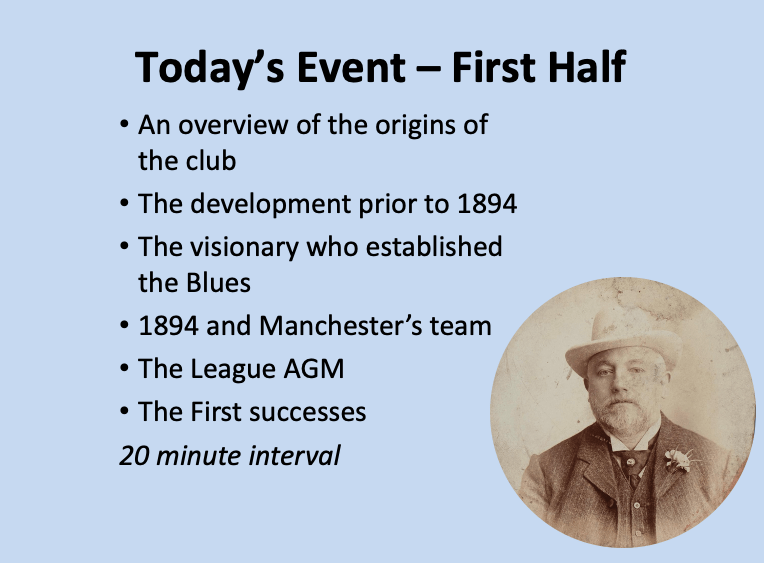
Manchester City’s birth as City in April 1894 was a major landmark moment and is rightly celebrated today on the club’s badge. But, this came after over 14 years of development as a community club representing districts in east Manchester. For this subscriber piece I’ve decided to focus on the earliest years of the club that became City, focusing on the period before 1884. I explain some of the myths that have developed and highlight the facts.

The Origins

Manchester City’s birth as City in April 1894 was a major landmark moment and is rightly celebrated today on the club’s badge. But, this came after over 14 years of development as a community club representing districts in east Manchester. For this website piece today I’ve decided to focus on the earliest years of the club that became City, focusing on the period before 1884.

In the beginning

St Mark’s Church opened in West Gorton – a separate township to Gorton and outside the city’s boundaries at the time – in 1865. In the years that followed the rector Arthur Connell (pictured above) and his wife Anna worked tirelessly for the parish and as his family grew (he had a son and two daughters) they became involved in parish activities, especially his daughter Georgina. She established a number of initiatives while her siblings pursued careers elsewhere. Big sister Anna worked as a Governess, near Preston, returning by 1879 when she established a Working Men’s Club at St Mark’s.

Over the years many myths have developed and so it is important to spell out the facts as we know them based on the latest research. One of the myths is that Anna Connell established the football club. There is no evidence whatsoever that she actually did this. Prior to 1983 no publication ever credited the club’s formation to Anna and no contemporary reports mention her in connection with the football club at all. The story of how her name became linked is a long complicated one which I’ve spelt out in several publications, including Manchester: A Football History (2nd edition, 2010), Manchester The City Years (2012). My Manchester City Folklore book provides the latest research. Paul Toovey, author of several City books, has also analysed this period in great detail.

What is known

Within a couple of years of St Mark’s Church opening a cricket club was established. This played in the late 1860s and by the late 1870s had grown, comprising of at least two teams. Church Warden William Beastow was involved with the cricket team, as were his sons, and at some point in either 1879 or 1880 the younger men and boys decided to add other sporting activities. They established a rugby team and an association football team with both their earliest known games occurring in November 1880. Both the rugby and cricket teams eventually faded but the football team developed and grew. Beastow retained involvement with the sports clubs. 

By 1883 the football club dropped references to the church from its name and later that year it merged with another team called Belle Vue Rangers.

The Founders?


The desire to find names attached to the formation of any club is often fruitless. Historians search for firsts, founders and the like but the truth is that the birth of any organisation is rarely the idea of one person. With St Mark’s people have incorrectly linked the formation of the Working Men’s Club by Anna Connell with the founding of the St Mark’s Cricket Club and ultimately the formation of the football club by cricketers was seen by some as having a direct link to Anna (I fell for this myself for a while!). However, the cricket club predates the Working Men’s Club and, if match reports are anything to go by, it came to prominence at a time in the late 1860s/1870s when Anna was living near Preston. 

There’s no doubt that the community ethos espoused by the Rev Arthur Connell and some members of his family contributed to the well-being of St Mark’s parishioners and may have inspired some to establish clubs and activities, but none of the Connell family could be said to be founders of the football club. That was the boys and young men who played cricket.

One of the boys, Walter Chew, became a major figure in both our club’s history and in Manchester football. In later year he spoke on the BBC and to newspapers on several occasions of the birth of the club. To him it was perfectly clear who founded it and that was his older brother William and some of his friends. One of the older boys, William Sumner, is believed to have been the club’s first captain and his arrival in West Gorton around 1879 coincides with St. Mark’s move into both forms of football. He was an engineering student lodging in Gorton and was also a member of the St. Mark’s cricket club, though Walter did not name Sumner in his interviews.

Walter Chew did play his part in City’s formative seasons though. As well as appearing in some games (many of William’s appearances have previously been credited to Walter but both men did appear for the club in the early 1880s) he was the founder, alongside his cousin, of Belle Vue Rangers. He contributed to the purchase of the club’s first ball and in 1883 he was with the Rangers when they merged with West Gorton. 

There’s much more to be said and written about these formative years but after the merger between West Gorton and Belle Vue Rangers many of the players from the merged club established Gorton AFC in 1884 and, wearing their newly adopted black shirts with white cross pattee, they posed for their first team photo – the earliest known image of our club.

So, here we are around 140 years later. A club created by the boys and young men who played cricket within a supportive community environment encouraged by the church of St Mark’s.  The formation of the club was never about an individual, it was about building a team and community spirit. 

City Voices – Memories of the 1920s-50s

Previously I’ve posted about the City Voices project capturing the stories and memories of Manchester City fans (if you’ve missed the story take a look at: https://gjfootballarchive.com/2021/02/06/city-voices-project/ ). The idea is to capture the experiences of Blues from all over the globe regardless of age, gender, ethnicity etc. Basically, if you’re a City fan I’d love to hear from you.

I’ve been capturing the stories of City fans since the early 1990s and always love hearing individual’s memories and stories. Back in 2002 I interviewed a female supporter called Fran Parker. At the time she was in her early 80s and she was able to talk to me about attending Maine Road in the 1920s to 1950s plus a few memories from the 1990s (for example, she talked about the sadness she felt when Paul Lake swallowed his tongue and how she feared for his life). I loved the fact that she was still attending games and still felt as enthusiastic in 2002 as she had in 1932.

For me it’s the experience of football that needs capturing. The media capture the games and the key moments but supporter views are often ignored or misunderstood. To give you an idea of what I’m talking about here’s a brief trailer of the interview I did with Fran. She does talk about goals, but it’s details like how she felt when Eric Brook scored in the 84,569 game; her umbrella and Dave Ewing stories that are different.

Anyway, have a listen:

If you would like to complete the City Voices questionnaire then please download it here and email it to me at gary@GJFootballArchive-com

https://gjfootballarchive.com/wp-content/uploads/2021/02/city-voices-modelconsent.docx

One important point to note is that I am keen to hear from fans of all ages based in Manchester, the United Kingdom and around the world. The greater the number that respond the better the archive of fans’ stories will become.

As for Fran Parker’s interview… Over the coming months http://www.GJFootballArchive.com will develop to include some of my interviews (my John Bond interview from 1995 has already been posted). IF you would like to subscribe then see below:

Subscribe to get access to all the content on http://www.GJFootballArchive.com

If you would like to read all the in-depth articles (including the entire Manchester A Football History book and the audio interview with John Bond) then please subscribe. It works out about £1.67 a month if you take out an annual subscription (£20 per year) or £3 a month if you’d like to sign up for a month at a time. Each subscriber gets full access to the 270+ articles posted so far and the hundreds scheduled to be posted in the coming weeks.

International Women’s Day – Manchester Football

Today (8th March 2021) is International Women’s Day and so I thought I’d post a few links to great content about pioneering women connected to Manchester football on this website.

My intention over the coming months and years is to make http://www.GJFootballArchive.com an archive of my past writing and new material on all aspects of football in the Manchester region (and material on activity beyond Manchester or involving national figures connected with the region). To subscriber to my site then please see the details below.

This includes material on the women’s teams of Manchester, such as the pioneering Wythenshawe/Manchester Ladies of the 1940s & 1950s; the Manchester Corinthians (globe trotting pioneering team of the 1940s to 1980s); Manchester City; Manchester United and the other clubs, such as FC Redstar, that have existed in our region. It also includes profiles and interviews with footballers; those working in football and the media; footballers’ partners; supporters and more.

All of this is based on my detailed research and writing on football in the region. I attended my first women’s game in 1988 (home team was F.C. Redstar) and was a regular at their games and Manchester City Ladies (now Women) during their formative years, including brief details on their first ever game in my first book published in 1989. Since then I’ve also written Manchester City Women: An Oral History (see https://gjfootballarchive.com/shop/ to order copies) and am researching for a detailed history on women and football in Manchester at the moment.

Listed here are a few links to articles connected with women, football and Manchester that may be of interest:

I did an interview with Premier League World on Manchester City Women. It’s episode 38 and can be viewed here (if you have Amazon Prime): https://www.amazon.co.uk/Premier-League-World/dp/B08HDGSNZN Or it can be viewed on the following channels:

BT Sport 1                                      Monday              12pm

BT Sport 1                                      Tuesday              12:30am

Sky Sports Premier League         Thursday            5pm

Sky Sports Premier League         Friday                  3pm

Sky Sports Premier League         Saturday             8am

The feature is the last one shown in the programme, so please keep watching to the end. The piece starts after about 18 minutes.

Here’s a story about Jan Lyons, a Mancunian who went to play for Juventus in the 1970s: https://gjfootballarchive.com/2020/12/26/the-italian-job-a-manchester-corinthians-journey/

Here’s a piece I’ve written on the Manchester Corinthians: https://gjfootballarchive.com/2021/02/14/pioneering-mancunian-women/

A piece on games between Manchester City and Manchester United: https://gjfootballarchive.com/2021/02/11/manchester-city-v-manchester-united/

The story of Manchester City’s relaunch: https://gjfootballarchive.com/2021/01/24/manchester-citys-womens-team-the-relaunch/

The earliest film of Manchester City Ladies/Women: https://gjfootballarchive.com/2021/01/22/manchester-city-ladies-the-earliest-film/

An academic article on my Manchester City Women project: https://gjfootballarchive.com/2021/01/07/establishing-women-in-sports-history-manchester-city-football-club/

Here’s Steve Bolton’s guest blog on Manchester Ladies from 1940s/50s. Part One: https://gjfootballarchive.com/2021/02/26/guest-blog-steve-bolton-the-pioneering-manchester-ladies-part-one/

Part Two: https://gjfootballarchive.com/2021/03/05/guest-blog-steve-bolton-the-pioneering-manchester-ladies-part-two/

To access all of the above and everything else on this site please subscribe:

Subscribe to get access

If you would like to read all the in-depth articles on this site (including the entire Manchester A Football History book and the audio interview with John Bond) then please subscribe. It works out about £1.67 a month if you take out an annual subscription (£20 per year) or £3 a month if you’d like to sign up for a month at a time. Each subscriber gets full access to the 270+ articles posted so far and the hundreds scheduled to be posted in the coming weeks.

Spurs, The Umbro Stand, Swales Out and That Pitch Invasion!

On this day (7th March) in 1993 Manchester City faced Tottenham in the FA Cup Quarter-Final at Maine Road. It was a day that saw the media express shock at the behaviour of City’s fans when they invaded the pitch during the tie with Spurs.  They condemned the supporters without understanding the background story.  To put the record straight it’s vital the day’s events are covered correctly.  Here for subscribers is the full story of that game, including quotes from Niall Quinn and Peter Swales (from my interviews with them in the years since that day…

Subscribe to get access

If you would like to read this and all the in-depth articles on this site (including the entire Manchester A Football History book and the audio interview with John Bond) then please subscribe. It works out about £1.67 a month if you take out an annual subscription (£20 per year) or £3 a month if you’d like to sign up for a month at a time. Each subscriber gets full access to the 260+ articles posted so far and the hundreds scheduled to be posted in the coming weeks.