Pep Guardiola officially became Manchester City manager on July 1 2016 (five years ago today). When he arrived his opening run of competitive games prompted much discussion on the opening achievements of his predecessors. I ended up trawling through the opening months of every City manager to establish whether Pep’s opening results (ten successive wins!) were the best achieved by any Blues’ boss.
Here for subscribers is the result of that trawl…
Subscribe to get access
Read more of this content and read/listen to everything else on the site when you subscribe today.
It looks familiar, so can you name the latest ‘Historic Name That Ground’? If you’ve not seen this feature before then each week for the close season I’ll be posting an image of a ground taken in the past and you can see if you can recognise the ground. Some will be easy, others not so. You’ll be able to post your view in comments at the bottom of each page.
On Friday I’ll post the answer. So here goes….
Can you name the ground featured in the image above? I know it looks a little familiar to many of the subscribers, followers and visitors to this site. It’s an image from the 1920s when this stadium was new. So, can you work out which stadium this is. As always, answer on Friday.
While you’re here why not subscribe to my site and you can then access every article, interview, audio recording etc. already posted and those that will be posted during your subscription. It costs £20 per year (about £1.67 a month) or you can sign up on a monthly basis at £3 per month (you can cancel at any time, so you could sign sign up for a month, access everything you want and then cancel). You can subscribe below:
Subscribe to get access
Read more of this content when you subscribe today.
If you have an old image of a ground that you think it’d be worth including in this weekly quiz then please get in touch. They don’t have to be from the 1900s to 1960s – even ground images from the 70s and 80s may prove a challenge to identify these days. You can email me at gary@GJFootballArchive.com Thanks.
Have you ordered the Peter Barnes biography yet? Details here:
On Monday I asked you to name the ground featured in the above photo. Well, here’s the answer…
It’s Tottenham’s old White Hart Lane ground. I also asked if anyone knew the event being staged… It’s a boxing match between 32 year old British Heavyweight Champion Jack London and 24 year old Bruce Woodcock (the winner in the 6th round) in July 1945. There was an attendance of almost 40,000 and this was the first commercial boxing event in the open air in England since 1939.
London’s the boxer on the left with Woodcock on the right.
Come back on Monday for the next ‘Historic Name That Ground’.
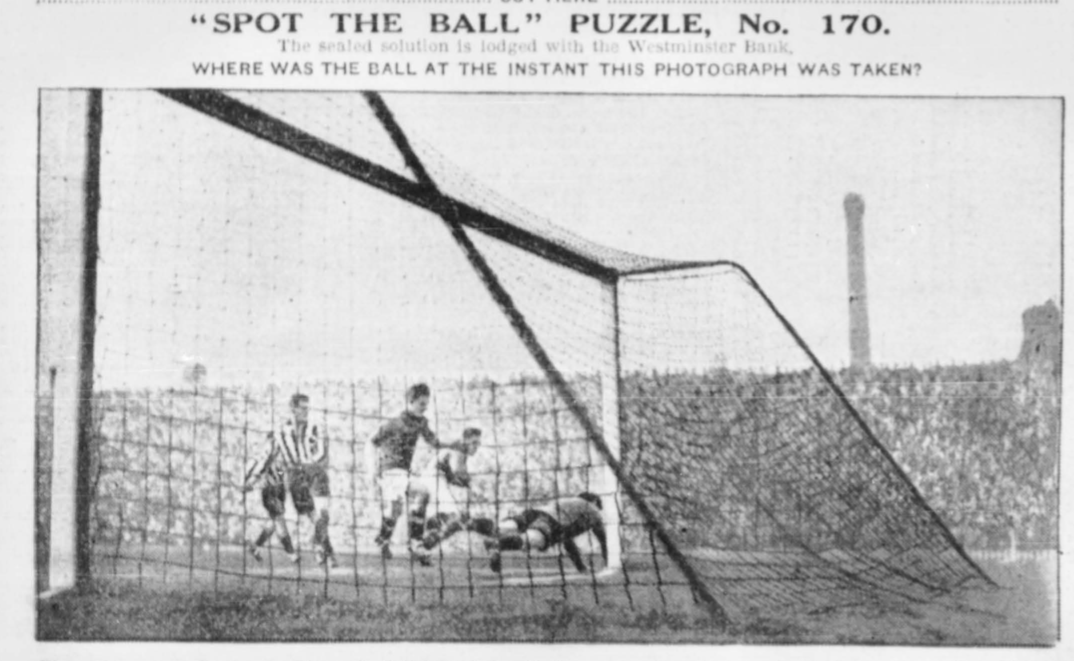
Each week for the next few weeks I’ll post an image of a football ground taken in the past and you can see if you can recognise the ground. Some will be easy (believe it or not there are some grounds that have not changed much in all those decades!), others not so. You’ll be able to post your view in comments at the bottom of each page.
Here’s one (above) I’ve spotted from the 1930s at Old Trafford. Can you work out where the ball should be? The winner wasn’t the person who accurately identified where the ball was, instead it was the person who accurately identified where football experts, employed by the newspaper or pools company, said the ball would be.
So where do you think the ball was? Is it in the goal; has it been saved and at the feet of a striker; could it have been curled around the post; maybe it’s flying high over that Trafford Park chimney?
See below for the answer…
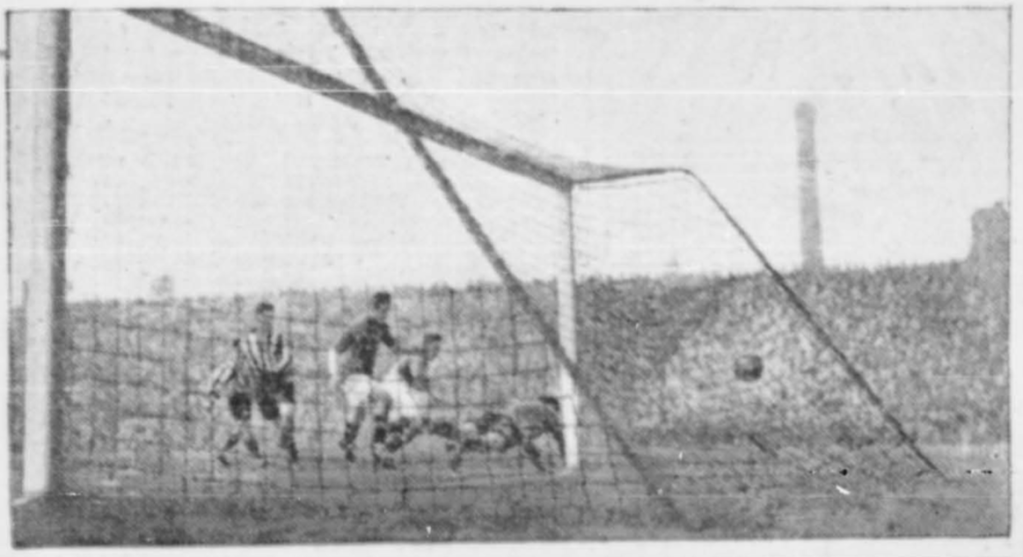
Sadly, I don’t know which game this was (and they never said at the time) but it is Old Trafford and it appeared in the Athletic News in January 1931.
The experts identified that the ball would be here:
I can’t make out if that’s in the back of the net (possible – these were bad days for United and the club was relegated this season) or if it’s been curled around the post.
Louie Moulden, 19, has agreed a two-year deal at Molineux, and will become a Wolves player on July 1 after his contract at Manchester City expires next week.
Louie is the son of former City striker Paul Moulden whose goalscoring exploits earned him a place in the Guinness Book Of Records.
Goalkepper Louie has a wealth of international experience, having played at every age group for England up to under-19s, including appearances between at the European under-17 championships in 2019.
After progressing through the Academy systems at both Liverpool and City, featuring for the under-18 and under-23 sides at the reigning Premier League champions, Moulden secured his move to the West Midlands after a successful trial at Wolves earlier this year.
Moulden saw game time for James Collins’ under-23s in their clash with Premier League 2 Division 2 title winners Leeds United at Aggborough Stadium, in February.
If you want to find out more about Paul Moulden, here’s an interview I did with him a few years back:
From tomorrow (Tuesday June 22 2021) subscribers to my site will be able to download a PDF of my entire first book. It was published back in 1989 and, Ignoring yearbooks, this was only the 6th book (and two of those were more like pamphlets published in the 1930s & 40s) ever published specifically on Manchester City.
Watch this space tomorrow for more details.
The book was published in April 1989 and I talk a little bit about it here:
For a few years now I’ve been posting a ‘name that ground’ quiz during the close season, but instead of focusing on modern images, perhaps at an unusual angle, I’ve been posting images from the past. Typically, my images of grounds have been from the 1920s to 1950s.
Now, for the first time on www.GJFootballArchive.com I’m posting them here. Each week for the next few weeks I’ll post an image of a football ground taken in the past and you can see if you can recognise the ground. Some will be easy (believe it or not there are some grounds that have not changed much in all those decades!), others not so. You’ll be able to post your view in comments at the bottom of each page.
The following Friday I’ll post the answer. So here goes….
Can you name the ground featured in the image above?
It’s a nice easy one to start with. Bonus points (though I’m not really keeping score!) for anyone who can tell me what the specific event was. Leave your comments below.
From World War Two up to and including 2011 Manchester City won every FA Cup semi-final they played with a 1-0 scoreline. That’s five games. In 2013 I caught up with two of the goalscorers – Tommy Booth (1969) and Paul Power (1981) – to discuss their memories of those games. Here for subscribers is what they said:
Subscribe to get access
Read more of this and all the other content when you subscribe today. £20 a year works out about £1.67 a month and you get access to the 360+ articles posted here, including exclusive audio interviews and other archive material.
Earlier today I asked ‘Can you name the ground featured in the image above?’ Well, the answer is…
Manchester City’s Maine Rd stadium being built in 1922. This end was the Scoreboard End/later North Stand original terracing being constructed, looking towards Maine Road itself. Note the church in the top right corner – that was replaced by the MCFC Social club and shop in 1966.
Starting Monday for the next few weeks I’ll be posting one image of a football ground taken in the past each week. Some will be easy (believe it or not there are some grounds that have not changed much in all those decades!), others not so. You’ll be able to post your view in comments at the bottom of each page.
The following Friday I’ll post the answer.
While you’re here why not subscribe to my site and you can then access every article, interview, audio recording etc. already posted and those that will be posted during your subscription. It costs £20 per year (about £1.67 a month) or you can sign up on a monthly basis at £3 per month (you can cancel at any time, so you could sign sign up for a month, access everything you want and then cancel). You can subscribe below:
Subscribe to get access
Read more of this content when you subscribe today.
Starting Monday for the next few weeks I’ll be posting an image of a football ground taken in the past and you can see if you can recognise the ground. Some will be easy (believe it or not there are some grounds that have not changed much in all those decades!), others not so. You’ll be able to post your view in comments at the bottom of each page.
The following Friday I’ll post the answer. So as a bit of a preview…
Can you name the ground featured in the image above?
I think it’s a nice easy one to start with. Leave your comments below.
I’ll post the answer tonight a few minutes before the England-Scotland game.
While you’re here why not subscribe to my site and you can then access every article, interview, audio recording etc. already posted and those that will be posted during your subscription. It costs £20 per year (about £1.67 a month) or you can sign up on a monthly basis at £3 per month (you can cancel at any time, so you could sign sign up for a month, access everything you want and then cancel). You can subscribe below:
Subscribe to get access
Read more of this content when you subscribe today.




 Gary James' Football Archive