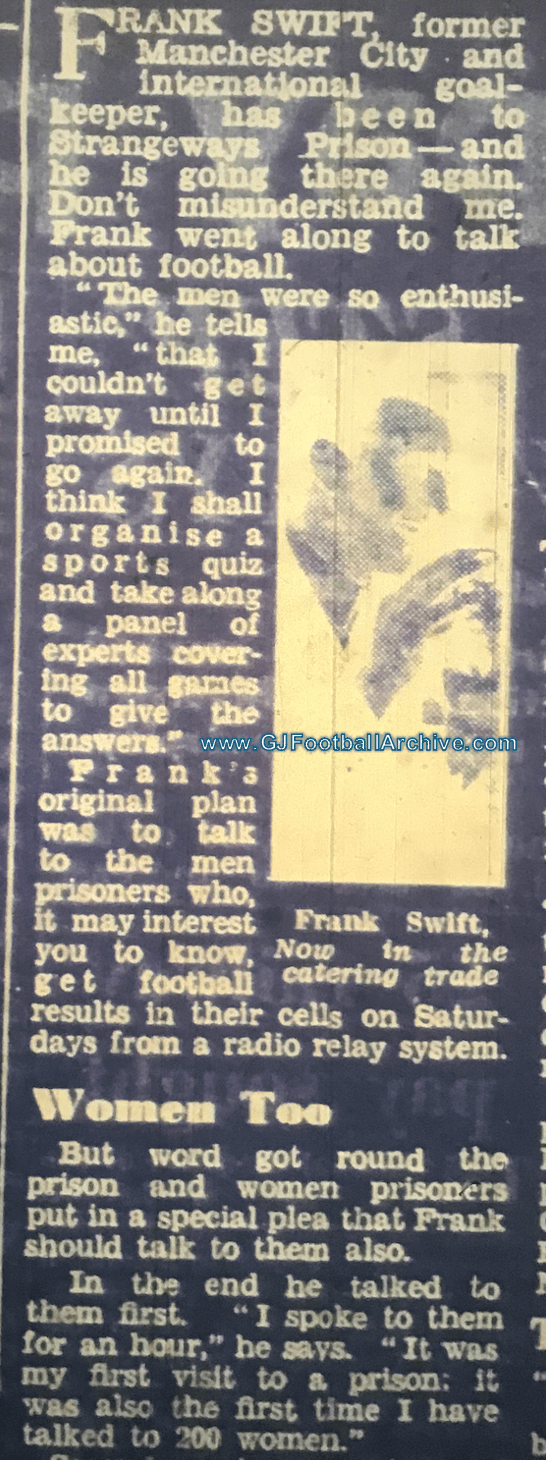
On this day (4 October) in 1949 it was reported that Frank Swift went to Strangeways prison… to talk to inmates about football. He assumed he would be just talking to the male prisoners but there was so much interest from the female inmates that he spent some time with them first. He talked about his career; City and United and whether Billy Meredith or Stanley Matthews was the greatest all-time forward apparently.
Author Archives: garyjamesfootballarchive
Steve Staunton for Manchester City?

Forty years ago (4 October 1985) it was reported in Drogheda that their talented local footballer Stephen Staunton was being watched by Manchester City. The feeling was that the player may be signed by the Blues, however when City were due to watch him play in a second game (a specially arranged match) the scout had to cancel his trip at the last minute!
Defender Steve Staunton signed for Liverpool a year later and eventually became most famous for his time at Aston Villa and with the Republic of Ireland.
Manchester City 3 Bolton Wanderers 1

On this day (2 October) in 1920 Bolton Wanderers were defeated by Manchester City 3-1 with goals from Tommy Browell, Fred Fayers and Wilf Woodcock. A crowd recorded as 40,000 at the time watched the match at Hyde Road.
For more on this season why not read the following 2,350 word subscriber article. If you subscribe (see below) I hope you enjoy it. If you are not currently a subscriber then why not try it for a month (£3 per month or sign up for a year at a discounted £20 per year)?
Here’s the article:
Subscribe to get access
Read more of this content when you subscribe today. It costs £3 a month (cancel anytime) or sign up for a year at £20 per year. Subscribers have access to the 1000s of articles, features, interviews etc. posted so far and all those posted during your subscription.
As well as subscriber pieces this series on the 1920s includes some free articles. Watch out for a daily post.
International Football History Conference 2026

The call for papers/presentations has been released for the 2026 International Football History Conference (#Footycon26). If you are interested in attending or presenting the details are here:
International Football History Conference
11th June – 13th June 2026
***CFP Deadline January 5th 2026***
The 2026 International Football History Conference will take place at Fulham Pier, Fulham Football Club, London, England on Friday the 12th & Saturday the 13th of June 2026. We hope delegates can join us for a welcome social event on the evening of Thursday 11th June too.
This is a call for papers for those who wish to present at the conference. There will be an opportunity to present on any topic relating to the history of football of all codes. This includes, but is not limited to: Association Football, Rugby Union & Rugby League, Gaelic Football and Aussie Rules.
- Main conference proceedings will take place between 8.30 am and 6 pm on Friday the 12th and Saturday the 13th of June 2026.
- As with previous years, Abstracts are welcomed on any football-related topic (football of ALL codes)
- Abstracts are welcomed by researchers from any discipline.
- Presentations must not have appeared at another conference. As our conference does not have parallelsessions, we insist that presentations must not repeat something presented elsewhere.
NEW FOR 2026: We have added a new style of presentation (‘Interview’) which some delegates may find more appropriate to their style, topic or experience and we encourage delegates to consider that or any of the other formats. Please also get in touch if there’s a style you have used elsewhere that you feel would work well instead of those listed below.
Abstracts for the following presentation styles are welcomed:
Interview (20 minutes) – New for 2026. We are aware that some delegates may find the idea of standing up to do a presentation daunting. Similarly, a traditional presentation style may not always be the best way to get your material out there, while some find it difficult to engage with audiences. So, for this year we would like to offer delegates the opportunity to be interviewed about their research by either one of the organising committee or by another delegate. The intention is to have the expert/author/presenter and interviewer seated for a general discussion covering the key points (agreed in advance) of the expert’s research.
This would be a more relaxed style and, hopefully, will appeal to those who would like to present but are put off in some way by traditional formats.
The opportunity for multiple delegates with related topics to be interviewed together exists (like a panel presentation).
Short Form (10 minutes) – Suggested 20 slides (plus a title slide) with a maximum of 20 seconds per slide. Ideal for a summary of research; to present early findings; Image-related research etc. We allow ten minutes for these.
Twenty Minutes – Those choosing a 20-minute slot will be able to split that time between presentation and questions as they feel appropriate (for example 15 minutes of presentation and 5 minutes of questions or 20 minutes presentation and no audience questions).
Panel – One hour: three presenters and a moderator on a related theme with specific time for individual presentations within the session agreed by the moderator including allowance for questions at the end to the group.
If you wish to present at the conference, please send a 100-to-150-word proposal to footycon@outlook.com bythe 5th of January 2026. The selection of presentations will take place by the organising committee, and we will ensure confirmation as soon as possible after that date, particularly for those travelling some distance.
COST OF ATTENDANCE
The International Football History Conference is a self-funding event. All delegates, whether presenting or not, willneed to book their place before attending. We will open the booking system in October.
Financially, these remain difficult times for delegates and for the conference (a self-funding, non-profit making endeavour). Once again an early bird price for delegates will be available for booking before the end of January. This will keep the cost of attendance for full-time delegates at the 2023, 2024 and 2025 conference rates. The rate from 1 February will be the same as last year’s final rate.
Full Delegate (2 days): £139 (rising to £149 from 1 February)
Students/unwaged/retired delegates (2 Days): £129 (rising to £139 from 1 February)
Special Day Rate: £76 (employed) & £67.50 (unwaged/Students/retired; rising to £70 on 1 February)
Travel & Accommodation
Delegates will need to make their own arrangements regarding travel & accommodation for the conference. The organisers of the conference recommend reviewing transport arrangements to Fulham Pier/Fulham FC before booking accommodation. The venue is about a 20 minute walk from the nearest London underground station, Putney Bridge. London prices can be steep, but Fulham’s excellent transport connections via the underground or bus network mean that it may be cheaper to stay in locations around the Greater London area with direct connections to Fulham than in Fulham or central London.
Further information will be released closer to the conference.
It is our intention to have a welcome gathering on Thursday 11th June evening. Any social gatherings on Friday 12th and Saturday 13th of June are expected to be in the Fulham area.
Future Opportunities
We hope to announce exciting new opportunities linked to the International Football History Conference over the next few months. Please watch this space.
The 2010s: Blackburn 0 Manchester City 4
On this day (1 October) in 2011 Manchester City faced Blackburn in the Premier at Ewood Park. Here’s a few words I wrote on that game a few years ago:
At Blackburn on 1st October the home side tried to stifle Mancini’s men for some time. In fact City sat back and took stock of the situation throughout the first half as a negative Blackburn team seemed happy to kill the game at every opportunity. In the second half, as often the case during the opening months of the season, the Blues had total control and ten minutes after the interval Johnson made it 1-0.
Balotelli sent Nasri’s cross home three minutes later, before Nasri added a third and Savić headed City’s fourth. City fans, who had sung Roberto Mancini’s name at various points before and during the match, were in full voice at the end while the Blackburn supporters chanted for the dismissal of their boss Steve Kean. Post match Mancini’s assistant David Platt faced the press: ‘It was the result we were looking for to put Bayern Munich to bed.’
City had lost 2-0 at Munich in their previous game. Here are highlights of the Blackburn match:
Spend For Billy City

On this day (30 September 1985) forty years ago Manchester City manager Billy McNeill highlighted the need for his club to spend if they hoped to stay in the top flight. The Blues had been promoted in May and McNeill felt the squad needed strengthening. City did survive in 1985-86 (in fact they reached a Wembley final) but McNeill’s concerns were valid. The following couple of seasons would see City rely on talented young players coming through the ranks, alongside some seasoned professionals, but many felt the club needed to spend to survive. Unfortunately they were relegated in 1987, by which time McNeill had left, frustrated by City’s lack of investment in the first team.
The 1980s was a truly important decade in the history of Manchester City Football Club and you can find out more on this season by reading the following 2,500 word feature on 1985-86 (available to subscribers). Enjoy!
Subscribe to get access
Read more of this content when you subscribe today. It costs £3 per month (cancel anytime) to access everything posted since 1 October 2022 or £20 a year to access everything posted since the site was created in December 2020. This special rate works out about £1.67 a week and gives access to everything posted, including PDFs of 3 of my books.
If you’d like to know more about subscribing then see:
Tomorrow’s feature is on the 1986-87 season. If you missed the earlier features then start here:
The 1980s: 1980-1981 Gow, Hutchison & McDonald
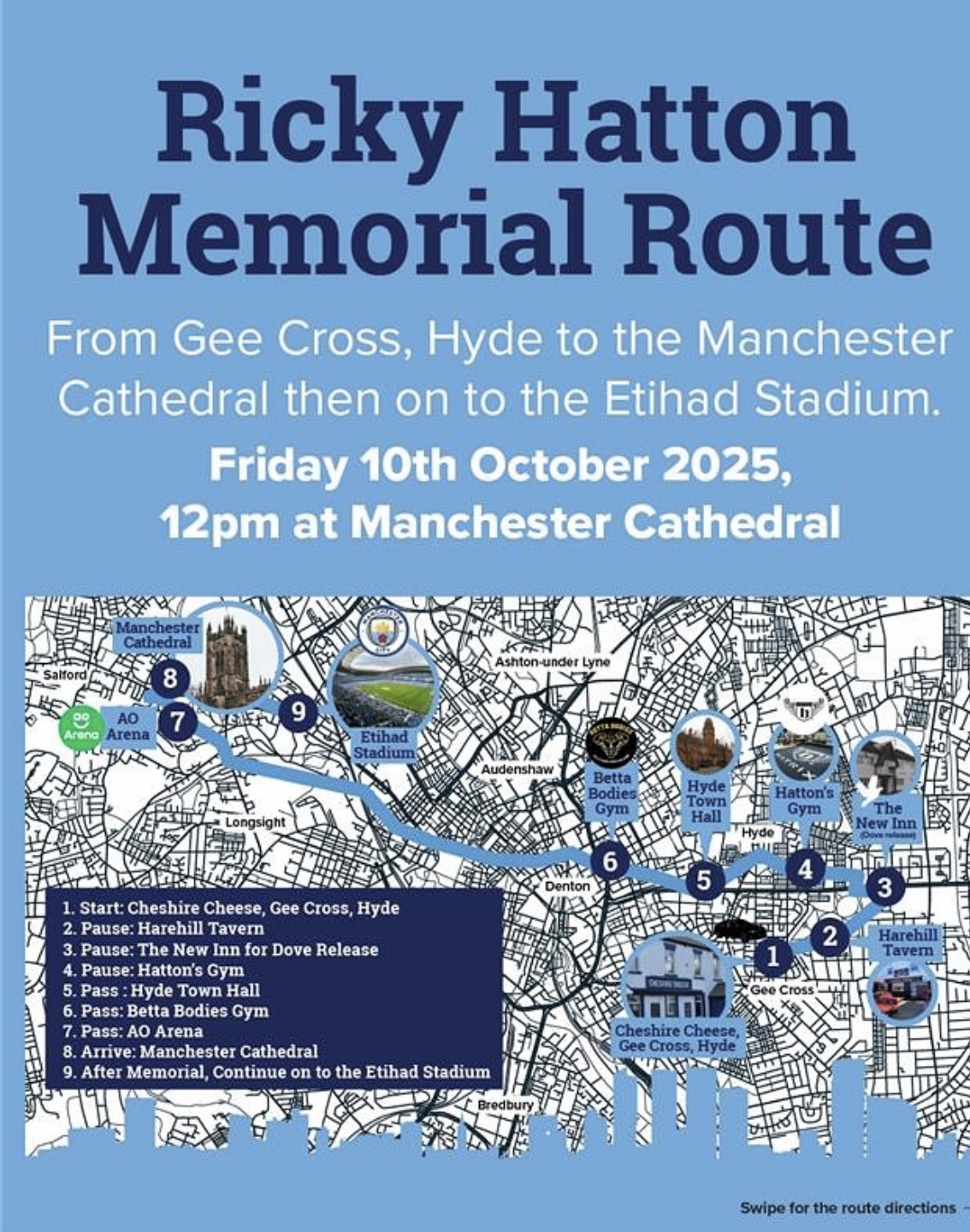
Ricky Hatton Memorial Route
Ricky Hatton

Appropriately Saturday saw some further tributes to Ricky Hatton at the Etihad with a couple of banners, plus the Hatton silhouette on the blue moon video pre match (seeing that was quite emotional). These have prompted me to dig out this main image from October in 2011 when I went with City Academy players & staff, Tony Faulkner, Patrick Vieira and Brian Marwood to Ricky’s gym in Hyde. That year I had been performing a series of ‘history’ sessions with City’s Academy and this day with Ricky was a day when Ricky & I were to do an interview about what it’s like being a supporter.


The whole day was wonderful and it was a somewhat surreal experience to do a presentation/talk on the history of MCFC support and then follow that up with an interview with Ricky in the boxing ring itself at Ricky’s gym. It was great for the Academy players to be in the presence of such an iconic sportsman and Ricky was on good form that day. He talked openly and honestly about being a Blue and, as a fellow lad from Hattersley, it was good to share similar experiences about going to Maine Road as kids, catching the 211 bus then the 53 from Belle Vue to the ground.
Ricky spent considerably more time with the Academy players than planned and was welcoming throughout. He demonstrated some of his training techniques and got us all to pose for this photo (I can’t remember quite what we were supposed to be doing but it seemed appropriate and funny at the time).
I’m a few years older than Ricky and it feels so sad when someone dies when still a young man. I remember seeing Ricky as a boy at his dad’s pub the New Inn (my first regular pub when I was a teenager). I used to go there with another City fan, Paul Alexander, who has also passed away in recent years.
The tributes to Ricky are well deserved and he was such an iconic figure, not just in Hattersley, Hyde or Manchester but around the globe.


Barnes Bidding for England

Forty years ago today (29 September 1985) it was reported that Manchester United’s winger Peter Barnes was being considered for a place in Bobby Robson’s England. The former City player had dropped out of the England squad a few years earlier but, as this report shows, his form for United brought him back in contention for an England place.
Sadly, injury ended the prospect for the talented winger.
You can read Peter’s story in the authorised biography I have written on him. It covers every aspect of his career. Details here:
Tevez v West Ham
On this day (28 September) in 2009 Manchester City faced one of Carlos Tévez’s former sides, West Ham. The Hammers were swept aside with a 3-1 victory. Tévez (seen here with Mark Hughes at his signing) netted twice and Martin Petrov scored the other at the City of Manchester Stadium (now the Etihad).
 Gary James' Football Archive