A new daily series of articles for subscribers started earlier this month covering the 1980s. This is a seasonal journey through a truly important decade in the history of Manchester City Football Club. Today’s article is a 8,000 word long read on the 1989-90 season. Enjoy!
Subscribe to get access – Monthly
Read more of this content when you subscribe today. It costs £3 per month (cancel anytime) to access everything posted since 1 October 2022 or there’s a special annual rate below which gives greater access and works out much cheaper.
Read more of this content when you subscribe today. It costs £3 per month (above) or £20 a year (here) to access everything posted since the site was created in December 2020. This special rate works out about £1.67 a week and gives access to everything posted, including PDFs of 3 of my books.
A new daily series of articles for subscribers started earlier this month covering the 1980s. This is a seasonal journey through a truly important decade in the history of Manchester City Football Club. Today’s article is a 4,100 word feature on the 1988-89 season. Enjoy!
Subscribe to get access – Monthly
Read more of this content when you subscribe today. It costs £3 per month (cancel anytime) to access everything posted since 1 October 2022 or there’s a special annual rate below which gives greater access and works out much cheaper.
Read more of this content when you subscribe today. It costs £3 per month (above) or £20 a year (here) to access everything posted since the site was created in December 2020. This special rate works out about £1.67 a week and gives access to everything posted, including PDFs of 3 of my books.
This weekend marks the latest in the series of games between one of the Manchester clubs and a Liverpool team. Today (25 November 2023) treble winners City face second placed Liverpool at the Etihad. Tomorrow it’s 6th placed United v 19th placed Everton (who have been docked points for Financial Fair Play breach). Understandably, much will be made of the Manchester-Liverpool rivalry and it is true that the two cities have been rivals for over 150 years (it certainly predates the building of the Ship Canal!) BUT the football clubs have not always been rivals. In fact Utd and Liverpool have been close over the decades at times while the on-the-pitch rivalry between City and Liverpool was extremely strong in the late 60s and 70s.
The strength of the two conurbations’ footballing rivalries came during the late 1960s but intensified in the late 70s. Prior to this one-off seasons may have seen grudge matches or significant games between clubs from the cities but nothing more than that. In fact for many, many years Manchester United and Liverpool, for example, were extremely close. They once put forward a suggestion to the Football League that all home teams should wear red and away teams white – the rest of football soon got wise to the plan!
There was also the time when United and Liverpool ‘fixed’ a game of football. It’s a long story (amazingly United’s solicitor was part of the ‘neutral’ investigating committee!) and can be read here:
The rivalry between the footballing clubs developed in the 60s and there were many significant games between all the clubs in the two cities with several prominent matches (there were significant grudge matches between Everton and City for example in the 60s and at one point Liverpool’s Bill Shankly told the media that City were Liverpool’s biggest rival!).
Back in 1995 I interviewed former Manchester City boss John Bond at his home. The interview lasted about two hours and here’s a brief snippet from that interview where Bond talks about beating Liverpool on Boxing Day 1981.
The Blues won 3-1 (Bond, Hartford & Reeves) then two days later (Bond says it’s the next day in this clip but it was 28th December) City defeated Wolves 2-1 at Maine Rd. John discusses a brilliant goal from Trevor Francis. City went top of the League after the Wolves victory.
Stick with the clip because it ends with Bond’s views on how Liverpool used to react to wins and defeats. I’d best not comment – have a listen:
I’ve covered one particularly bitter moment in the City-Liverpool rivalry from the 80s that concerns John Bond here:
I hope this weekend’s games between go well and it’d be great if one of Manchester’s Blues could score four goals as Fred Howard did on his debut against Liverpool – see:
A new daily series of articles for subscribers started last week covering the 1980s. This is a seasonal journey through a truly important decade in the history of Manchester City Football Club. Today’s article is a 4,000 word feature on the 1987-88 season. Enjoy!
Subscribe to get access – Monthly
Read more of this content when you subscribe today. It costs £3 per month (cancel anytime) to access everything posted since 1 October 2022 or there’s a special annual rate below which gives greater access and works out much cheaper.
Read more of this content when you subscribe today. It costs £3 per month (above) or £20 a year (here) to access everything posted since the site was created in December 2020. This special rate works out about £1.67 a week and gives access to everything posted, including PDFs of 3 of my books.
A new daily series of articles for subscribers started last week covering the 1980s. This is a seasonal journey through a truly important decade in the history of Manchester City Football Club. Today’s article is a 2,500 word feature on the 1986-87 season. Enjoy!
Subscribe to get access – Monthly
Read more of this content when you subscribe today. It costs £3 per month (cancel anytime) to access everything posted since 1 October 2022 or there’s a special annual rate below which gives greater access and works out much cheaper.
Read more of this content when you subscribe today. It costs £3 per month (above) or £20 a year (here) to access everything posted since the site was created in December 2020. This special rate works out about £1.67 a week and gives access to everything posted, including PDFs of 3 of my books.
WORLD-RENOWNED SCULPTOR REVEALED AS ARTIST BEHIND PERMANENT TRIBUTE TO CITY’S LEGENDARY TRIUMVIRATE
Unveiling confirmed for Tuesday 28 November
World-renowned sculptor David Williams-Ellis chosen following exhaustiveselection process overseen by Club Chairman Khaldoon Al Mubarak
Tribute will celebrate the legacy of Manchester City’s trophy-laden era of the late1960s and early 1970s Manchester City Football Club is delighted to reveal that world-renowned sculptor David Williams-Ellis is the artist behind a permanent tribute to legendary triumvirate Colin Bell, Francis Lee and Mike Summerbee. A student of eminent octogenarian drawing teacher, Nerina Simi, Williams-Ellis sought out classical training in Florence where his signature style was first established. His sculptures, worked in clay, from life, are inspired by the romanticism of French sculptors Auguste Rodin and Antoine Bourdelle and are noted for their sense of movement and vitality. With exhibitions proudly displayed at Perthshire’s Scone Palace, Aberdeen’s Maritime Museum and the IFC Building in Shanghai, Williams-Ellis is perhaps most famously known for his commission of the Normandy Memorial Trust’s D-Day Sculpture. That monument was unveiled by French President Emmanuel Macron and then-British Prime Minister Theresa May in 2019. Designed and created at his Oxfordshire home studio, Williams-Ellis’s work on this commission has focused on capturing the motion and characteristics of each player and embodying the spirit of their combined 30 years representing Manchester City. This initiative is the latest in a series of tributes to key figures forming the Club’s legacy project, first announced in 2019 and directed by Chairman Khaldoon Al Mubarak. Modern-day legends Vincent Kompany, Sergio Aguero and David Silva were celebrated upon their respective departures from the Club, with each of their sculptures located on the east side of the stadium, in addition to permanent mosaic artworks featured throughout the City Football Academy.
This installation will be located on the west side of the perimeter and will be unveiled on Tuesday morning ahead of a UEFA Champions League meeting with RB Leipzig later that day, where fans will be invited to visit the permanent tribute to an extraordinary era in the Club’s history.
Speaking of his appointment to the project David Williams-Ellis said:
“It is a great honour to create a work of art for Manchester City Football Club celebrating the diverse, talented players, Bell, Lee and Summerbee.
“It’s been an extraordinary last two years, working on this project that celebrates these players from a great era in Manchester City’s football history.
“I hope that the work will give a sense of history and place to the legions of fans and visitors that come to the football ground from around the world and become an enduring part of Manchester’s cultural landscape.”
David Williams-Ellis – Artist Biography
David Williams-Ellis’ sculptures, worked in clay directly from life, are inspired by the romanticism of Rodin and Bourdelle and are noted for their sense of movement and vitality.
David was classically trained in Florence under drawing teacher, Nerina Simi. From there he went on to be an apprentice wood carver and then joined a community of marble carvers beneath the Carrara Mountains in Pietresanta.
David’s reputation was cemented after his time in Italy. Today, his work is in private and public collections across the globe and can be seen in flagship buildings including Scone Palace in Perthshire, Aberdeen’s Maritime Museum, the IFC Building in Shanghai and Oxford House, Swires, Hong Kong.
Amongst his most notable work includes the D-Day Memorial Sculpture, unveiled on 6th June 2019 above Gold Beach in Normandy to commemorate the 22443 service men and women who fell on D-Day and in the Normandy campaign under British command.
A new daily series of articles for subscribers started last week covering the 1980s. This is a seasonal journey through a truly important decade in the history of Manchester City Football Club. Today’s article is a 2,500 word feature on the 1985-86 season. Enjoy!
Subscribe to get access – Monthly
Read more of this content when you subscribe today. It costs £3 per month (cancel anytime) to access everything posted since 1 October 2022 or there’s a special annual rate below which gives greater access and works out much cheaper.
Read more of this content when you subscribe today. It costs £3 per month (above) or £20 a year (here) to access everything posted since the site was created in December 2020. This special rate works out about £1.67 a week and gives access to everything posted, including PDFs of 3 of my books.
A new daily series of articles for subscribers started last week covering the 1980s. This is a seasonal journey through a truly important decade in the history of Manchester City Football Club. Today’s article is a 2,600 word feature on the 1984-85 season. Enjoy!
Subscribe to get access – Monthly
Read more of this content when you subscribe today. It costs £3 per month (cancel anytime) to access everything posted since 1 October 2022 or there’s a special annual rate below which gives greater access and works out much cheaper.
Read more of this content when you subscribe today. It costs £3 per month (above) or £20 a year (here) to access everything posted since the site was created in December 2020. This special rate works out about £1.67 a week and gives access to everything posted, including PDFs of 3 of my books.
A new daily series of articles for subscribers started last week covering the 1980s. This is a seasonal journey through a truly important decade in the history of Manchester City Football Club. Today’s article is a 2,500 word feature on the 1983-84 season. Enjoy!
Subscribe to get access – Monthly
Read more of this content when you subscribe today. It costs £3 per month (cancel anytime) to access everything posted since 1 October 2022 or there’s a special annual rate below which gives greater access and works out much cheaper.
Read more of this content when you subscribe today. It costs £3 per month (above) or £20 a year (here) to access everything posted since the site was created in December 2020. This special rate works out about £1.67 a week and gives access to everything posted, including PDFs of 3 of my books.
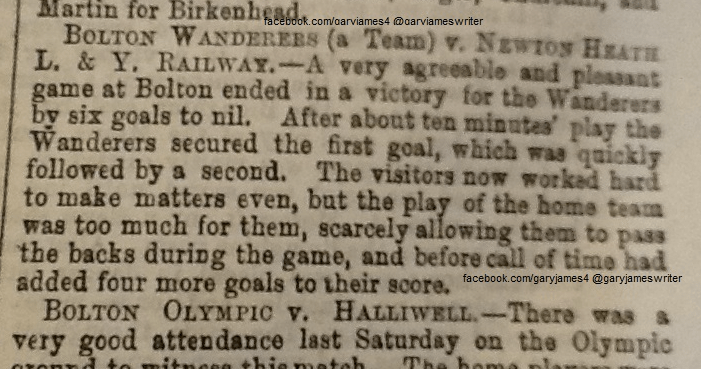
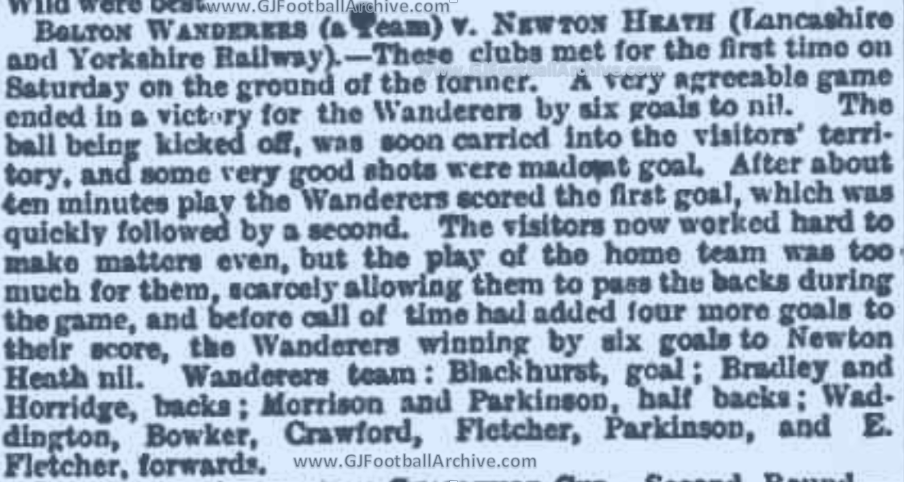
On this day (20 November) in 1880 as Newton Heath L&Y Railway Manchester United played their earliest known game. It was against Bolton Wanderers 2nd team and United lost 6-0. In the years that have followed some have claimed they wore green and gold at this game but the contemporary references given do not say anything of the sort.
It is still repeated often that a newspaper report in the Bolton Evening News mentioned the colours of green and gold were worn for Newton Heath’s first reported match. The origin of this is unclear but the Manchester United Pictorial History and Club Record (Charles Zahra, Joseph Muscat, Iain McCartney and Keith Mellor; Nottingham: Temple Press, 1986) specifically refers to the match report on page 11 as being published on 24 November 1880 and implies it stated the team colours. It also suggests that Bolton wore scarlet shirts.
My research over the decades has included a review of every Bolton newspaper for that period and I did discover a match report in the Bolton Evening News on the date mentioned in the above book but this did not include any reference to the colours worn. This is actually the report that gets quoted. You can see there’s no mention of colours:
Like so many football clubs the early history of Newton Heath has lots of myths associated with it. The facts are that at the railway works in Newton Heath various sporting activities were established during the 1870s. In 1922 Herbert Dale, a railway worker who played football for a decade from the formation of what became Newton Heath, was asked how football became established at the works. He explained that the club when initially formed had been a cricket team (suggesting it was established in 1878), and that after some time a member of the committee bought a football from a shop on Market Street in the city centre. This appears to be in 1880 and, according to Dale, the instigator of the club was Sam Black and that the original colours were red and white quartered shirts (NOT green and gold; quartered shirts meant 2 panels on front and 2 on back with a red and a white panel on both the front and the back). Those colours may surprise some but I do provide references and explain more in a book The Emergence of Footballing Cultures: Manchester 1840-1919 published by Manchester University Press. In that I talk about all the early clubs of the Manchester area such as Hulme Athenaeum, Manchester Association and Hurst.
Black was seventeen when the club played its earliest known game on 20 November 1880 and his age then seems consistent with others, such as those at St Mark’s (Manchester City) who are known to have played in November 1880.
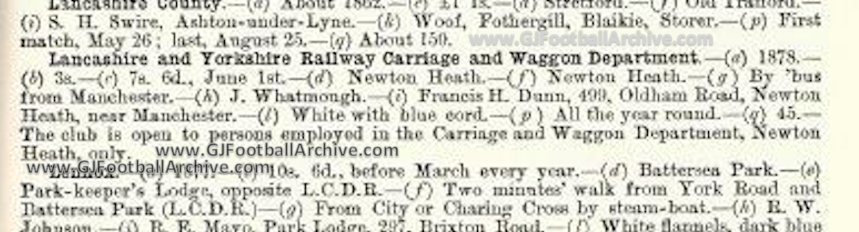
The was a Sportsman’s Yearbook for 1880 produced which the Newton Heath club was mentioned in. It appeared in both the cricket and football sections. Here are the details published in the cricket section:
Sportsman’s year book 1880 Newton Heath cricket section
You’ll notice mention there of the cricket whites/kit to be worn: white with a blue cord. Typically, this is believed to mean ‘white cricket shirts and trousers’ with a blue cord as belt (to differentiate between opponents). Some cricket clubs wore different coloured belts/cords; some wore specific caps with their whites and some wore badges (or even different colours).
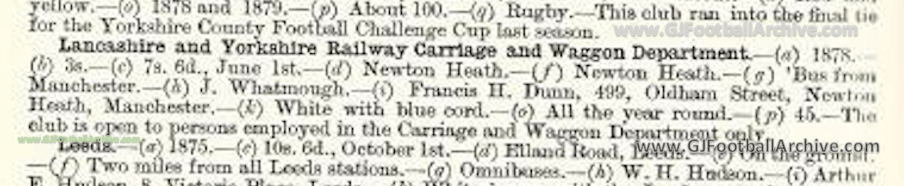
In that same yearbook the following appeared in the football section (back then a football section had rugby and association football clubs alongside each other):
Sportsman’s year book 1880 Newton Heath football section
You’ll notice the details are simply a repeat of the cricket section and it may well be that the club had decided to be listed in both sections without thinking specifically about football, or it could even be that it was a mistake to publish in both sections. For me it does seem that having the club’s details in both sections was deliberate, afterall it says the club is all year around and not specific to the cricket or football/rugby season. But I don’t believe the colours can be trusted for the association football team, especially as Dale talks of red and white being the club’s earliest football colours. Whatever is true it is important to recognise that to date no contemporary evidence has been found saying the club wore green and gold when they played their earliest games. They did wear those colours at times later on though.
Newton Heath reformed as Manchester United in 1902, winning the club’s first major trophy in 1908 (the League).
Incidentally Bolton Wanderers’ first team beat Irwell Spring (Bacup) 7-1 in the Lancashire Cup on the same day as the earliest known game for the Heathens. A good day all round for the Wanderers it seems.
For those wondering the earliest known MCFC game took place one week earlier (St Mark’s v Macclesfield Baptists).



 Gary James' Football Archive