The 1960s: 1967-1968 Leeds v Manchester City

On this day (23 March) in 1968 came a game between two title challenging teams – Leeds Utd and Manchester City. The view was that this game could knock City out of the title race if it went Leeds’ way. So what happened? Here’s film of the game:

You can find out more aboutthe potential impact of this game by reading this subscriber article on Manchester City during the 1967-68 season. If you’d like to read this 7,600 word article (yes, 7,600 words on one season!), plus all other articles on the site, then please subscribe (see below). As with most of the other features in this series it includes words from interviews I have performed with those who were there.

Subscribe to get access

Read more of this content when you subscribe today. It costs £3 per month (cancel anytime) or sign up for a year at the discounted price of £20 per year (works out £1.67 per month). Subscribers access the 1000+ articles posted so far and the others scheduled during the life of your subscription.

The 1950s: The 1953-54 Season

The new series on the 1950s continues today with this 1,700 word article on the 1953-54 season. Enjoy!

This is a subscriber article and you can read it by subscribing below.

Subscribe to get access

Read more of this content when you subscribe today. It costs £3 per month or you can subscriber for the discounted annual rate of £20 per year. Each subscriber gets access to everything posted so far, including PDFs of a couple of my books.

The 1950s: The 1951-52 Season

The new series on the 1950s continues today with this article on the 1951-52 season. Enjoy!

This is a subscriber article and you can read it by subscribing below.

Subscribe to get access

Read more of this content when you subscribe today. It costs £3 per month or you can subscriber for the discounted annual rate of £20 per year. Each subscriber gets access to everything posted so far, including PDFs of a couple of my books.

The 1960s: Summerbee Treble

On this day (31 January) in 1968 Manchester City defeated Reading 7-0 in a FA Cup replay. As the players left the field the Elm Park tannoy announcer claimed:  ‘Ladies and Gentlemen, you have just seen one of the greatest teams England has produced in a long time.’

Goalscorers were Mike Summerbee (3), Colin Bell, Tony Coleman, George Heslop and Neil Young. This photo is of the Bell, Lee & Summerbee statue at the Etihad today.

Dozens of letters arrived at Maine Road commenting on City’s performance.  Many Reading fans wrote in saying they could have watched the Blues all night.  Other letters arrived commenting on how well behaved the City supporters were, while fans themselves commented on the cheerfulness of the Reading police.  

These points may seem trivial today, but in 1968 football had already begun to enter its hooligan period.  Football supporters had started to be seen as trouble causers and incidents of violence, or of vandalism, soon found their way into national newspapers.  Although City supporters were never totally blameless, during the late 1960s Blues fans continued to gain commendations rather than condemnation.

You can read more on this remarkable, trophy winning season below. If you’d like to read this 7,600 word article (yes, 7,600 words on one season!), plus all other articles on the site, then please subscribe (see below). As with most of the other features in this series it includes words from interviews I have performed with those who were there.

Subscribe to get access

Read more of this content when you subscribe today. It costs £3 per month (cancel anytime) or sign up for a year at the discounted price of £20 per year (works out £1.67 per month). Subscribers access the 1000+ articles posted so far and the others scheduled during the life of your subscription.

The 1960s: Johnny Crossan

As part of the series on Manchester City in the 1960s I’m taking a look today at an Irish player who joined the club in January 1965 and went on to captain the team, Johnny Crossan. Here goes…

Johnny Crossan was born in Derry on 29th November 1938 and first came to the notice of English clubs when he was a youth.  Crossan:  “I had apparently been doing quite well as a youngster.  I had got into the Derry team when only aged 14 and Joe Mercer came over to have a look round and weigh up likely prospects.  Later, I learned he wanted to sign me for his club, which was then Sheffield United, and a fee of around £5,000 was discussed.  I never did find out what went wrong.  Perhaps Derry wanted more money.”

He moved on to Coleraine a little later, and then another proposed move to England collapsed when problems over a possible transfer to Bristol City resulted in a ‘life’ ban.  Crossan then moved to the continent, signing for Sparta Rotterdam, and then Standard Liege.  At Liege he played in the European Cup.  By October 1962 the English ban was lifted and he was transferred to Sunderland for £27,000.  

At Roker Park he managed to score 39 goals in 82 appearances, before George Poyser brought him to Maine Road as a last desperate act to save his own job.  

Johnny Crossan signs with City boss George Poyser, January 1965

Crossan made his debut in a 2-0 defeat at Derby County on 30 January 1965.

Although the Irishman did little to impress City’s support during Spring 1965, over time he did prove to be an excellent signing.  

When Mercer took over from Poyser he was delighted to find Crossan was already at the club.  He was determined to award him the captaincy and always admitted that Crossan was one of the main reasons City achieved success:  “We received tremendous help from one little fellow in the dressing room – Johnny Crossan.  In those early days this whimsical Irishman was a wonderful dressing room influence as we tried to mould players we hardly knew into a fighting unit.”

The promotion season was Crossan’s best at Maine Road and clearly demonstrated his playing ability, humour, and captaincy skills.  He seemed to be destined to play a major part in City’s future when tragedy struck.  At the age of 28 he was involved in a car crash close to Roker Park prior to the 1966-7 season.  He missed the opening game of the season and, despite managing to regain his place, his City career was nearing its end.  Foolishly he tried to disguise an injured knee and as a result gave the impression he just wasn’t trying.  In actual fact he was probably trying more than most, but he was simply unable to cope.  He also suffered from a grumbling appendix.

In August 1967 he was transferred to Middlesbrough for £32,000 – proving that he was still a player with much to offer.  At Middlesbrough he made a total of 56 appearances and scored 8 goals, but suffered with insomnia and was forced to endure several hospital visits.

Once his footballing career was over Crossan returned to Derry, and in later years played an active role in training local youngsters. 

In total Crossan made 24 international appearances for Northern Ireland (ten while with City), and proved to be a very popular player within the dressing room and, for most of his City career, on the terraces.  Without Crossan Mercer and Allison would have found it more difficult to lift the Blues out of the Second Division, and the transformation in City’s fortunes may have taken a while longer.  

Johnny Crossan

Born: Derry, 29th November 1938

Debut v Derby County (away) 30/1/1965

City Appearances:

FL: 94 apps. 24 goals.

FAC: 14 apps. 2 goals.

FLC: 2 apps. 2 goals.

TOTAL: 110 apps. 28 goals.

Middlesbrough Appearances: 

FL: 54+2 apps. 7 goals.

FAC: 5 apps. 1 goal.

FLC: 2 apps. 

TOTAL: 61+2 apps. 8 goals.

If you enjoy all the free material on my website and would like to support my research and keep this website going (but don’t want to subscribe) then why not make a one-time donation (or buy me a coffee). All support for my research is valued and welcome. It allows me to keep some free material available for all. Thanks.

Choose an amount

£2.50
£5.00
£7.50

Or enter a custom amount

£

Your contribution is appreciated.

Donate
Johnny Crossan and Joe Mercer celebrating City’s promotion in 1966

The 1960s: 1967-1968 Congratulations

Continuing the series of features on the 1960s, here’s a subscriber article on Manchester City during the 1967-68 season. A trophy winning season. If you’d like to read this 7,600 word article (yes, 7,600 words on one season!), plus all other articles on the site, then please subscribe (see below). As with most of the other features in this series it includes words from interviews I have performed with those who were there.

Subscribe to get access

Read more of this content when you subscribe today. It costs £3 per month (cancel anytime) or sign up for a year at the discounted price of £20 per year (works out £1.67 per month). Subscribers access the 1000+ articles posted so far and the others scheduled during the life of your subscription.

Happy 75th Dennis Tueart

Today (27 November 2024) is former Sunderland, Manchester City, New York Cosmos and England forward Dennis Tueart’s 75th birthday. You can watch a video interview I did with Dennis last year elsewhere on this site, or enjoy the following MCFC profile of him I wrote a while back.

Forward, 5ft 8in, 11st. 4lbs, b. Newcastle-on-Tyne, 27 November 1949

Signed from Sunderland, 11 March 1974 (£275,000)

Transferred: New York Cosmos, 13 February 1978 (£250,000)

Signed from New York Cosmos, 31 January 1980 (£150,000)

Transferred: Stoke City, 9 July 1983 (free)

Career: Manor Park Technical Grammar School, Welbeck Juniors, Sunderland, City, New York Cosmos, City, Stoke City, Burnley, Derry City.

Debut v Manchester United, 13 March 1974

Debut v Norwich City, 1 March 1980

Appearances: League: 216+8 apps. 86 gls; FA Cup: 13+2 apps. 3 gls; League Cup: 27, 18 gls; UEFA Cup: 3 aps, 0 gls; AS Cup: 3 apps, 0 gls; TC Cup: 2 apps, 2 gls; T Cup: 3 apps, 2 gls; Total: 267+10 apps, 111 gls

Remembered often for his spectacular overhead goal at Wembley in the 1976 League Cup final, Dennis Tueart was always a hero with City fans.  Earlier in his career he was a popular member of Sunderland’s 1973 FA Cup winning side, alongside Dave Watson, and he joined City in March 1974.

Often described by supporters as an entertaining, exciting, determined player, Tueart constantly delivered during a period when City challenged for the title in addition to the League Cup success, however in 1977-78 he became a little disenchanted and decided to move to the States to play for the New York Cosmos.  He became the first ‘current’ England international to transfer to the USA, and played alongside players such as Beckenbauer.

He remained in America for a couple of seasons before re-joining City in 1980.  He netted five goals during 11 games that season but a wrist injury during a 2-1 defeat at Stoke the following September caused Tueart to miss significant games against Manchester United, Liverpool, and Leeds.  During that period the Blues struggled and the management team of Allison & Book were dismissed.  New manager John Bond transformed the club, but Tueart was not given much opportunity to impress.  Then, in the 1981 FA Cup final replay Tueart was brought on as substitute for Bobby McDonald.  This brief appearance led to him appearing in 15 of the opening 18 matches of 1981-2, scoring 9 goals in the process.  It was a great period for him personally, but he damaged his Achilles tendon against his former team Sunderland in December and missed the rest of the season.

In 1982-3 he made 36 appearances but relegation on the final day led to Tueart being transferred to Stoke.  After his playing career finished Tueart concentrated on his sports promotions company and became a director at City in the mid 1990s, contributing significantly to first the period of resurrection (1998 to 2003) and then stability at the new stadium.

Don Revie

On this day (10 November) in 1956 the great Don Revie left Manchester City for Sunderland.  Revie had been in and out of favour with manager Les McDowall for over a year, but fans recognised his qualities. Here for subscribers is a profile of Don. Enjoy.

Subscribe to get access

Read more of this content when you subscribe today. It costs £3 per month or there’s a special discounted rate of £20 a year. Subscribers have access to everything posted on the site, including PDFs or Manchester A Football History and my 1st book on MCFC (published in 1989).

Kendall’s Last

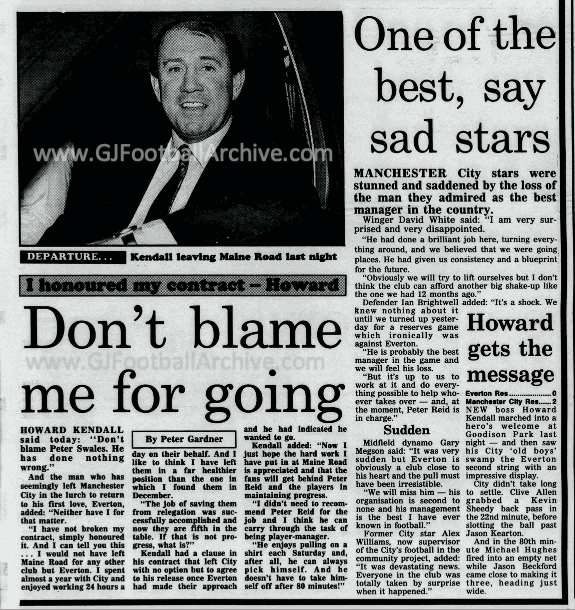
On this day (3 November) in 1990 Manchester City and Sunderland played out a 1-1 draw at Roker Park, watched by 23,137. This was Howard Kendall’s last match in charge as his affair with City came to an end. Within days he had returned to his first love Everton.

While you’re here why not subscribe and read a series of articles covering Manchester City in the 1990s (and other decades too)? Here’s an article on the 1990-91 season when a shock managerial departure could have disrupted the club but ultimately they finished 5th, 3 points ahead of Manchester United: (it’s a 2,700 word article available to subscribers):

Subscribe to get access – Monthly

Read more of this content when you subscribe today. It costs £3 per month (cancel anytime) to access everything posted since 1 October 2022 or there’s a special annual rate below which gives greater access and works out much cheaper.

Subscribe to get access – Annual

Read more of this content when you subscribe today. It costs £3 per month (above) or £20 a year (here) to access everything posted since the site was created in December 2020. This special rate works out about £1.67 a week and gives access to everything posted, including PDFs of 3 of my books.

If you’d like to know more about subscribing then see:

If you enjoy all the free material on my website and would like to support my research and keep this website going (but don’t want to subscribe) then why not make a one-time donation (or buy me a coffee). All support for my research is valued and welcome. It allows me to keep some free material available for all. Thanks.

Choose an amount

£2.50
£5.00
£7.50

Or enter a custom amount

£

Your contribution is appreciated.

Donate

Billy McAdams

On 13 October in 2002 Fifties goalscoring star Billy McAdams died. During his Manchester City career he made 134 first team appearances and scored 65 goals. He had joined City on 6 December 1953 and on 2 January 1954 McAdams, signed from Distillery, made his debut. It was a memorable one as he scored an equaliser in the 49th minute against Sunderland at Maine Road.  The game was played in poor, foggy conditions but City won.

A week after the Sunderland game, McAdams scored a hat-trick in City’s 5-2 Cup win at Bradford.  He followed that with an equaliser in the 56th League derby match at Old Trafford.  His arrival and goalscoring streak was viewed as refreshing that season..