The Starting Eleven – Bobby McDonald

It’s the 40th anniversary of the 1981 FA Cup final on May 9 and ten years ago, as we looked forward to Manchester City appearing in the 2011 FA Cup final, I was asked by the Manchester Evening News to write profiles of the eleven players who started the 1981 final.

For the next few days I will post those profiles, one a day, free to read here. These will only be free to view until May 16, so please read them while you can. Thanks.

Here’s the latest (appearing here as it was written in 2011)…

As we look forward to the 2011 FA Cup final, Gary James takes a look at the eleven players who made the starting line-up for City’s last FA Cup final in 1981.  Today, left-back Bobby McDonald.

Bobby McDonald joined the Blues six months before the 1981 final and soon became hugely popular with City fans.  Together with Tommy Hutchison, he was new manager John Bond’s first signing.  The two men arrived for a combined fee of £320,000 with McDonald’s value an estimated £275,000.  

The former Coventry men, together with Bond’s third key-signing Gerry Gow, added a bit of footballing guile and experience to a side the manager felt needed on-the-pitch guidance.  Fifteen years later Bond gave his ultimate assessment on McDonald:  “I had a few doubts about him when I found out a bit more about him, but he still did a good job for us.  He had a streak in him which was a bit wayward, a bit naughty.  But he did a job and the fans loved him.  

“So we’d got a left back who was a real left back, we’d got a midfielder [Gow] who could tackle, win balls and make things happen, and we had a tremendous fellow [Hutchison] up front.  It seems a simple concept really.”     

The fans did love left-back McDonald a great deal, particularly for his exploits during the Cup run.  Most memorably in the quarter-final against Everton.  He played a part in City’s equalising goal at Goodison Park, then in the replay he scored twice in the space of three minutes.  The first coming after 65 minutes.  The match ended 3-1 with McDonald the undisputed Man Of The Match.  “He loved the glory, ” Bond later laughed.

When it came to the final McDonald – an ‘unexpected hero’ claimed the final’s match programme – made his presence felt immediately.  Garth Crooks certainly knew he was there as the City man pressured his every move.  At one point Crooks appealed for a penalty as McDonald cleverly interrupted his advance on to a pass from Ardiles.  It set the tone.  

Together with Paul Power, McDonald also kept England star Glenn Hoddle under control. 

Fate played its part of course and the final went to a replay.  When Ricky Villa made the replay 3-2 to Spurs, Bond made a switch as the Blues searched for an equaliser.  On came winger Dennis Tueart and off came left-back McDonald in the 79th minute.

After Wembley, McDonald was a consistent member of Bond’s defence, with his most-headline grabbing moment coming three games into the 1982-83 season.  In only the third minute against newly promoted Watford, goalkeeper Joe Corrigan suffered a dislocated shoulder.  These were the days before substitute ‘keepers.  McDonald:  “We didn’t have anyone named before the game for Joe’s job, and it was a shock to see Joe injured.  As soon as I was told to go in goal I accepted it, and it seemed the best decision at the time because Paul Power could take over from me at left-back.”

For the remaining 87 minutes McDonald performed superbly, making many fine saves.  In fact a Gerry Armstrong shot two minutes from time resulted in a save that any ‘keeper would have been delighted to make.  McDonald’s performance helped City win 1-0 and head the table after three straight victories.  

During the game the supporters chanted ‘Scotland’s Number One’.  McDonald:  “I appreciated the reaction from the supporters.”

At the end of that season the arrival of Billy McNeill, following relegation, brought a premature end to McDonald’s Maine Road career.  A well-publicised breach of club discipline during the 1983 pre-season led to the left-back being transferred to Oxford United that September.  The majority of supporters were disappointed to see the player go, but the manager wanted to ensure his total authority from the start.

McDonald helped his new club to the Third Division and Second Division titles in successive years, and later had spells at Leeds, Wolves and a host of non-League sides, including VS Rugby, Redditch United and Burton Albion.

In 2011, McDonald coaches in Scotland and is a youth coach with Aberdeen FC helping guide youngsters in the Glasgow area.

My biography of Peter Barnes is now available to subscribe to. Order by May 15 and you will receive a copy signed by me & Peter, the book posted to your home address before it appears in any shop AND your name printed in the book. Order (and more details) here:
The Starting Eleven – Joe Corrigan

It’s the 40th anniversary of the 1981 FA Cup final on May 9 and ten years ago, as we looked forward to Manchester City appearing in the 2011 FA Cup final, I was asked by the Manchester Evening News to write profiles of the eleven players who started the 1981 final.

For the next eleven days I will post those profiles, one a day, free to read here. These will only be free to view until May 16, so please read them while you can. Thanks.

Here’s the first (appearing here as it was written in 2011)…

As we look forward to the 2011 FA Cup final, Gary James takes a look at the eleven players who made the starting line-up for City’s last FA Cup final in 1981.  Today, Joe Corrigan.

Heralded as the Man Of The Final for his performance over the two games, Joe Corrigan was one of the biggest Maine Road stars of the period.  The 32 year old England goalkeeper had already been a Wembley Cup Final winner twice with the Blues – the 1970 and 1976 League Cup final – and his appearances in the 1981 final; cemented his name and reputation as one of England’s best.  

During the final Corrigan played superbly, making several brilliant saves, most notably when Tottenham’s Roberts sent a downward header goal-bound and another time when he rushed from his line to check Crooks on the edge of the area. 

Ultimately, Corrigan was beaten but the goal was a freak own goal scored by Tommy Hutchison.  Despite his obvious disappointment one of the most memorable sights was when the City ‘keeper walked over to Hutchison, lifted him up and patted him on the back.  Corrigan:  “We’d been on top for most of the game.  I knew that what had happened to him could have happened to any one of us.  So I just told him to ‘get up, get on with it.  It’s only 1-1 and we are still going to win!’  He was devastated to be fair, but we did almost win it in the dying minutes.  Personally, I believe the game should have been played to a conclusion on that night.  The FA Cup is all about the Saturday and I know we would have won had it gone to a conclusion.  No question.”

With the final ending in a draw Corrigan missed an important opportunity.  England were playing Brazil the following Wednesday and it is widely accepted that the City ‘keeper was to appear.  With the FA Cup replay taking place the next night, Corrigan couldn’t play and the opportunity to gain the upper hand in the race to be England’s permanent ‘keeper went begging.

After the FA Cup final replay defeat Corrigan was presented with his Man Of The Final award by Spurs’ manager Keith Burkenshaw.  “It does mean a lot to me, but I’d rather have won the final” he later admitted.

Corrigan’s reputation as one of City’s greatest players developed with the final, and he remained a popular and significant member of John Bond’s side.  However, by the summer of 1982 the Club was changing.  Finance meant Bond’s squad building plans were brought to a swift end.  The signs were not good and players like Corrigan deserved better.

The ‘keeper realised City had changed:  “I think I should have left a little earlier.  I love City but it got to the stage where I knew I wasn’t really wanted here.  The fans were marvellous; the players were great; but maybe it wasn’t really my time any more.  When Seattle made their approach in 1983 I was told I could go.”

A spell at Brighton followed before Corrigan moved into coaching:  “Bert Trautmann and the other ‘keepers taught me more than other coaches could because they had been there.   I felt that I need to do the same.  I’ve coached all over the UK and, at one point, I was flying to Scotland, driving to Yorkshire and the north-east the next day… every day I was on the road.  Then I had ten very enjoyable years at Liverpool, and then Stockport and Chester as well.  It’s been great to put something back.”

In 2004 Corrigan was the first player inducted into the MEN sponsored Manchester City Hall Of Fame and his name will forever be bracketed with Swift & Trautmann as three of the game’s greatest goalkeepers.

My biography of Peter Barnes is now available to subscribe to. Order by May 15 and you will receive a copy signed by me & Peter, the book posted to your home address before it appears in any shop AND your name printed in the book. Order (and more details) here:
A Special relationship

As West Ham visit the Etihad Stadium today (27th February 2021) to face Pep Guardiola’s Manchester City in the Premier League I thought I’d take a look at the special relationship between the fans of the two clubs.

Similarities

Both City and West Ham fans have a shared understanding of football history, status and achievements with supporters aware of their club’s traditions, rivalries and shared history. The two clubs’ roots are very much based around hardworking working class areas of their cities with the supporters of both the Hammers and the Blues coming traditionally from the working classes. In recent years an analysis of the original shareholders at the majority of Football League clubs identified that by 1900 City’s shareholders came mostly from the working class – a larger percentage than at any club other than West Ham who had a slightly higher percentage. This demonstrates that those who owned both City and West Ham were representative of the fans on the terraces and that these clubs were similarly organised and run. As a result of this both clubs were representative of their communities in ways in which their nearest local rivals were not at the time.

Both clubs have enjoyed stylish, attractive football over the years with a belief that the game should be an entertainment. The roots of this go back decades at both clubs with West Ham’s Ted Fenton and Ron Greenwood influencing men such as Malcolm Allison and John Bond who managed the Blues. 

Recently, City fans have been delighted to see Manuel Pellegrini and Pablo Zabaleta become Hammers following a line that includes other popular Blues such as Ian Bishop and Trevor Morley.

Attendances

The support both clubs have received has varied at times but what is abundantly clear is that they have remained the most loyal in the country regardless of League status. West Ham, like City, have never been the worst supported club in their division (both United and Arsenal have!) and West Ham’s attendances over the decades have been fairly consistent, never dipping below 16,000. Recent years have of course seen both City and West Ham eclipse previous record average attendances thanks to the larger capacity of their current homes.

Successes and Struggles

Although West Ham did not become a League side until 1919 (City joined the League as Ardwick in 1892), the Hammers didn’t waste much time in progressing, reaching Division One and their first FA Cup final in 1923. The 1960s was a glorious period for West Ham – as it was with City – winning their first European trophy, the ECWC, in 1965. City won the same trophy in 1970 meaning that the Hammers were the second English team to win a major UEFA trophy and City were the fourth (For those wondering – the Fairs Cup was not a UEFA tournament and its entry requirements were not based on performance at times).

Of course both teams have had periods of struggle, ensuring that when success is achieved the fans of both clubs do not take this for granted. The great Malcolm Allison, a former Hammer & Blue, once told me in an interview that it’s important to “celebrate each success as if it’s your first, because it could well be your last.” Although he was perceived as a boastful character at times his philosophy, gained through his experiences at West Ham as a player, is one both sets of fans seem to agree with.

Celebrating the title – 2014

We must not forget how gracious and sporting the majority of West Ham fans were in 2014 when City became champions of England, securing their first ever league and cup double. That day the Blues beat the Hammers 2-0 with goals from Nasri (39) and Kompany (49). Manuel Pellegrini’s City were applauded and congratulated extensively that day – something that hasn’t happened with the fans of some other clubs when City have won the title.

The “You’ll be back” Game

The biggest demonstration of the special relationship between the fans of the two clubs came in May 1987. City were relegated after a 2-0 defeat at West Ham.  At the end of the game City supporters and West Ham fans climbed over the fences and onto the pitch. Some thought that the two sets of supporters were about to confront each other, but the fans knew differently. The Hammers began chanting “You’ll be back” and both groups swapped scarves and souvenirs on the pitch. It was the kind of moment that should have been widely reported in the media but at the time focus tended to be on hooliganism and confrontation rather than the positives of football support. City had been relegated, but their supporters did not seek revenge.  The West Ham fans could have ridiculed, but they didn’t.  If only those condemning football fans at the time could have seen the two sets of loyal supporters genuinely appreciating and understanding each other.

The relationship between the fans of the two clubs is not something that is widely discussed or promoted but it is something that has endured. City fans have never forgotten the ‘You’ll be back’ game and in recent years, as others have unfairly mocked both sets of fans, the supporters of both the Blues and the Hammers seem to understand and respect each other. Inevitably, there will always be banter during a game but outside of the match the mutual recognition and respect always seems to win through.

To many West Ham are the City of the South – a proud football club with a great history and heritage, combined with a loyal and passionate fanbase.

Want To Read More Like This?

If you would like to read more like this and all the in-depth articles on this site (including the entire Manchester A Football History book and the audio interview with John Bond) then please subscribe. It works out about £1.67 a month if you take out an annual subscription (£20 per year) or £3 a month if you’d like to sign up for a month at a time. Each subscriber gets full access to the 250+ articles posted so far and the hundreds scheduled to be posted in the coming weeks.

While you’re here why not check out the frank audio interview with former WHU player and MCFC boss John Bond? Taster clip here:

Liverpool 1 MCFC 3 – John Bond’s Views on Liverpool’s Reaction

‘Nonsense at Board Level’

For those who haven’t listened to my John Bond interview yet, here’s a snippet from one of the sections. All 7 parts to Bondy’s interview will be posted by the end of next week for subscribers. He was frank throughout and this is a taste of what he had to say:

If you would like to listen to the rest then the details and so on can be read here:

The John Bond Interview

Of course I’ve also posted this brief clip on John Bond’s views on the reaction of Liverpool when they’re defeated:

Liverpool 1 MCFC 3 – John Bond’s Views on Liverpool’s Reaction

Liverpool 1 MCFC 3 – John Bond’s Views on Liverpool’s Reaction

Back in 1995 I interviewed former Manchester City boss John Bond at his home. The interview lasted about two hours and here’s a brief snippet from that interview where Bond talks about beating Liverpool on Boxing Day 1981.

The Blues won 3-1 (Bond, Hartford & Reeves) then two days later (Bond says it’s the next day in this clip but it was 28th December) City defeated Wolves 2-1 at Maine Rd. John discusses a brilliant goal from Trevor Francis. City went top of the League after the Wolves victory.

Stick with the clip because it ends with Bond’s views on how Liverpool used to react to wins and defeats. I’d best not comment – have a listen:

This is only a brief clip of my John Bond interview. The full interview is being uploaded here in stages for subscribers. More details here:

The John Bond Interview

Johnny Bond, Johnny Bond, Johnny Bond

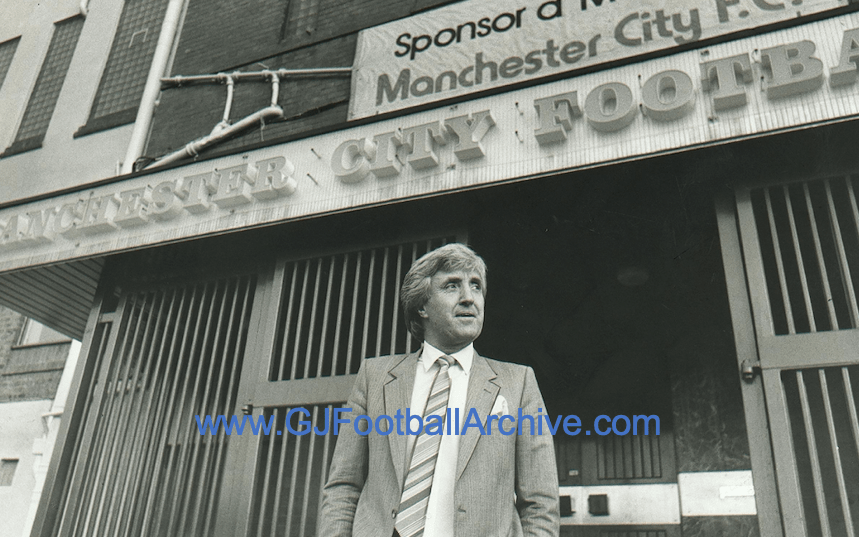
On September 25 2012 former City manager and West Ham FA Cup winner John Bond died at the age of 79. Bond followed Malcolm Allison as manager of the Blues in October 1980 and within his first seven months he turned a struggling side into one that reached the FA Cup final and the League Cup semi-final. I wrote an obituary to John in the days that followed.

Here, for the benefit of subscribers to my blog, is that obituary.

Subscribe to get access – Annual

If you would like to listen to read this and the other in-depth articles on this site (including the entire Manchester A Football History book) then please subscribe. It works out about £1.67 a month if you take out an annual subscription (£20 per year) or £3 a month (see below) if you’d like to sign up for a month at a time.

Subscribe to get access – Monthly

If you would like to listen to read this and the other in-depth articles on this site (including the entire Manchester A Football History book) then please subscribe. It costs £3 a month (cancel anytime) if you’d like to sign up for a month at a time or there’s the special price of £20 a year (see above).

I’ve also posted an audio interview I performed with John back in 1995. For details see: https://gjfootballarchive.com/2021/02/12/the-john-bond-interview/

The John Bond Interview

Back in November 1995 I interviewed the former Manchester City manager John Bond. At the time I was researching my in-depth history of the club called Manchester The Greatest City (later updated as Manchester The City Years).

I met John at his home and spent a good few hours with him chatting about the Blues and his career. I loved doing this interview and was always grateful for the time he gave me. He was quite frank, open and honest – which delighted me because he was a great talker. He was also happy for me to quote everything he said in the interview. I did end up quoting him extensively in the book (and in others I’ve produced) but, until now, none of the interview has ever been heard by the wider public.

Now, for the first time ever you can hear the opening 17 minutes of the interview. Here he talks about the steps taken by City to appoint him; the interview (and the directors involved in that notorious filmed interview for the City documentary in 1980-81); the signing of Tommy Hutchison, Bobby McDonald and Gerry Gow. As I said earlier, he is quite frank in his comments and that may surprise a few.

This audio recording of the first 17 minutes of the interview is available to subscribers of my blog until 19th February 2021. If you want to hear it then please subscribe below. If subscribers enjoy this piece then please let me know and, if you do, I will release other sections of the interview over the coming weeks.

Of course as this interview was recorded on my old cassette recorder the quality isn’t the best but I’m working on improving that for future pieces.

Subscribe to get access

If you would like to listen to this frank interview and read the in-depth articles on this site (including the entire Manchester A Football History book) then please subscribe. It works out about £1.67 a month if you take out an annual subscription (£20 per year) or £3 a month if you’d like to sign up for a month at a time. Each subscriber gets full access to the 220+ articles posted so far and the hundreds scheduled to be posted in the coming weeks.

The second part of the interview is now available here: https://gjfootballarchive.com/2021/02/22/john-bond-interview-part-two/

I’ve also posted an obituary I wrote to John here: https://gjfootballarchive.com/2021/02/12/johnny-bond-johnny-bond-johnny-bond/

40 Years Ago Today (Yes, 40!) – ‘Illegal Jumping’, Alf Grey and Manchester City (Sorry!)

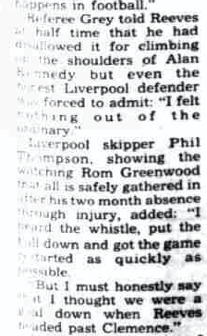
On this day (14th January) in 1981 Kevin Reeves had a goal disallowed for ‘illegal jumping’, according to referee Alf Grey, in the first leg of the League Cup semi-final against Liverpool at Maine Road.  

Afterwards manager John Bond claimed the referee would “never make a worse decision for as long as he lives.”  

When I interviewed Bond two decades later he was still fuming about the decision.

Even the Liverpool players, such as Souness. Phil Thompson and Alan Kennedy, believed it was a valid goal. This is even more significant as Kennedy was the player Reeves is supposed to have impeded when he jumped up to the ball!

Subscribers to http://www.GJFootballArchive.com can read an in-depth piece, with quotes from some of my interviews with those involved that night, such as John Bond, Kevin Reeves and the late Eddie Large talks about his post match discussion with Bill Shankly:

https://gjfootballarchive.com/2021/01/13/manchester-city-liverpool-and-the-1981-league-cup-semi-final/

If you would like to read more pieces like this and the in-depth, longer articles on this site then please subscribe below. It works out about £1.67 a month if you take out an annual subscription (£20 per year) or £3 a month if you’d like to sign up for a month at a time. Each subscriber gets full access to the 120+ articles posted so far and the hundreds scheduled to be posted in the coming weeks.

Subscribe to get access

Read the entire GJFootballArchive website by subscribing today