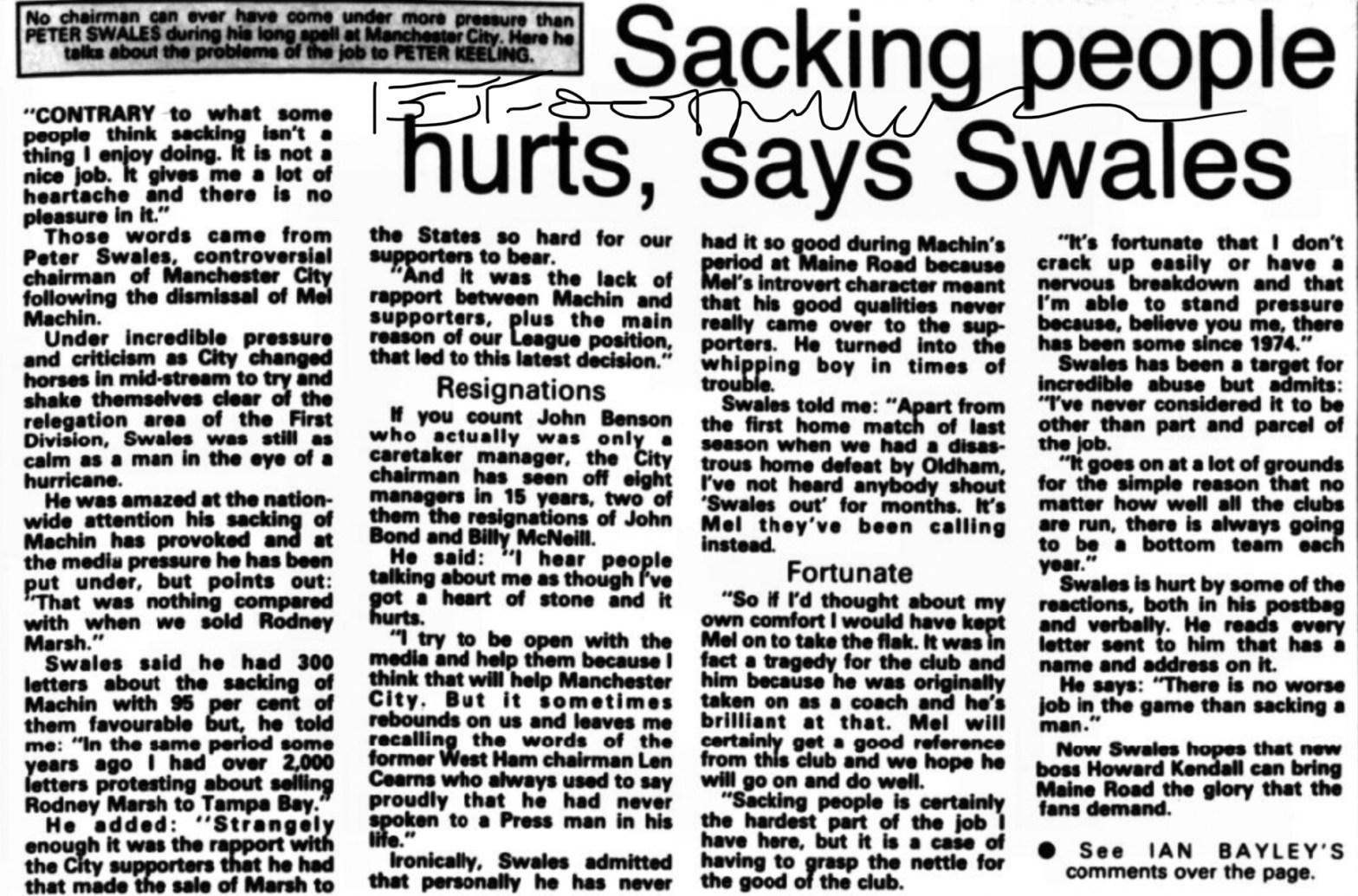
The series of features covering the 1980s for Manchester City continues with an article from this day (11 December) in 1989 when City chairman Peter Swales was profiled. Back then profiles like this on the chairman appeared fairly regularly, usually after he’d just sacked a manager. It all makes interesting reading today.
If you want to know more about this period and the entire 1989-90 season then become a subscriber and read the following 8,000 word article on that season. Enjoy!
Subscribe to get access – Monthly
Read more of this content when you subscribe today. It costs £3 per month (cancel anytime) to access everything posted since 1 October 2022 or there’s a special annual rate below which gives greater access and works out much cheaper.
Read more of this content when you subscribe today. It costs £3 per month (above) or £20 a year (here) to access everything posted since the site was created in December 2020. This special rate works out about £1.67 a week and gives access to everything posted, including PDFs of 3 of my books.
The series of features covering the 1980s for Manchester City continues with a reminder of a day when City lost at Southampton (9 December) in 1989 BUT this short video is worth watching for a few reason. New manager Howard Kendall had flown down to Southampton to watch his new team and this clip begins with him signing autographs. But have a look who is stooding to the left as we watch – it’s Helen ‘the Bell’ Turner. A dedicated Blue who was part of City’s folklore for decades.
Other reasons to watch: There’s a Clive Allen goal (Allen was City’s first £1m player since Trevor Francis in 1981) and you can catch a glimpse of part of the away fans celebrating. City fans were in pens and there were at least a couple full behind the goal and to the left of the pitch as viewed from the camera.
The photo that heads this page is of Clive Allen on the cover on the City-Southampton game at Maine Road earlier in the season. If you want to know more about the entire 1989-90 season then become a subscriber and read the following 8,000 word article on that season. Enjoy!
Subscribe to get access – Monthly
Read more of this content when you subscribe today. It costs £3 per month (cancel anytime) to access everything posted since 1 October 2022 or there’s a special annual rate below which gives greater access and works out much cheaper.
Read more of this content when you subscribe today. It costs £3 per month (above) or £20 a year (here) to access everything posted since the site was created in December 2020. This special rate works out about £1.67 a week and gives access to everything posted, including PDFs of 3 of my books.
A new daily series of articles for subscribers started earlier this month covering the 1980s. This is a seasonal journey through a truly important decade in the history of Manchester City Football Club. Today’s article is a 8,000 word long read on the 1989-90 season. Enjoy!
Subscribe to get access – Monthly
Read more of this content when you subscribe today. It costs £3 per month (cancel anytime) to access everything posted since 1 October 2022 or there’s a special annual rate below which gives greater access and works out much cheaper.
Read more of this content when you subscribe today. It costs £3 per month (above) or £20 a year (here) to access everything posted since the site was created in December 2020. This special rate works out about £1.67 a week and gives access to everything posted, including PDFs of 3 of my books.
The departure of Howard Kendall from Manchester City in November 1990 led to a number of fan related chants, banners and more as fans tried to make their feelings known. United fans got in on the act and started to sing a version of Blue Moon that laughed at Kendall’s departure (which in itself shows how much everyone believed Kendall would bring success City’s way). City fans retaliated with a version that reminded United that only a year or so earlier City’s bargain basement Blues had defeated Ferguson’s Reds 5-1 – at that time the United team assembled by Ferguson was the most expensive British team ever created (and he still had further spending to make).
Banter between the Blues and Reds continues, with Kendall’s departure at the centre of it all but, demonstrating the self-deprecating sense of humour the Blues were known for at this time, Kendall started to be blamed for almost everything that was going wrong in Manchester. Unemployment rises – that’ll be Kendall’s fault. Buses are late – Kendall did that… and so on. Even a storyline in Coronation Street triggered a banner. In the soap opera Mavis and Derek Wilton’s house had been broken into. Who was to blame? Howard Kendall of course if a banner in the North Stand at Maine Road was to be believed.
This Manchester Evening News cutting mentions the chants and the banner. The banner appeared at the City-Leeds game played on this day (11 November) in 1990. It ended in a 3-2 Leeds win (bizarrely Alan Harper took a City penalty) and you can see the highlights here:
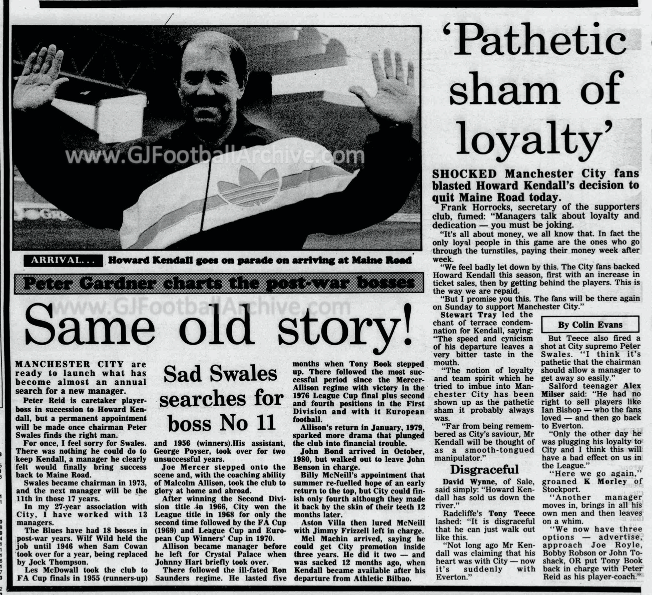
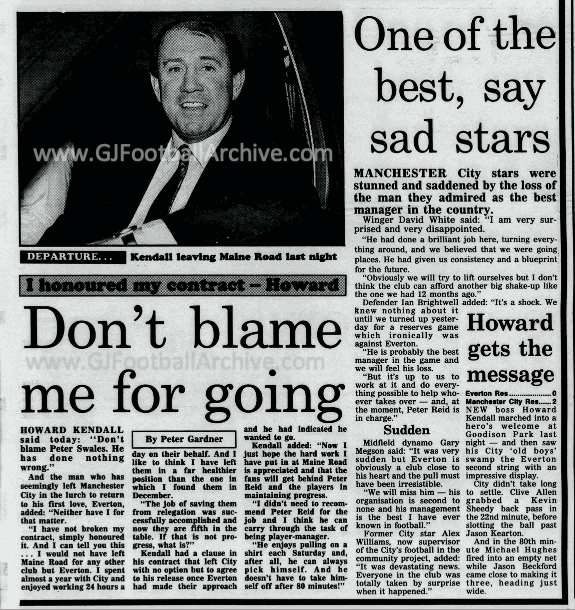
On this day (7 November) newspapers were full of the previous day’s news that had stunned Manchester City and that was the resignation of manager Howard Kendall. Kendall had decided to return to his former club Everton.
The move absolutely stunned City fans (though we did get the blame in some newspapers who claimed we’d never actually taken to him – absolute rubbish and demonstrates the typical attitude of the period which was if anything went wrong blame the fans!). Fans had voiced concern over Kendall’s signing of many, many former Evertonians but overall they were satisfied (more than satisfied) with the manager’s approach at City.
The bottom line with Kendall leaving is that chairman Peter Swales and his supporting directors had given him a contract that allowed him to walk out on the job whenever he chose. It was a strange situation and the belief at the time was that the City board had believed the ONLY job Kendall would be tempted to leave City for was the England job and, with Peter Swales in charge of the international selection committee, the chance of that happening was extremely slim.
Ah well! Here are some newspaper articles from this day back in 1990.
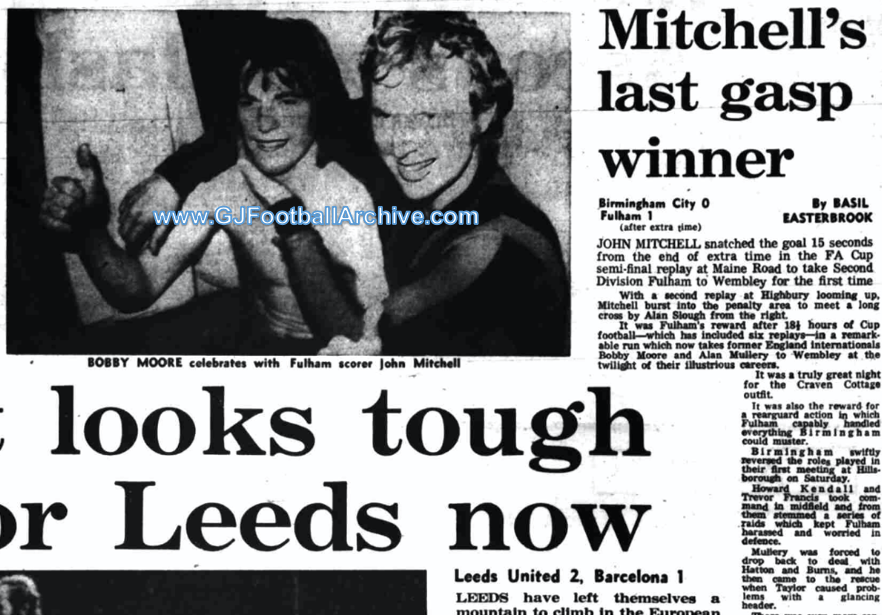
On this day (9 April) in 1975 Fulham and Birmingham City met at Maine Road in a FA Cup semi-final replay. It was an evenly matched game until – with only around a minute of extra-time left – Fulham striker John Mitchell chased a hopeful ball into the Birmingham area. The Birmingham ‘keeper Dave Latchford blocked a shot which then rebounded off John Mitchell’s leg and into the net to give Fulham a 1-0 victory.
The attendance for this midweek replay was 35,205 with over 20,000 coming from Birmingham (according to their local press!). Although Maine Road was a regular and popular semi-final venue during most of its history, it does seem a rather strange choice for this tie considering the location of the sides taking part.
On this day (25 March) in 1998 cult hero Ian Bishop returned to Maine Road for his second spell with Manchester City. At the time fans saw that as further evidence new manager Joe Royle understood the club and its fans. Bishop was idolised in his previous spell almost nine years earlier, and his departure provoked demonstrations against then manager Howard Kendall.
Bishop loved the support he got during his first brief spell: ‘I remember we were playing Norwich and the crowd sang my name. I cannot describe how that felt. I never wanted to leave but I knew that there was no future for me at City. Ever since then I have hoped I would get another chance at the Club but you begin to wonder if it will ever happen. Whenever I have returned to Maine Road with West Ham the reception has been amazing.
‘I feel I have at least three or four good years in me because my game has never been based on pace alone. I want to make up for the time I lost because I have always regretted that my first spell here only lasted six months. Nothing would give me greater pleasure than to end my career here, although I am not planning to hang up my boots for some time.’
On this day (19 January) in 1991 Mark Ward scored twice as Howard Kendall’s Manchester City defeated Sheffield United 2-0 before 25,741 at Maine Road. However, the game opened with the visitors’ Vinnie Jones getting booked after just 5 seconds play! He was later sent off too. You can see highlights (and Jones’ tackle) here:
I was sat in the Main Stand that day. Were you also at this match? If you were why not leave your memory as a comment or email it to me for possible future use on this website?
After achieving promotion the previous season City embarked on the 1989-90 First Division campaign with a view to consolidate rather than set the world alight. The relatively low-key City manager, Mel Machin, seemed determined to play down expectations, especially as other clubs – in particular Manchester United – were spending millions on strengthening their squad. City could not afford to spend wildly, although they did increase their overdraft by signing Clive Allen and Ian Bishop during the close season for a combined fee of around £1.75m.
Subscribe to get access – Annual
Read more of this content when you subscribe today. It costs £20 per year to access everything posted since December 2020 and throughout your subscription or £3 per month (see below).
Read more of this content when you subscribe today. It costs £3 per month (cancel anytime) to access this post and everything posted since 1st October 2022 & throughout your subscription or £20 per year (see above).
On this day (February 3) in 1990 Manchester City and Manchester United drew 1-1 at Old Trafford. The derby became remembered as the ‘Wellied It!’ derby. Here is the story of that day with quotes from an interview I did with Ian Brightwell a few years ago. He explains how the ‘Wellied It!’ phrase came about and why he said it. Enjoy….
Howard Kendall’s City arrived at Old Trafford for the return derby match on February 3 1990. So much had changed since September when Mel Machin’s City had defeated Alex Ferguson’s United 5-1 and so the game was always going to be a difficult one to call. As the Blues were now supposedly a better side it is true to say most City fans eagerly awaited this particular match. Disappointingly, United only gave City 600 seats and 4,500 terrace tickets, although even that was considerably more than in the years that followed. The eventual attendance was only 40,274 in a stadium holding a minimum of 48,000, as many disenchanted United fans stayed away.
Although there were noticeable gaps in the United sections, the paddock in front of the Main Stand appeared full of City supporters. They were later joined by Blues evacuated from the Stretford End and estimates from impartial observers suggested there were around 12,000 City fans in the 40,000 crowd.
The match was the 100th meeting in the First Division and commenced with City tearing into the Reds as they had in September. The Blues were actually two points better off than United in the League and the difference in position prompted City fans to chant “Fergie in” to annoy the home contingent… Football humour, hey?
Squandering some early chances, City looked the more composed overall but when Clarke missed a sitter some fans still muttered about Everton rejects (it had been a thing ever since Howard Kendall’s arrival and transfer of several former Evertonians to Maine Road). It wasn’t just the Evertonians who should have given City the lead; Ian Brightwell was also guilty of a shocking miss when, with Leighton off his line, the youngster feebly lobbed the ball wide. Don’t worry, he made up for it!
Against the run of play it was actually United who took the lead when Clayton Blackmore was gifted a free header. Fortunately, within five minutes Mark Ward found Brightwell who, from fully 25 yards out, blasted a stunning shot past Leighton for the equaliser. Afterwards the delighted player explained exactly how he’d scored by succinctly telling the media: “I just wellied it!” In May 2010 he remembered how the expression came about: “We totally outplayed them, but Clayton Blackmore scored even though we’d had most of the chances. I had a chance in the first half, but that’s a different story. Once they went a goal ahead you’d normally think it’s going to be difficult, but we still had a lot of chances and I felt we’d still do it. I remember that the ball was out on the right and Mark Ward sort of half-crossed it. It came to me and I’ll never forget this – I heard Steve Redmond on the half way line shout: “Bob…” I’d best not say his exact words, but let’s just say he wanted me to have a go in his strong scouse accent! It was on my left foot, which isn’t my strongest, but I did what Reddo said. It went in the top corner!
“I ran off and jumped about twenty feet in the air – or at least that’s how it looks on the photos. I remember the noise because back then the away fans used to get about 10,000 tickets at Old Trafford and it was phenomenal.
“When we came to do the post-match TV interview I was asked the usual stuff and then was asked about the goal. So I told him what I just told you, being careful not to say what Reddo actually shouted! Just as I was doing it, someone walked past and we had to do the interview again. But then the same happened again. So we had to do it a third time. By this point I thought I had to say it in a different way – inexperience I guess. I didn’t need to, but I ended up saying: ‘the ball came out to me and I just wellied it!’ It’s true I did, but now it’s the phrase that people remember. It summed it up nicely, but it wasn’t what I’d meant to say.”
The match should have brought a City victory, but everyone seemed satisfied with a point. You can watch highlights of the game here:
This is a free taster of the content on my website. If you have enjoyed it why not subscribe? It costs £20 a year (£1.67 per month) or £3 per month if paying a month at a time. You can always sign up for a month and see what you think. Cancel anytime. There are over 500 articles/interviews on the site, including exclusive audio interviews I have performed over the years with Malcolm Allison, John Bond & others. You also get the ability to download PDFs of my entire Manchester A Football History book for free – and my first ever book (published in 1989). You can subscriber here:




 Gary James' Football Archive