Haaland Goals Per Game Comparison

It doesn’t feel that long ago since I did something like this for Sergio Aguero and I honestly felt it would be some time before the opportunity came again but then Erling Haaland arrived at Manchester City. So much was rightly made of Erling scoring his 100th Premier League goal last night that I thought I’d post a comparison between him and all other players who have netted 100 Premier League goals. Instead of totals though I decided to focus on the goals per game ratio and so here is a list of the top 25 goals per game ratios of PL players who have netted 100 goals or more. There are some amazing players on this list but significantly Haaland tops that list by some distance. It’s also gratifying to see that Aguero is third on the list.

The top 25 goals per game ratios for all PL players who have scored 100 goals or more… (note: some sources incorrectly put Kane above Aguero)

GoalsFirst NameSurnameGoals Per GameTotal PL Appearances
100ErlingHaaland0.9009111
175ThierryHenry0.6783258
184SergioAguero0.6691275
213HarryKane0.6656320
190MoSalah0.6070313
260AlanShearer0.5896441
113IanWright0.5305213
144Robinvan Persie0.5143280
127JimmyFloyd Hasselbank0.4739268
150MichaelOwen0.4601326
187AndyCole0.4517414
103CristianoRonaldo0.4364236
121RomeluLukaku0.4353278
163RobbieFowler0.4301379
149LesFerdinand0.4245351
145JamieVardy0.4240342
208WayneRooney0.4236491
111SadioMane0.4221263
104DidierDrogba0.4094254
106DarrenBent0.3841276
127SonHeung-min0.3814333
100MattLe Tissier0.3704270
126RobbieKeane0.3610349
111DionDublin0.3558312
146TeddySheringham0.3493418

Watch this space for other comparisons over the coming weeks.

If you enjoy all the free material on my website and would like to support my research and keep this website going (but don’t want to subscribe) then why not make a one-time donation (or buy me a coffee). All support for my research is valued and welcome. It allows me to keep some free material available for all. Thanks.

Choose an amount

£2.50
£5.00
£7.50

Or enter a custom amount

£

Your contribution is appreciated.

Donate

International Football History Conference 2026

The call for papers/presentations has been released for the 2026 International Football History Conference (#Footycon26). If you are interested in attending or presenting the details are here:

International Football History Conference 

11th June – 13th June 2026

***CFP Deadline January 5th 2026***

The 2026 International Football History Conference will take place at Fulham Pier, Fulham Football Club, London, England on Friday the 12th & Saturday the 13th of June 2026. We hope delegates can join us for a welcome social event on the evening of Thursday 11th June too.

This is a call for papers for those who wish to present at the conference. There will be an opportunity to present on any topic relating to the history of football of all codes. This includes, but is not limited to: Association Football, Rugby Union & Rugby League, Gaelic Football and Aussie Rules. 

  • Main conference proceedings will take place between 8.30 am and 6 pm on Friday the 12th and Saturday the 13th of June 2026.
  • As with previous years, Abstracts are welcomed on any football-related topic (football of ALL codes)
  • Abstracts are welcomed by researchers from any discipline.
  • Presentations must not have appeared at another conference. As our conference does not have parallelsessions, we insist that presentations must not repeat something presented elsewhere.

NEW FOR 2026: We have added a new style of presentation (‘Interview’) which some delegates may find more appropriate to their style, topic or experience and we encourage delegates to consider that or any of the other formats. Please also get in touch if there’s a style you have used elsewhere that you feel would work well instead of those listed below.

Abstracts for the following presentation styles are welcomed:

Interview (20 minutes) – New for 2026. We are aware that some delegates may find the idea of standing up to do a presentation daunting. Similarly, a traditional presentation style may not always be the best way to get your material out there, while some find it difficult to engage with audiences. So, for this year we would like to offer delegates the opportunity to be interviewed about their research by either one of the organising committee or by another delegate. The intention is to have the expert/author/presenter and interviewer seated for a general discussion covering the key points (agreed in advance) of the expert’s research. 

This would be a more relaxed style and, hopefully, will appeal to those who would like to present but are put off in some way by traditional formats.

The opportunity for multiple delegates with related topics to be interviewed together exists (like a panel presentation).

Short Form (10 minutes) – Suggested 20 slides (plus a title slide) with a maximum of 20 seconds per slide. Ideal for a summary of research; to present early findings; Image-related research etc. We allow ten minutes for these.

Twenty Minutes – Those choosing a 20-minute slot will be able to split that time between presentation and questions as they feel appropriate (for example 15 minutes of presentation and 5 minutes of questions or 20 minutes presentation and no audience questions).

Panel – One hour: three presenters and a moderator on a related theme with specific time for individual presentations within the session agreed by the moderator including allowance for questions at the end to the group.

If you wish to present at the conference, please send a 100-to-150-word proposal to footycon@outlook.com bythe 5th of January 2026. The selection of presentations will take place by the organising committee, and we will ensure confirmation as soon as possible after that date, particularly for those travelling some distance.

COST OF ATTENDANCE


The International Football History Conference is a self-funding event. All delegates, whether presenting or not, willneed to book their place before attending. We will open the booking system in October.

Financially, these remain difficult times for delegates and for the conference (a self-funding, non-profit making endeavour). Once again an early bird price for delegates will be available for booking before the end of January. This will keep the cost of attendance for full-time delegates at the 2023, 2024 and 2025 conference rates. The rate from 1 February will be the same as last year’s final rate.

Full Delegate (2 days):  £139 (rising to £149 from 1 February)

Students/unwaged/retired delegates (2 Days): £129 (rising to £139 from 1 February)

Special Day Rate: £76 (employed) & £67.50 (unwaged/Students/retired; rising to £70 on 1 February)

Travel & Accommodation

Delegates will need to make their own arrangements regarding travel & accommodation for the conference. The organisers of the conference recommend reviewing transport arrangements to Fulham Pier/Fulham FC before booking accommodation. The venue is about a 20 minute walk from the nearest London underground station, Putney Bridge. London prices can be steep, but Fulham’s excellent transport connections via the underground or bus network mean that it may be cheaper to stay in locations around the Greater London area with direct connections to Fulham than in Fulham or central London.

Further information will be released closer to the conference. 

It is our intention to have a welcome gathering on Thursday 11th June evening. Any social gatherings on Friday 12th and Saturday 13th of June are expected to be in the Fulham area.

Future Opportunities

We hope to announce exciting new opportunities linked to the International Football History Conference over the next few months. Please watch this space.  

The 2020s: Fulham 1 Manchester City 2

On this day (30 April) in 2023 goals from Haaland (his 50th of the season – see image) and Alvarez gave City a 2-1 victory at Fulham. You can watch highlights here:

https://www.mancity.com/citytv/mens/fulham-city-extended-highlights-63818471

Manchester City 2 Fulham 0

On this day (5 December) in 2020 in front of an official crowd of zero (these were the days when no fans were allowed to attend due to Covid) Raheem Sterling (5th minute) and Kevin De Bruyne (penalty after Sterling had been brought down) gave City a 2-0 victory at home to Fulham. You can watch highlights here:

https://www.mancity.com/citytv/mens/manchester-city-2-0-fulham-extended-highlights-63742795

A Well Earned Victory

Today (5 November) last year Manchester City defeated Fulham 2-1 but the victory had not been as straightforward as some had predited. Julian Alvarez opened the scoring after 17 minutes and the Blues looked comfortable but then Cancelo was sent off ten minutes later (a straight red) and City conceded the resulting penalty too.

The Blues seemed up against it and as the game entered added time it felt like it was going to be one of those days. Then De Bruyne was judged to have been fouled when he went down for a penalty deep into added time and Erling Haaland made it 2-1 from the spot kick. The following highlights are worth watching to see what you think of it all but, most significantly, listen to Alistair Mann’s commentary. His final words say in effect that this is the moment that swings the advantage to City in the title race and should be remembered in May as the day City won it. There’s often hyperbole in commentary but those words, recorded in November 2022, do seem to predict the future somewhat:

https://www.mancity.com/citytv/mens/manchester-city-2-1-fulham-extended-highights-63803266

Bert Trautmann Centenary

Today marks a special day in the history of football. 100 years ago today (22 October 1923) a boy was born in Bremen, Germany who would go on to be a major footballing icon with a remarkable story. Bernhard Carl Trautmann was that boy. Here to mark the centenary of his birth is a feature on a crucial game in his career. No, it’s not the 1956 FA Cup final, it’s 6 years earlier…

The game I’m talking about is a League game with Fulham – in fact it’s a City defeat! Why was this so special? Subscribers can find out below. There’s also a special video interview with me about Trautmann here for subscribers to view:

Subscribe to get access

Read more of this content when you subscribe today.

Subscribe to get access

Read more of this content when you subscribe today.

Fulham Defeated

On this day (2nd September) in 1959 Ian Barton, a key member of the Manchester City Supporters Club, attended his first game. I spoke with Ian years ago about this and here’s his story of that day all those years ago: ‘It may not be the most significant game in City’s history but for me it shines out like a beacon light.  As a 5 year old – I’ve given my age away now! – it was my first ever game. I had looked forward to this more than anything I could remember, after all my Dad, cousins, uncles and everyone else in the family could go to Maine Road so it was natural for me to follow on.

‘I remember how huge the place looked.  I’d never seen anything on such a scale and I’ll never forget the smell which was a combination of tobacco, wintergreen & Bovril which always seemed to permeate around the stadium.  Then there were the floodlights.  They created a fantastic effect for a young boy and to this day I always think night games have a dramatic feel to them.  

‘Our team had the great Bert in goal, Joe Hayes up front, with Colin Barlow on the wing and Ken Barnes at wing half.  Sadly the local hero Denis Law was injured so didn’t play.  Fortunately his heal, which he put to such good use some 15 years later, was not harmed.  Although he was soon to become a firm favourite of mine, it was short-lived.  For some reason – and I’m sure all Blues agree on this one – Law seemed to disappear from the scene for most of his career only to have one glorious season before retiring in style.

‘Fulham had some names which were to become famous namely Bobby Robson, George Cohen, Alan Mullery & Jimmy Hill, but neither Hill nor Robson turned out that night.  City turned on the style and won comfortably.  I was hooked for life.

‘Since then like all City fans I have suffered the ups and downs the highs and lows which we accept as the norm.  From Rotherham to Newcastle…  from Wembley to Vienna…  from Stoke to Blackburn via Wembley… it’s been a hell of a ride and I don’t regret one moment of it.

‘I look upon this game with Fulham as the day when my lifelong passion was born.’

The Fulham consolation goal was scored by debutant Alf Stokes, who joined Fulham for £10,000 in July 1959 from Tottenham, although it’s doubtful the young Ian would have cared about the opposition of course!

Statistics:  Football League 2nd September 1959.

City 3 Fulham 1

Scorers – City: McAdams (2; the image at the top of this article is of McAdams), Colbridge

Fulham: Stokes

City: Trautmann, Branagan, Kerr, Cheetham, McTavish, Barnes, Barlow, Hannah, McAdams, Hayes, Colbridge 

Fulham:  Macedo, Cohen, Langley, Mullery, Bentley, Lawler, Leggat, Stokes, Doherty, Cook, Chamberlain

Attendance: 37,485 

You can read more about Billy McAdams here:

Maine Road 100 – Day 5

The fifth of my posts counting down to the centenary of Maine Road’s opening game. Today it’s about the Players’ Tunnel at Maine Road…

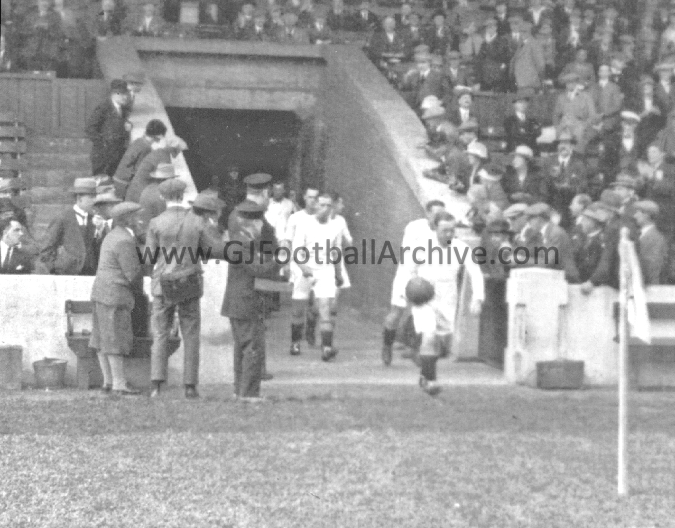
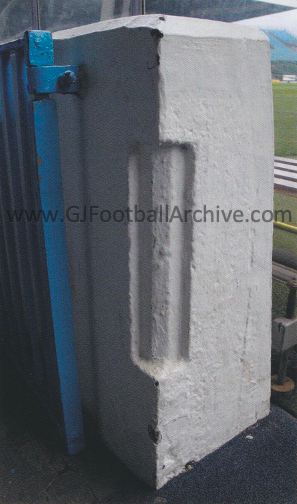
Before I start notice on the black and white image the pitchside stone post. Yesterday I mentioned the carved edge style and how originally there were two impressive stone posts, one either side of the tunnel entrance. I said that by 2003 these had been remodelled extensively to match the rest of the white perimeter wall but that one of them still showed an element of the styling used throughout the stadium at the time of construction.

Maine Road’s Tunnel post. Photo by Ed Garvey

Well on the black and white image you can see that same post (on the right of captain Jimmy McMullan) in its original form.

So, what’s my angle for today? Well, it’s the players’ tunnel itself. In this 1926 image you can see the tunnel as it looked when it was first built. Eagle eyed readers may notice that the tunnel looks a little different to how it did during the 1970s onwards. That wall above the tunnel was actually taken down and the front of the seating above the tunnel was brought forward into the tunnel during the 1960s. You can see that by looking at this image of chairman Albert Alexander and Joe Mercer who are actually sat in front of where the original tunnel wall was. The space they occupy would have been open air, floating above the tunnel only a few years earlier.

Albert Alexander & Joe Mercer in the Directors’ Box extension (Copyright Mirrorpix).

The 1926 photo of the tunnel appeared in my 1997 book Manchester The Greatest City and about a year after it was published I received a letter from Canada. It came from an elderly City supporter who had emigrated to Canada many years earlier. His daughter had returned to England for a visit in 1998 and she popped into a bookshop (I think it was the old Sportspages shop) thinking that if there was a book on Manchester City she would buy it for her dad. She saw my book and bought it.

When she returned to Canada she gave the book to her father and while reading it he was stunned to find himself as a small boy on this photo. He is pictured leaning on the wall close to his mother and father. It was a remarkable coincidence but what made it even more special is that this photo came from film of the game. I was able, with the support of the British Film Institute to get a VHS copy of the game and I sent it to Canada so that he could also see himself and his parents on film, moving around.

For me that story gave me an overwhelming feeling that researching and writing about history can add significantly to the wellbeing, interests or lives of others. Research matters. There was also a great feeling of coincidence – I could easily have chosen a different illustration; the daughter may not have bought my book; her father may have only glanced through the book and so on.

1926 City v Fulham, Maine Road. Jimmy McMullan with the ball.

If you’d like to read more on the history of Maine Road, take a look at Farewell To Maine Road, which can be downloaded from this page:

If you enjoy all the free material on my website and would like to support my research and keep this website going (but don’t want to subscribe) then why not make a one-time donation (or buy me a coffee). All support for my research is valued and welcome. It allows me to keep some free material available for all. Thanks.

Choose an amount

£2.50
£5.00
£7.50

Or enter a custom amount

£

Your contribution is appreciated.

Donate

Neutral Venue

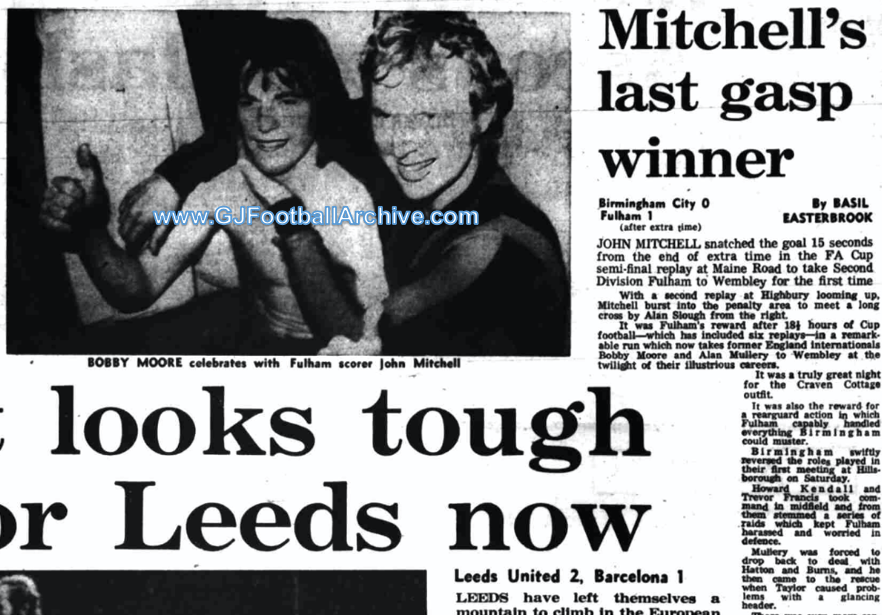
On this day (9 April) in 1975 Fulham and Birmingham City met at Maine Road in a FA Cup semi-final replay.  It was an evenly matched game until – with only around a minute of extra-time left – Fulham striker John Mitchell chased a hopeful ball into the Birmingham area.  The Birmingham ‘keeper Dave Latchford blocked a shot which then rebounded off John Mitchell’s leg and into the net to give Fulham a 1-0 victory.

The attendance for this midweek replay was 35,205 with over 20,000 coming from Birmingham (according to their local press!).  Although Maine Road was a regular and popular semi-final venue during most of its history, it does seem a rather strange choice for this tie considering the location of the sides taking part. 


Penalty Decides

When Manchester City and Fulham these sides met on this day (6 April) at Easter 1928 City were fighting for promotion out of Division Two, while Fulham were desperate to avoid relegation.  It was a Good Friday game and a crowd of 50,660 attended, though some reports claimed it was a 60,000 crowd (these were the days before Peter Swales though!).

The match was not as entertaining as other fixtures between the Blues and the Cottagers during this period, although the first few minutes suggested otherwise.  The Daily Dispatch reporter explained:  “Though they had a strong wind and sun against them, Manchester City opened the scoring in practically the first advance they made.  Marshall taking a pass by Sharp almost from the flag on the half-volley and crashing it into the net.”

After 30 minutes Fulham went further behind when their left-back Barrett handled a shot from Marshall.  Frank Roberts netted the resultant penalty.  Ten minutes later McNab scored a consolation goal for Fulham.  

In summary the Daily Dispatch claimed that the penalty – hotly disputed by Fulham – was the only significant difference between the sides (well it did end 2-1!).