At Elland Road Manchester City defeated Leeds 3-1 on this day (28 December) in 2022. Erling Haaland scored twice to establish a new record – the fastest man to twenty goals in the Premier League. Rodri score the other City goal and you can watch highlights here:
If you enjoy all the free material on my website and would like to support my research and keep this website going (but don’t want to subscribe) then why not make a one-time donation (or buy me a coffee). All support for my research is valued and welcome. It allows me to keep some free material available for all. Thanks.
On this day (27 December) in 2023 Manchester City and Everton met at Goodison Park in City’s first game back in England following the FIFA Club World Cup. The world champions defeated Merseyside’s Blues 3-1 with goals from Foden, Silva and Alvarez.
If you enjoy all the free material on my website and would like to support my research and keep this website going (but don’t want to subscribe) then why not make a one-time donation (or buy me a coffee). All support for my research is valued and welcome. It allows me to keep some free material available for all. Thanks.
On this day in 1913: Frank Swift was born. Here for subscribers is a detailed article I wrote on Swift a few years back:
Swift, Frank Victor (1913-1958), footballer and journalist was born in Blackpool, Lancashire on 26 December 1913, the second son of five children. From his earliest memories, he was always obsessed with the game of football, playing at every opportunity with his brothers, one of whom, Fred, became first team goalkeeper for a variety of clubs, most notably Blackpool, Oldham Athletic and Bolton Wanderers.
Subscribe to get access
Read more of this content when you subscribe today. It’s £20 for an annual subscription or £3 per month (cancel anytime, see below).
Merry Christmas. If you’re bored and wondering what to do (I know… unlikely), here’s an article for subscribers. Today I’m focusing on Manchester emblems and, in particular, those used by Manchester City over the years. City’s current badge has been worn on shirts since summer 2016 after first being revealed at Christmas 2015, but its roots go back decades with City developing a round badge by the 1930s.
Here for subscribers is a 1500 word piece on the development of badges at City and United. Enjoy!
Subscribe to get access
Read more of this content when you subscribe today. It costs £20 a year (works out about £1.67 a month) and you get access to everything on the site and help future research into Manchester’s football history.
On this day (24 December) in 1948 the great maverick Mancunian footballer Stan Bowles was born. Here’s a profile of him…
Bowles joined City as an amateur on 27 July 1965, becoming an apprentice on 1 October 1965 and then professional on 29 December 1966.
Then in 1967 things really began to happen and Bowles’ first game was as a substitute in a League Cup tie at home to Leicester City. He scored two goals in the second half and the following Saturday he made his League debut another memorable one. He scored two again!
Lots of stories have circulated over the years about his time at City. Like Mario Balotelli many years later some are truthful; others are exaggerations and some are completely make up.
The stories go that Bowles once missed a flight to Amsterdam where City were to play against Ajax, and that Bowles’ interest in the horses led to Joe Mercer saying: ‘If Stan could pass a betting shop like he can pass a ball, he’d be a world beater.’ Suspensions and other issues led to Stan refusing to sign a new contract and he asked to leave. That in itself led to him being suspended for 14 days on the advice of the Football League.
Inevitably Bowles moved on, first to Bury (July 1970) and then to Crewe (September 1970).
A spell at Carlisle followed and then in September 1972 a bid of £110,000 took him to Loftus Road where he won five England caps as a QPR player.
Seven years later Nottingham Forest’s Brian Clough bought him for £210,000 but sold him again less than a year later after further issues. Further spells were reported at Orient, Brentford, Hounslow and Epping.
In 2015 it was announced he was suffering with Alzheimer’s Disease, like his former boss Joe Mercer. Bowles died on 24 February 2024.
At City Bowles made a total of 20 first team appearances, scoring 4 goals, but he remains recognised as a hugely talented player.
There are articles on this site mentioning Bowles. Here’s a selection:
If you enjoy all the free material on my website and would like to support my research and keep this website going (but don’t want to subscribe) then why not make a one-time donation (or buy me a coffee). All support for my research is valued and welcome. It allows me to keep some free material available for all. Thanks.
Joe Royle signed for Manchester City on this day (24 December) in 1974. You can find several articles that mention Joe throughout this website. Start looking here:
The Manchester Corinthians book has arrived at my home today! Great news and a nice surprise from Santa! I’m doing the final quality control checks and signing all subscriber copies before we can distribute it. The full distribution to all who have ordered it will hopefully be complete within the next week (Christmas post will affect deliveries I guess).
If you’ve not ordered it and would like to get a copy sent out by New Year’s Eve then order it now (below). I’ll sign all copies ordered direct through this way. Once all orders have been sent out then the book will start to be distributed to book shops/retailers.
UK ONLY – Manchester Corinthians: The Authorised History
The story of a pioneering women’s club as told to Gary James by those who were there. This will be published in late December 2024. This is UK only at £25 (incl UK postage and packaging). Outside UK contact for additional postage costs.
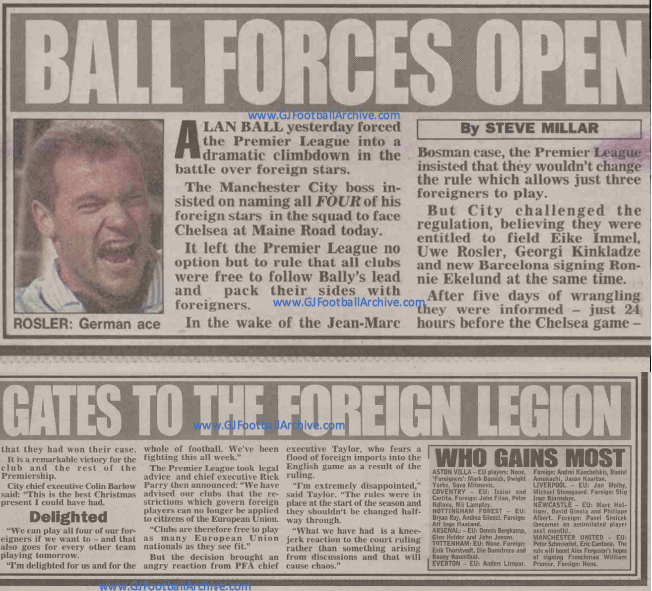
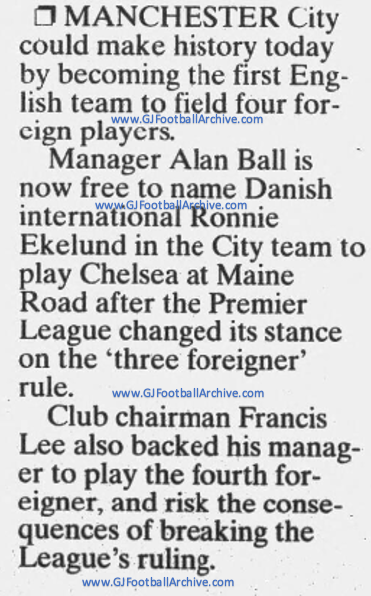
On this day (23 December) in 1995 there was a great deal of speculation that Manchester City would be the first team to field four ‘foreign players’ which wound PFA chief Gordon Taylor up considerably. There had been a rule in place limiting the number of foreign players to three but this had been challenged by English clubs, following the historic Bosman judgement in the European Court of Justice.
Basically, before Bosman challenged the restrictive trade practices UEFA insisted that a maximum of three foreign players could appear for clubs. The Bosman judgement was immediately considered by Premier League clubs who felt it meant they could play as many players from the European Union as they wanted (though the maximum of 3 from outside the EU was still a limit).
The Premier League, supported by the FA, said the ruling meant that City and other clubs could play as many EU players as they wanted. At Maine Road Alan Ball had brought Danish under-21 international Ronnie Ekelund on loan and together with Eike Immel, Uwe Rosler and Georgi Kinkladze it was suggested he would play against Chelsea on 23 December 1995.
In the end Ekelund came on as substitute for Rosler, so 4 ‘foreign players’ had appeared that day but only 3 at any one time (though there’s a whole other discussion to be had about players from other United Kingdom countries and Ireland and whether they should count as that day the Republic of Ireland’s Niall Quinn played, as did Gerry Creaney from Scotland and Welsh international Kit Symons!).
As for the game… City lost 1-0 to Chelsea!
Ekelund had a brief up and down career at City, making only 6 (plus 3 as sub) appearances and he was soon off to Barcelona, while the change to the ‘foreign player’ rule was to have a massive impact on the development of football in England, paving the way for the multitude of talented players at City today.
Subscribe to get access
If you have enjoyed this piece and would like to support my writing while also accessing further great content, then why not subscribe? Those who subscribe on an annual basis get access to everything posted on this site since December 2020 (including PDFs of 2 out of print books, and audio interviews with John Bond, Malcolm Allison etc.). Those subscribing on a monthly basis get access to everything posted since 1 October 2022. It’s £20 a year or £3 per month. Why not try it for a month?
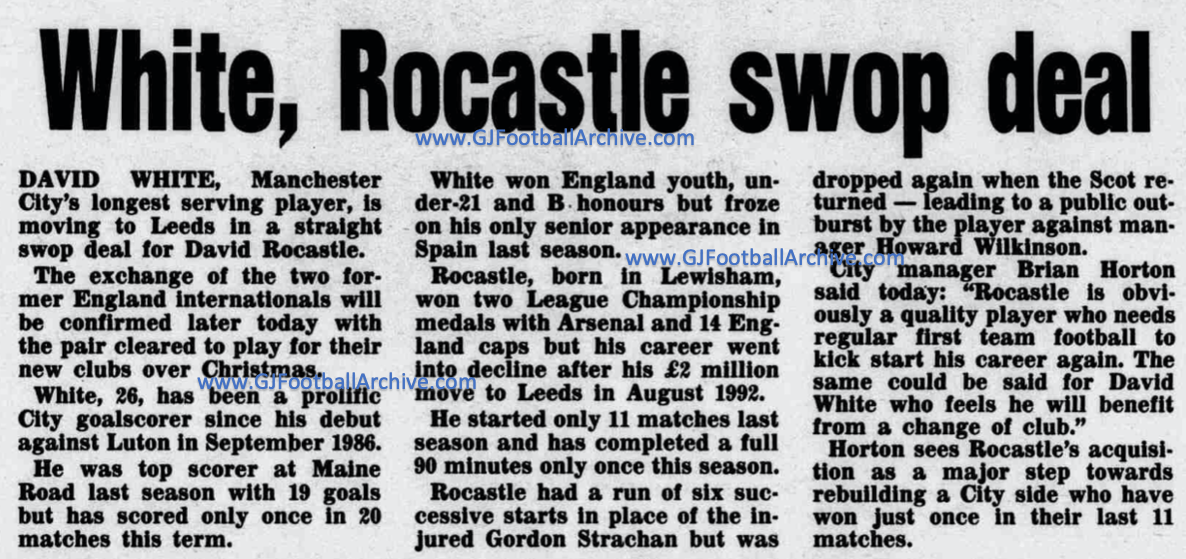
On this day (22 December) in 1993 David White left Manchester City after years of dedication to the Blue cause. He was transferred to Leeds United in a swap deal for David Rocastle. It was a sad loss for the Blues but it was also a new beginning for Rocastle.
If you enjoy all the free material on my website and would like to support my research and keep this website going (but don’t want to subscribe) then why not make a one-time donation (or buy me a coffee). All support for my research is valued and welcome. It allows me to keep some free material available for all. Thanks.
On this day (22 December) last year Manchester City became the first English club to hold the Premier League, FA Cup, UEFA Champions League, Super Cup and FIFA Club World Cup at the same time, following their 4-0 victory over Fluminense in the FIFA Club World Cup. It was an extraordinary achievement.
Julian Alvarez opened the scoring after 40 seconds, when he chested in from close range after Nathan Ake’s long-range strike hit the post.
In the 27th minute Nino turned Phil Foden’s cross into the back of his own net to make it 2-0.
In the second half Foden darted through the middle to send home a cross from Alvarez. Alvarez made it 4-0 with his second in the 88th minute.
Afterwards manager Pep Guardiola reflected: ‘It was an incredible year. Today we closed the chapter. We won everything we could. Now time to try again.’
If you enjoy all the free material on my website and would like to support my research and keep this website going (but don’t want to subscribe) then why not make a one-time donation (or buy me a coffee). All support for my research is valued and welcome. It allows me to keep some free material available for all. Thanks.




 Gary James' Football Archive