Congratulations Newcastle

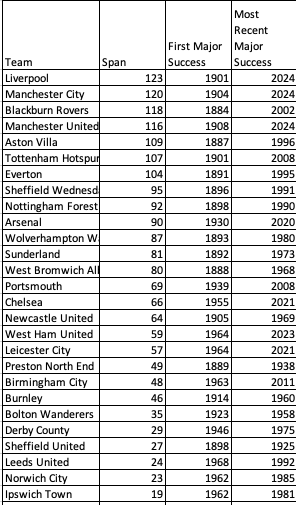
Congratulations Newcastle on defeating Liverpool in today’s League Cup final. The victory also means that 120 years separate their first major trophy success with their most recent. This span equals Manchester City. Every year, usually when the domestic season ends I update the table showing the span of success – i.e. the number of years between a club’s first major success (FA Cup, League, League Cup, major European trophy) and their most recent – for each major men’s trophy winning English club. I last did this after the 2023-24 season ended (see below). There wasn’t much difference between the 2023 final table and the 2024. Both Liverpool and Manchester City increased their span, as did United. Newcastle have leaped from 16th place (just behind Chelsea) to joint second with City. Here’s the table as it stood before today’s game:
As I always say, the span of success does not show how many trophies each club has won or how frequently that club has experienced great eras of success, but it does demonstrate how wrong those people are who believe certain clubs were unsuccessful until recent years, or those who think certain clubs have always been giants. The column on first major success helps to show when some clubs first became trophy-winning significant (often after transformational investment too!).

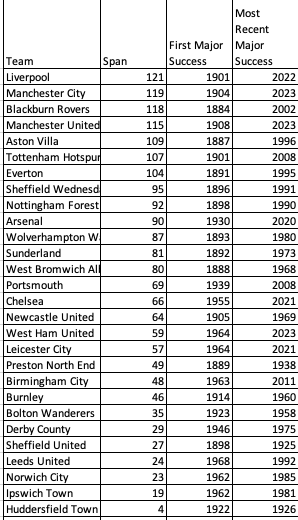
There’s not much difference between 2023 and 2024 – numbers have changed but not positions. In 2023 West Ham, like potentially Newcastle this year, proved that if you’re a club that hasn’t won a major trophy for a while putting your focus on achieving trophy success ahead of the odd Premier League position can bring significant reward. In future decades no one will remember who finished seventh, tenth or fifteenth but they will remember the trophies. Here’s the previous year’s table for comparison purposes:
I know clubs focus on their financials but winning a trophy has longevity, gaining the odd Premier League place provides a bit of extra cash now but no long term kudos. Winning a trophy attracts new fans and brings money-spinning opportunities too.

If I was a supporter of any of the major clubs who have not found significant success in recent decades then I would absolutely want my team to go for whichever cup competition seems the most likely to win. That’s what I always wanted from City before they were able to compete for the League again. Winning the FA Cup in 2011 helped everything that followed happen – it gave confidence and a trophy winning mentality.

While you’re here why not take a look at the wide range of articles available on this site? Such as the 100 day series of features on Maine Road:

If you enjoy all the free material on my website and would like to support my research and keep this website going (but don’t want to subscribe) then why not make a one-time donation (or buy me a coffee). All support for my research is valued and welcome. It allows me to keep some free material available for all. Thanks.

Choose an amount

£2.50
£5.00
£7.50

Or enter a custom amount

£

Your contribution is appreciated.

Donate

The Span of Success: Will Newcastle Change History?

Every year, once the domestic season ends I update the table showing the English clubs’ span of success – i.e. the number of years between a club’s first major success (FA Cup, League, League Cup, major European trophy) and their most recent. I last did this after the 2023-24 season ended (see below). There wasn’t much difference between the 2023 final table and the 2024. Both Liverpool and Manchester City increased their span, as did United. Next month there’s a chance Newcastle can leap from 16th place (just behind Chelsea) to joint second with City. Here’s the table as it stands at present:

As I always say, the span of success does not show how many trophies each club has won or how frequently that club has experienced great eras of success, but it does demonstrate how wrong those people are who believe certain clubs were unsuccessful until recent years, or those who think certain clubs have always been giants. The column on first major success helps to show when some clubs first became trophy-winning significant (often after transformational investment too!).

There’s not much difference between 2023 and 2024 – numbers have changed but not positions. In 2023 West Ham, like potentially Newcastle this year, proved that if you’re a club that hasn’t won a major trophy for a while putting your focus on achieving trophy success ahead of the odd Premier League position can bring significant reward. In future decades no one will remember who finished seventh, tenth or fifteenth but they will remember the trophies. Here’s the previous year’s table for comparison purposes:

I know clubs focus on their financials but winning a trophy has longevity, gaining the odd Premier League place provides a bit of extra cash now but no long term kudos. Winning a trophy attracts new fans and brings money-spinning opportunities too.

If I was a supporter of any of the major clubs who have not found significant success in recent decades then I would absolutely want my team to go for whichever cup competition seems the most likely to win. That’s what I always wanted from City before they were able to compete for the League again. Winning the FA Cup in 2011 helped everything that followed happen – it gave confidence and a trophy winning mentality.

While you’re here why not take a look at the wide range of articles available on this site? Such as the 100 day series of features on Maine Road:

If you enjoy all the free material on my website and would like to support my research and keep this website going (but don’t want to subscribe) then why not make a one-time donation (or buy me a coffee). All support for my research is valued and welcome. It allows me to keep some free material available for all. Thanks.

Choose an amount

£2.50
£5.00
£7.50

Or enter a custom amount

£

Your contribution is appreciated.

Donate
An Old Trafford First

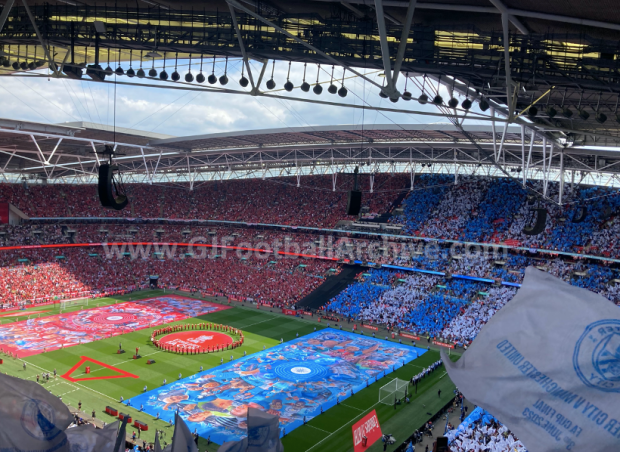
On this day (19 November) in 2023 Old Trafford staged its first Manchester Derby in the Women’s Super League. A crowd of 43,615 watched City defeat United 3-1 after the Reds had taken the lead.

The United goal came from a Katie Zelem’s penalty, given for handball against the Reds’ former captain Alex Greenwood, despite the Blues being in control for much of the match.

Two goals in a little over a minute from Jill Roord first and then Lauren Hemp (see photo) inflicted United’s first Women’s Super League defeat of the season. It also lifted City above the Reds. Khadija Shaw added a third for City in the second half, by charging down the goalkeeper Mary Earps’ clearance, before City’s Laia Aleixandri was sent off for a second yellow for pulling back Lucía García.

It was a wonderful victory for the Blues who had been keen to face United at Old Trafford in earlier seasons. However, according to journalist Suzy Wrack: ‘United have waited to play a derby at Old Trafford until the performance gap between the six‑year-old club and their neighbours, the 2016 WSL champions and regular contenders, was a little smaller. They have played four times at Old Trafford, against West Ham twice, Everton and Aston Villa, before breaking the club’s attendance record for the visit of City on Sunday with 43,615 fans present.’

This was not a record for the women’s Manchester derby however, as that had been set on 11 December 2022 when 44,259 had watched City and United play out a 1-1 draw at the Etihad Stadium.

After the game City boss Gareth Taylor spoke to the media: ‘There’s a huge feeling of pride playing like we did in such a big spectacle. When you turn up to Old Trafford and there is a huge crowd there, it is a completely different game to any other normal WSL game.

‘I thought the two goals we scored in the first half were actually the hardest chances, there were some easier ones [not taken]. So yeah work for us to do still but credit to the players.

‘We were thrown into another situation again with another red card. We can’t have too many complaints about it, but we are prepped for those situations now. Fair play to the players that came on, they helped us to manage the game and helped us to nullify any chances United had. “

United defender Hannah Blundell commented: ‘Against the run of play we got the penalty, then the disallowed goal spurred them on and let them have momentum and we need to figure out how to switch that.We will come back stronger and I know we will with this team. We have a lot of players who can put in the performance and there is a togetherness in this team.’

The Span of Success: Updated for 2024

As usual, once the domestic season ends I update the table showing the English clubs’ span of success – i.e. the number of years between a club’s first major success (FA Cup, League, League Cup, European trophy) and their most recent. There’s actually not much difference between last year’s final table and this:

Okay, the span of success does not show how many trophies each club has won or how frequently that club has experienced great eras of success, but it does demonstrate how wrong those people are who believe certain clubs were unsuccessful until recent years, or those who think certain clubs have always been giants. The column on first major success helps to show when some clubs first became trophy-winning significant (often after transformational investment too!).

There’s not much difference between 2023 and 2024 – numbers have changed but not positions. In 2023 West Ham proved that if you’re a club that hasn’t won a major trophy for a while putting your focus on achieving trophy success ahead of the odd Premier League position can bring significant reward. In future decades no one will remember who finished seventh, tenth or fifteenth but they will remember the trophies. Here’s last year’s table for comparison purposes:

I know clubs focus on their financials but winning a trophy has longevity, gaining the odd Premier League place provides a bit of extra cash now but no long term kudos. Winning a trophy attracts new fans and brings money-spinning opportunities too.

If I was a supporter of any of the major clubs who have not found significant success in recent decades then I would absolutely want my team to go for whichever cup competition seems the most likely to win. That’s what I always wanted from City before they were able to compete for the League again. Winning the FA Cup in 2011 helped everything that followed happen – it gave confidence and a trophy winning mentality.

While you’re here why not take a look at the wide range of articles available on this site? Such as last summer’s 100 day series of features on Maine Road:

Another All-Manchester FA Cup Final

Good luck to all those interested in, attending and watching the second all-Manchester FA Cup final today. Let’s make sure it’s another that makes the world see the quality of Manchester’s football and fans.

Four Major Trophies This Season?

Tomorrow will see Manchester City and Manchester United face each other in the second All-Manchester FA Cup final. This promises to be another dramatic day in the history of Manchester football (we are so blessed being able to see days like these).

Obviously, the game could go either way and I don’t want to make predictions as derby days are often difficult to predict. I well remember arriving at Maine Road in September 1989 when Alex Ferguson’s United were most expensive squad ever assembled in British football at the time. That day City fans feared the worst and by full-time the Blues had defeated the Reds 5-1 with chants of Fergie Out coming from the fans left in the away section of the Platt Lane Stand. Who would have thought that night that he would keep his job and bring so much success to the Reds?

Whatever happens enjoy the day and game. Clearly, if United win then that will help their development and if City win then that will mean four major trophies have been won this season – the other three are of course the Premier League, the UEFA Super Cup and the FIFA Club World Cup. Not bad hey? Add to that the FA Youth Cup and it’s been another great season.

The Second All-Manchester FA Cup Final

Well, the Premier League is now over for another year and we know who the Champions (4-in-a-row) are and who has qualified for Europe etc. so it’s time to look forward to the second all Manchester FA Cup final. The first was of course last season and started off wonderfully for Manchester’s Blues with that record-making Gundogan opener.

Prior to this last year’s final, the closest Manchester City and Manchester United got to playing each other in a Wembley FA Cup final were the FA Cup semi finals in 1926 and 2011. I wasn’t around in 1926 but I definitely was in 2011! A few years back I made this special audio recording talking about the years building up to the semi and the day itself from a Manchester City perspective. Many of you have listened to this already but if you haven’t then it tells the story of the 2011 FA Cup semi final and the years between 1976 and that moment in 2011 for City.

I included audio from interviews I did with a variety of people including Khaldoon, Peter Swales, Garry Cook, Brain Marwood and many others.

If you have heard it before then maybe you should listen again to remind yourself of how we all felt and why that game was so significant.

I included a few words from Roberto Mancini recorded in 2011 and at one point he talks about the view that was then being expressed that City were ‘trying’ to buy success (now they say City ‘have’ bought success!). His words are a reminder that City have been having that particular criticism thrown at them for over a decade! Oh well, I wonder how long those criticisms were laid at other clubs who had seen major investment which propelled them forward?

Anyway, get yourself a brew and be prepared to be transported back in time. Here’s the recording:

If you enjoy the recording then please let me know, comment or subscribe to the site. If you don’t fancy doing that then there’s also the option to make a welcome donation to keep this site going (see below). I’ve produced videos/talks like this highlighting key points in Manchester City’s footballing history which subscribers can watch too. 

If you enjoy all the free material on my website and would like to support my research and keep this website going (but don’t want to subscribe) then why not make a one-time donation (or buy me a coffee). All support for my research is valued and welcome. It allows me to keep some free material available for all. Thanks.

Choose an amount

£2.50
£5.00
£7.50

Or enter a custom amount

£

Your contribution is appreciated.

Donate


Subscribe to get access – Annual

Read more of this content when you subscribe today. It costs £20 a year to subscribe (it works out £1.67 a month) or £3 if you’d like to sign up a month at a time. Annual subscribers get full access for as long as you subscribe (you can always try it for a month). It’s worth bearing in mind that the 2010 Manchester A Football History cost £24.95 and all subscribers will be able to access all of that for as long as they are a subscriber (plus all the other stuff of course).

Subscribe to get access – Monthly

It costs £3 a month to subscribe a month at a time. Why not give it a try! Monthly subscribers get access to everything posted since 1 October 2022 for as long as you subscribe.

Match Stats for the 2011 FA Cup Semi-final

City 1-0 United (HT 0-0)

Yaya Toure 52

City: 25 Hart 04 Kompany (yellow card), 05 Zabaleta (yellow card), 13 Kolarov, 19 Lescott, 11 Johnson (Wright-Phillips 79), 18 Barry, 21 Silva (Vieira 86), 34 De Jong (yellow card), 42 Y Toure, 45 Balotelli (yellow card). Substitutes 12 Taylor, 38 Boyata, 07 Milner, 08 Wright-Phillips, 24 Vieira, 10 Dzeko, 27 Jo

United: 01 Van der Sar, 03 Evra, 05 Ferdinand, 15 Vidic, 22 O’Shea (Fabio Da Silva 84), 13 Park Ji-Sung, 16 Carrick, 17 Nani, 18 Scholes (red card), 25 Valencia (Hernandez 65), 09 Berbatov (Anderson 74). Substitutes 29 Kuszczak, 12 Smalling, 20 Fabio Da Silva, 08 Anderson, 28 Gibson, 07 Owen, 14 Hernandez

Referee: Dean

Attendance: 86,549

Women’s FA Cup Final: The Original Manchester United Ladies

My research into women’s football in Manchester has highlighted the stories of many players and clubs over the years. I think people tend to think my research is only about City and the Corinthians but it aims to cover all teams. This includes Manchester United, whose history as a women’s team, I’ve been researching for many years. They have a fascinating story and were pioneers in many ways.

The original Manchester United Ladies team was established via the United Supporters’ Club and played its first game in October 1977, against a team from Ireland. In 1986, while looking back on this period, manager Anne Smith joked: ‘Our standard of football was not very high. It couldn’t have been as I was playing!’

Over the course of the next two years, the club played a number of friendlies until, in 1979, the team joined the long-established Three Counties League and the Women’s Football Association (FA). Anne Smith was one of the leading figures within the club, and became manager around this time. Anne was a driving force behind the club for many years and deserves to be recognised as a pioneer of women’s football, helping to establish competitions in the 1970s and 1980s.

Publicity in the men’s United match programme during the late 1970s encouraged other women to join United and in their first season of league football they finished sixth. The Three Counties League covered a large geographic area and travel to games was difficult, so Anne and the United committee worked with others to create a local league. The Women’s FA gave permission to establish the Greater Manchester Women’s Football League with its first season of operation being 1982-83 (if you have information and seasonal records of the Three Counties League then please get in touch as this will help some of my current projects – Gary@GJFootballArchive.com Thanks).

United Ladies won the competition in its first three seasons and the club remained a leading team in the region for many years. Jane Morley, who is currently the secretary of Stockport County Ladies, was a player for many years:

‘As a United men’s supporter it was great to play for the original women’s team. Wearing the red of United and training at the Cliff was really great and we were a strong team too. We were very successful in the Greater Manchester Women’s League. The two strongest clubs were ourselves and Wythenshawe and games between the two were real tests. Wythenshawe were our main rivals.’

During her time with the team Jane remembers playing at the Old Trafford stadium once: ‘There was a men’s testimonial game and we were asked to play on the pitch as part of the day’s events. That was something special for us all.’

The club continued to develop during the 1980s and 1990s, officially forming part of Manchester United by 2001. However, the club disbanded in 2005, not long after the Glazers takeover of the Reds.

In 2018, a new Manchester United women’s team was established and this team went on to win the Championship in 2019. United women have been a formidable challenger in the FA Women’s Super League ever since and reached the Women’s FA Cup final in 2023 for the first time. They’re in the final again today against Tottenham. Will this be their first major trophy success since the resurrection of the team?

Many former United players also played for the Manchester Corinthians during the 1960s, 1970s and 1980s (if you did then please get in touch). The influence of that club, established in 1949, played its part in the development of Manchester’s footballing life. This year to mark the Corinthians 75th anniversary I’m self funding a book on the club: Manchester Corinthians: The Authorised History will be published late summer and tells the story of the club via the voices of women who played from its first ever game in 1949 right the way through until its final game over 40 years later. Players from every season have been interviewed and anyone ordering the book pre-publication will be able to have their name printed in a special roll of honour at the back.

The Corinthians’ legacy is still felt strongly and their influence on both United’s and City’s women’s teams remain. You can find out more on the book here:

As for Jane Morley… she stayed with the original Manchester United women’s team for six successful years. In 1985, together with other United players, she established FC Redstar and took the team into the North West Women’s Regional Football League where they achieved promotion in 1987 to the top division – at the time the highest league competition available. Playing in Stretford, FC Redstar impressed but player recruitment issues brought a premature end to the club in 1990.

Once her playing days were over Jane coached and managed at various levels with Manchester City Ladies for many years. Always keen to promote football to young girls Jane enjoyed developing an array of talent with the club. She also brought success to the club and managed the first team for a spell when they were based in Urmston, Trafford.

After leaving City Jane continued to develop opportunities for girls and young women within both Greater Manchester and in Cheshire and is secretary of Stockport County’s women’s team, dedicating her adult life to promoting football for women and girls.

You can watch a brief interview, captured as part of a project I did for the Women’s Euros, with Jane here:

The 1990s: The First Women’s Manchester League Derby

The latest City in the 1990s flashback feature is about the women’s Manchester derby. This weekend marks the latest Manchester derby in the Women’s Super League and it will be played at the Etihad Stadium (City currently hold the record attendance for a women’s club game in Manchester – you can find details of that elsewhere on the website). There’s a long history of competition between teams representing the women of Manchester City and Manchester United.

City’s team has been in existence continually since November 1988 when Donna Haynes and Heidi Ward both scored two goals in their first game (v Oldham Athletic at Boundary Park).

I was at the City Ladies (as they were then known) first game and I was also at their first league derby in September 1990 when City defeated United 4-3. It was a fantastic day, watched by around 150 people.

City’s goals came from Rhoda Taylor (8 min), Rachel O’Shaughnessy (43 mins), Jenny Newton (50 mins) and Lesley Peters. City’s manager Neil Mather told me as part of my research for the Manchester City Women book: ‘United were the top side, you know, and beating them was so good for morale. The men’s team were a good side in the early 90s when City Ladies carried on developing, you know. This was the Howard Kendall era, and City had top five finishes. City were one of the top five or six teams in the country at the time, so it was fabulous for women’s football to have Man City, you know.’

Helen Hempenstall played for City that day and she described her memory of the day for my book: I remember when we played United (30/9/90) and Neil (Helen’s boyfriend, now husband) and all his mates came to watch us. There were a lot of people there that day. United had a decent team then. It was always a difficult game against United. They had a right-winger… We never got on. Every time we played each other we were at each other all the way through the game. Me and Carol Woodall were having a go at her. The referee told Lesley Wright “Tell both your full backs to shut their mouths otherwise they’ll both be off!” We just didn’t get along and before every game I thought I’ll get in their first. ‘I’m having her.’ Neil Mather still talks about it.

‘I think Lesley Wright kept the team together. She kept it all tight at the back. I played at the back with her and I learnt a lot from her. Because I was next to her I knew how important she was. If I missed something she always got it. She always encouraged me and kept shouting ‘different class, different class’. You learn from the people around you and I listened to her. Before every game she came to speak to me. She’d put her arm around me and reassure me. She’d tell me not to worry about anything. Most of the time travelling to away games I’d go with Lesley in the car. We used to have a laugh. I remember one day we were travelling to an away game some distance away and we stopped for petrol and all got out. I lit up a fag and everyone else jumped back in the car screaming! I didn’t even think! When we got to the ground they all told Neil Mather and I think he worried that he could’ve lost half his team. At another game I was sat in the middle and as we got out the person before me slammed the door back. It hit my head and I had a big lump for the game.’

Lesley Wright was one of several women who had first played for the pioneering Manchester Corinthians team. I’ve been researching their remarkable story for years and this summer (2024) my work will be published. It will tell the story of the Corinthians from its formation in 1949 through to its final days forty years later. For more information on that club and the book see:

The story of the first women’s League derby and of the first 30 years or so of City Women’s existence can be read in my book on the club. It’s called Manchester City Women: An Oral History and is basically the women telling their stories of playing for the club and how they got into football, plus statistics covering the journey from friendlies in 1988-89 through to competition and the modern day successes.

You can buy the book via this link (every copy is signed by me):

Manchester v Liverpool

This weekend marks the latest in the series of games between one of the Manchester clubs and a Liverpool team. Today (25 November 2023) treble winners City face second placed Liverpool at the Etihad. Tomorrow it’s 6th placed United v 19th placed Everton (who have been docked points for Financial Fair Play breach). Understandably, much will be made of the Manchester-Liverpool rivalry and it is true that the two cities have been rivals for over 150 years (it certainly predates the building of the Ship Canal!) BUT the football clubs have not always been rivals. In fact Utd and Liverpool have been close over the decades at times while the on-the-pitch rivalry between City and Liverpool was extremely strong in the late 60s and 70s.

The strength of the two conurbations’ footballing rivalries came during the late 1960s but intensified in the late 70s. Prior to this one-off seasons may have seen grudge matches or significant games between clubs from the cities but nothing more than that. In fact for many, many years Manchester United and Liverpool, for example, were extremely close. They once put forward a suggestion to the Football League that all home teams should wear red and away teams white – the rest of football soon got wise to the plan!

There was also the time when United and Liverpool ‘fixed’ a game of football. It’s a long story (amazingly United’s solicitor was part of the ‘neutral’ investigating committee!) and can be read here:

Match Fixing – Manchester United v Liverpool: A Long Read

The rivalry between the footballing clubs developed in the 60s and there were many significant games between all the clubs in the two cities with several prominent matches (there were significant grudge matches between Everton and City for example in the 60s and at one point Liverpool’s Bill Shankly told the media that City were Liverpool’s biggest rival!).

Back in 1995 I interviewed former Manchester City boss John Bond at his home. The interview lasted about two hours and here’s a brief snippet from that interview where Bond talks about beating Liverpool on Boxing Day 1981.

The Blues won 3-1 (Bond, Hartford & Reeves) then two days later (Bond says it’s the next day in this clip but it was 28th December) City defeated Wolves 2-1 at Maine Rd. John discusses a brilliant goal from Trevor Francis. City went top of the League after the Wolves victory.

Stick with the clip because it ends with Bond’s views on how Liverpool used to react to wins and defeats. I’d best not comment – have a listen:

I’ve covered one particularly bitter moment in the City-Liverpool rivalry from the 80s that concerns John Bond here:

40 Years Ago Today (Yes, 40!) – ‘Illegal Jumping’, Alf Grey and Manchester City (Sorry!)

I hope this weekend’s games between go well and it’d be great if one of Manchester’s Blues could score four goals as Fred Howard did on his debut against Liverpool – see:

https://gjfootballarchive.com/2021/01/18/imagine-scoring-four-goals-for-mcfc-against-liverpool-on-your-debut/

and Frank Roberts did:

https://gjfootballarchive.com/2021/01/17/the-flu-limits-mcfcs-selections-but-they-beat-liverpool-5-0-roberts-4-goals/

Whatever happens enjoy the weekend and remember these games are individual matches. No season is determined in one fixture.