That day – 25 Years Ago

Today (30 May 2024) is the 25th anniversary of Manchester City’s play off final victory over Gillingham. Rightly, Paul Dickov’s goal in the 1999 Play Off final has often been described as the most important Manchester City goal of all time.  However some also forget about the penalty shoot-out and, before either that or the all-important Dickov goal, came the opening City goal scored by Kevin Horlock.

The late 1990s had been a very difficult period for City and Horlock’s goal came at a moment when all hope that the Club could resurrect itself seemed to have vanished.   This goal was obviously important as it gave City hope and ultimately that transferred into achievement.

The following article, covering Horlock’s goal and the story of that day, is available for subscribers to the website. It costs £20 a year (it works out £1.67 per month) or £3 per month (cancel anytime) and you get full access to all articles posted, including PDFs of the out of print Manchester A Football History and my first ever book about Manchester City. There are also audio interviews & more. Do a few searches on past content to see what’s available. Why not try subscribe on a monthly basis and try it out?  

Subscribe to get access

Read more of this content when you subscribe today.

The Span of Success: Updated for 2024

As usual, once the domestic season ends I update the table showing the English clubs’ span of success – i.e. the number of years between a club’s first major success (FA Cup, League, League Cup, European trophy) and their most recent. There’s actually not much difference between last year’s final table and this:

Okay, the span of success does not show how many trophies each club has won or how frequently that club has experienced great eras of success, but it does demonstrate how wrong those people are who believe certain clubs were unsuccessful until recent years, or those who think certain clubs have always been giants. The column on first major success helps to show when some clubs first became trophy-winning significant (often after transformational investment too!).

There’s not much difference between 2023 and 2024 – numbers have changed but not positions. In 2023 West Ham proved that if you’re a club that hasn’t won a major trophy for a while putting your focus on achieving trophy success ahead of the odd Premier League position can bring significant reward. In future decades no one will remember who finished seventh, tenth or fifteenth but they will remember the trophies. Here’s last year’s table for comparison purposes:

I know clubs focus on their financials but winning a trophy has longevity, gaining the odd Premier League place provides a bit of extra cash now but no long term kudos. Winning a trophy attracts new fans and brings money-spinning opportunities too.

If I was a supporter of any of the major clubs who have not found significant success in recent decades then I would absolutely want my team to go for whichever cup competition seems the most likely to win. That’s what I always wanted from City before they were able to compete for the League again. Winning the FA Cup in 2011 helped everything that followed happen – it gave confidence and a trophy winning mentality.

While you’re here why not take a look at the wide range of articles available on this site? Such as last summer’s 100 day series of features on Maine Road:

Manchester’s Football Origins

For well over a century football has been a crucial and popular aspect of Mancunian life. It’s been part of the city’s identity. So for today’s piece I’m taking a look at football’s early years. Here is a 1800 word overview of the major Manchester clubs that existed before today’s giants, followed by the origins of Newton Heath and St. Mark’s, who both played their earliest known games in November 1880.

This article is available to subscribers to my site.

Subscribe to get access

Read more of this content when you subscribe today. It costs £20 a year (or £3 per month if signing up a month at a time). Throughout your membership you have full access to everything on this site including interviews, recordings and PDFs of a couple of my books that have been long out of print. Why not sign up for a month and see what you think? I commit to 4 new lengthy articles per month, though in practice it’s been much more than that.

Seattle Storm

On 27 May 1986 Billy McNeill’s Manchester City defeated Seattle Storm 1-0 as part of their post season North American tour. The City scorer was Mark Lillis and that season’s FA Youth Cup winners David White, Steve Redmond and Andy Hinchcliffe were in the starting 11. Other FA Youth Cup winners such as Ian Brightwell were also part of the official touring party. Here’s the starting 11 from my ledgers:

Here’s a team photo of Seattle Storm soccer team in 1987:

Subscribers can read more on 1985-86 in this 2,500 word feature below:

Subscribe to get access – Monthly

Read more of this content when you subscribe today. It costs £3 per month (cancel anytime) to access everything posted since 1 October 2022 or there’s a special annual rate below which gives greater access and works out much cheaper.

Subscribe to get access – Annual

Read more of this content when you subscribe today. It costs £3 per month (above) or £20 a year (here) to access everything posted since the site was created in December 2020. This special rate works out about £1.67 a week and gives access to everything posted, including PDFs of 3 of my books.

If you’d like to know more about subscribing then see:

Tomorrow’s feature is on the 1986-87 season. If you missed the earlier features then start here:

The 1980s: 1980-1981 Gow, Hutchison & McDonald

Mike Doyle

On 26 May 1964 Mancunian Mike Doyle signed professional forms for Manchester City. He embodied a spirit and determination as a player that brought great success and the loyal support of City fans.  He was a vital member of two successful periods at Maine Road, and had managed to bridge the gap between Mercer and Allison’s great team of the late 60s and Book’s mid-70s entertainers. In fact he was also there for the miserable period that predated Mercer’s arrival!

Doyle joined the City groundstaff in May 1962 and made his debut in the 2-2 draw at Cardiff on 12 March 1965 and appeared in 6 games during the latter end of a traumatic season.  That summer Mercer & Allison arrived and transformed the Blues with Doyle playing a leading role in every City triumph of the period.  In fact, until recent years he shared the distinction with Tommy Booth of appearing in more finals than any other City player.  He appeared in ECWC, FA Cup and 3 League Cup finals but also played his part in the League title success in 1968 and Second Division title in 1966. He even captained City to their 1976 League Cup triumph and scored in the 1970 victory. 

Ever the determined player City fans loved his fighting spirit and never say die attitude.  Significantly, in an era of major talent and success, Doyle was voted City’s player of the year twice (1971 & 1974).  After making five appearances for England and over 550 competitive first team appearances for the Blues he moved to Stoke in 1978, where he was voted their player of the year in 1979, and later had spells at Bolton and Rochdale.

Mike Doyle was a tremendous City player who played in a determined manner.  He won many admirers with his total dedication to the Blue cause. He died on 27 June 2011.

Howard White and a Liverpool Controversial Game

On this day (25 May) in 1971 defender Howard White signed professional forms for Manchester City.  White had a very unlucky career at Maine Road.  He had alread made his debut on 24 April 1971 in a controversial League game with Liverpool. 

Basically, Liverpool were enjoying a busy, competitive season and decided to rest several key players.  This was against League rules and as City had also fielded a side that seemed to be relatively inexperienced, the League investigated. 

The game ended 2-2 and the League eventually fined Liverpool for fielding a weakened side, but judged that City had managed to field their strongest side considering injuries etc.  For White the game was a low point as he suffered a broken ankle shortly before half time and was never again able to make a first team appearance.     

Another All-Manchester FA Cup Final

Good luck to all those interested in, attending and watching the second all-Manchester FA Cup final today. Let’s make sure it’s another that makes the world see the quality of Manchester’s football and fans.

Four Major Trophies This Season?

Tomorrow will see Manchester City and Manchester United face each other in the second All-Manchester FA Cup final. This promises to be another dramatic day in the history of Manchester football (we are so blessed being able to see days like these).

Obviously, the game could go either way and I don’t want to make predictions as derby days are often difficult to predict. I well remember arriving at Maine Road in September 1989 when Alex Ferguson’s United were most expensive squad ever assembled in British football at the time. That day City fans feared the worst and by full-time the Blues had defeated the Reds 5-1 with chants of Fergie Out coming from the fans left in the away section of the Platt Lane Stand. Who would have thought that night that he would keep his job and bring so much success to the Reds?

Whatever happens enjoy the day and game. Clearly, if United win then that will help their development and if City win then that will mean four major trophies have been won this season – the other three are of course the Premier League, the UEFA Super Cup and the FIFA Club World Cup. Not bad hey? Add to that the FA Youth Cup and it’s been another great season.

Roy Clarke Signs

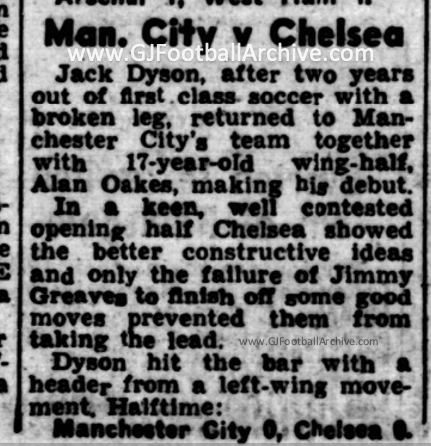
On this day (23 May) in 1947 Roy Clarke signed for Manchester City.  His debut came on 14 June when the Blues defeat Newport 5-1.  Until the Covid affected seasons, this was the latest finish to a season for the Blues. It had been delayed due to poor weather causing postponements.

Years ago I wrote the Manchester City Hall of Fame book and as part of that I featured Roy. The game selected for his ‘most significant’ was the 1955 FA Cup semi final and subscribers can read that below.

City 1 Sunderland 0

FA Cup Semi-Final at Villa Park

26th March 1955

Goalscorer: Clarke

City Team: Trautmann, Meadows, Little, Barnes, Ewing, Paul, Fagan, Hayes, Revie, Johnstone, Clarke.

Attendance: 58,498

Subscribe to get access

If you would like to read this and all the in-depth articles on this site (including the entire Manchester A Football History book and the audio interviews with Malcolm Allison & John Bond) then please subscribe. It works out about £1.67 a month if you take out an annual subscription (£20 per year) or £3 a month if you’d like to sign up for a month at a time.

Four-in-a-Row: An Incredible Achievement

I’ve left it a few days to let it all sink in but ‘wow!’ What an achievement for Manchester City! Never in the near 140 years of League football has any club achieved such a remarkable feat of four successive titles. This record, like the domestic treble, will last for an eternity with future generations aware of how brilliant these players and this manager was.

So for today’s piece I thought I’d look back at the successive titles record and see how that has developed. This demonstrates what a truly remarkable achievement this has been, but it also adds to the debate about whether teams have dominated particular eras or not. We’re often told that City’s era of dominance is new and no team has ever done this before – well no team has ever won 4 consecutive titles that’s for certain – but we’re also told that other clubs, Liverpool, Arsenal and United for example, have had greater periods of dominance (though that’s acceptable and City’s is not – that’s odd in itself!). It seems your view depends on which team you support. For neutrals and those prepared to explore the facts, the following can help with all of this assessment.

Record 2 in a row progression

Preston won the first two League titles in 1888-89 and 1889-90 (and were runners up in the three seasons that followed).

Sunderland equalled the record in 1891-92 and 1892-93 (and were runners up in 1893-94 6 points behind Villa) before winning it again in 1894-95

Aston Villa matched the 2-in-a-row twice in 1895-96 & 1896-97 and 1898-99 & 1899-1900. They actually won 5 out of 7.

Wednesday were next winning 2-in-a-row 1902-03 & 1903-04 (pipping FA Cup winners City to the title).

Liverpool were next with successes in 1921-22 & 1922-23

After Liverpool’s 2-in-a-row came a new record:

Record 3 in a row progression

Huddersfield Town were the first to win three successive title. Their successes came between 1923 and 1926 BUT they also were runners-up in 1926-27 & 1927-28 (missing it by 2 points).

Arsenal achieved the feat of 3-in-a-row between 1932 and 1935. The gunners had won the title in 1931 and were runners up in 1932 (missing it by only 2 points – 1 win), so came close to five.

Liverpool matched the 3-in-row between 1981 and 1984 but they’d come close to 5-in-a-row between 1975 and 1980 when they won the League in 1976, 1977, 1979 and 1980 and were second in 1978. In total Liverpool won 7 out of 9 between 1975 and 1983 (8 out of 11 too).

Manchester United were the next to achieve 3-in-a-row between 1998 and 2001. They had also won 7 out of 9 (1992 to 2001) and 8 out of 11. The years they managed 7 out of 9 saw them finish as runners up in the other two seasons, missing it by only 1 point in both 1994-95 and 1997-98. Rightly, this was heralded as a remarkable achievement.

Manchester United matched their own 3-in-a-row with another between 2006 and 2009. They also finished as either champions or runners up in the following four seasons. This meant that between 1992 and 2009 United had won 11 out of 17 titles and finished second in a further three.

Record 4 in a row setting

Manchester City are the only team to win 4-in-a-row English League titles. This remarkable feat has been achieved with title successes in 2020-21, 2021-22, 2022-23 and 2023-24. City also won consecutive League titles in 2018 and 2019 and were runners up in 2020. This means City have won 6 out of 7 Premier Leagues.

There have been a lot of people out there claiming that this year’s League title was a ‘foregone conclusion’ and that it was ‘boring’. As I pointed out last week that all depends on whether things become boring once your own team are unable to challenge, but for many neutrals it’s about title races going to the final day or ones that are close.

Did you know that only 10 of the Premier League’s 32 seasons have finished with 3 points or less separating the top two teams? In exactly 50% of those seasons Manchester City were the champions – more than any other club! Also, if you’re the kind of person who believes City are the ‘only’ team to challenge and that it’s a foregone conclusion then it may surprise you to learn that 62.5% of ALL City’s Premier League titles have been won by 2 points or less! That’s not even a victory – how close do you want it? How much less of a foregone conclusion works for you?

As a comparison only 15% of Manchester United’s Premier League titles have been won by 3 points or less! I know Liverpool have only won one title since the Premier League was created (yes, and many, many more before that of course!) which means that 100% of LFC’s Premier Leagues have been won by 18 points (that was a foregone conclusion and boring if we believe that the earlier the competition is won the more boring it is!).

If you enjoy all the free material on my website and would like to support my research and keep this website going (but don’t want to subscribe) then why not make a one-time donation (or buy me a coffee). All support for my research is valued and welcome. It allows me to keep some free material available for all. Thanks.

Choose an amount

£2.50
£5.00
£7.50

Or enter a custom amount

£

Your contribution is appreciated.

Donate