Historic Name That Ground – Week 21 Answer

On Monday I asked if you could name this ground. I said: ‘I know it’s a tough one BUT… there’s a reason I’ve chosen this week to post this image plus eagle-eyed visitors to this site may notice that I have actually used part of this image before in connection with another story. So where is it?’ The answer is…

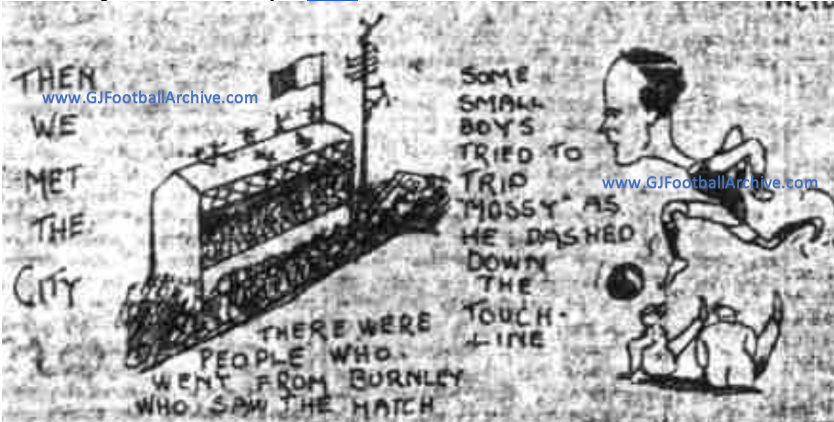
Manchester City’s old Hyde Road ground. So did you work out why I’ve posted the image this week and what the previous story I’d used part of this image for was in connection with? Well this equivalent week in 1920 saw the stand featured being built. This is the only known surviving photo of Hyde Road’s temporary Main Stand built in the week following the Hyde Road fire.

The Main Stand was destroyed on the night of the November 6 by fire and, after attempts to move to United’s Old Trafford failed as a result of United demanding an exorbitant rent. For the full story of this see this chapter of Manchester A Football History (available with the rest of the book as a download for subscribers):

Manchester A Football History part 13

City didn’t think the rent was fair (neither did the media – again see that chapter of Manchester A Football History) and so they decided to soldier on at Hyde Road. A new stand – the one seen from the back here – was constructed using wood.

So, what about the previous story part of the image was used for? That was a piece about Billy Meredith returning to City in July 1921. Meredith is the player on the far right and this photo was taken to show him back at Manchester City.

Watch out for another Historic Name That Ground on Monday.

While you’re here why not subscribe to my site and you can then access every article, interview, audio recording etc. already posted and those that will be posted during your subscription. It costs £20 per year (about £1.67 a month) or you can sign up on a monthly basis at £3 per month (you can cancel at any time, so you could sign sign up for a month, access everything you want and then cancel). You can subscribe below:

Subscribe to get access

Read more of this website including all of Manchester A Football History and my first book, From Maine Men To Banana Citizens, when you subscribe today.

The First ‘Manchester Derbies’

Back in 1881-82 the two teams that would eventually become Manchester City and Manchester United met for the first time with the first fixture occurring on this sate (12th November 1881). To mark this anniversary here’s a free article on the first two derby matches. Both were friendlies of course!

The First Time

Back in 1881-82 the two teams that would eventually become Manchester City and Manchester United met for the first time. This was only a year after the first reported games played by the clubs, then known as St Mark’s (MCFC) and Newton Heath (MUFC). The first St Mark’s game to make it into print was against Macclesfield Baptists on 12th November 1880 while Newton Heath’s earliest known game came seven days later against Bolton Wanderers’ 2nd team.

On the anniversary weekend of St. Mark’s first reported game, 12th November 1881, Newton Heath and West Gorton (St Mark’s) met for the first time.  The game, played at North Road, Newton Heath, attracted an attendance of around 3,000 (according to details recorded many years later – I’m dubious about the number but we have nothing contemporary that’s accurate so we’ll go with that).  

The ‘Heathens’, who went on to become Manchester United in 1902, defeated West Gorton (St. Mark’s) 3-0 in what was described as a ‘pleasant game’.  I wonder what the reporter would make of 21st Century derby matches!  Two goals were scored in the first half, one being an own goal by one of West Gorton’s ‘backs’.  It is not reported who scored the goal, all the ‘Ashton Reporter’ match report says is that the player was “attempting to stop a shot by E. Thomas”.  

One of the significant aspects of the way this game was reported which has created some confusion over the years concerns the St. Mark’s name.  It was recorded as West Gorton (St. Mark’s) as opposed to St.Mark’s (West Gorton) and that change has caused some to suggest that the church were unhappy in some way with the club.  There was a suggestion that the club was attracting players from outside of the parish and that was an issue, but none of this now appears to be correct.  The church appeared to be happy with the way the side was developing and, if anything, the selection of Kirkmanshulme Cricket ground actually meant the team were playing fairly close to the St. Mark’s rectory.  The move potentially increased the opportunity for spreading the church’s work and that may be why the person sending in the match reports to the local newspaper changed the emphasis.

The Return Match

The return match took place at the Kirkmanshulme Cricket ground (West Gorton’s home) on 4th March 1882. On the image above this is the cricket ground to the right of Tank Row (and left of Belle Vue Zoo).  

West Gorton (St Mark’s) gained revenge for the 3-0 defeat in their first encounter, as they overturned Newton Heath 2-1. The Gortonians had managed to take the lead, via Charles Beastow, as early as the eighth minute, and then had to hold off the Heathens who had been awarded a couple of consecutive corners.  The second actually lead to West Gorton’s second goal.  James Collinge obtained possession in front of the West Gorton goal then proceeded to run the full length of the pitch, before sending the ball flying between the Heathens’ posts amid loud cheering.  

The score remained 2-0 until late in the game when, according to reports, the Heathens baffled the home ‘keeper Edward Kitchen by performing several good passes before the ball entered the goal.  Exactly how baffled Kitchen was we don’t know, but we do know that this game was well attended.

Years later the attendance that day was reported as ‘around 5,000’, although it would be unfair and ridiculous to suggest that this was the actual attendance.  It seems incredible that around a sixth of Gorton’s population would have been able to attend a game which, at that point, was not regarded as a ‘derby’ or an important fixture whatsoever.  Nevertheless. it does provide an indication that football in West Gorton was becoming popular.

Subscribe to access everything else

This has been a sample of the material on http://www.GJFootballArchive.com If you would like to read all the in-depth articles (including the entire Manchester A Football History book and the audio interview with John Bond) then please subscribe. It works out about £1.67 a month if you take out an annual subscription (£20 per year) or £3 a month if you’d like to sign up for a month at a time. Each subscriber gets full access to the hundreds of articles posted so far and the hundreds scheduled to be posted in the coming weeks.

Dismal Days AFTER the MCFC Takeover

Here’s a flashback to a difficult period on this day in 2008…

City conceded twice in three consecutive League games during this period, dropping to 13th after a 2-1 defeat to Spurs on 9thNovember. It was a difficult time, especially as manager Mark Hughes felt aggrieved with some refereeing decisions. Most notably, Hughes was unhappy that Middlesbrough on 29th October had been awarded a highly debateable penalty by referee Lee Mason. Replays showed that there had been minimal contact between City’s Sturridge and Boro’s Wheater as the player went down outside the area. That goal switched control in the game. Hughes: “Wheater was not in full control of the ball, he was outside the box and the linesman did not give it. The shape of the game changed… All night the referee took it upon himself to make decisions that were quite frankly disappointing.”

After defeats at Bolton and at home to Spurs the media began to speculate that Mark Hughes’ position was in doubt. City, a point above the relegation zone, had suffered seven defeats in 12 League games causing journalist Daniel Taylor to comment: “Hughes is now at a club where the high expectation levels make him vulnerable…[Hughes] did not sound entirely convincing as he tried to pass some of the blame for this defeat to the referee Mike Dean for ‘not taking into account the [rainy] conditions’.”

It should be noted that City had ended the Spurs game with only nine players following the dismissals of Fernandes (26 min) & Dunne (83) and that Tottenham also had a man sent off. 

Match Stats:

2008-09

29 Oct  Middlesbrough (A)                    L 0-2                                        25,731

2 Nov   Bolton Wanderers (A)               L 0-2                                        21,095

9 Nov   Tottenham Hotspur (H)              L 1-2 Robinho                          41,893

#ManchesterDerby – Utd 0 City 2

Here’s a brief clip I took today of City fans at the end of the Manchester Derby at Old Trafford. A dominant day for Manchester’s Blues.

Norwich Suffer

A flashback to a high scoring win for Manchester’s Blues on this day in 2013…

After the 2-1 last gasp defeat at Chelsea in their previous League game, manager Manuel Pellegrini took the decision to drop goalkeeper Joe Hart for this important match with Norwich. The decision brought much scrutiny City’s way but Hart’s replacement Pantilimon had little to do as the Blues thrashed Norwich 7-0.  The win lifted City to fourth in the League but more significantly demonstrated the fire power the Blues possessed and demonstrated to all that Pellegrini’s men were determined to mount a serious challenge for the title. Seven separate scorers – including an own goal – made this City’s largest top flight win since 1968. Afterwards Pellegrini was delighted that his side kept striving for more: “Normally a team 4-0 ahead finishes working.”

City had a 100% home record in the Premier League but away from home life was not so easy. At Sunderland in the next League game the Blues were unfortunate to lose 1-0. The BBC’s Sam Sheringham explained: “Referee Mike Dean’s leniency was on display once again in the build-up to the opening goal. The official opted not to penalise Bardsley when he appeared to bundle over Milner, allowing the full-back to race on to Brown’s long pass and curl a precise finish past Costel Pantilimon.”

The Blues were back down to eighth in what seemed likely to be a tight title race.

Match Stats:

2013-14

2 Nov   Norwich City (H)                        W 7-0 Silva, Nastasic, Negredo, Toure, Aguero, Dzeko & Johnson (OG)              47,066

10 Nov Sunderland (A)                         L 0-1                                        40,137

League Cup

30 Oct  Newcastle United (A)                 W 2-0 Negredo, Dzeko             33,846

Andy Morrison – On This Day

A flash back to this date in 1998 and the debut of an influential figure in MCFC history…

Manchester City’s first ever third tier season had been one of struggle so far prompting manager Joe Royle to search for changes. He brought in loan signings Michael Branch and Andy Morrison and they made impressive debuts at home to Colchester. The game had been goalless at half time – and City had been booed off! – but substitute Ian Bishop brought some drive to the team in the second half. In the 49th minute Horlock netted a penalty and four minutes later his corner was headed home by Morrison for a debut day goal. Colchester scored a consolation via Jason Dozzell but it was Morrison who ended the day the happiest. Royle: “Morrison was strong-willed and proved a good passer. And at least we have someone who talks at the back!”  A week later the Blues made Morrison’s move a permanent one, signing him for £80,000.

Morrison continued to impress in the next game, a 3-0 victory over near neighbours Oldham. Kevin Horlock was actually the star man, scoring twice in the first half, with Morrison netting a volley for the third. Royle was happy with the win but not the specifics of the match: “We were nowhere near our best but we scored three terrific goals, had one disallowed, hit the bar and didn’t get a blatant penalty so I can’t be disappointed.”

The Blues were now up to fifth and there was a feeling that a corner had been turned – but the season had many twists to come yet!

Match stats: 31 Oct 1998 Colchester United (H) W 2-1 Horlock (pen), Morrison   Attendance 24,820

Historic Name That Ground – Week 17 Answer

Well, did you get the latest ‘Historic Name That Ground’… On Monday I asked ‘Can you name the ground featured in the image above? This was taken in the 1950s.’ The ground is…

Bolton Wanderers’ old Burnden Park Stadium, seen in 1952. Years later they build a Co-op store on part of that end and I remember standing there (on the terracing, not in the Co-op!) for the Nat Lofthouse Testimonial in August 1989. My first book had come out that year and as I was stood waiting for the game to start I heard a bloke in front of me say to his mate: ‘Have you seen that new book that’s come out on City?’

Immediately, my ears pricked up. This was the first time I’d overheard anyone talking about one of my books and couldn’t wait to hear what he said. His mate replied: ‘no, not seen it. I’ll have a look.’

First bloke replied: ‘I wouldn’t bother. It’s sh*t!’

Since then I’ve always been somewhat grounded about my writing and books!

While you’re here why not subscribe to my site and you can then access every article, interview, audio recording etc. already posted and those that will be posted during your subscription. It costs £20 per year (about £1.67 a month) or you can sign up on a monthly basis at £3 per month (you can cancel at any time, so you could sign sign up for a month, access everything you want and then cancel). You can subscribe below:

Subscribe to get access

Read more of this content when you subscribe today.

I had planned to run ‘Historic Name That Ground’ only during the close season as in previous years, but it’s proving of interest so I’ll keep it going for a little while yet. If you have an old image of a ground that you think it’d be worth including in this weekly quiz then please get in touch. They don’t have to be from the 1900s to 1960s – even ground images from the 70s and 80s may prove a challenge to identify these days. You can email me at gary@GJFootballArchive.com Thanks.

MCFC Attendances Sequences

Lots of people talk incorrectly of Manchester City’s support and so for today’s subscriber feature I’ve decided to focus on the growth in City’s average attendance from the club’s first season in the League through to recent years, alongside other crowd related statistics. Hopefully, this will help to answer any questions raised on the loyalty of City’s support (but somehow I doubt it!).

If you would like to subscribe and read this and all my other content posted to this site (over 400 articles/sound recordings/interviews including the entire Manchester A Football History) then please use the button below. It costs £20 a year (that’s about £1.67 a month) and you have access to everything for as long as you are a subscriber (you can even subscribe for a month at a time at £3, access everything and then cancel your subscription if you like!).

Here’s the article for subscribers…

Subscribe to get access

Read more of this content and everything else on the site, when you subscribe today.

Historic Name That Ground – Week 16 Answer

Well, did you get it? Last week I asked: ‘Can you name the ground featured in the image above? This was taken during the last 40 years.’ The answer is, of course:

Manchester City’s old ground, Maine Road. Photographed during the summer of 1982 when the Main Stand roof was being replaced.

While you’re here why not subscribe to my site and you can then access every article, interview, audio recording etc. already posted and those that will be posted during your subscription. It costs £20 per year (about £1.67 a month) or you can sign up on a monthly basis at £3 per month (you can cancel at any time, so you could sign sign up for a month, access everything you want and then cancel). You can subscribe below:

Subscribe to get access

Read more of this content when you subscribe today.

I had planned to run ‘Historic Name That Ground’ only during the close season as in previous years, but it’s proving of interest so I’ll keep it going for a little while yet. If you have an old image of a ground that you think it’d be worth including in this weekly quiz then please get in touch. They don’t have to be from the 1900s to 1960s – even ground images from the 70s and 80s may prove a challenge to identify these days. You can email me at gary@GJFootballArchive.com Thanks.

Who Decides the Big Six?

Today I’m taking a look at the so-called current Premier League Big Six and the significance of football history. It frustrates me when people assume that any group of clubs have been the biggest throughout football history and so I’ve decided to post this article.

It considers the claims of the so-called Big Six and has some findings that may surprise fans of some of those Big Six clubs. This article is available to subscribers to my site. Subscribing costs £20 a year and subscribers have full access to everything posted on the site, including audio interviews with John Bond, Malcolm Allison, George Graham and others, plus the entire text of Manchester A Football History and a PDF of my first book From Maine Men to Banana Citizens. You can always try it out by subscribing £3 per month and cancel at any time. No matter whether you sign up for a year or a month at a time you get full access to everything for as long as you are a subscriber.

Anyway, here’s the article…

Subscribe to get access

Read more of this content when you subscribe today.